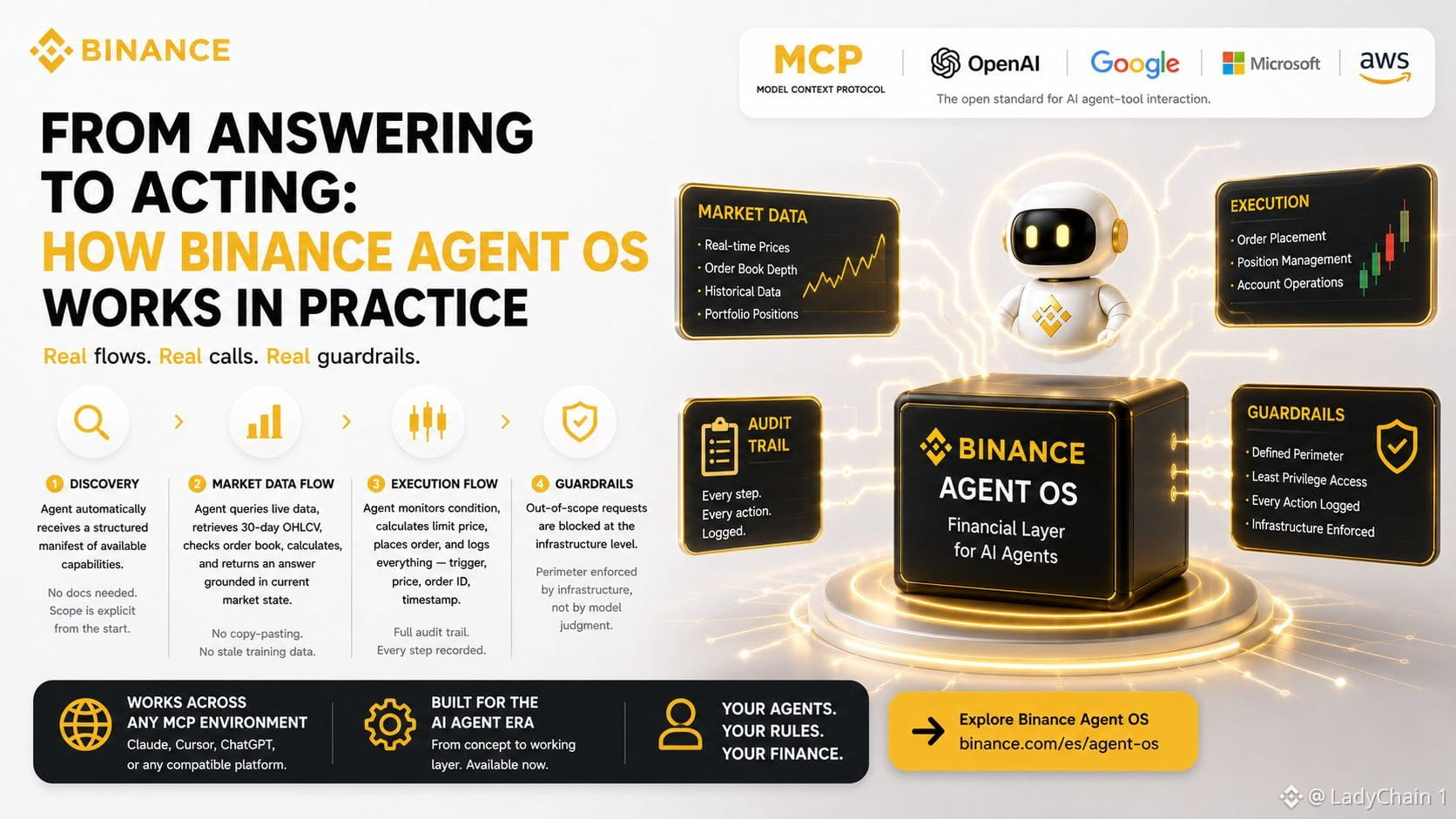
From Answering to Acting: How Binance Agent OS Works in Practice Binance Agent OS is live. Here is what the actual flows look like — discovery, market data, execution, and guardrails. Discovery When an MCP-enabled agent enters an environment with Agent OS connected, it automatically receives a structured manifest of available capabilities: real-time prices, order book depth, historical data, portfolio positions, and order placement — with parameters and return formats. No documentation needed. The scope of the agent's financial capability is explicit from the first moment. A market data flow User asks Claude: "Is BTC above or below its 30-day average, and what does the order book look like?" With Agent OS connected, Claude queries the live BTC price, retrieves 30-day OHLCV data, queries the order book, calculates the average, and returns a synthesized answer grounded in current market state. No copy-pasting. No stale training data. An execution flow A Cursor agent monitors ETH: if it drops 5% in a 4-hour window, place a limit buy at current price minus 2%. Agent OS handles the price monitoring, condition detection, limit calculation, and order placement — logging the trigger condition, calculated price, order ID, and timestamp. Full audit trail. Every step recorded. The guardrails The agent above can place orders because that capability is in its manifest. If it attempted a withdrawal, the MCP call would fail at the infrastructure level — the capability is not in the manifest, so it does not exist from the agent's perspective. The authorized perimeter is enforced by infrastructure, not by model judgment. Finance for agents is not a concept. It is a working layer. 👉 https://www.binance.com/es/agent-os For informational purposes only. Not financial advice.

Post