
GM, #学堂日报 Market Snapshot for September 3
1️⃣ Market Overview
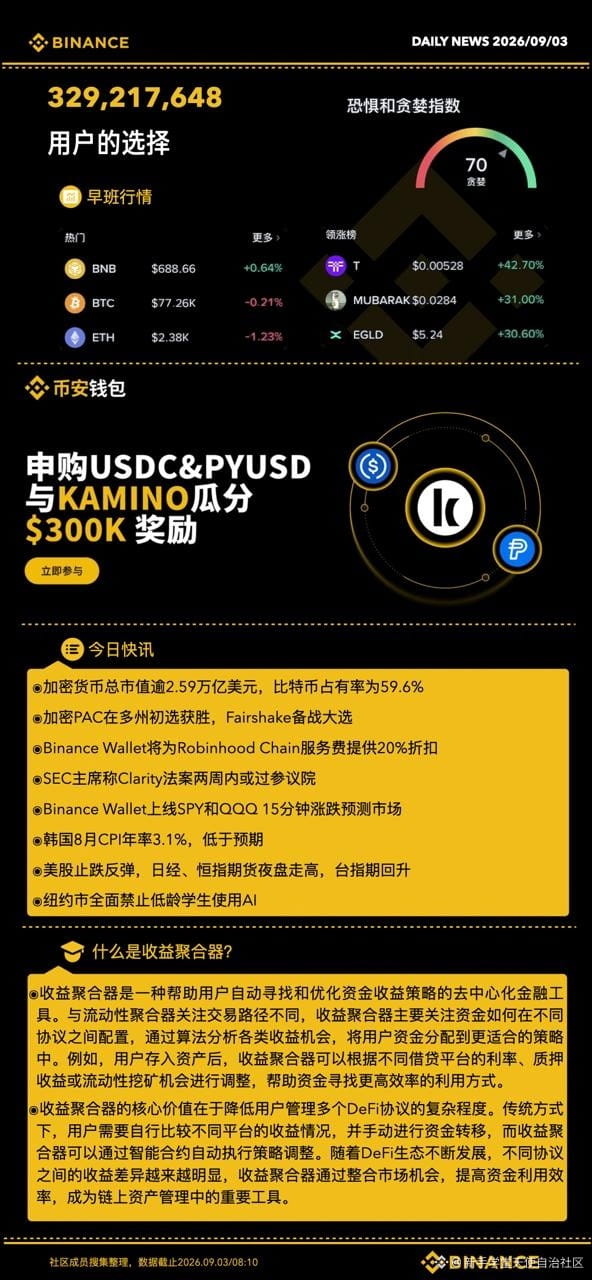
▪ Total crypto market cap is about $2.59 trillion, with Bitcoin’s dominance at 59.6%.
▪ Fear and Greed Index: 70 (Greed). Market sentiment continues to cool compared with the previous day.
2️⃣ Binance Updates
▪ Binance Wallet launches USDC, PYUSD, and Kamino campaign activities. Users can participate in the subscriptions to share a total of $300,000 in rewards.
▪ Binance Wallet will offer a 20% discount on fees for Robinhood Chain, further lowering on-chain usage costs.
▪ Binance Wallet launches 15-minute price movement prediction markets for SPY and QQQ, continuing to expand scenarios that combine TradFi and on-chain prediction.
3️⃣ Industry Hot Topics
▪ Crypto PAC has made progress in multi-state primary elections. Fairshake is preparing for the U.S. election, and its political influence continues to grow.
▪ The SEC chair said the CLARITY Act could be passed by the Senate within two weeks. The market continues to watch developments in the regulatory framework.
▪ South Korea’s August CPI year-over-year came in at 3.1%, below market expectations.
▪ U.S. stocks bounced after a pullback. Nikkei and Hang Seng index futures rose, and the Taiwan index futures also rebounded.
▪ New York City has fully banned underage students from using AI in schools, sparking discussions about AI education standards.
4️⃣ Today’s Quick Learn: What is a yield aggregator?
🔸 What is a yield aggregator?
▪ A yield aggregator is a type of DeFi tool that helps users automatically find and optimize on-chain yield strategies.
▪ It compares opportunities across different protocols—such as interest rates, staking rewards, and liquidity mining—and tries to allocate funds to the more suitable strategies.
🔸 How does it work?
▪ After users deposit assets into the aggregator, smart contracts allocate funds according to predefined strategies.
▪ When yields across different protocols change, some aggregators also automatically rebalance, reducing manual effort for users.
🔸 Why is it useful?
▪ Users don’t have to compare rates platform by platform, and they don’t need frequent asset transfers.
▪ For users participating in multiple DeFi protocols at the same time, it reduces management complexity and improves capital efficiency.
🔸 Notes to keep in mind
▪ “Higher yield” does not mean “lower risk.”
▪ Users still need to pay attention to smart contracts, underlying protocols, stablecoin de-pegging risk, and liquidity risk.
Follow @新手学堂天使自治社区 for more updates 🚀
1️⃣ Market Overview
▪ Total crypto market cap is about $2.59 trillion, with Bitcoin’s dominance at 59.6%.
▪ Fear and Greed Index: 70 (Greed). Market sentiment continues to cool compared with the previous day.
2️⃣ Binance Updates
▪ Binance Wallet launches USDC, PYUSD, and Kamino campaign activities. Users can participate in the subscriptions to share a total of $300,000 in rewards.
▪ Binance Wallet will offer a 20% discount on fees for Robinhood Chain, further lowering on-chain usage costs.
▪ Binance Wallet launches 15-minute price movement prediction markets for SPY and QQQ, continuing to expand scenarios that combine TradFi and on-chain prediction.
3️⃣ Industry Hot Topics
▪ Crypto PAC has made progress in multi-state primary elections. Fairshake is preparing for the U.S. election, and its political influence continues to grow.
▪ The SEC chair said the CLARITY Act could be passed by the Senate within two weeks. The market continues to watch developments in the regulatory framework.
▪ South Korea’s August CPI year-over-year came in at 3.1%, below market expectations.
▪ U.S. stocks bounced after a pullback. Nikkei and Hang Seng index futures rose, and the Taiwan index futures also rebounded.
▪ New York City has fully banned underage students from using AI in schools, sparking discussions about AI education standards.
4️⃣ Today’s Quick Learn: What is a yield aggregator?
🔸 What is a yield aggregator?
▪ A yield aggregator is a type of DeFi tool that helps users automatically find and optimize on-chain yield strategies.
▪ It compares opportunities across different protocols—such as interest rates, staking rewards, and liquidity mining—and tries to allocate funds to the more suitable strategies.
🔸 How does it work?
▪ After users deposit assets into the aggregator, smart contracts allocate funds according to predefined strategies.
▪ When yields across different protocols change, some aggregators also automatically rebalance, reducing manual effort for users.
🔸 Why is it useful?
▪ Users don’t have to compare rates platform by platform, and they don’t need frequent asset transfers.
▪ For users participating in multiple DeFi protocols at the same time, it reduces management complexity and improves capital efficiency.
🔸 Notes to keep in mind
▪ “Higher yield” does not mean “lower risk.”
▪ Users still need to pay attention to smart contracts, underlying protocols, stablecoin de-pegging risk, and liquidity risk.
Follow @新手学堂天使自治社区 for more updates 🚀