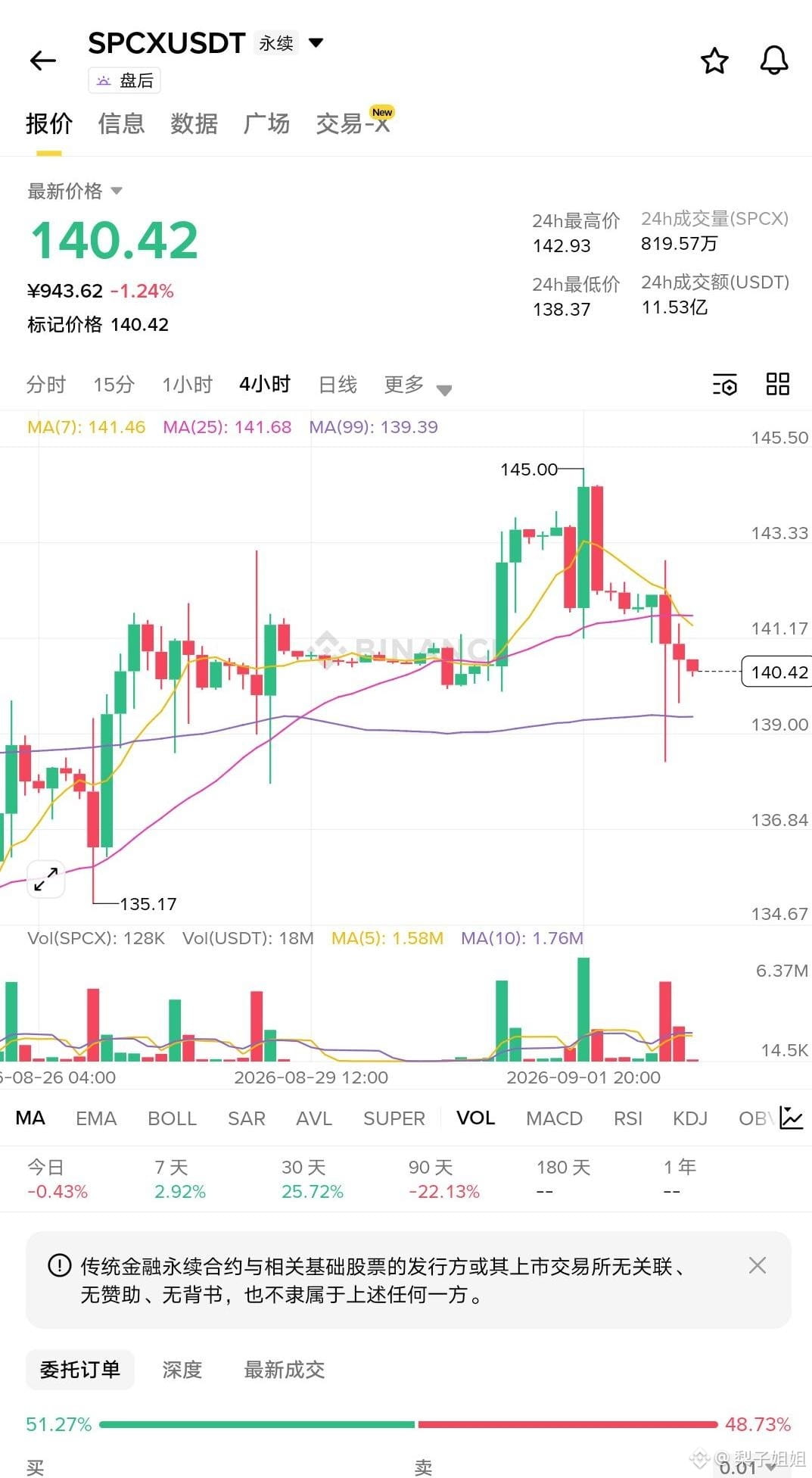
The most lively moments in SPCX aren’t happening on the price—it’s in the contract executions: 140.4 slides down while hugging two 15-minute moving averages. On the four-hour chart, the trend line is hanging DOWN, and in the past 24 hours it’s down 1.27%. But in the seven-hour window, the主动成交量 (active execution volume) suddenly spikes by 367%, with buy orders accounting for nearly 80%. This chase-buy momentum doesn’t match the weakness of the price action at all.
The contradiction is right here: the more aggressive the buy side is, the less the price “buys in.” Those huge buy orders don’t push the price upward—they get taken off one by one by sell orders above. So who’s selling? Whale accounts have long positions down to just 33%, and they also cut another 5.6% over the seven hours. Big players are firmly one-sided on the shorts. Even in the spot order book, sell orders are thicker than buy orders. Funding rates show no positives in eight samples—leverage capital overall is positioned on the short side.
This is a classic long-squeeze trap: retail pours in real money to push up, while big capital borrows that force to distribute. The harder the buy side burns, and the tighter the price is suppressed, the thicker the shorts’ foundation becomes.
So I’m bearish on SPCX; any rebound is a chance for shorts to add.
I’m watching for two reversal signals: first, price volume should rise and reclaim above 140.94 (15-minute MA50); second, the主动买盘 (active buy orders) should stay dominant, while OI expands along with it. Then it means the buy side has truly taken control, and the short positions won’t linger.
#spcx $SPCX
The contradiction is right here: the more aggressive the buy side is, the less the price “buys in.” Those huge buy orders don’t push the price upward—they get taken off one by one by sell orders above. So who’s selling? Whale accounts have long positions down to just 33%, and they also cut another 5.6% over the seven hours. Big players are firmly one-sided on the shorts. Even in the spot order book, sell orders are thicker than buy orders. Funding rates show no positives in eight samples—leverage capital overall is positioned on the short side.
This is a classic long-squeeze trap: retail pours in real money to push up, while big capital borrows that force to distribute. The harder the buy side burns, and the tighter the price is suppressed, the thicker the shorts’ foundation becomes.
So I’m bearish on SPCX; any rebound is a chance for shorts to add.
I’m watching for two reversal signals: first, price volume should rise and reclaim above 140.94 (15-minute MA50); second, the主动买盘 (active buy orders) should stay dominant, while OI expands along with it. Then it means the buy side has truly taken control, and the short positions won’t linger.
#spcx $SPCX