
加密朵儿
3.8k Posts

加密朵儿
 Square Verified+
✅币安聊天室ID 1171709603 一位加密货币投资爱好者,精通山寨币布局和主力币分析。《合约》每天日内波段,月稳定收益达到80%以上。{现货} 周期性埋伏潜力币,熊市买入,牛市卖出,年收益300%以上。五湖四海认识就是朋友!
63 Following
47.2K+ Followers
58.5K+ Liked
Posts
All
Videos
PINNED
🔥🔥🔥 Binance ID: 1171709603
New features are here! The Binance chat room has opened the 【Private Chat】 feature!
From now on, it’s easier for everyone to communicate—no more worries about messages getting buried!
Using it is super simple:
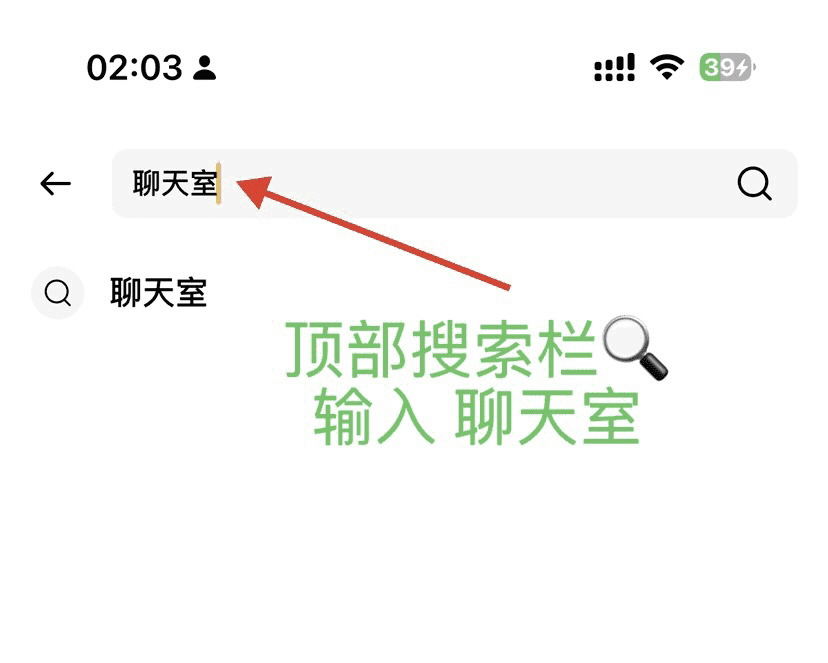
① On the Binance homepage, enter 【Chat】 in the search bar at the top to find the entry
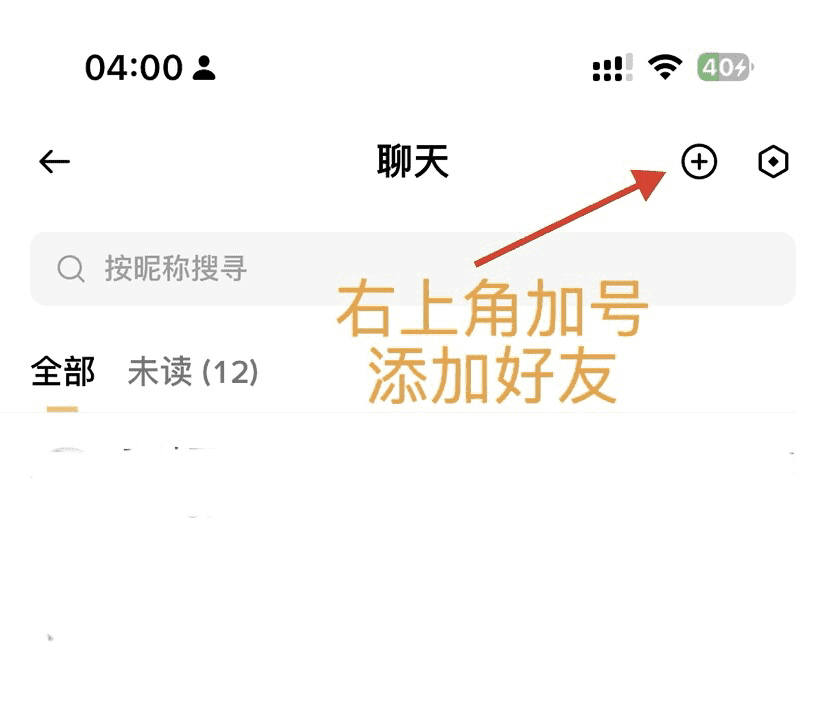
② Tap the + in the top-right corner to add a little “flower”
③ Enter your Binance ID (for example, mine: 1171709603) (or scan the QR code directly)
④ One-click search—add me and chat anytime!
Family, add your little “flower” first—then you can discuss market updates and opportunities right away!
New features are here! The Binance chat room has opened the 【Private Chat】 feature!
From now on, it’s easier for everyone to communicate—no more worries about messages getting buried!
Using it is super simple:
① On the Binance homepage, enter 【Chat】 in the search bar at the top to find the entry
② Tap the + in the top-right corner to add a little “flower”
③ Enter your Binance ID (for example, mine: 1171709603) (or scan the QR code directly)
④ One-click search—add me and chat anytime!
Family, add your little “flower” first—then you can discuss market updates and opportunities right away!

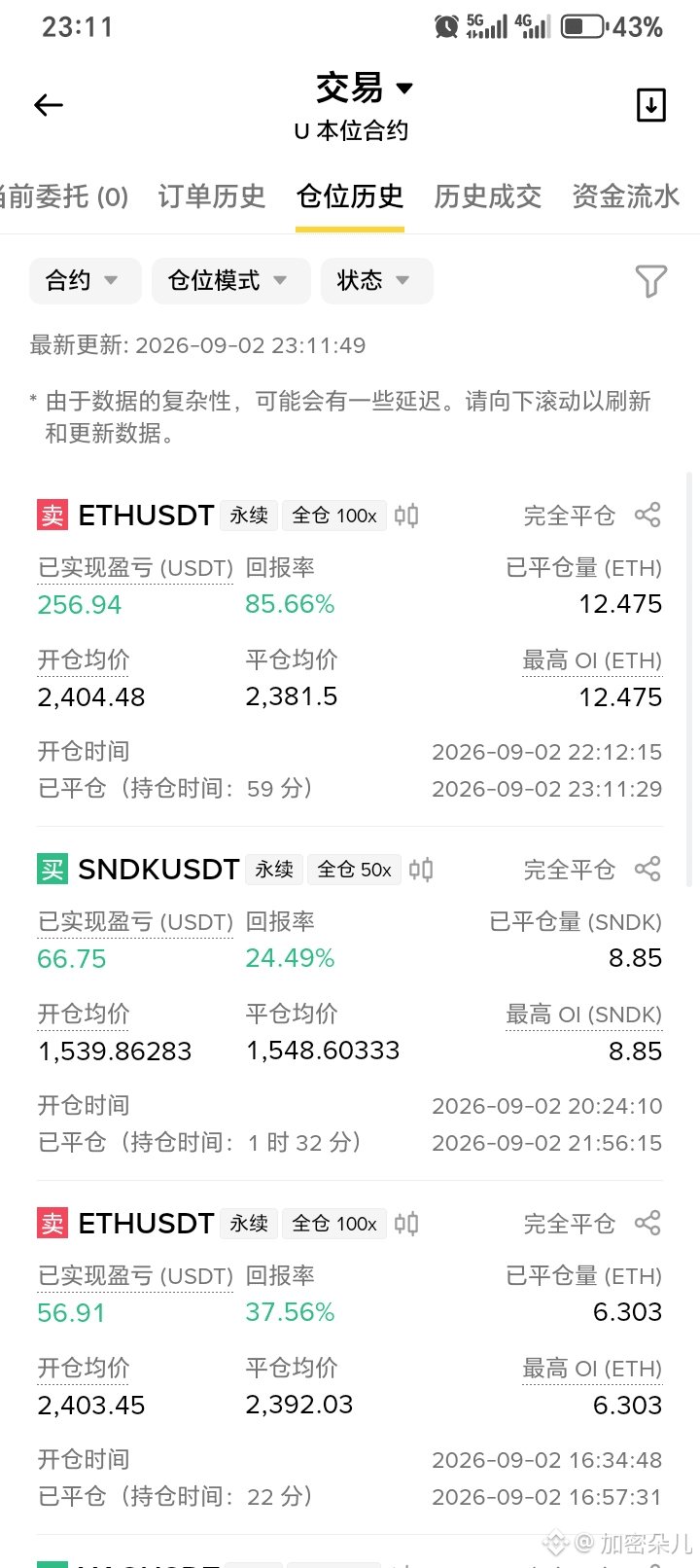
$ETH followers profit exit, wait—looking for another chance to short later, 💪 come find Duor, let's play together ✌️✌️✌️
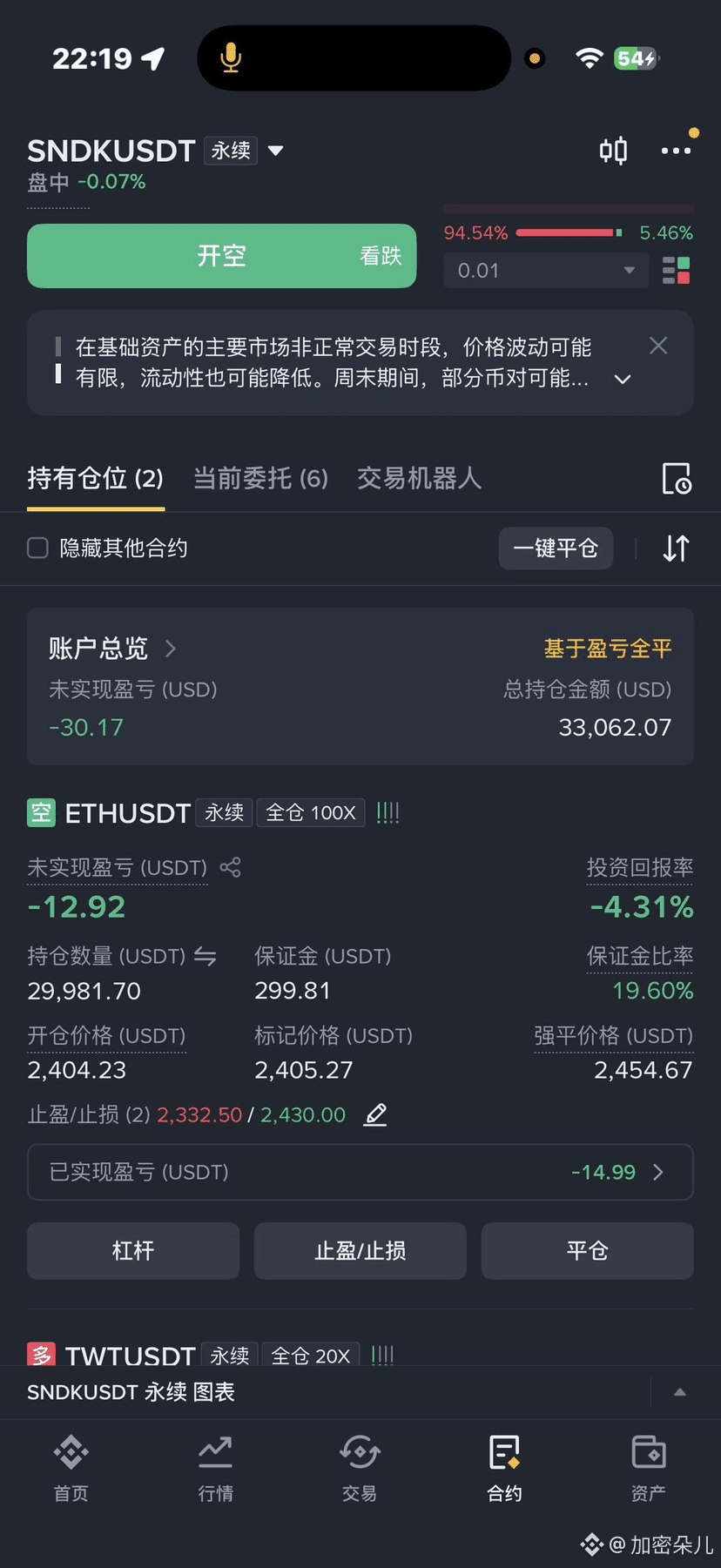

$SNDK Good thing I got away; this US stock market is too hard ☹️, it’s ridiculous. I’d better just stick to crypto 😞
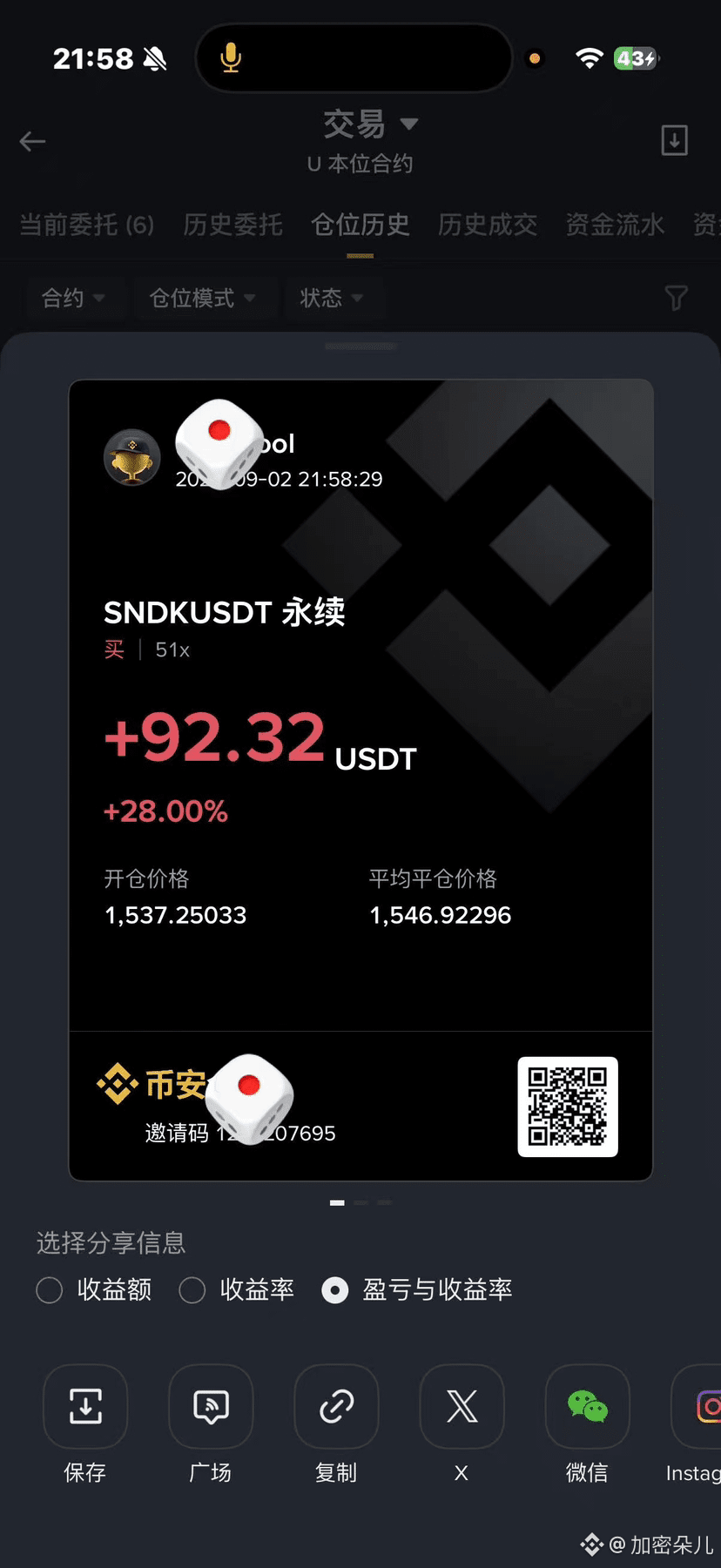
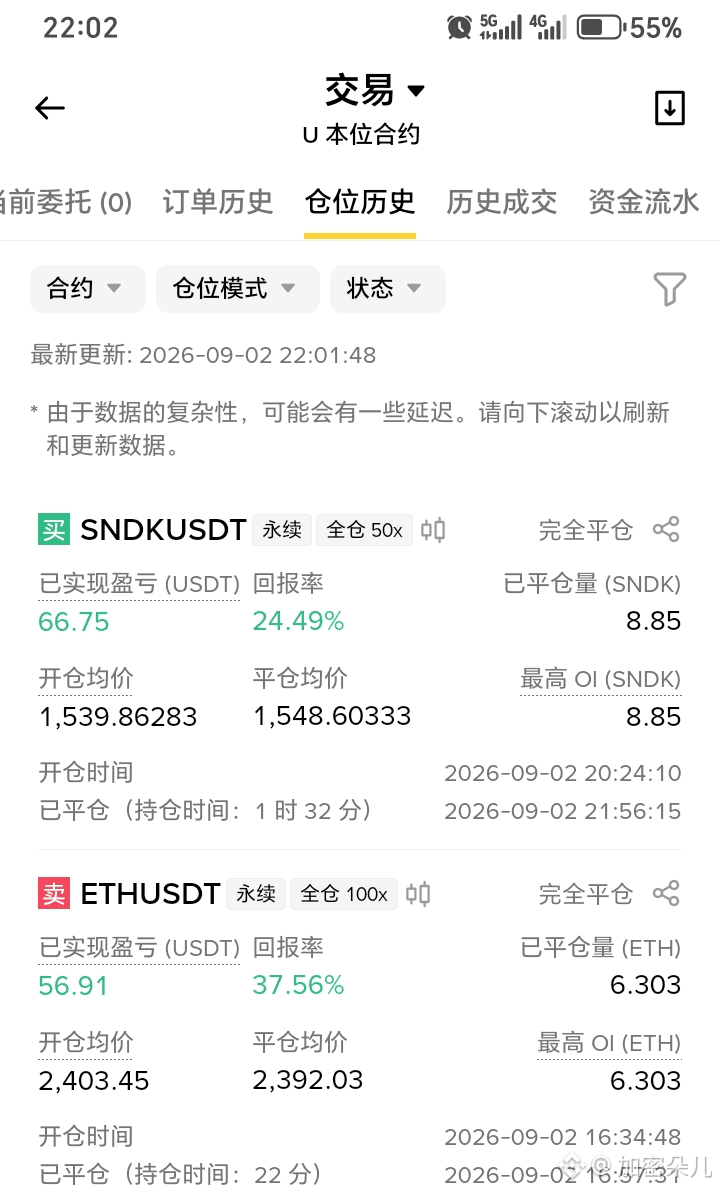
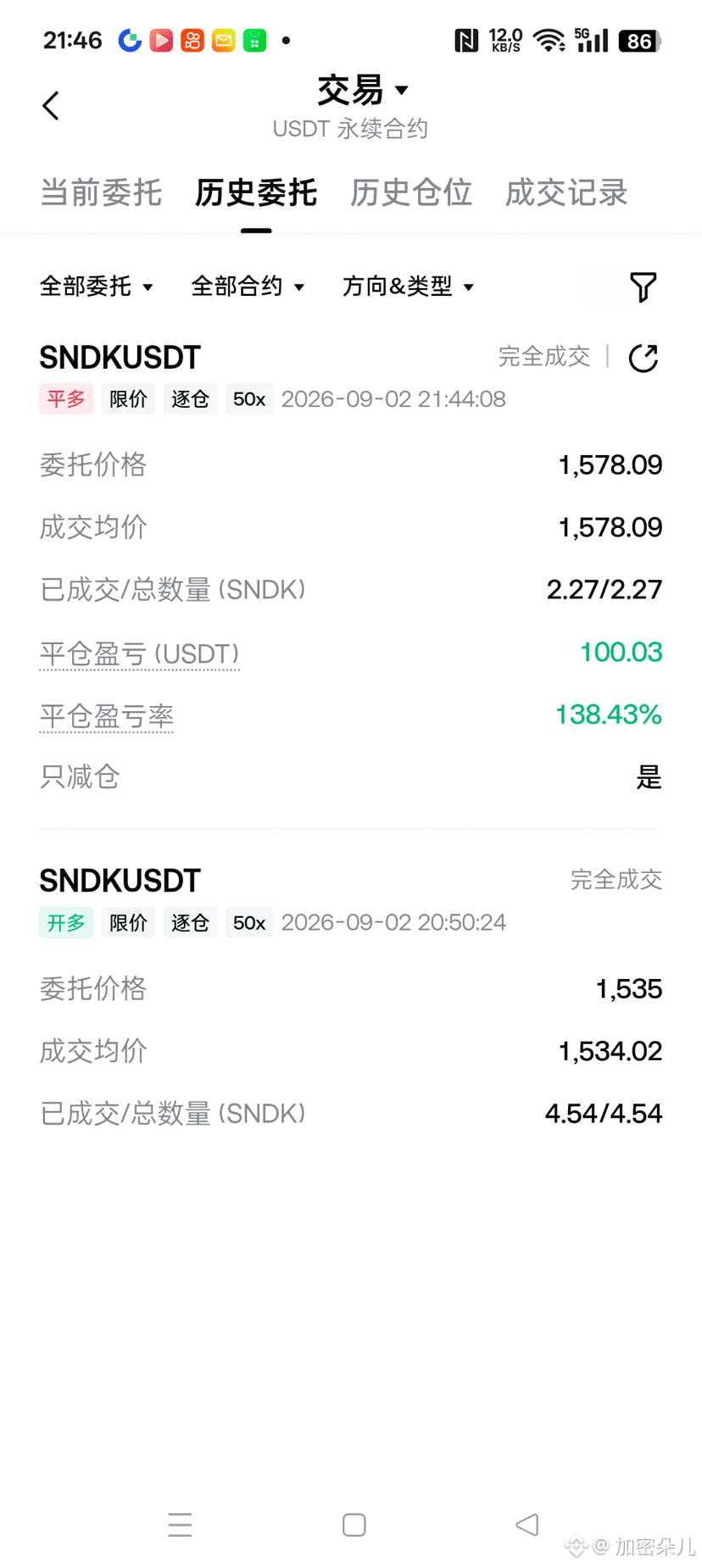
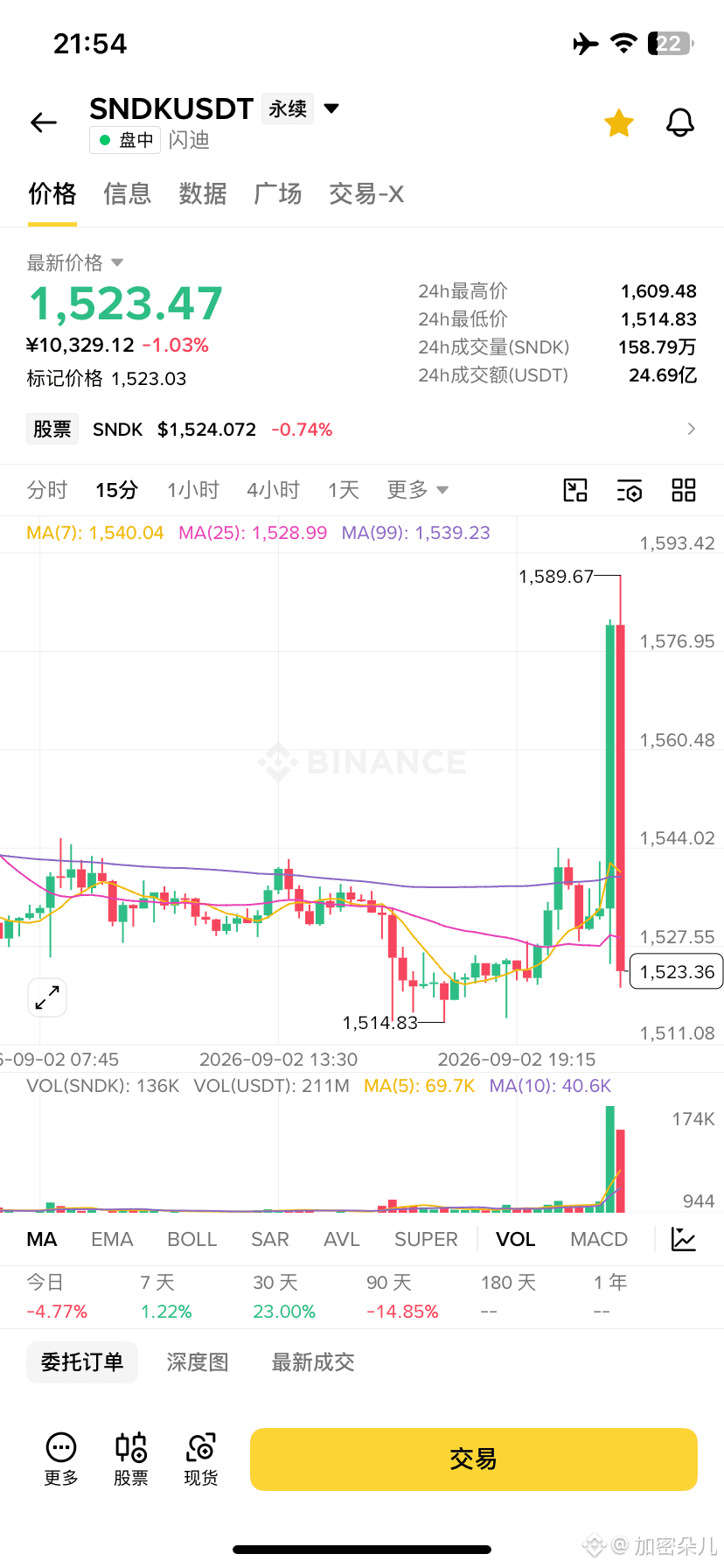
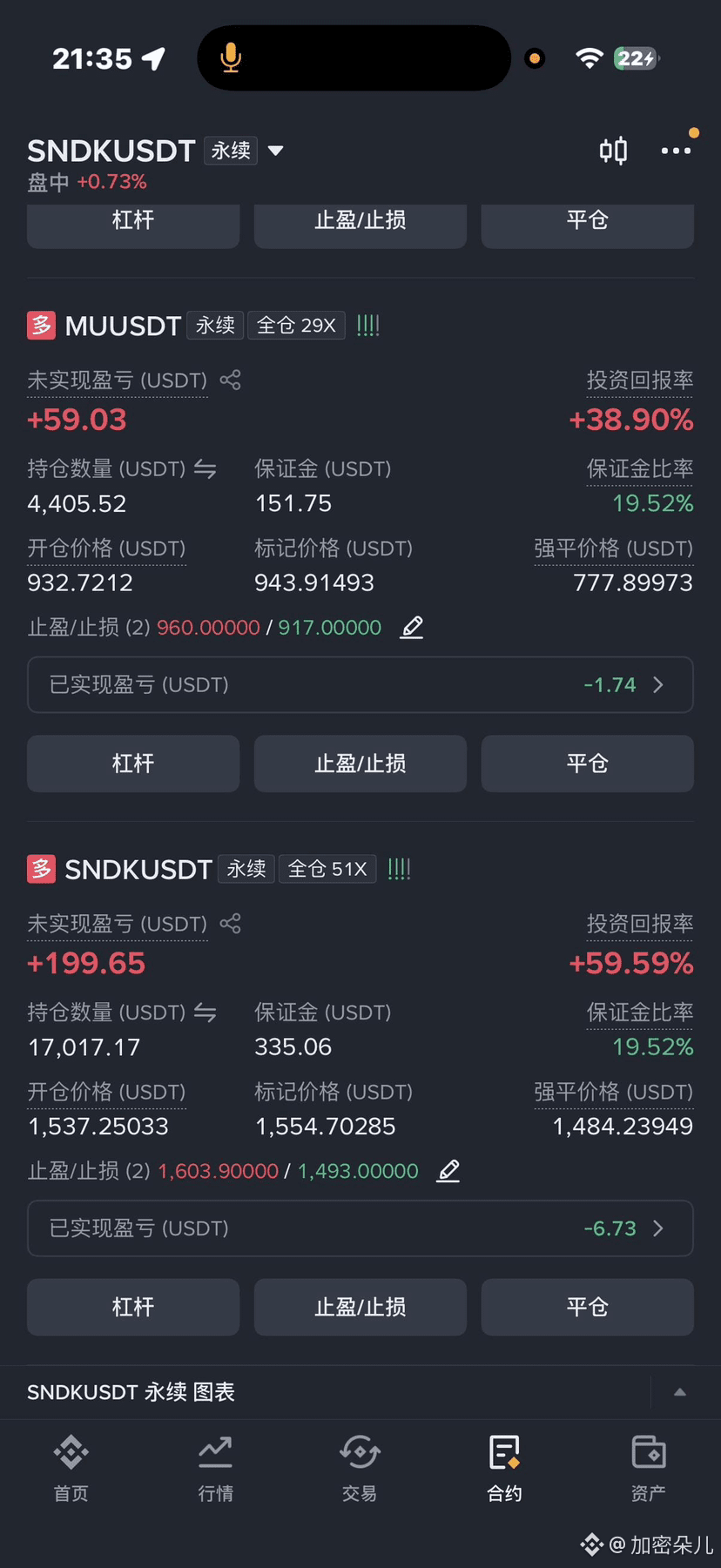
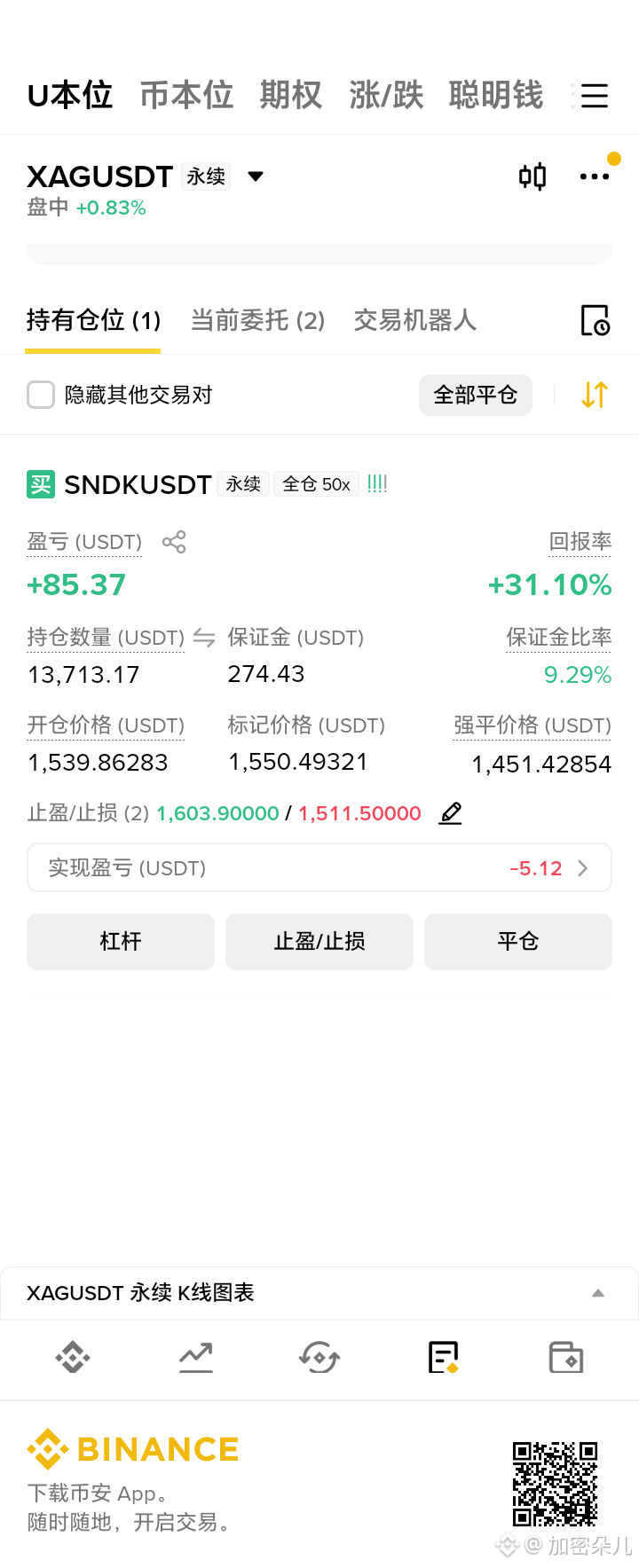
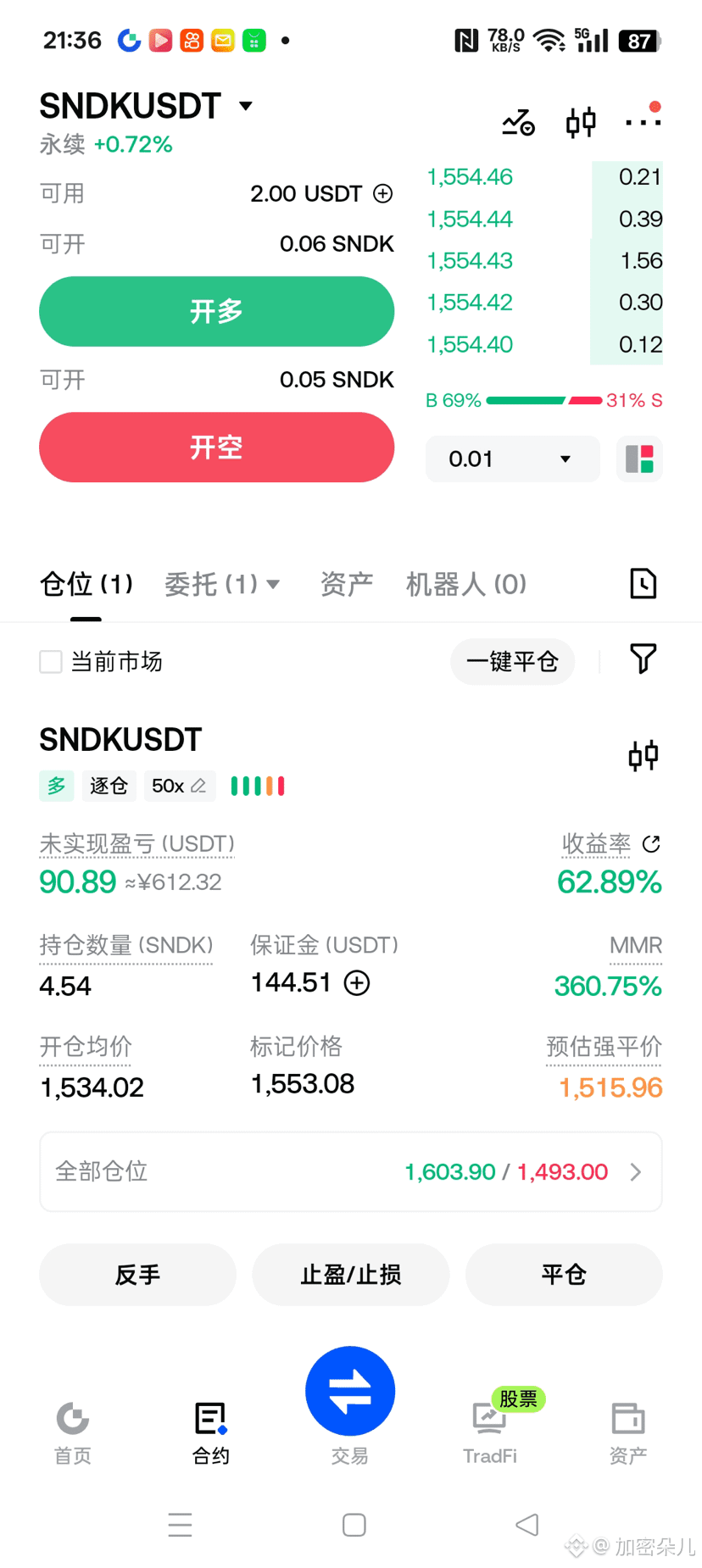
I dare say the crypto market is the best place for ordinary people to turn their lives around—but you have to find the right way. Stick to discipline and quit gambling with all-in moves!
Last year I brought a follower along. Starting with 1,000 USDT, within three months he reached 60,000 USDT. No liquidation the entire time, and he never had a catastrophic drawdown.
It wasn’t luck. Luck might make you profitable for a while, but it won’t last. And my “three-pronged approach,” although slow, is steady!
First blade: Split your capital—never go all-in, even when you’re tempted to “take the shot.”
Split 1,000 USDT into three parts:
350 USDT for intraday (only 1 trade per day; don’t do too many)
350 USDT for swing trading (only place trades once every ten days or half a month)
300 USDT as a backstop (if you truly take a loss, you still have the chance to recover)
Key point: Absolutely do not go all-in ❗️❗️
Second blade: Only bite the thickest meat; don’t touch everything else.
Don’t trade in a sideways range (80% of losses die here).
If the direction is unclear, stay flat (better to earn nothing than to take a reckless loss).
Only enter when the price action is clearly understood.
Remember this line:
Market conditions may not present opportunities every day, but your life must be there every day.
Third blade: Lock the rules in—zero out emotions.
• Stop loss at 2% (like eating—normal and routine)
• Take profit at 4%: cut half the position first
• If account profit exceeds 20% over your principal, withdraw 30% immediately
• Never add to your position when you’re losing
This is the root of why 90% of people can’t turn things around.
Remember for sure: don’t gamble, don’t hold on out of stubbornness, don’t fantasize.
So what happened?
His account already broke through 100,000 USDT+.
Even more importantly—
He doesn’t need to stay up all night watching the charts anymore.
Just 5 minutes a day: check your levels, then you’re done.
Want to rise and turn around? Remember this:
Always leave yourself the right to open the next trade.
Split your capital, wait for the right timing, and control the pace.
These things don’t feel exciting, but they can save you five years of detours.
In the crypto market, you can’t get rich quickly. If you want it fast, first slow yourself down.
The market is always there. Find “Duor,” use systematic thinking, and let me guide you through the fog of investing.
Last year I brought a follower along. Starting with 1,000 USDT, within three months he reached 60,000 USDT. No liquidation the entire time, and he never had a catastrophic drawdown.
It wasn’t luck. Luck might make you profitable for a while, but it won’t last. And my “three-pronged approach,” although slow, is steady!
First blade: Split your capital—never go all-in, even when you’re tempted to “take the shot.”
Split 1,000 USDT into three parts:
350 USDT for intraday (only 1 trade per day; don’t do too many)
350 USDT for swing trading (only place trades once every ten days or half a month)
300 USDT as a backstop (if you truly take a loss, you still have the chance to recover)
Key point: Absolutely do not go all-in ❗️❗️
Second blade: Only bite the thickest meat; don’t touch everything else.
Don’t trade in a sideways range (80% of losses die here).
If the direction is unclear, stay flat (better to earn nothing than to take a reckless loss).
Only enter when the price action is clearly understood.
Remember this line:
Market conditions may not present opportunities every day, but your life must be there every day.
Third blade: Lock the rules in—zero out emotions.
• Stop loss at 2% (like eating—normal and routine)
• Take profit at 4%: cut half the position first
• If account profit exceeds 20% over your principal, withdraw 30% immediately
• Never add to your position when you’re losing
This is the root of why 90% of people can’t turn things around.
Remember for sure: don’t gamble, don’t hold on out of stubbornness, don’t fantasize.
So what happened?
His account already broke through 100,000 USDT+.
Even more importantly—
He doesn’t need to stay up all night watching the charts anymore.
Just 5 minutes a day: check your levels, then you’re done.
Want to rise and turn around? Remember this:
Always leave yourself the right to open the next trade.
Split your capital, wait for the right timing, and control the pace.
These things don’t feel exciting, but they can save you five years of detours.
In the crypto market, you can’t get rich quickly. If you want it fast, first slow yourself down.
The market is always there. Find “Duor,” use systematic thinking, and let me guide you through the fog of investing.

$ETH Magi keeps cutting positions again and again, so they must also be worried about getting liquidated. Slowly pushing the liquidation price down 🤭
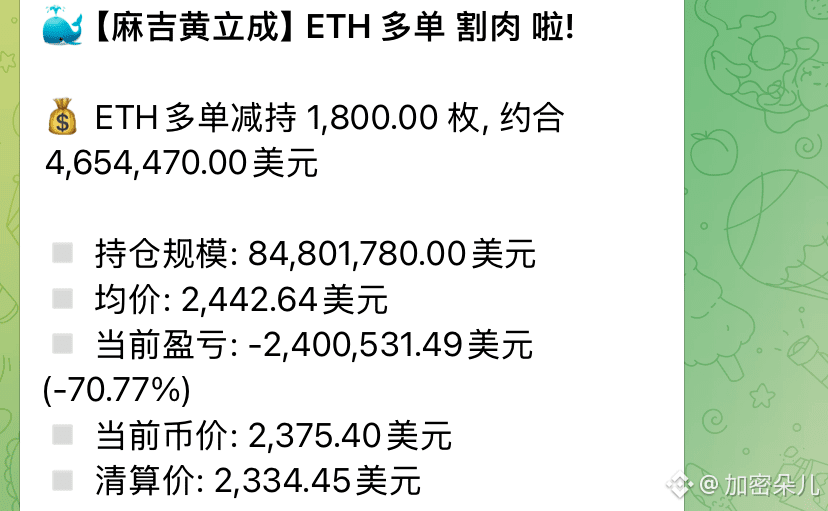
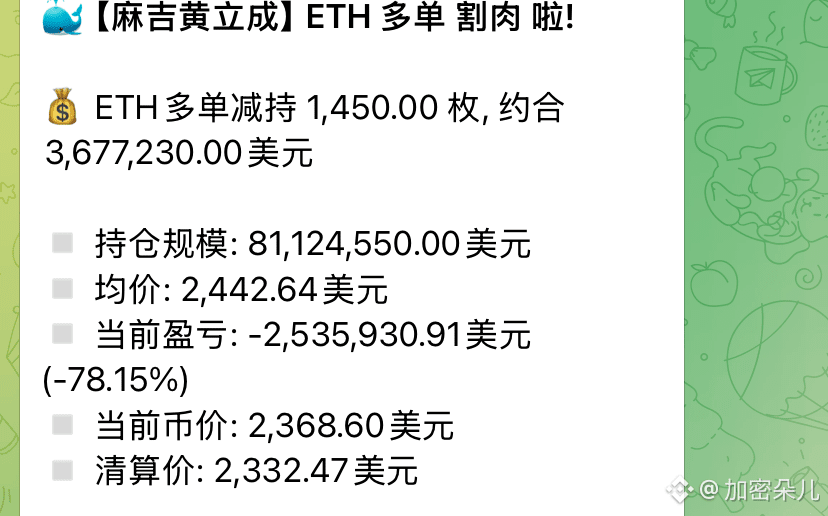
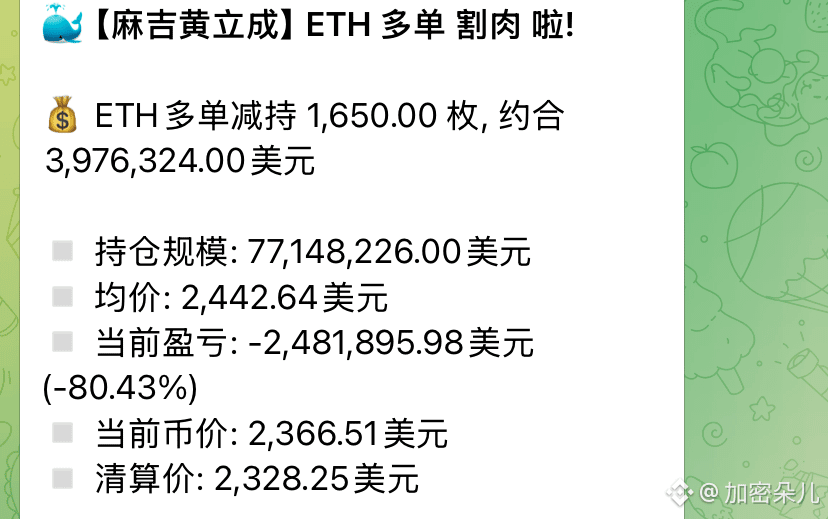
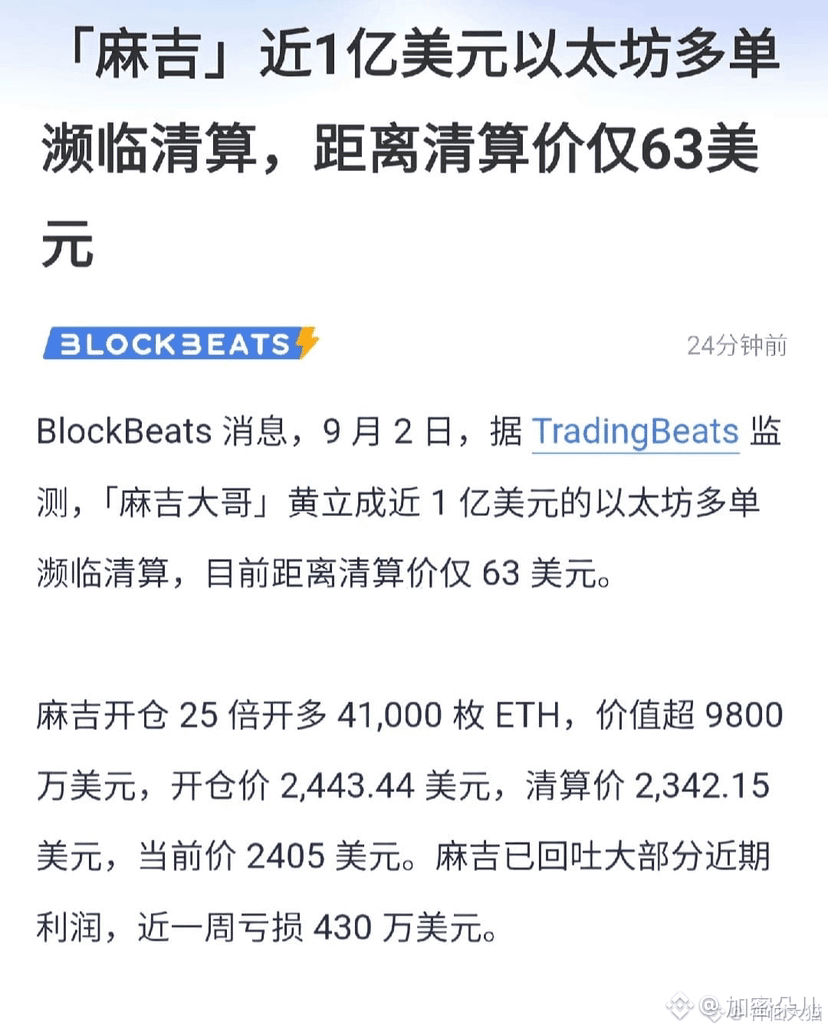
$ETH I feel like this spotlight (Maji) is about to give out again—he’s only about 20-something US dollars away from getting liquidated. He’s gonna be done for 😲
Verified
$BTC $ETH My god 🤦♀️ Fighting has caused casualties—will this Revolutionary Guard retaliate? Trump said: If you dare to retaliate, the consequences will be even worse! The percentage for the September rate hike has also been raised, so it looks like September won’t be that optimistic 😲
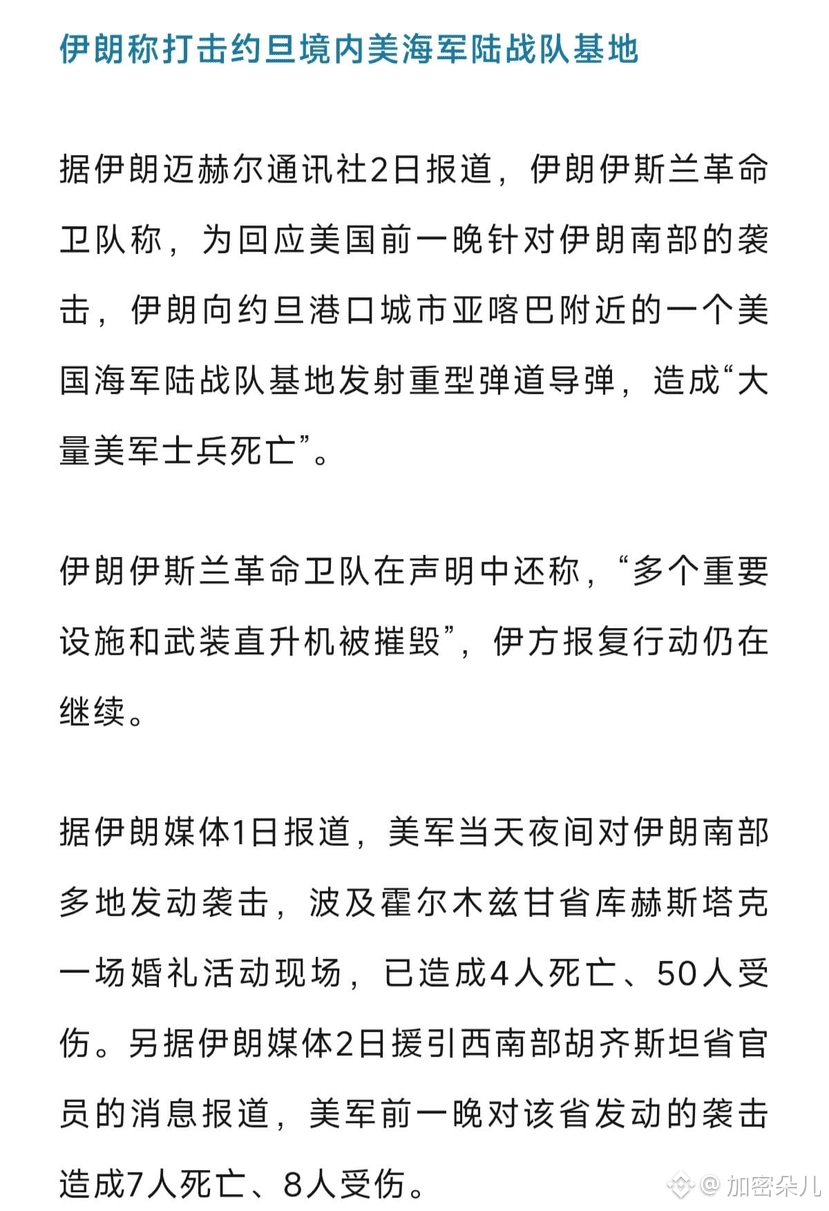
Crude oil stays stubbornly high, and Ethereum fees are on the rise. The longs are crowded—just now I led the fans through a round of gains, taking profit at 2373 ✌️✌️✌️
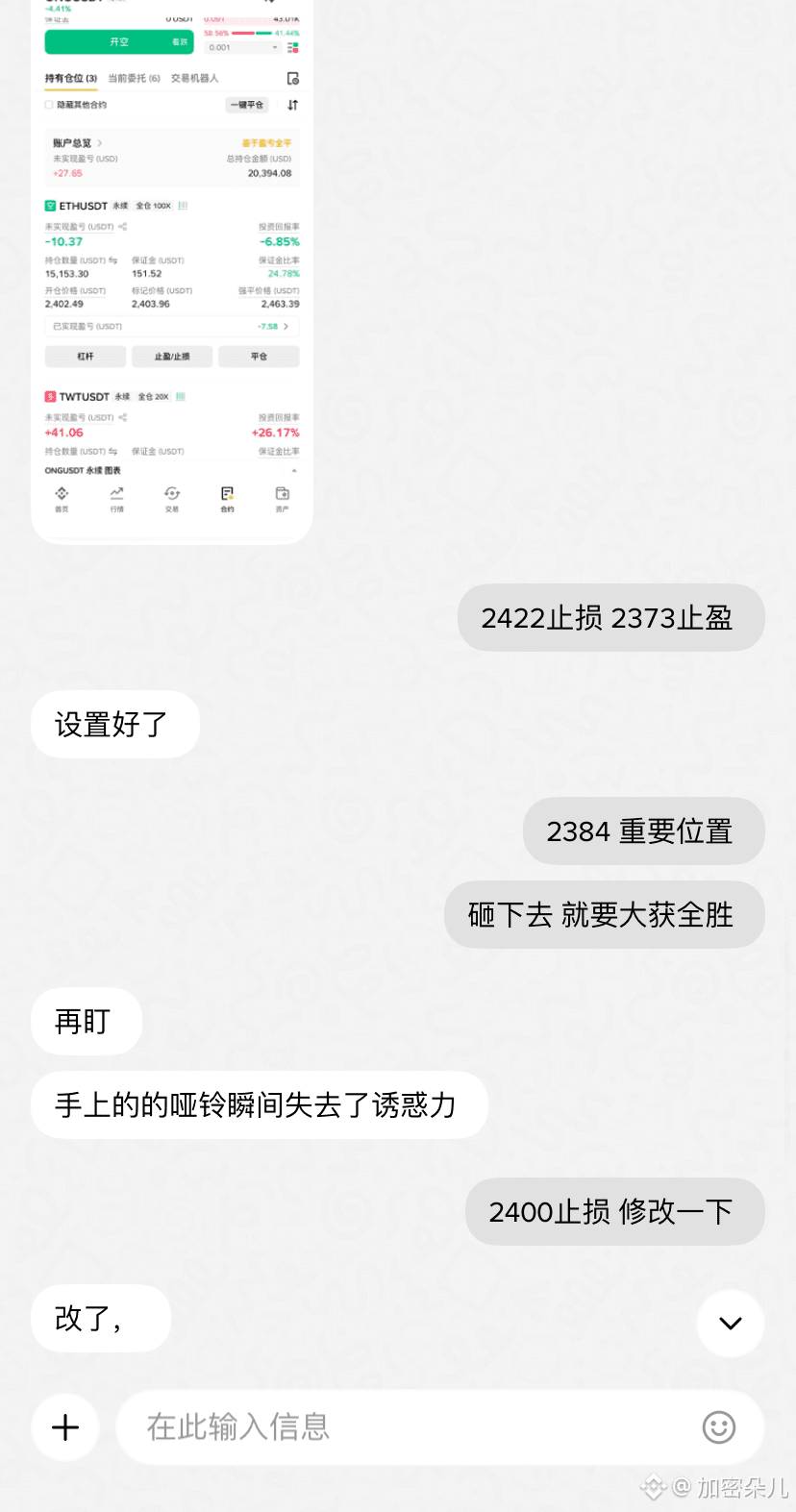
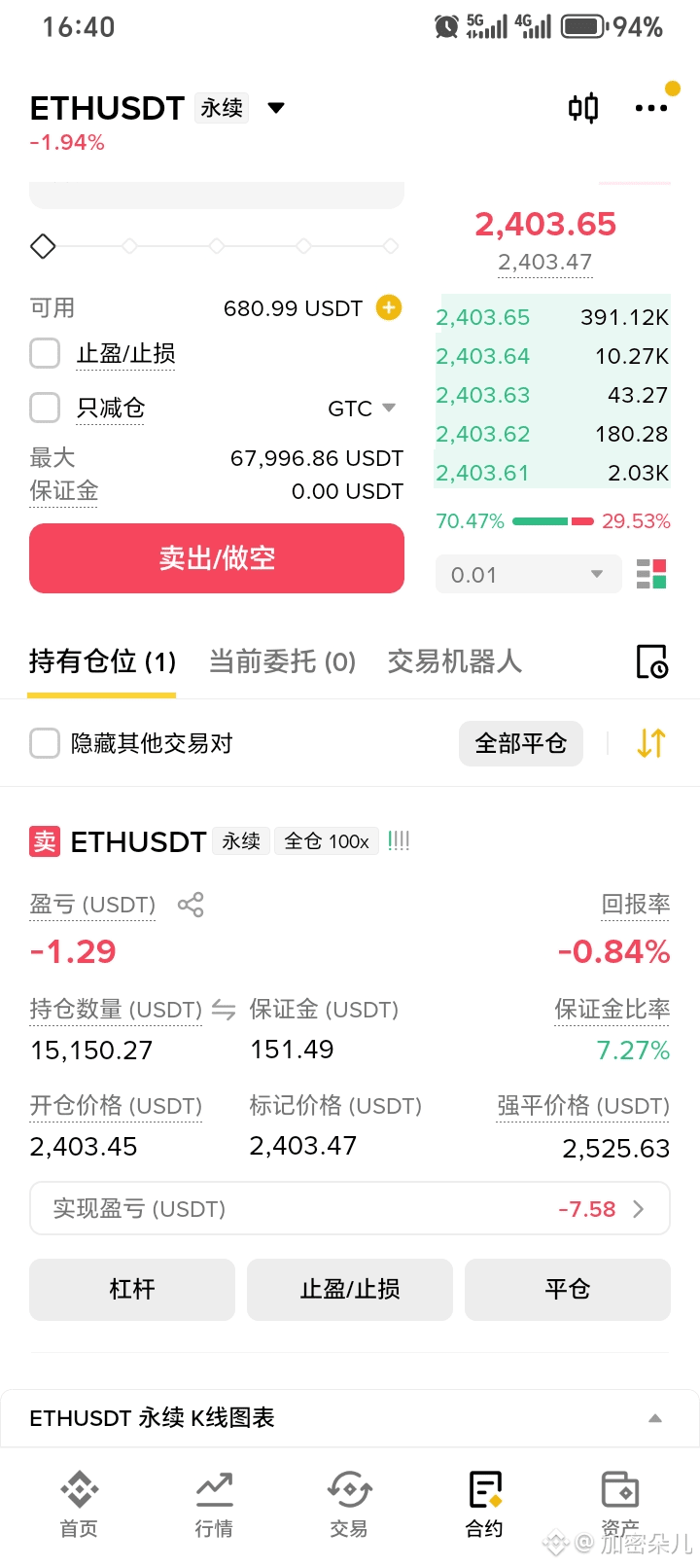

I’ve been trading coins for 9 years. Now I’m 38, with assets in the eight-figure range. When I go out to stay in hotels, I don’t even look at the prices.
Not bragging—just the truth. Compared with the people around me who work in factories or do e-commerce, those born in the 1980s, it’s way more comfortable.
These days, trying to turn your life around by relying on a dead-end salary is just too hard. I realized that a decade ago, so I went all in on trading directly. I’ve taken so many losses that now I have the confidence to stay grounded.
I’ve seen too many markets. I’ve been through both bull and bear, and I’ve gotten used to both explosive rallies and brutal crashes. The reason I’m still alive today is that I’ve stuck to a few principles. It’s not that my technical skills are super amazing—it’s that I know when to hide and when to charge.
The most typical case is when something rises extremely fast and falls extremely slowly—don’t chase. That’s the operator accumulating, slowly setting a trap for you. The other way around: after a brutal plunge, they come with a feeble little rebound. Don’t fantasize about catching the bottom—basically it’s the operator distributing at high levels, pretending it’s a rebound to trick you into taking the bag.
And many people see a bit of sudden volume near the top and panic to sell. But it may not actually be the top. Sometimes the operator is pulling the final leg. However, if it rises to high levels but there’s no volume, that’s when you really should run. If you don’t run, you’ll end up waiting to be the last unlucky passenger who boards.
When volume shows up at the bottom, don’t be too eager either—many times it’s a bull trap. The real signal to enter is to see consecutive days of rising volume, and it still holds steady without dropping.
In the end, trading crypto is all about trading sentiment. How the market moves depends on sentiment, and sentiment depends on trading volume. When you feel like you want to charge in, that’s when the operator is basically preparing to leave. When you feel scared and want to run, they’ve usually already bought.
That’s how the crypto world is. In the end, it’s always the same few types of people cutting and being cut. The ones who get liquidated aren’t necessarily talentless—they just can’t control their hands. Anyone who fantasizes about turning everything around with one once-in-a-lifetime windfall gets cleaned up by the market.
I don’t think I’m that great, but I’ve kept changing, kept watching, and kept learning. The money I’ve made isn’t because of luck—it’s because of doing post-trade reviews again and again, stepping into traps, and adjusting my strategy. Living on fantasy, Telegram signal groups, and luck—you won’t survive in this market for even half a year.
Now I run data with AI systems. Strategy sets are set up one after another, and I ride the waves by following the rhythm. To be blunt: the crypto market is not short of opportunities—what it lacks is people who can actually understand opportunities.
If you want to make more money, you need to follow the right people. Stop being a sheep. These days, if you’re still trading based on gut feelings, you’re pretty miserable.
The market is always there, but your principal and opportunities might only come a few times. Find Dou’er—use a systematic way of thinking to take you through the fog of investing. #CryptoMarketObservation
Not bragging—just the truth. Compared with the people around me who work in factories or do e-commerce, those born in the 1980s, it’s way more comfortable.
These days, trying to turn your life around by relying on a dead-end salary is just too hard. I realized that a decade ago, so I went all in on trading directly. I’ve taken so many losses that now I have the confidence to stay grounded.
I’ve seen too many markets. I’ve been through both bull and bear, and I’ve gotten used to both explosive rallies and brutal crashes. The reason I’m still alive today is that I’ve stuck to a few principles. It’s not that my technical skills are super amazing—it’s that I know when to hide and when to charge.
The most typical case is when something rises extremely fast and falls extremely slowly—don’t chase. That’s the operator accumulating, slowly setting a trap for you. The other way around: after a brutal plunge, they come with a feeble little rebound. Don’t fantasize about catching the bottom—basically it’s the operator distributing at high levels, pretending it’s a rebound to trick you into taking the bag.
And many people see a bit of sudden volume near the top and panic to sell. But it may not actually be the top. Sometimes the operator is pulling the final leg. However, if it rises to high levels but there’s no volume, that’s when you really should run. If you don’t run, you’ll end up waiting to be the last unlucky passenger who boards.
When volume shows up at the bottom, don’t be too eager either—many times it’s a bull trap. The real signal to enter is to see consecutive days of rising volume, and it still holds steady without dropping.
In the end, trading crypto is all about trading sentiment. How the market moves depends on sentiment, and sentiment depends on trading volume. When you feel like you want to charge in, that’s when the operator is basically preparing to leave. When you feel scared and want to run, they’ve usually already bought.
That’s how the crypto world is. In the end, it’s always the same few types of people cutting and being cut. The ones who get liquidated aren’t necessarily talentless—they just can’t control their hands. Anyone who fantasizes about turning everything around with one once-in-a-lifetime windfall gets cleaned up by the market.
I don’t think I’m that great, but I’ve kept changing, kept watching, and kept learning. The money I’ve made isn’t because of luck—it’s because of doing post-trade reviews again and again, stepping into traps, and adjusting my strategy. Living on fantasy, Telegram signal groups, and luck—you won’t survive in this market for even half a year.
Now I run data with AI systems. Strategy sets are set up one after another, and I ride the waves by following the rhythm. To be blunt: the crypto market is not short of opportunities—what it lacks is people who can actually understand opportunities.
If you want to make more money, you need to follow the right people. Stop being a sheep. These days, if you’re still trading based on gut feelings, you’re pretty miserable.
The market is always there, but your principal and opportunities might only come a few times. Find Dou’er—use a systematic way of thinking to take you through the fog of investing. #CryptoMarketObservation

At 33, I settled in Shanghai—with two apartments, a car, and tens of millions in assets in my accounts. No one knows that behind these achievements is my eight-year blood-and-tears struggle in the crypto world.
I didn’t rely on my family, and I didn’t take shortcuts. I only fought it out and stayed the course, until I managed to carve out a path for myself.
In 2017, I entered the market with 200,000 yuan in capital, staring at the charts late into the night every day.
In the bull market, I went wild with excitement after making up to 800,000 yuan—but then in a brutal crash, I watched my balance shrink to 50,000 with my own eyes.
When I felt desperate, a friend urged me to quit. But I held on to one line: “The market won’t deceive you—only your emotions will.”
I reorganized my strategy, strictly controlled my position sizing, and burned stop-loss and take-profit rules into my bones.
In the years that followed, I used this “stupid-simple approach” to get through bull and bear cycles.
In early 2024, I heavily allocated to projects in certain sectors. In just three months, it surged by over 200 times, and I earned my first 20 million yuan.
Some people say I was lucky, but only I know this: it’s a trading system forged over eight years—the accumulation after countless moments of collapse, followed by starting over again.
Looking back now, I’ve distilled my blood-and-tears experience into four iron rules. I hope they help my confused sisters and brothers avoid pitfalls:
1. Position management is the bottom line.
Never go all-in. Keep 30% as liquid funds—survive first, so you still have the next opportunity.
2. Mindset determines success or failure.
Don’t let greed and fear control you. When you’re losing, calmly review and analyze; when you’re winning, decisively take profits and cash out. Refuse emotionally driven trading.
3. Stop-loss is dignity.
Once the price breaks your level, even if the project still looks promising, exit decisively. Money that comes from outside your own understanding is something you can never truly earn.
4. Focus on one system.
Don’t constantly switch indicators or change strategies. Candlesticks and MACD are just tools. Find the rhythm that suits you and stick with it to the end.
There are no miracles in the crypto world—only execution.
Steadily capture every small trend, and wealth will be amplified by time.
In 2026, my goal isn’t to make more money—I want to help more people take fewer detours. In this market, the true winners aren’t the ones who made the most. It’s the ones who are still standing in the end.
I didn’t rely on my family, and I didn’t take shortcuts. I only fought it out and stayed the course, until I managed to carve out a path for myself.
In 2017, I entered the market with 200,000 yuan in capital, staring at the charts late into the night every day.
In the bull market, I went wild with excitement after making up to 800,000 yuan—but then in a brutal crash, I watched my balance shrink to 50,000 with my own eyes.
When I felt desperate, a friend urged me to quit. But I held on to one line: “The market won’t deceive you—only your emotions will.”
I reorganized my strategy, strictly controlled my position sizing, and burned stop-loss and take-profit rules into my bones.
In the years that followed, I used this “stupid-simple approach” to get through bull and bear cycles.
In early 2024, I heavily allocated to projects in certain sectors. In just three months, it surged by over 200 times, and I earned my first 20 million yuan.
Some people say I was lucky, but only I know this: it’s a trading system forged over eight years—the accumulation after countless moments of collapse, followed by starting over again.
Looking back now, I’ve distilled my blood-and-tears experience into four iron rules. I hope they help my confused sisters and brothers avoid pitfalls:
1. Position management is the bottom line.
Never go all-in. Keep 30% as liquid funds—survive first, so you still have the next opportunity.
2. Mindset determines success or failure.
Don’t let greed and fear control you. When you’re losing, calmly review and analyze; when you’re winning, decisively take profits and cash out. Refuse emotionally driven trading.
3. Stop-loss is dignity.
Once the price breaks your level, even if the project still looks promising, exit decisively. Money that comes from outside your own understanding is something you can never truly earn.
4. Focus on one system.
Don’t constantly switch indicators or change strategies. Candlesticks and MACD are just tools. Find the rhythm that suits you and stick with it to the end.
There are no miracles in the crypto world—only execution.
Steadily capture every small trend, and wealth will be amplified by time.
In 2026, my goal isn’t to make more money—I want to help more people take fewer detours. In this market, the true winners aren’t the ones who made the most. It’s the ones who are still standing in the end.

Contracts are like putting an “accelerator” on trading—when you win, profits come fast like a lucky find; when you lose, losses come just as fast and make people panic.
But I found that about 90% of beginners who end up eating the dust fall because they’re “too急”—they rush to make quick money with high leverage without even understanding the most basic rules.
Last month I met my colleague, Sister Li, a working mom. She looked worried and asked me, “Sister, I’ve been trading contracts for a month, and my 300U is down to 80U. Am I just not cut out for this?”
I asked her to send her trade records. When I looked, every trade was chasing hot coins with 12x leverage, and she kept going long when funding was positive. She never even thought about setting a stop-loss. I told her, “Follow my rules. We can slowly pull it back.”
In the first week, I had her focus only on funding. I noticed SOL’s funding rate stayed negative for two straight days, which means shorts are “paying” longs, so the trend is more likely bullish. I had her open a long SOL with 3x leverage, set a stop-loss at 2%, and a take-profit at 6%. In the end, that trade gained 8%, and the principal rose to 86.4U.
In the second week, ADA’s 4-hour chart retraced to the MA30. The RSI turned upward from 28, and volume also expanded by 1.8x. I had her enter with 4x leverage and follow the rule strictly: “Take profit at 5%—reduce half the position first.” That trade ended up delivering a 12% gain, and the principal climbed to 96.7U.
Over the next month, Sister Li went all-in on three rules: when funding is positive, she never chases longs; her leverage never exceeded 5x; and if a single trade lost more than 2%, she closed the app and calmed down while taking care of the kids. Now her account has climbed to 720U—exactly a 9x return—and she can still balance parenting and trading.
Actually, to survive in contracts, it comes down to three things:
When the funding rate is positive, longs have to “subsidize” shorts. Chasing high prices then is basically throwing money away;
When the funding rate is negative, shorts “transfer blood” to longs—conditions often still allow the market to rise.
A lot of people’s losses over a year—30% of them—are spent on fees and funding.
Leverage is the “brake” for beginners. For beginners, 3–5x is just right to amplify returns. 10x and above is more like a tool for experienced traders—not something beginners should gamble their luck on.
Position sizing is the “safety cushion.” Never let a single coin’s position exceed 30% of your principal, and your total exposure should never be fully invested. Trading contracts isn’t about who can make money fastest—it’s about who can stay consistent the longest.
I’ve seen plenty of “quick traders” who turned 7x in one night, and I’ve also seen more beginners lose everything in five days. The difference isn’t talent—it’s whether anyone warned them.
But I found that about 90% of beginners who end up eating the dust fall because they’re “too急”—they rush to make quick money with high leverage without even understanding the most basic rules.
Last month I met my colleague, Sister Li, a working mom. She looked worried and asked me, “Sister, I’ve been trading contracts for a month, and my 300U is down to 80U. Am I just not cut out for this?”
I asked her to send her trade records. When I looked, every trade was chasing hot coins with 12x leverage, and she kept going long when funding was positive. She never even thought about setting a stop-loss. I told her, “Follow my rules. We can slowly pull it back.”
In the first week, I had her focus only on funding. I noticed SOL’s funding rate stayed negative for two straight days, which means shorts are “paying” longs, so the trend is more likely bullish. I had her open a long SOL with 3x leverage, set a stop-loss at 2%, and a take-profit at 6%. In the end, that trade gained 8%, and the principal rose to 86.4U.
In the second week, ADA’s 4-hour chart retraced to the MA30. The RSI turned upward from 28, and volume also expanded by 1.8x. I had her enter with 4x leverage and follow the rule strictly: “Take profit at 5%—reduce half the position first.” That trade ended up delivering a 12% gain, and the principal climbed to 96.7U.
Over the next month, Sister Li went all-in on three rules: when funding is positive, she never chases longs; her leverage never exceeded 5x; and if a single trade lost more than 2%, she closed the app and calmed down while taking care of the kids. Now her account has climbed to 720U—exactly a 9x return—and she can still balance parenting and trading.
Actually, to survive in contracts, it comes down to three things:
When the funding rate is positive, longs have to “subsidize” shorts. Chasing high prices then is basically throwing money away;
When the funding rate is negative, shorts “transfer blood” to longs—conditions often still allow the market to rise.
A lot of people’s losses over a year—30% of them—are spent on fees and funding.
Leverage is the “brake” for beginners. For beginners, 3–5x is just right to amplify returns. 10x and above is more like a tool for experienced traders—not something beginners should gamble their luck on.
Position sizing is the “safety cushion.” Never let a single coin’s position exceed 30% of your principal, and your total exposure should never be fully invested. Trading contracts isn’t about who can make money fastest—it’s about who can stay consistent the longest.
I’ve seen plenty of “quick traders” who turned 7x in one night, and I’ve also seen more beginners lose everything in five days. The difference isn’t talent—it’s whether anyone warned them.

Less than 5,000U in principal? Read this before you place an order first.
Sisters and brothers who don’t have a principal of 5,000U yet—stop what you’re doing for now. Don’t touch anything. Listen to me, honestly.
Crypto isn’t a street market where you gamble on odds; it’s a battlefield with strategy. The less principal you have, the more you need to stay steady. If you’re rushing to get it back, you’ll just end up losing all the money you have.
Last year, I guided a kid who had just entered the industry. His account had only 600U. When he placed his first trade, his fingers were shaking. He kept asking me, “If I buy, will it drop right after? I’m scared this money will be wasted.”
I told him, “Don’t panic. Follow the rules. Even small money can grow.” I didn’t expect that half a year later, his account would jump to 26,000U—and he never blew a single position the whole time.
Some people say it’s luck. Actually, it all comes down to three iron rules.
First: split the money into three parts.
300U for day trading short-term—only watch BTC and ETH. If the movement hits 2%, you take profits immediately. No greed for a little more.
200U for swing trades—wait for clear signals, then act. Hold for 3 to 4 days to prioritize stability.
The remaining 100U is your trump card. Even in extremely volatile conditions, you don’t touch it. That’s the confidence to turn things around.
I’ve seen too many people with 600U who go all-in, then feel invincible after a 2% rise and dare to add leverage. When it drops a little, they panic and cut losses. They never go far.
At the beginning, this kid also almost messed up. There was a time he wanted to add the trump-card money in. I scolded him and woke him up—real winners always know how to leave a way back.
Second: only chase trends, never burn energy on chop.
Most of the time, the market spends about 80% of it sideways grinding you down. Frequent trading just pays the platform fees. If there’s no signal, sit there and drink tea. If there is a signal, act decisively. After a 12% profit, withdraw half first. Cashing out safely is the only reliable approach.
When he first made 12%, he rushed to tell me the good news, excited. I told him to withdraw half first. He hesitated, but he did it. Later, as expected, there was a pullback. He told me afterward that looking back, he was really scared.
The most important thing is the third rule: rules matter more than emotions. Single-trade stop-loss is never more than 1.2%. When the time comes, you exit. If profit exceeds 2.5%, reduce the position by half first, and let the remaining profit run. Never add to a losing trade.
There was a time he didn’t set a stop-loss. He lost 1.5%. I yelled at him badly. After that, whenever it hit the point, he cut immediately—and he never got deeply trapped again.
Having a small principal isn’t the scary part. What’s scary is always thinking about “turning the whole thing around in one go.”
Going from 600U to 26,000U wasn’t luck. It was being patient enough to wait for opportunities, and sticking to the rules without being impulsive.
Now he tells everyone, “Thanks to my rules.” But really, I only helped him keep his hands from doing random trades.
Sisters and brothers who don’t have a principal of 5,000U yet—stop what you’re doing for now. Don’t touch anything. Listen to me, honestly.
Crypto isn’t a street market where you gamble on odds; it’s a battlefield with strategy. The less principal you have, the more you need to stay steady. If you’re rushing to get it back, you’ll just end up losing all the money you have.
Last year, I guided a kid who had just entered the industry. His account had only 600U. When he placed his first trade, his fingers were shaking. He kept asking me, “If I buy, will it drop right after? I’m scared this money will be wasted.”
I told him, “Don’t panic. Follow the rules. Even small money can grow.” I didn’t expect that half a year later, his account would jump to 26,000U—and he never blew a single position the whole time.
Some people say it’s luck. Actually, it all comes down to three iron rules.
First: split the money into three parts.
300U for day trading short-term—only watch BTC and ETH. If the movement hits 2%, you take profits immediately. No greed for a little more.
200U for swing trades—wait for clear signals, then act. Hold for 3 to 4 days to prioritize stability.
The remaining 100U is your trump card. Even in extremely volatile conditions, you don’t touch it. That’s the confidence to turn things around.
I’ve seen too many people with 600U who go all-in, then feel invincible after a 2% rise and dare to add leverage. When it drops a little, they panic and cut losses. They never go far.
At the beginning, this kid also almost messed up. There was a time he wanted to add the trump-card money in. I scolded him and woke him up—real winners always know how to leave a way back.
Second: only chase trends, never burn energy on chop.
Most of the time, the market spends about 80% of it sideways grinding you down. Frequent trading just pays the platform fees. If there’s no signal, sit there and drink tea. If there is a signal, act decisively. After a 12% profit, withdraw half first. Cashing out safely is the only reliable approach.
When he first made 12%, he rushed to tell me the good news, excited. I told him to withdraw half first. He hesitated, but he did it. Later, as expected, there was a pullback. He told me afterward that looking back, he was really scared.
The most important thing is the third rule: rules matter more than emotions. Single-trade stop-loss is never more than 1.2%. When the time comes, you exit. If profit exceeds 2.5%, reduce the position by half first, and let the remaining profit run. Never add to a losing trade.
There was a time he didn’t set a stop-loss. He lost 1.5%. I yelled at him badly. After that, whenever it hit the point, he cut immediately—and he never got deeply trapped again.
Having a small principal isn’t the scary part. What’s scary is always thinking about “turning the whole thing around in one go.”
Going from 600U to 26,000U wasn’t luck. It was being patient enough to wait for opportunities, and sticking to the rules without being impulsive.
Now he tells everyone, “Thanks to my rules.” But really, I only helped him keep his hands from doing random trades.

If your principal is less than 800U, don’t just think about turning it tenfold—first learn to stand firm in the market.
There was a follower who started with only 500U. At first, he didn’t even know how to set take-profit and stop-loss. Within just three months, he reached 28,000U. His success wasn’t luck—it was because I gave him three iron rules.
First, get your capital allocation right—never go all-in. Forty percent of your funds go to mainstream coins for short-term trades; once you’re in profit, take it. Another forty percent is for waiting for trend opportunities—enter only when the signals are clear. Keep the remaining twenty percent as backup.
Second, go to cash when the market is chaotic. Most of the time, the market is in a range-bound (sideways) phase. Frequent trading often leads to losses. It’s better to miss an opportunity than to make blind moves.
Third, strictly follow stop-loss rules. Limit losses on each trade to within 3% of your total capital, and when it hits the preset level, exit immediately.
If you want to turn things around with a small amount of money, don’t rely on gambling luck—protect your principal and stick to trading discipline. As long as your principal is still there, you’ll always have a chance.
The market is always there. Find “Du’er”—and with a systematic mindset, I’ll help you navigate through the fog of investing.
There was a follower who started with only 500U. At first, he didn’t even know how to set take-profit and stop-loss. Within just three months, he reached 28,000U. His success wasn’t luck—it was because I gave him three iron rules.
First, get your capital allocation right—never go all-in. Forty percent of your funds go to mainstream coins for short-term trades; once you’re in profit, take it. Another forty percent is for waiting for trend opportunities—enter only when the signals are clear. Keep the remaining twenty percent as backup.
Second, go to cash when the market is chaotic. Most of the time, the market is in a range-bound (sideways) phase. Frequent trading often leads to losses. It’s better to miss an opportunity than to make blind moves.
Third, strictly follow stop-loss rules. Limit losses on each trade to within 3% of your total capital, and when it hits the preset level, exit immediately.
If you want to turn things around with a small amount of money, don’t rely on gambling luck—protect your principal and stick to trading discipline. As long as your principal is still there, you’ll always have a chance.
The market is always there. Find “Du’er”—and with a systematic mindset, I’ll help you navigate through the fog of investing.

There is a most笨 method, with an almost 99.85% profit rate! I’ve made 1 million in a few months trading crypto using this method!
1. When the overall market crashes, if your coin only drops slightly, it means there’s a whale/major player protecting the order book and not letting it fall. Such a coin can be held with confidence—you’ll surely get returns in the future.
2. For beginners who want a simple and direct method: for short-term trades, watch the 5-day moving average—hold as long as the coin price stays above the 5-day line, and sell once it falls below. For medium-term, watch the 20-day moving average—hold when the coin price is above the 20-day line, and exit when it breaks below. The best method is the one that suits you; the key is to keep executing it.
3. If the coin’s main uptrend surge has already formed and there’s no obvious volume expansion, then buy decisively. When it rises with increased volume, keep holding. If it pulls back on decreased volume but the trend hasn’t broken, also hold. But if it falls on increased volume and breaks the trend, then cut exposure quickly.
4. After buying for a short-term trade, if the coin price doesn’t move within three days, sell if you can. If after you buy the coin price drops and your loss reaches 5%, stop the loss unconditionally.
5. If a coin drops 50% from its high and keeps falling for 8 consecutive days, it likely enters an oversold state. A rebound could happen at any time—consider following it.
6. When trading crypto, choose leading coins (the “leaders”), because when they rally they move the most, and when they fall they’re the most resistant to dropping. Don’t buy just because the price has fallen a lot, and don’t ignore it just because it has risen a lot. When trading leaders, the most important thing is to buy at high-enough levels and sell at even higher levels.
7. Trade in line with the trend. Your buy price isn’t about being as low as possible—it’s about being as appropriate as possible. When the market is falling, don’t easily call the bottom; give up coins that are performing poorly. The trend is what matters most.
8. Don’t get carried away by momentary profits. Remember: what’s hardest is持续获得 profit. Do a serious post-trade review and see whether your profits came from luck or from skill. Building a stable trading system that fits you is the key to achieving consistent gains.
9. Don’t force trades or place orders when you don’t have enough certainty. Staying in cash (not trading) is also a strategy—learning how to stay in cash is important. When you trade, first consider preserving capital, not chasing profits. Crypto trading isn’t a contest of frequency—it’s a contest of success rate.
Duo’er only does real trading, not empty promises. There are still open spots in the team right now. If you want to learn the method and turn things around, hop on—we’ll work together!
1. When the overall market crashes, if your coin only drops slightly, it means there’s a whale/major player protecting the order book and not letting it fall. Such a coin can be held with confidence—you’ll surely get returns in the future.
2. For beginners who want a simple and direct method: for short-term trades, watch the 5-day moving average—hold as long as the coin price stays above the 5-day line, and sell once it falls below. For medium-term, watch the 20-day moving average—hold when the coin price is above the 20-day line, and exit when it breaks below. The best method is the one that suits you; the key is to keep executing it.
3. If the coin’s main uptrend surge has already formed and there’s no obvious volume expansion, then buy decisively. When it rises with increased volume, keep holding. If it pulls back on decreased volume but the trend hasn’t broken, also hold. But if it falls on increased volume and breaks the trend, then cut exposure quickly.
4. After buying for a short-term trade, if the coin price doesn’t move within three days, sell if you can. If after you buy the coin price drops and your loss reaches 5%, stop the loss unconditionally.
5. If a coin drops 50% from its high and keeps falling for 8 consecutive days, it likely enters an oversold state. A rebound could happen at any time—consider following it.
6. When trading crypto, choose leading coins (the “leaders”), because when they rally they move the most, and when they fall they’re the most resistant to dropping. Don’t buy just because the price has fallen a lot, and don’t ignore it just because it has risen a lot. When trading leaders, the most important thing is to buy at high-enough levels and sell at even higher levels.
7. Trade in line with the trend. Your buy price isn’t about being as low as possible—it’s about being as appropriate as possible. When the market is falling, don’t easily call the bottom; give up coins that are performing poorly. The trend is what matters most.
8. Don’t get carried away by momentary profits. Remember: what’s hardest is持续获得 profit. Do a serious post-trade review and see whether your profits came from luck or from skill. Building a stable trading system that fits you is the key to achieving consistent gains.
9. Don’t force trades or place orders when you don’t have enough certainty. Staying in cash (not trading) is also a strategy—learning how to stay in cash is important. When you trade, first consider preserving capital, not chasing profits. Crypto trading isn’t a contest of frequency—it’s a contest of success rate.
Duo’er only does real trading, not empty promises. There are still open spots in the team right now. If you want to learn the method and turn things around, hop on—we’ll work together!

If you don’t even have 2,000U in your account, let me give you a piece of advice: stop researching those flashy gimmicks every day.
On-chain sniping, inscriptions, quant trading, high-frequency trading—
They sound impressive, but for small capital, most of them are shortcuts that speed up your money to zero.
If you want small capital to survive, there’s really only one thing: use the simplest rules to let your money grow slowly.
I’ve guided many followers before, and many of them built up from just a few hundred U, then a few thousand U, gradually making progress.
The method isn’t complicated. To put it bluntly, it’s four steps. Being a bit “dumber” actually makes it easier to stick with.
Step one: when choosing coins, look at only one signal—daily MACD golden cross.
Ignore all that random noise—messaging, trade calls, insider info—throw it aside first.
Especially a golden cross above the zero line tends to be more stable.
Technical indicators are at least objective; what people say is mostly emotions.
Step two: for trading, focus on only one line—the daily moving average.
If the price is above the moving average, you can just hold with confidence.
If it breaks below the moving average, leave immediately.
Don’t hesitate, don’t fantasize about a rebound, and don’t make excuses for yourself.
Many people lose money because they don’t exit when they should.
Step three: when entering, only look at two things—price + trading volume.
When the price is above the moving average and the trading volume starts to expand, then consider entering.
Once the setup is showing, go with it.
Take profit is also simple: when it rises 40%, take some off first; when it rises 80%, take more off.
If later the price falls back below the moving average, liquidate everything that remains.
Step four, and the most important one: stop-loss must be strict.
As long as the closing price breaks below the moving average, no matter what the next day looks like, get out first.
Many people end up giving back all the profits they earned earlier because of one act of “luck.”
Missing the entry isn’t scary. If the market comes back and stands above the moving average again, you can buy back.
People who truly grow their money aren’t relying on one or two miracle trades—they’re relying on a simple discipline they repeat again and again.
The crypto market is never short of opportunities. What’s missing is a set of rules you can execute long-term.
If your account is still hovering around a few hundred U or a few thousand U right now, don’t think about getting rich overnight. First, build a trading rhythm that belongs to you.
As for the specifics—how to choose coins, when to enter, and when to withdraw—there are also a few details that most people don’t notice.
Once you understand it, people who get it will naturally ask.
On-chain sniping, inscriptions, quant trading, high-frequency trading—
They sound impressive, but for small capital, most of them are shortcuts that speed up your money to zero.
If you want small capital to survive, there’s really only one thing: use the simplest rules to let your money grow slowly.
I’ve guided many followers before, and many of them built up from just a few hundred U, then a few thousand U, gradually making progress.
The method isn’t complicated. To put it bluntly, it’s four steps. Being a bit “dumber” actually makes it easier to stick with.
Step one: when choosing coins, look at only one signal—daily MACD golden cross.
Ignore all that random noise—messaging, trade calls, insider info—throw it aside first.
Especially a golden cross above the zero line tends to be more stable.
Technical indicators are at least objective; what people say is mostly emotions.
Step two: for trading, focus on only one line—the daily moving average.
If the price is above the moving average, you can just hold with confidence.
If it breaks below the moving average, leave immediately.
Don’t hesitate, don’t fantasize about a rebound, and don’t make excuses for yourself.
Many people lose money because they don’t exit when they should.
Step three: when entering, only look at two things—price + trading volume.
When the price is above the moving average and the trading volume starts to expand, then consider entering.
Once the setup is showing, go with it.
Take profit is also simple: when it rises 40%, take some off first; when it rises 80%, take more off.
If later the price falls back below the moving average, liquidate everything that remains.
Step four, and the most important one: stop-loss must be strict.
As long as the closing price breaks below the moving average, no matter what the next day looks like, get out first.
Many people end up giving back all the profits they earned earlier because of one act of “luck.”
Missing the entry isn’t scary. If the market comes back and stands above the moving average again, you can buy back.
People who truly grow their money aren’t relying on one or two miracle trades—they’re relying on a simple discipline they repeat again and again.
The crypto market is never short of opportunities. What’s missing is a set of rules you can execute long-term.
If your account is still hovering around a few hundred U or a few thousand U right now, don’t think about getting rich overnight. First, build a trading rhythm that belongs to you.
As for the specifics—how to choose coins, when to enter, and when to withdraw—there are also a few details that most people don’t notice.
Once you understand it, people who get it will naturally ask.

Have you also often heard stories of overnight riches in the crypto world? You feel itchy, but you’re afraid to make a move. You only have a few thousand RMB, and you want a turnaround like a dead fish returning to the sea, but you’re worried the risk is too high—so you’ve been hesitating?
Don’t rush! Today, I’m bringing you a truly executable strategy to double small capital, so you can catch this 26-year bull market in crypto and still generate big returns even with a small amount of money!
You may have heard that futures leverage can make you rich overnight, but 99% of people get “blown up” because of excessive leverage. You think you can earn overnight riches, but one mistake and you get liquidated—account wiped out. You’ve got to throw away this “bet-your-life” style of trading! What高手(the pros) play is timing, not fate—when to go light, when to go heavy, when to preserve your life, and when to add more.
Are you still fantasizing about “holding coins” like other people? Sorry—if you only have a few thousand RMB, trying to turn things around by holding coins is simply not possible! Others can hold Bitcoin for 10 years because they have more principal and a steadier mindset. But you—once it rises 20% you can’t help but sell, and when it drops you panic and cut losses. How can you make money?
So my core strategy is ultra-short-term scalping: aim to make about 5% in a day. Small capital, stable returns—that’s the right path! If you don’t have that much capital, start with these “wild” coins—like $SNDK $MU $SKHYNIX —coins with big volatility and strong liquidity.
Don’t touch those “zombie coins” that don’t move more than 2%; that’s meaningless.
When entering, I look at three signals—if they don’t all align, I don’t enter:
1-minute candlestick breaks through all moving averages, volume surges by 2x—go long immediately!
On the 15-minute timeframe there’s a long lower shadow, and the price doesn’t break the previous low—buy the dip right away!
When the market panics, coins that rise against the trend on the gainers list—let the market maker get fat on your behalf!
Stop-loss and take-profit are mandatory! If losses exceed 3%, cut immediately—no dragging it out;
If profits exceed 6%, exit in batches—early is never too early, late is never too late. Don’t skip stop-losses.
Your future is gone.
Finally, here’s a top-tier tip: the order-book “dark code” that market makers fear most—you should know this:
Fishing order trap: buy one and sell one with huge volume orders, but the price doesn’t move? That’s the market maker tricking you into entering—just do the opposite!
Second-hand needle dump: after a wick/needle pierces the support level, it quickly snaps back? That’s a washout—buy the dip immediately.
There’s no “Holy Grail” in crypto—only information advantage, and that’s your chance to turn things around! Markets change in the blink of an eye. If you want to hold your chips firmly and catch opportunities, follow along—don’t miss the next wave.
Don’t rush! Today, I’m bringing you a truly executable strategy to double small capital, so you can catch this 26-year bull market in crypto and still generate big returns even with a small amount of money!
You may have heard that futures leverage can make you rich overnight, but 99% of people get “blown up” because of excessive leverage. You think you can earn overnight riches, but one mistake and you get liquidated—account wiped out. You’ve got to throw away this “bet-your-life” style of trading! What高手(the pros) play is timing, not fate—when to go light, when to go heavy, when to preserve your life, and when to add more.
Are you still fantasizing about “holding coins” like other people? Sorry—if you only have a few thousand RMB, trying to turn things around by holding coins is simply not possible! Others can hold Bitcoin for 10 years because they have more principal and a steadier mindset. But you—once it rises 20% you can’t help but sell, and when it drops you panic and cut losses. How can you make money?
So my core strategy is ultra-short-term scalping: aim to make about 5% in a day. Small capital, stable returns—that’s the right path! If you don’t have that much capital, start with these “wild” coins—like $SNDK $MU $SKHYNIX —coins with big volatility and strong liquidity.
Don’t touch those “zombie coins” that don’t move more than 2%; that’s meaningless.
When entering, I look at three signals—if they don’t all align, I don’t enter:
1-minute candlestick breaks through all moving averages, volume surges by 2x—go long immediately!
On the 15-minute timeframe there’s a long lower shadow, and the price doesn’t break the previous low—buy the dip right away!
When the market panics, coins that rise against the trend on the gainers list—let the market maker get fat on your behalf!
Stop-loss and take-profit are mandatory! If losses exceed 3%, cut immediately—no dragging it out;
If profits exceed 6%, exit in batches—early is never too early, late is never too late. Don’t skip stop-losses.
Your future is gone.
Finally, here’s a top-tier tip: the order-book “dark code” that market makers fear most—you should know this:
Fishing order trap: buy one and sell one with huge volume orders, but the price doesn’t move? That’s the market maker tricking you into entering—just do the opposite!
Second-hand needle dump: after a wick/needle pierces the support level, it quickly snaps back? That’s a washout—buy the dip immediately.
There’s no “Holy Grail” in crypto—only information advantage, and that’s your chance to turn things around! Markets change in the blink of an eye. If you want to hold your chips firmly and catch opportunities, follow along—don’t miss the next wave.

From liquidation to profitability, I survive by 3 iron rules
In contracts, it’s really a dual-sided arena—paradise and hell, separated by only a fleeting moment of market fluctuation.
When I first got into contracts, I had 8,000 U in my pocket and a head full of fantasies about “turning a bicycle into a motorcycle.” I went straight for 100x leverage at the screen.
Turns out the market barely twitched, and in less than fifteen minutes, half my position’s capital was gone.
That day I sat rigid in front of my computer, fingertips cold, the red text on the screen stabbing my eyes, my heartbeat pounding like a drum—my mind went completely blank.
I realized then: liquidation is never an accident—it’s the market’s most direct “welcome gift” for newcomers.
After that, I stamped out my impatience completely. I carved “reverence for the market” into my heart, and slowly I came to understand: contracts aren’t gambling—they’re an art of risk control.
I’ve seen too many people fall in contracts. Some make a little money and call themselves a “chosen one,” trade frequently, yet get liquidated again and again;
Some lose so much they can’t sleep all night, stare at the charts until 4 a.m., and are eventually devoured by anxiety and unwillingness.
But real experts spend most of their time “waiting”—they stay in flat positions for about 70% of the time, only use the remaining 30% for precise heavy entries, and digest profits by catching a move.
Last year, during the Solana wave, I nailed it steadily with the BOLL indicator.
While others watch the ups and downs of the K-line, I care more about the rhythm behind the indicator: the Bollinger Bands tightening is the market quietly building momentum;
When the bands open up with increased volume, that’s the signal that an opportunity is about to burst.
I built my position in batches near the lower band, set my stop loss firmly at the previous low, and within three weeks I made thirty times the profit. This isn’t about predicting luck—it’s about executing discipline.
Now I strictly follow my three iron rules: no single trade’s loss ever exceeds 2%, no more than two entries per day, and when floating profit reaches 50%, I immediately set a break-even stop loss. These seemingly “rigid” rules are my protective talisman in the market.
The market never lacks daredevils who rush in. What it lacks are people who can hold on to their capital and survive.
If you’re still letting emotions drive your trading and letting the market throw off your rhythm, then pause for a moment—if you want to double in contracts, you must first learn not to get liquidated.
I struggled in the depths of the contract abyss, and now I’ve finally found the way in.
If you also want to avoid the liquidation trap and protect your profits, feel free to follow my rhythm—use discipline for stability, and patience to wait for opportunities.
In contracts, it’s really a dual-sided arena—paradise and hell, separated by only a fleeting moment of market fluctuation.
When I first got into contracts, I had 8,000 U in my pocket and a head full of fantasies about “turning a bicycle into a motorcycle.” I went straight for 100x leverage at the screen.
Turns out the market barely twitched, and in less than fifteen minutes, half my position’s capital was gone.
That day I sat rigid in front of my computer, fingertips cold, the red text on the screen stabbing my eyes, my heartbeat pounding like a drum—my mind went completely blank.
I realized then: liquidation is never an accident—it’s the market’s most direct “welcome gift” for newcomers.
After that, I stamped out my impatience completely. I carved “reverence for the market” into my heart, and slowly I came to understand: contracts aren’t gambling—they’re an art of risk control.
I’ve seen too many people fall in contracts. Some make a little money and call themselves a “chosen one,” trade frequently, yet get liquidated again and again;
Some lose so much they can’t sleep all night, stare at the charts until 4 a.m., and are eventually devoured by anxiety and unwillingness.
But real experts spend most of their time “waiting”—they stay in flat positions for about 70% of the time, only use the remaining 30% for precise heavy entries, and digest profits by catching a move.
Last year, during the Solana wave, I nailed it steadily with the BOLL indicator.
While others watch the ups and downs of the K-line, I care more about the rhythm behind the indicator: the Bollinger Bands tightening is the market quietly building momentum;
When the bands open up with increased volume, that’s the signal that an opportunity is about to burst.
I built my position in batches near the lower band, set my stop loss firmly at the previous low, and within three weeks I made thirty times the profit. This isn’t about predicting luck—it’s about executing discipline.
Now I strictly follow my three iron rules: no single trade’s loss ever exceeds 2%, no more than two entries per day, and when floating profit reaches 50%, I immediately set a break-even stop loss. These seemingly “rigid” rules are my protective talisman in the market.
The market never lacks daredevils who rush in. What it lacks are people who can hold on to their capital and survive.
If you’re still letting emotions drive your trading and letting the market throw off your rhythm, then pause for a moment—if you want to double in contracts, you must first learn not to get liquidated.
I struggled in the depths of the contract abyss, and now I’ve finally found the way in.
If you also want to avoid the liquidation trap and protect your profits, feel free to follow my rhythm—use discipline for stability, and patience to wait for opportunities.



With only 1500U, you can still multiply your principal by 20x! It’s not gambling—it’s these 3 moves
I’m advising friends whose principal is below 2000U: don’t rush.
The truth is: if you’re holding just a few hundred or a thousand U and you want to get rich overnight, you’re very likely to blow up within a month and be forced out.
But I trained a beginner who started with 1500U and, after 5 months, managed to reach 30,000U. Now the account is steadily above 45,000U.
No account blow-ups the entire time.
So what’s the secret?—I use 3 core techniques that helped me go from 10,000U to stable profitability.
First move: split your funds into three parts—you must protect the principal
Split 1500U into three portions:
500U for day trading—look for one opportunity, take 3% profit and leave, never get greedy;
500U for trend trading—wait for the big move, only enter when the target is 15%+;
500U as a “dead” reserve—no matter how tempting the market gets, you can’t touch it.
Most people die fast because they go all-in from the start. Remember: staying alive matters more than anything.
Second move: only trade the main impulsive wave—don’t get involved in random, messy chop
Most of the time, the market is just wandering around. Frequent trading is basically handing money away. If there’s no direction, stay in cash—don’t act out of itchiness.
Wait for the breakout, wait for confirmation—one shot, one hit.
Once you’ve earned 25% on your principal, withdraw some of the profits first—don’t leave regrets.
Move less, watch more. When you act, eat the full meal. It’s far better than random trading.
Third move: control your hands—eat with discipline
Three iron rules:
Single-trade stop loss ≤ 2% of your principal. Cut at the set time—never hesitate;
When profit hits 5%, take half first. For the rest, move to break-even stop loss—let the market run your profits;
After you lose, never add to the position. Don’t fantasize about averaging down.
Can you always pick the correct direction every time? Not necessarily.
But as long as you follow it strictly, making money becomes a probability problem.
To put it plainly: turning small capital into big capital doesn’t rely on luck. It’s not about getting rich overnight. It’s about risk control + patience + execution.
If you’re still anxious over the swings of a few dozen U, you don’t know how to split positions, and you don’t understand trends—then you’ll stay stuck in place forever.
Turning 1500U into 45,000U isn’t a myth. It’s a system.
Knowing how to protect what you have is worth more than charging blindly.
The market is always there. Find the “Duo’er,” and with systematic thinking, I’ll help you get through the fog of investing.
I’m advising friends whose principal is below 2000U: don’t rush.
The truth is: if you’re holding just a few hundred or a thousand U and you want to get rich overnight, you’re very likely to blow up within a month and be forced out.
But I trained a beginner who started with 1500U and, after 5 months, managed to reach 30,000U. Now the account is steadily above 45,000U.
No account blow-ups the entire time.
So what’s the secret?—I use 3 core techniques that helped me go from 10,000U to stable profitability.
First move: split your funds into three parts—you must protect the principal
Split 1500U into three portions:
500U for day trading—look for one opportunity, take 3% profit and leave, never get greedy;
500U for trend trading—wait for the big move, only enter when the target is 15%+;
500U as a “dead” reserve—no matter how tempting the market gets, you can’t touch it.
Most people die fast because they go all-in from the start. Remember: staying alive matters more than anything.
Second move: only trade the main impulsive wave—don’t get involved in random, messy chop
Most of the time, the market is just wandering around. Frequent trading is basically handing money away. If there’s no direction, stay in cash—don’t act out of itchiness.
Wait for the breakout, wait for confirmation—one shot, one hit.
Once you’ve earned 25% on your principal, withdraw some of the profits first—don’t leave regrets.
Move less, watch more. When you act, eat the full meal. It’s far better than random trading.
Third move: control your hands—eat with discipline
Three iron rules:
Single-trade stop loss ≤ 2% of your principal. Cut at the set time—never hesitate;
When profit hits 5%, take half first. For the rest, move to break-even stop loss—let the market run your profits;
After you lose, never add to the position. Don’t fantasize about averaging down.
Can you always pick the correct direction every time? Not necessarily.
But as long as you follow it strictly, making money becomes a probability problem.
To put it plainly: turning small capital into big capital doesn’t rely on luck. It’s not about getting rich overnight. It’s about risk control + patience + execution.
If you’re still anxious over the swings of a few dozen U, you don’t know how to split positions, and you don’t understand trends—then you’ll stay stuck in place forever.
Turning 1500U into 45,000U isn’t a myth. It’s a system.
Knowing how to protect what you have is worth more than charging blindly.
The market is always there. Find the “Duo’er,” and with systematic thinking, I’ll help you get through the fog of investing.

Log in to explore more content