


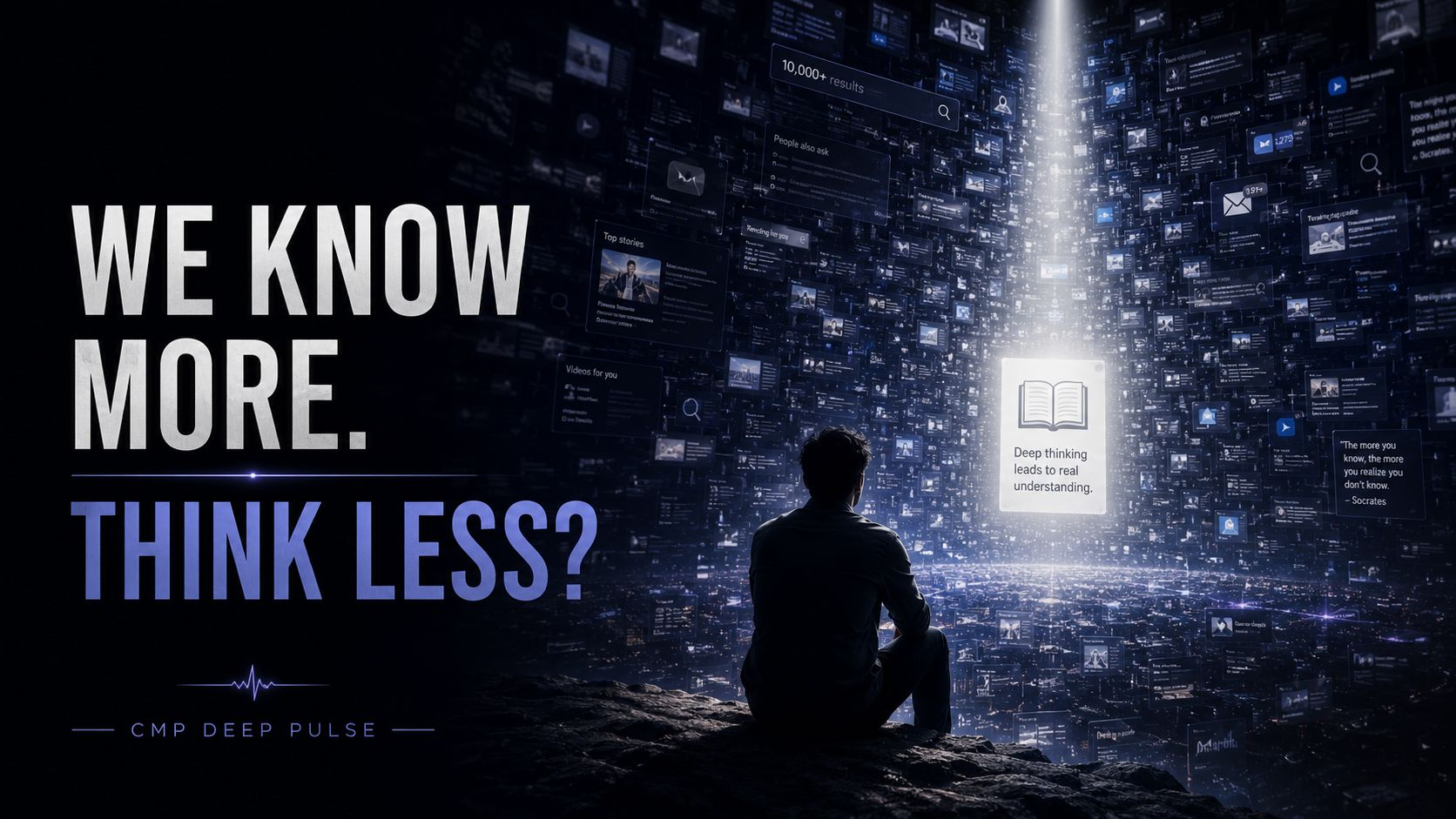
Once, information was scarce; to learn something new, you had to find a book, a teacher, or a person who already had the experience you needed.
Sometimes— to travel to another city.
Sometimes— for years, to study.
Sometimes, it was simply impossible to get the right answer.
Today it’s the opposite: in your pocket you have a device that, in a few seconds, gives access to almost any knowledge.
Want to learn to program—please.
Understand economics—please.
Learn a language, understand quantum physics, build a business model, cook a dish from another part of the world—all of this is literally a few taps away on a screen.
And now there’s also artificial intelligence.
You can ask about almost anything and, in a few seconds, get an explanation that used to require several books or a conversation with a specialist.
It would seem that humanity should be rapidly becoming smarter, but there’s a strange paradox: the easier it became to get information, the harder it became to hold on to attention. We can learn a new profession for free—and instead we open a short video. We can read a book—but after a few pages we check notifications. We can calmly work through a complex problem—but after just a couple of minutes, our hand automatically reaches to switch tabs.
When information was scarce, information itself was valued. When the internet appeared, the advantage became the ability to find it—but today even search is gradually ceasing to be a competitive edge. AI can find, explain, compare, and structure information faster than most people, and so maybe we’re entering a new era. An era where the most scarce resource is no longer knowledge, but attention.
There’s another interesting point: earlier, a person could take pride in knowing lots of facts. Today, simply knowing a fact is worth less and less on its own. A phone knows more than any of us. A search engine knows more than a phone. And AI can, in a matter of seconds, gather information from dozens of fields and explain it in simple language.
But it doesn’t answer the main question for us:
What is your time really worth spent on?
Out of a million available books—which one should you read?
Out of a thousand skills—what should you develop?
Out of a hundred possibilities—what should you choose?
Out of dozens of opinions—who should you trust?
The problem is no longer the absence of an answer.
The problem is an overabundance of answers.
And here comes another paradox of modern life: we’ve never had it so easy to start something new—and maybe we’ve never had it so easy to abandon it.
Didn’t like the course—there are another ten thousand.
Didn’t like a book—there’s an endless feed.
Work got harder—hundreds of job openings are open.
Get bored—within a second you can have a new form of entertainment.
Choice gives freedom, but endless choice makes us less patient: we want results before we’ve gone through the boring part of the path, and almost everything truly valuable contains that boring part.
To write well—you have to write a lot of bad writing.
To learn programming—you have to look for bugs for hours.
To build a company—you’ll have to do an enormous amount of work that nobody will see.
To become a specialist—sometimes it takes years of doing the same thing, making it only a little better than yesterday.
AI can speed up this process, but it can’t completely eliminate it. So it seems to me we’re asking the question a little wrong: «Will AI replace people?» maybe a much more interesting one is: «Which people will AI empower?»
A person who can concentrate now gets an incredible tool.
It can explore a topic faster, test hypotheses faster, write code faster, learn faster, and turn an idea into a working result faster.
But the person who can’t manage their attention gets a different tool—another endless source of content.
The same technology can give one person an enormous lever for growth, and another—even more ways to never finish anything.
And perhaps this is exactly where a new boundary between people will run—not between those who have access to knowledge and those who don’t. Access is gradually becoming almost universal, meanwhile between those who can use knowledge and those who simply consume it endlessly.
For the employer, it used to be important to ask:
«Where did you study?»
Then:
«What can you do?»
Today it’s increasingly interesting:
«What have you been able to create?»
And tomorrow, possibly, even more so:
«Can you independently identify the problem, figure it out, and not give up on it when it gets difficult?»
Because the answers will be available to virtually everyone.
Tools, too.
AI—too.
Curiosity, discipline, the ability to doubt, verify information, and work for a long time on one complex problem are not automatically included with a new smartphone.
Probably that’s why I’m becoming less and less convinced that the main advantage of the future person will be intelligence in the usual sense. Maybe it will be the ability to manage your own attention—to sometimes close all the tabs, not to react to every notification, not to change your goal just because a new interesting idea appears. To sit with a complex problem long enough to not understand it at first—and then, in the end, to figure it out.
When the whole world is fighting for our attention for just a few seconds, the ability to decide where to direct it yourself becomes a near form of freedom.
And then a question arises, one I myself don’t have a final answer to:
Will AI really make humanity smarter?
Or will it simply finally split us into those who use endless access to knowledge to create something new, and those who use it for endless consumption?