U.S. Employment Suddenly Cools—So Why Might the Market Not Jump Up Right Away?
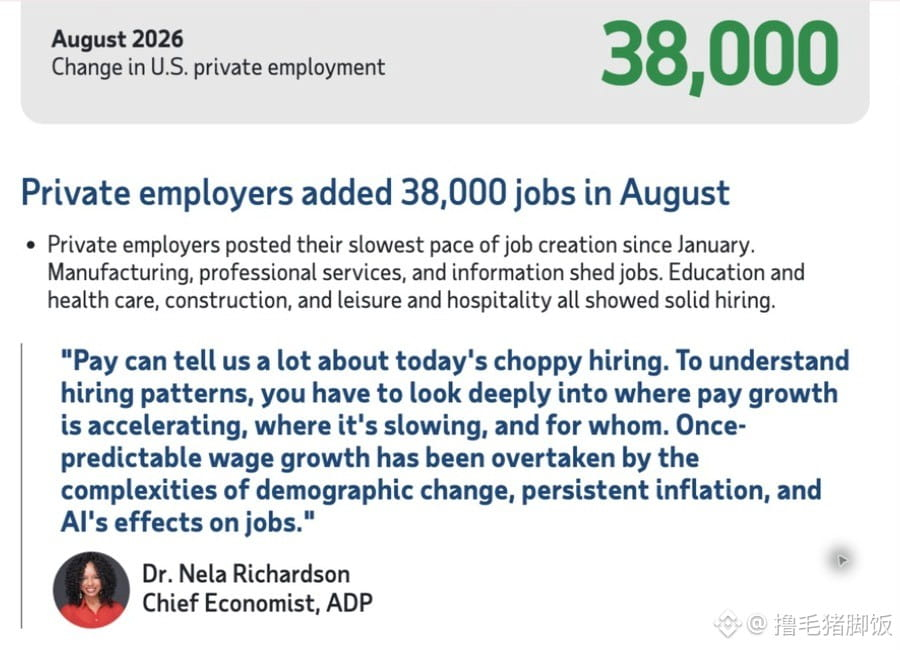
I just checked the ADP official report: In August, U.S. private-sector employment added only 38,000 jobs, below the market’s prior expectation of about 48,000, and the slowest pace since January this year. In July, it added 44,000.
Even more noteworthy is the structure.
Manufacturing declined by 17,000 jobs, professional and business services fell by 16,000, and the information sector dropped by 4,000; meanwhile, education and healthcare increased by 45,000 jobs, and construction rose by 12,000.
This isn’t “employment collapsing across the board,” but rather hiring continuing to become more differentiated.
For U.S. equities and the crypto market, weaker employment usually means pressure for further rate hikes may ease—typically friendlier for high-multiple tech stocks and $BTC .
But this time there’s another force: rising oil prices are boosting inflation concerns.
So the market is currently facing a set of conflicting signals:
Weaker jobs → lower rate pressure
Higher oil prices → higher inflation and rate-hike pressure
Next, don’t rush to look only at the ADP number for direction. I care more about:
① Whether Friday’s Nonfarm Payrolls also weaken
② Whether oil prices can fall
③ Whether U.S. Treasury yields drop along with the employment data
If Nonfarm Payrolls are weak too, and oil prices cool at the same time, risk assets are more likely to get genuine breathing room. But if inflation pressure keeps rising, weaker employment could instead turn into the troublesome combo of “growth slowing while prices stay high.” 🧐
$BTC
#美股 #非农 #宏观 #Bitcoin
I just checked the ADP official report: In August, U.S. private-sector employment added only 38,000 jobs, below the market’s prior expectation of about 48,000, and the slowest pace since January this year. In July, it added 44,000.
Even more noteworthy is the structure.
Manufacturing declined by 17,000 jobs, professional and business services fell by 16,000, and the information sector dropped by 4,000; meanwhile, education and healthcare increased by 45,000 jobs, and construction rose by 12,000.
This isn’t “employment collapsing across the board,” but rather hiring continuing to become more differentiated.
For U.S. equities and the crypto market, weaker employment usually means pressure for further rate hikes may ease—typically friendlier for high-multiple tech stocks and $BTC .
But this time there’s another force: rising oil prices are boosting inflation concerns.
So the market is currently facing a set of conflicting signals:
Weaker jobs → lower rate pressure
Higher oil prices → higher inflation and rate-hike pressure
Next, don’t rush to look only at the ADP number for direction. I care more about:
① Whether Friday’s Nonfarm Payrolls also weaken
② Whether oil prices can fall
③ Whether U.S. Treasury yields drop along with the employment data
If Nonfarm Payrolls are weak too, and oil prices cool at the same time, risk assets are more likely to get genuine breathing room. But if inflation pressure keeps rising, weaker employment could instead turn into the troublesome combo of “growth slowing while prices stay high.” 🧐
$BTC
#美股 #非农 #宏观 #Bitcoin