
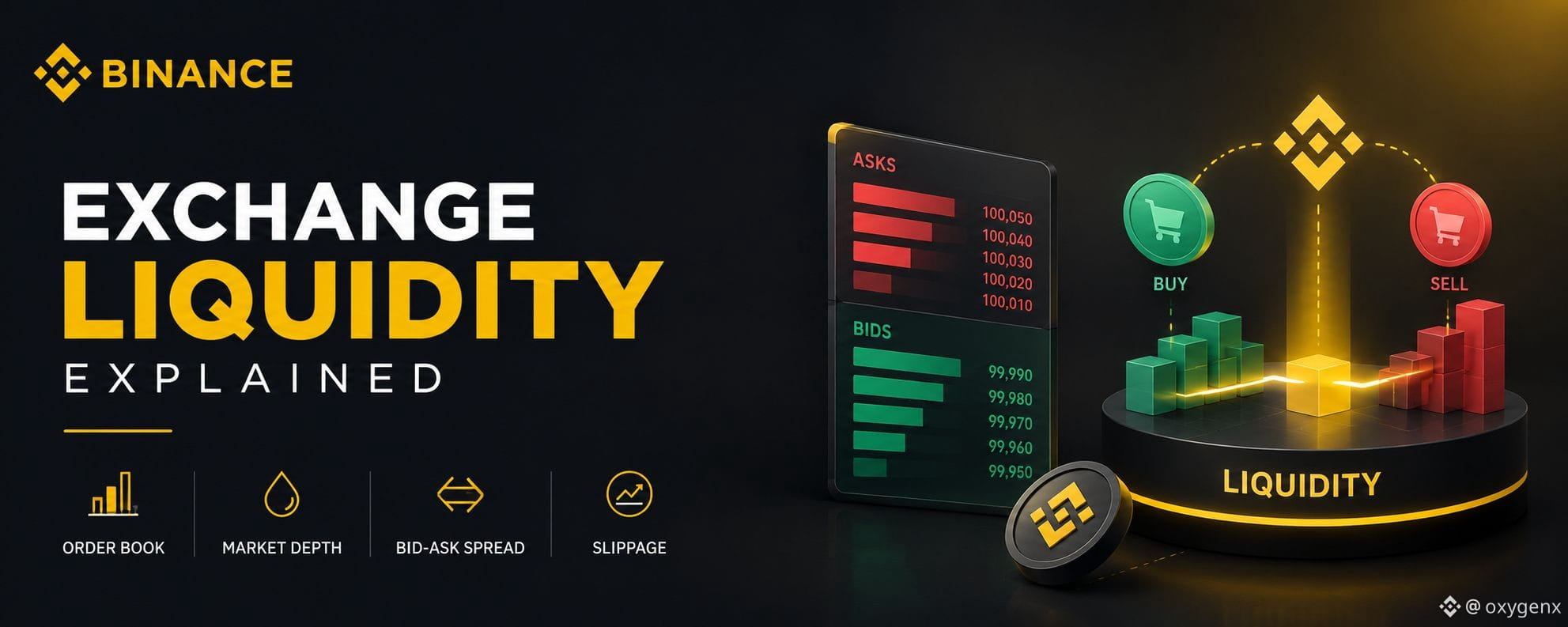

You can have the 'right" price on your screen…but that doesn't always mean you can actually trade at that price.
This is where "Exchange Liquidity" matters.
In simple terms, exchange liquidity means how easily you can buy or sell an asset without significantly moving its price. Think about Binance's order book. There are buyers placing bids and sellers placing asks at different price levels.
When there are plenty of orders close to the current market price, the market is considered deeper and more liquid. When there are fewer orders, even a relatively large trade can push the price around.
So why should traders care?
Because liquidity directly affects how your trade gets executed. Imagine BTC is showing at $100,000 (current $76000 something).
You place a small market order. If there is plenty of liquidity around $100,000, your order can usually be filled close to that displayed price.
But now imagine placing a very large order in a thin market. Your order may consume the available orders at $100,000… then $100,010… then $100,050… and so on. Your final average execution price can end up noticeably different from the price you originally saw.
That's slippage. and liquidity isn't measured by volume alone.
I usually think about three things:
1. Trading Volume
How much of the asset is actually being traded. Higher volume can indicate stronger participation, although volume can temporarily spike during major events.
2. Bid Ask Spread
The difference between the highest price buyers are offering and the lowest price sellers are accepting. A tighter spread generally indicates a more liquid market.
3. Market Depth
How many buy and sell orders are sitting around the current price. This is especially important when you're dealing with larger positions. A deep order book can absorb larger trades with less price impact. A shallow order book can't.
This is also why two exchanges can show almost the same BTC price, but your actual trading experience can still be different. One may have deeper liquidity. Another may have wider spreads. Another may produce more slippage on a large market order.
So the headline price isn't always the whole story. Execution matters.
And there's an interesting connection here with the things I've covered recently:
>> Funding Rate tells you something about positioning.
>> Liquidations show forced buying and selling.
>> Margin determines how your capital is exposed.
And liquidity determines how easily the market can absorb those trades.
When liquidity is thin, a large liquidation can have a much bigger price impact. When liquidity is deep, the same amount of selling may be absorbed more smoothly. That's one reason liquidity becomes especially important during volatile market conditions.
For me, the simplest way to remember it is:
- High liquidity → tighter spreads → less slippage → smoother execution.
- Low liquidity → wider spreads → more slippage → greater price impact.
So next time you open an exchange, don't just look at the order book behind the price.
Because the number you see on the screen is only the surface.
Liquidity tells you$ how much of that price the market can actually handle. 🟡