
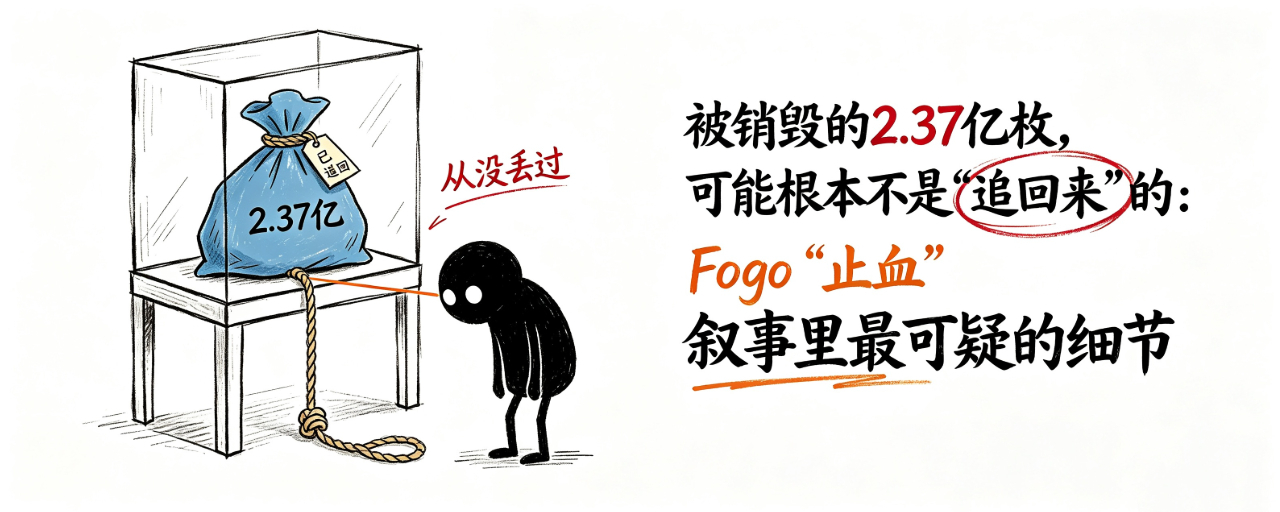

The main Fogo network has been restarted. 400 million FOGO were stolen, 237 million were recovered, and permanently destroyed.
The market’s first reaction: “Recovered more than half— the project team handled it beautifully.”
But I stared at the two words “recovered” for a long time, the more I looked, the more something seemed off.
“Recovered” implies these coins once slipped out of control. But what if they were never truly out of control in the first place?
This is the most worth questioning part of the news: those 237 million tokens that were destroyed—were they really “recovered,” or were they never lost in the first place?
Replace the subject with “those coins that were never lost, totaling 237 million.”
If the subject is “Fogo official,” the story is “professional bleeding control.” If the subject is “token holders,” the story is “we all foot the bill.” But if the subject becomes the 237 million frozen tokens themselves—tokens that never truly entered circulation—then the entire narrative collapses.
What state are these coins in? The official says “recovered.” But there’s usually only one way to recover: freezing them on a centralized exchange or on-chain addresses. That means from the moment they were stolen, these coins never truly left the controllable range.
They weren’t “recovered.” They were “allowed to stay where they were.”
What’s the difference? The difference is: if these coins had never been able to enter free circulation from the start, then the hacker would never have had the ability to cash them out. For these coins, the theft was never completed. They’re not a “loss”; they’re a “failed attempt.”
And the project party packaged a piece of “attempted theft” as a “victory of recovering more than half,” and then crossed them off the circulating supply.
400 million minus 237 million: who actually bears what?
Redo the arithmetic.
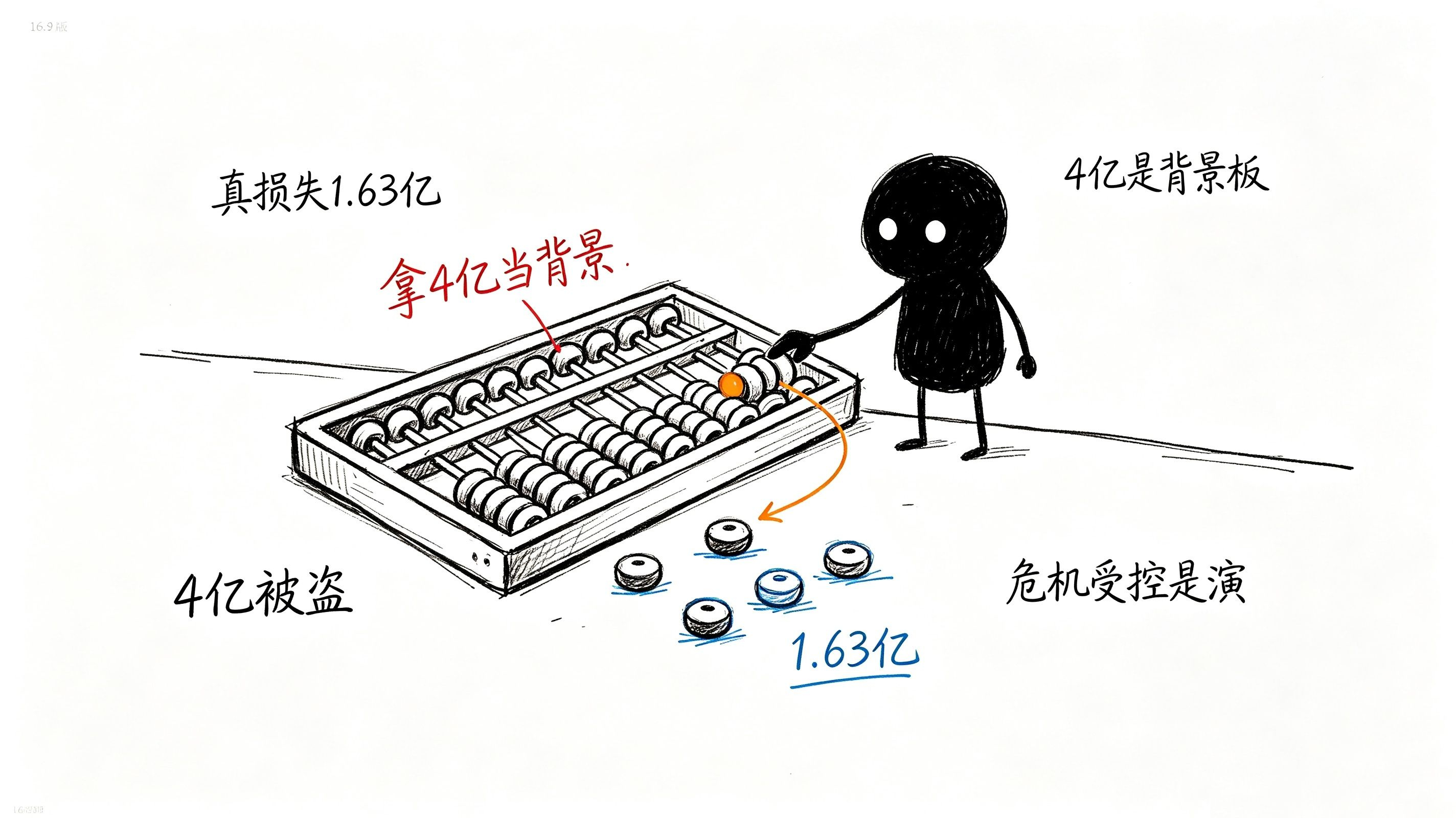
A total of 400 million FOGO was stolen. Of that, 237 million was “recovered” and destroyed. The remaining 163 million is unaccounted for.
But if the other 237 million were never truly out of the project’s control, then the real loss was 163 million from the very beginning—not 400 million. The project party used the larger figure of “400 million stolen” as a backdrop, then announced that “most has been recovered,” manufacturing a narrative that the crisis was effectively contained.
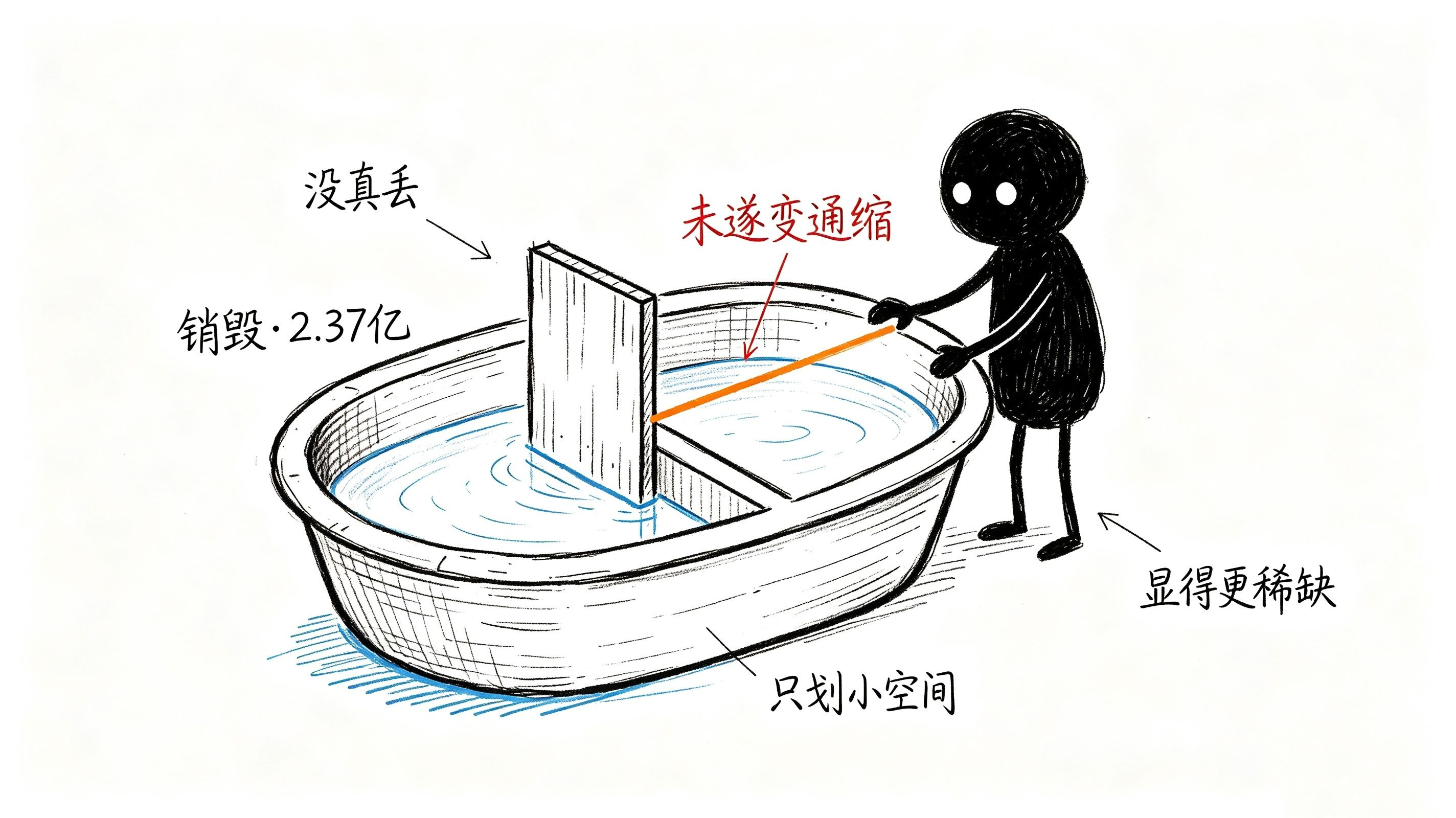
But those 237 million coins that were destroyed were permanently cut from the total supply across all FOGO holders. Those who held FOGO before the attack did nothing—yet the supply was reduced. Meanwhile, from start to finish, the hacker only took 163 million.
What does that mean? It means the project party turned an “attempted theft” into a “successful deflation.”
The 237 million coins that the hacker couldn’t cash out could have remained in the supply untouched. But the project party chose to destroy them, making the remaining tokens scarcer and supporting the price. This is a tokenomics move that uses the supply of all token holders to maintain the coin price.
Who benefits, who pays the price?
This is the misalignment that’s easiest to overlook.
Destroy 237 million, reduce the supply, and in theory the coin price should rise. Who benefits the most? Those who bought FOGO at a discount after the attack and during the mainnet pause, taking advantage of low prices. They bought the tokens at a discount and then enjoyed the deflationary bonus created by the project party’s supply reduction.
Who’s bearing the cost? It’s the long-term holders who already had FOGO before the attack. Their share has been permanently diluted. The hacker stole 163 million, but they bear losses equivalent to a 237 million supply reduction—plus the liquidity freeze during the mainnet pause.
Long-term holders were punished twice: first with the indirect damage from the hack, and second as the project party used their supply to prop up the coin price.

This isn’t bleeding control. This is a move that shifts the cost from the project party onto long-term holders.
What’s even more uncomfortable: where exactly are those 163 million coins?
The news says the investigation is still ongoing, and the official is working with exchanges and law enforcement to recover the remaining assets.
But what really keeps people up at night is this: the 163 million FOGO that weren’t recovered—who has them now?
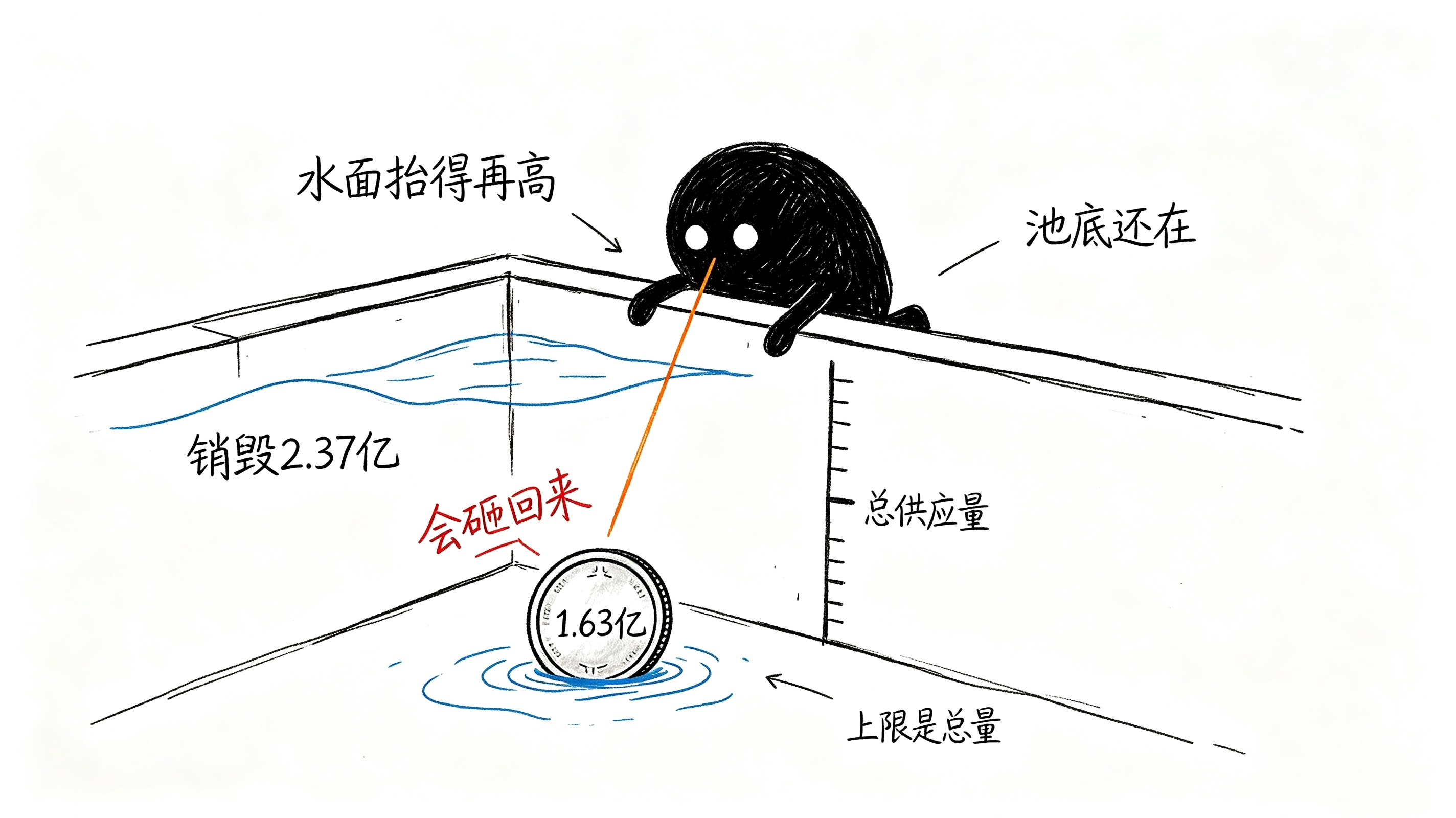
If they’ve already been cross-chained, mixed through mixers, or sent to some addresses that are difficult to track, then these coins are a ticking time bomb. At some point in the future, they’ll re-enter the market and become selling pressure hanging over the heads of all FOGO holders.
The deflationary effect created by destroying 237 million coins could be shattered at any moment by the “return” of those 163 million.
And when those 163 million coins reflow again, can the project party use “destruction” as a backstop one more time? How much further can the supply be reduced? Using “deflation” to offset a “theft” scheme has its limits—its limit is the total supply itself.
Dare I make a call: this isn’t crisis management—it’s narrative management
Here’s my next judgment: this “recovery and destruction” by Fogo is, in essence, a successful act of narrative management—not real asset protection.
The logic is simple: if the 237 million coins were in a controllable state from the start, then the very act of “recovery” doesn’t hold. You can only “recover” what you lost in the past. If you never lost it, then “recovery” is just a performance.
And the function of this performance is to shift the market’s attention from “that 163 million is still missing” to “we already recovered most of it.”
The coins that were destroyed are the project party’s curtain to cover up the real loss. The curtain is gorgeous, and the deflation narrative is catchy. But behind the curtain are 163 million FOGO coins that could crash down at any time—and a security problem that was never truly resolved.
The biggest problem that keeps people up at night
What’s most troubling about this news isn’t whether “burning” is right or wrong—it’s that the word “recovery” in the crypto world has become inflationary.
When the project party can label “tokens that never left the control range” as “recovered,” and package an “attempted theft” as a “successful loss prevention,” when the next truly irreversible loss happens, how will the market be able to tell what counts as “real recovery” versus “false narrative”?
And FOGO’s long-term holders are staring right now at the chart showing the supply reduction, calculating how much “deflation bonus” they’ve earned. What they don’t realize is that the wool that’s been cut off from them is being turned into the next “recovery” in the project party’s price-management toolbox.
That 163 million FOGO is quietly lying in some address, waiting for the day it’s “recovered.” And when that happens, whose supply will the destroyed coins come from?