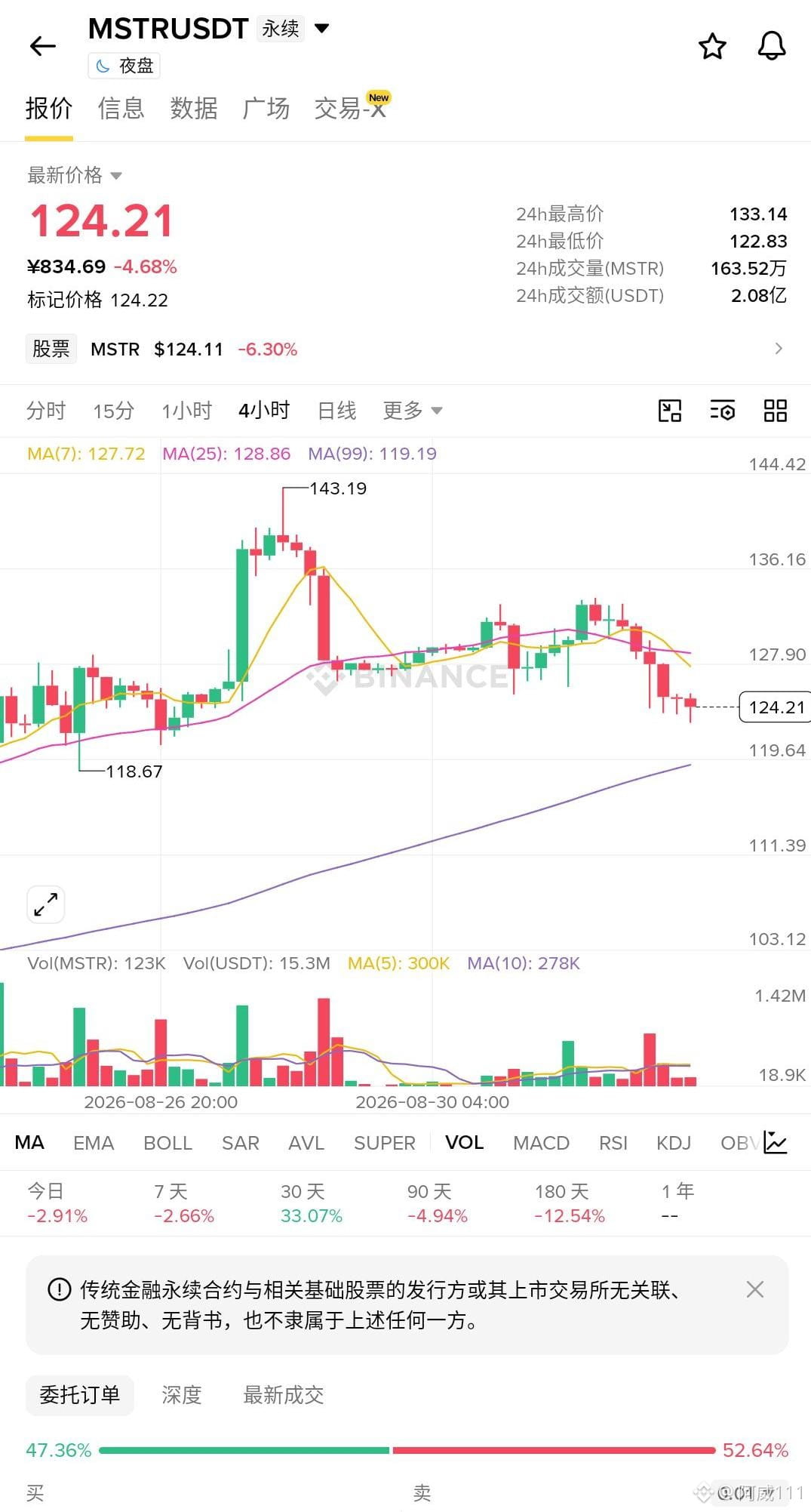
MSTR dropped 4.6% in one day. In the past four hours, five consecutive bearish candles have pressed down on a single green one, with the low briefly touching 123.66 before being pulled back. When it falls to this level, contract open interest over the last 24 hours has also shrunk by 5.86%. By rights, liquidation should have cleared out the leverage. But the funding rate is still hanging at a positive 0.064%—longs haven’t been washed out yet, and they’re still paying hourly subsidies to the shorts.
This is the most twisted part of this sell-off: price and open interest shrink in sync, which should be a sign that selling pressure is weakening. Yet the longs are still paying again at the lows. Since the funding rate hasn’t turned negative, it means the ones who’ve surrendered haven’t appeared. Long positions on the market haven’t been fully closed. The fuse for the next wave of decline is still buried below.
The big players’ books show the same picture. The long-to-short ratio is 2.15, with longs at 68%, yet within seven hours, positions were cut by 5% and the account balance fell by 4%—on paper, the longs are still holding on, but in action they’re withdrawing. Spot buy-side walls are only 8.6% thicker than sell-side walls. The active long-to-short ratio is 1.02, and directional buy orders can’t catch the downtrend. The current price is also being capped by the 50-line at 125.5, and any rebound can’t even get past this level.
For a short: enter near 124. Stop loss if it rebounds above 125.5. If it breaks below the prior low at 122.83, look toward around 120. Once the funding rate turns negative and the large-player long share drops back below 60%, then consider flipping long. Until then, every rebound is an opportunity for shorts to add positions.
#mstr $MSTR
This is the most twisted part of this sell-off: price and open interest shrink in sync, which should be a sign that selling pressure is weakening. Yet the longs are still paying again at the lows. Since the funding rate hasn’t turned negative, it means the ones who’ve surrendered haven’t appeared. Long positions on the market haven’t been fully closed. The fuse for the next wave of decline is still buried below.
The big players’ books show the same picture. The long-to-short ratio is 2.15, with longs at 68%, yet within seven hours, positions were cut by 5% and the account balance fell by 4%—on paper, the longs are still holding on, but in action they’re withdrawing. Spot buy-side walls are only 8.6% thicker than sell-side walls. The active long-to-short ratio is 1.02, and directional buy orders can’t catch the downtrend. The current price is also being capped by the 50-line at 125.5, and any rebound can’t even get past this level.
For a short: enter near 124. Stop loss if it rebounds above 125.5. If it breaks below the prior low at 122.83, look toward around 120. Once the funding rate turns negative and the large-player long share drops back below 60%, then consider flipping long. Until then, every rebound is an opportunity for shorts to add positions.
#mstr $MSTR