After BTC’s short-term weakness, the easiest mistake to make isn’t being bearish—it’s treating every rebound as “repair.”
In this stretch of weakness, what most easily leads people to misjudge isn’t the decline itself, but the fact that each small rebound makes them think, “Is it finally stable again?”
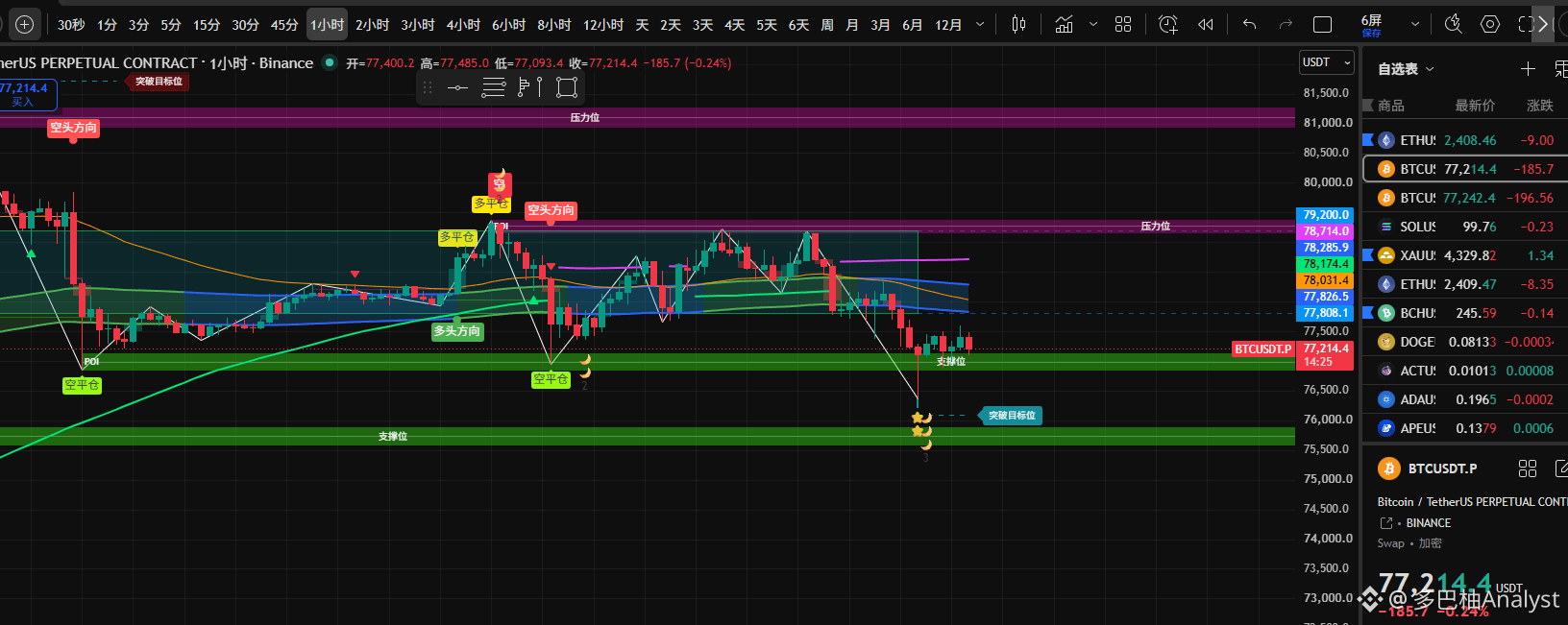
From the 1-hour structure, price has repeatedly been rejected overhead. After the pullback, it hasn’t quickly regained the levels it lost. So the short-term bias is still bearish; however, “bearish” doesn’t mean chasing downside, and it doesn’t mean every rebound must be denied.
What’s worth watching now are two zones:
First, look at 77,800—79,200 on the upside.
If rebounds repeatedly stall below this range, it suggests overhead supply hasn’t truly been digested, and the short-term structure still requires caution.
On the downside, first look at 75,500.
If this area is tested again, the key isn’t just whether price drops there, but whether after the test it can quickly show acceptance—pulling the price back into the structure. If that acceptance doesn’t appear for a long time, the market will start shifting its attention to the next lower level around 73,500.
Many people equate “no further big selloff” directly with “the selling has already ended.” But in a range, holding sideways could mean there is support (acceptance), or it could simply mean that selling pressure has temporarily slowed. The difference depends on whether the rebound can reclaim key areas—not on just one or two candlesticks.
The futures side also doesn’t need to rush to a conclusion: if positions keep increasing while price is weakening, it means new leverage is still participating, and the structural pressure deserves even more attention. If positions drop in sync, it’s closer to a leverage release, which can’t simply be equated with the continuation of the trend.
Short-term is bearish—first respect the structure. Until price reclaims the upper zone, don’t automatically treat rebounds as “repairs.”
#BTC #比特币 #行情分析 $BTC
Follow the homepage and keep tracking structural changes.
In this stretch of weakness, what most easily leads people to misjudge isn’t the decline itself, but the fact that each small rebound makes them think, “Is it finally stable again?”
From the 1-hour structure, price has repeatedly been rejected overhead. After the pullback, it hasn’t quickly regained the levels it lost. So the short-term bias is still bearish; however, “bearish” doesn’t mean chasing downside, and it doesn’t mean every rebound must be denied.
What’s worth watching now are two zones:
First, look at 77,800—79,200 on the upside.
If rebounds repeatedly stall below this range, it suggests overhead supply hasn’t truly been digested, and the short-term structure still requires caution.
On the downside, first look at 75,500.
If this area is tested again, the key isn’t just whether price drops there, but whether after the test it can quickly show acceptance—pulling the price back into the structure. If that acceptance doesn’t appear for a long time, the market will start shifting its attention to the next lower level around 73,500.
Many people equate “no further big selloff” directly with “the selling has already ended.” But in a range, holding sideways could mean there is support (acceptance), or it could simply mean that selling pressure has temporarily slowed. The difference depends on whether the rebound can reclaim key areas—not on just one or two candlesticks.
The futures side also doesn’t need to rush to a conclusion: if positions keep increasing while price is weakening, it means new leverage is still participating, and the structural pressure deserves even more attention. If positions drop in sync, it’s closer to a leverage release, which can’t simply be equated with the continuation of the trend.
Short-term is bearish—first respect the structure. Until price reclaims the upper zone, don’t automatically treat rebounds as “repairs.”
#BTC #比特币 #行情分析 $BTC
Follow the homepage and keep tracking structural changes.