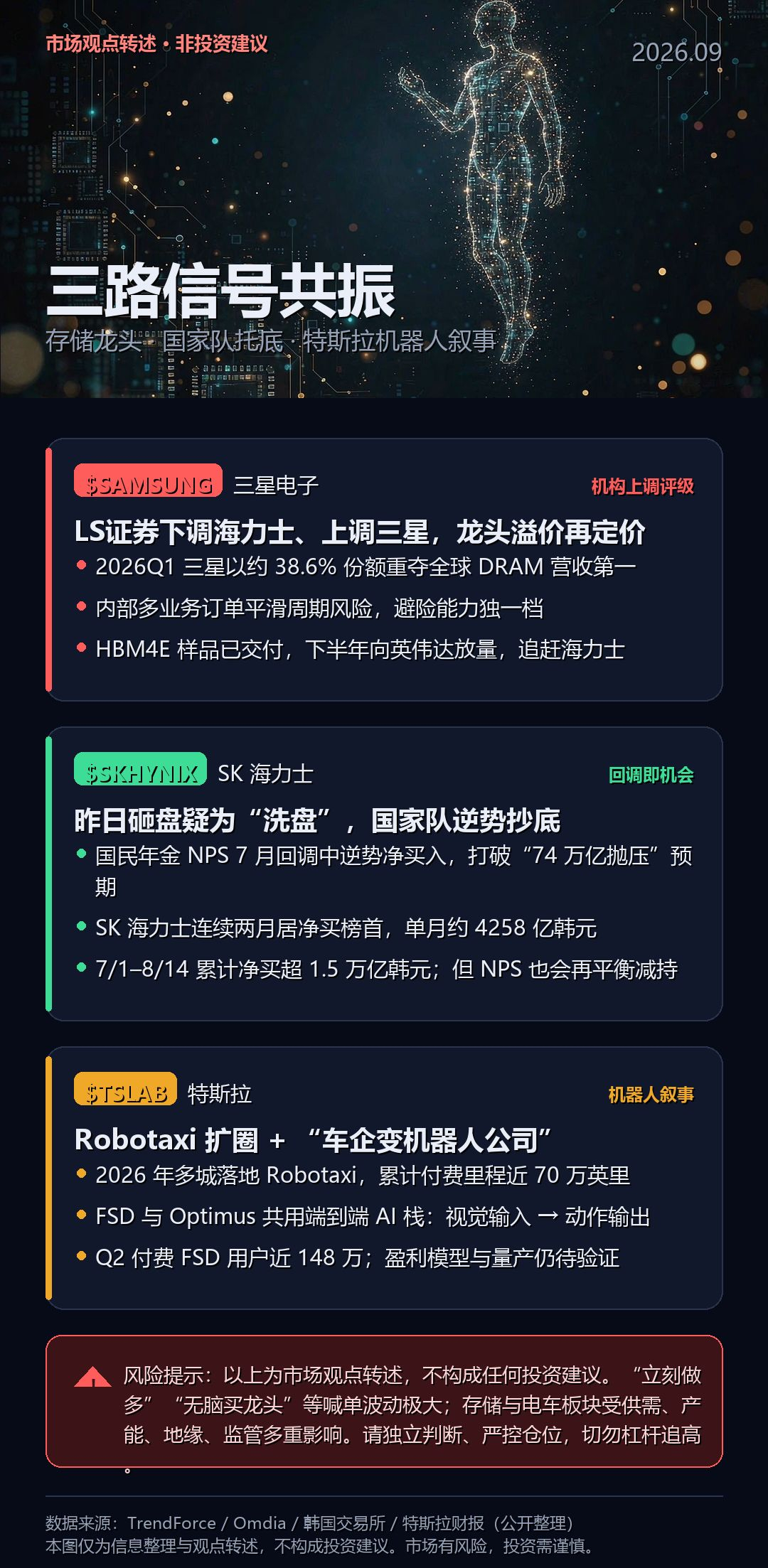
Three-Path Signal Resonance: Storage Leaders, National Team Backstops, and Tesla’s Robot Narrative
Recently, two narrative lines have heated up at the same time in both Korean and U.S. stocks. One is the “leader premium” re-rating for storage chips. The other is Tesla’s paradigm shift from cars to robots. Combined with Korea’s “National Team” pension funds adding to positions against the trend, the market has developed voices advocating “blindly buying leaders” and “the strong always stay strong.” This memory supercycle has been driven by sustained expansion supported by AI compute-capital. Samsung, SK hynix, and Micron $MUB together control nearly 90% of DRAM capacity, and pricing power is highly concentrated. When funds retrace, they reassess the certainty premium of “core assets.” This “leader faith” tends to reinforce itself during bull markets. The following is a summary of three parties’ viewpoints for comparison only, not as a basis for investment decisions.
【Signal One·$SAMSUNG Samsung Electronics】
LS Securities has recently both lowered its target price for SK hynix while raising its target price for Samsung Electronics. Behind these moves is a subtle shift in the industry landscape. In Q1 2026, Samsung regained the top spot globally in DRAM revenue with about 38.6% share. It has the broadest capacity base in general-purpose $DRAMB , mobile memory, and server RDIMM. When the cycle turns down, internal orders from smartphones, PCs, and servers can absorb risks—an “hedging capability” that neither #sk海力士 nor #美光 possesses. More importantly, Samsung has already delivered the first batch of HBM4E samples, and will ramp shipments to NVIDIA in the second half of the year. It is moving from being an HBM follower to a strong competitor. Under the consensus of “no matter the sector, buy the leader,” #三星 , as the world’s largest storage company, has seen its “the strong always stay strong” narrative rekindled. This also explains why institutions are willing to give leaders a higher margin of error. That said, SK hynix still holds nearly 60% of the HBM share; the thickness of its profit margin has not yet changed hands easily. A valuation re-rating does not necessarily mean earnings will transfer. Certainty in share and capacity is often more valued by long-term capital than profits in a single quarter.
Recently, two narrative lines have heated up at the same time in both Korean and U.S. stocks. One is the “leader premium” re-rating for storage chips. The other is Tesla’s paradigm shift from cars to robots. Combined with Korea’s “National Team” pension funds adding to positions against the trend, the market has developed voices advocating “blindly buying leaders” and “the strong always stay strong.” This memory supercycle has been driven by sustained expansion supported by AI compute-capital. Samsung, SK hynix, and Micron $MUB together control nearly 90% of DRAM capacity, and pricing power is highly concentrated. When funds retrace, they reassess the certainty premium of “core assets.” This “leader faith” tends to reinforce itself during bull markets. The following is a summary of three parties’ viewpoints for comparison only, not as a basis for investment decisions.
【Signal One·$SAMSUNG Samsung Electronics】
LS Securities has recently both lowered its target price for SK hynix while raising its target price for Samsung Electronics. Behind these moves is a subtle shift in the industry landscape. In Q1 2026, Samsung regained the top spot globally in DRAM revenue with about 38.6% share. It has the broadest capacity base in general-purpose $DRAMB , mobile memory, and server RDIMM. When the cycle turns down, internal orders from smartphones, PCs, and servers can absorb risks—an “hedging capability” that neither #sk海力士 nor #美光 possesses. More importantly, Samsung has already delivered the first batch of HBM4E samples, and will ramp shipments to NVIDIA in the second half of the year. It is moving from being an HBM follower to a strong competitor. Under the consensus of “no matter the sector, buy the leader,” #三星 , as the world’s largest storage company, has seen its “the strong always stay strong” narrative rekindled. This also explains why institutions are willing to give leaders a higher margin of error. That said, SK hynix still holds nearly 60% of the HBM share; the thickness of its profit margin has not yet changed hands easily. A valuation re-rating does not necessarily mean earnings will transfer. Certainty in share and capacity is often more valued by long-term capital than profits in a single quarter.