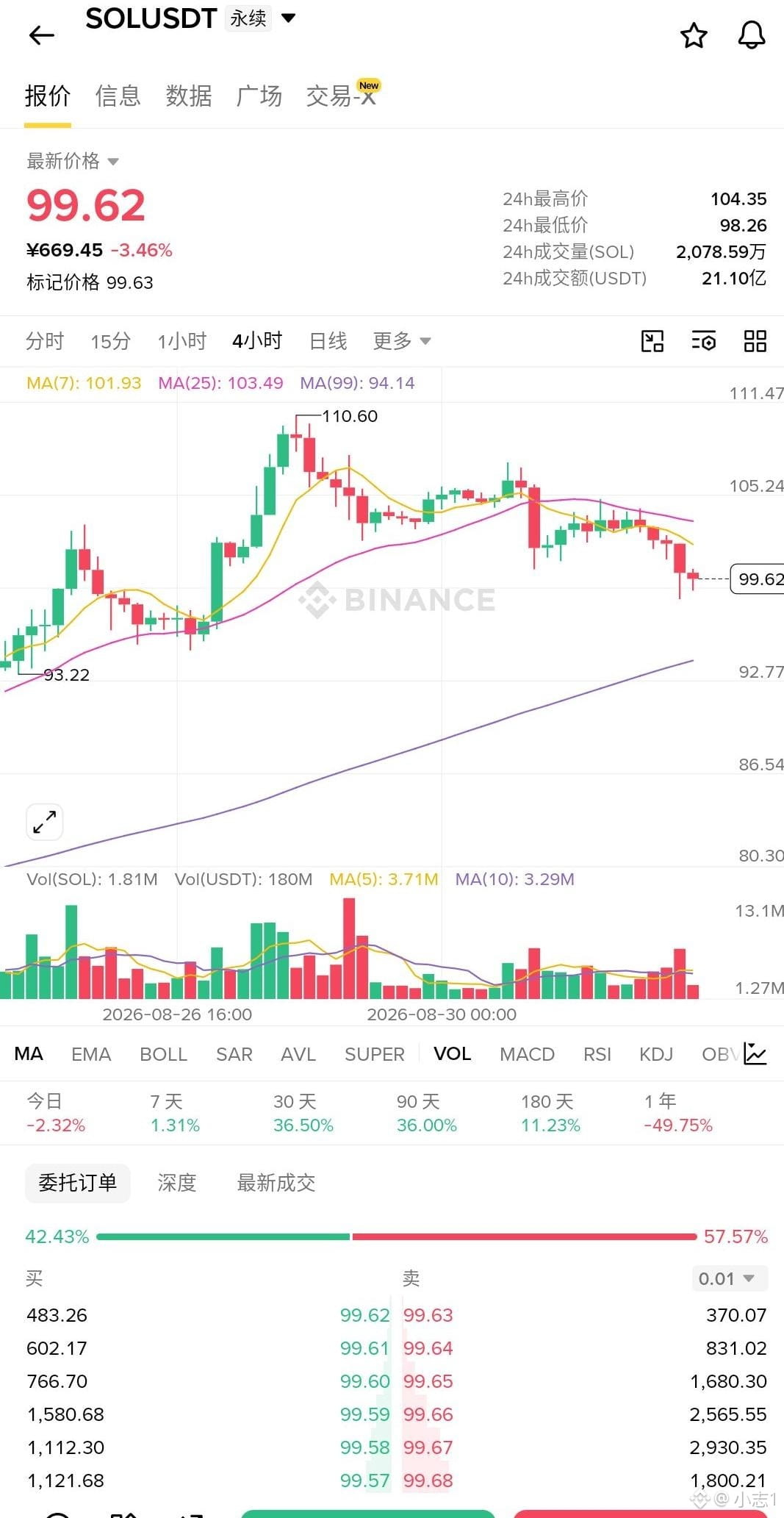
After SOL breaks below 100, the contract market turns first: positions don’t drop but actually rise by 0.93%; the funding rate flips from around zero into negative, the basis is squeezed into a discount, and the four quadrants label it directly as a strong bearish market. This is not a pullback where longs add more—it’s new shorts actively entering below 100.
Adding while prices fall has never been a good sign—over the past 24 hours, price is -3.36%, yet open interest keeps stacking upward. With every step down, new shorts add even more. The spot side is even more direct: large orders show net outflows of $3.57 million over 3 hours; across the entire sampling period there are zero positive net inflows—there’s not even a trace of real buying demand. Price is already 1.2% below the 50-day moving average, with the 4-hour and daily trends pointing fully downward.
The only ones still daring to catch against the trend are the contract whales: net long positions of 67.7%, who added another 5.42% over the past 7 hours, with active buy orders accounting for 59.5%. But they won’t even pay a premium—funding is negative, basis is negative, and the message is clear: they say they’re catching, but they won’t add even a single cent of extra money. This kind of zero-cost bottom-fishing can’t withstand the spot market’s sell-off.
I’m staying short. Real funds are exiting, new leverage positions are all in the bearish quadrant, and the trend lines are pointing downward across the board—under this setup, going long against the trend is handing the shorts fuel. On the other hand, if spot large orders turn net positive, price reclaims above the 50-day moving average at 100.9, and both the funding rate and basis flip back to positive, I’ll immediately admit I’m wrong and get out. #sol $SOL
Adding while prices fall has never been a good sign—over the past 24 hours, price is -3.36%, yet open interest keeps stacking upward. With every step down, new shorts add even more. The spot side is even more direct: large orders show net outflows of $3.57 million over 3 hours; across the entire sampling period there are zero positive net inflows—there’s not even a trace of real buying demand. Price is already 1.2% below the 50-day moving average, with the 4-hour and daily trends pointing fully downward.
The only ones still daring to catch against the trend are the contract whales: net long positions of 67.7%, who added another 5.42% over the past 7 hours, with active buy orders accounting for 59.5%. But they won’t even pay a premium—funding is negative, basis is negative, and the message is clear: they say they’re catching, but they won’t add even a single cent of extra money. This kind of zero-cost bottom-fishing can’t withstand the spot market’s sell-off.
I’m staying short. Real funds are exiting, new leverage positions are all in the bearish quadrant, and the trend lines are pointing downward across the board—under this setup, going long against the trend is handing the shorts fuel. On the other hand, if spot large orders turn net positive, price reclaims above the 50-day moving average at 100.9, and both the funding rate and basis flip back to positive, I’ll immediately admit I’m wrong and get out. #sol $SOL