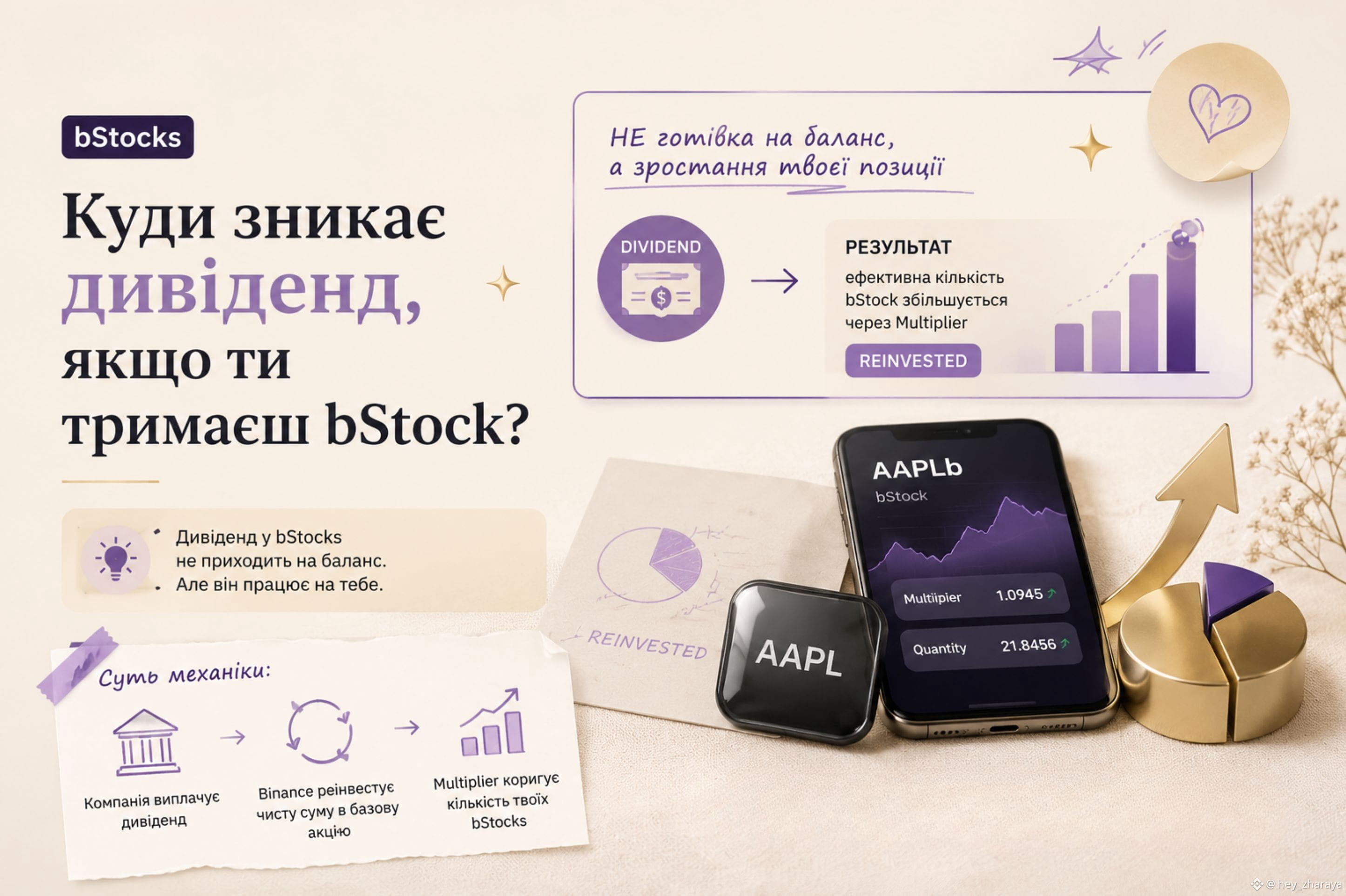
Where does the dividend go if you hold bStock?
At first, I expected to see a simple logic:
a stock pays a dividend → money comes to your balance.
But with bStocks, things work a bit differently.
If the company behind the bStock pays a dividend, you don’t receive a separate cash transfer.
Binance automatically reinvests the net dividend amount into the underlying stock. This uses the Multiplier mechanism.
And that raises an interesting question:
if the money didn’t arrive on my balance, then where exactly did I receive my dividend?
The answer is: within the position itself.
Instead of a separate payout, the effective number of bStock changes, reflecting the result of reinvesting the dividend via Multiplier.
So the mechanics differ from the usual stock scenario:
dividend → cash
Here the logic is different:
dividend → reinvestment → position adjustment
And this is exactly the moment I think it’s important to understand when comparing a tokenized asset with a traditional stock.
Because the same word “dividend” doesn’t necessarily mean the same way of receiving it.
For me, this is a good example of why, when working with bStocks, you should look not only at the token price, but also at the mechanics of corporate events under the hood.
#bStocks @BinanceCIS
At first, I expected to see a simple logic:
a stock pays a dividend → money comes to your balance.
But with bStocks, things work a bit differently.
If the company behind the bStock pays a dividend, you don’t receive a separate cash transfer.
Binance automatically reinvests the net dividend amount into the underlying stock. This uses the Multiplier mechanism.
And that raises an interesting question:
if the money didn’t arrive on my balance, then where exactly did I receive my dividend?
The answer is: within the position itself.
Instead of a separate payout, the effective number of bStock changes, reflecting the result of reinvesting the dividend via Multiplier.
So the mechanics differ from the usual stock scenario:
dividend → cash
Here the logic is different:
dividend → reinvestment → position adjustment
And this is exactly the moment I think it’s important to understand when comparing a tokenized asset with a traditional stock.
Because the same word “dividend” doesn’t necessarily mean the same way of receiving it.
For me, this is a good example of why, when working with bStocks, you should look not only at the token price, but also at the mechanics of corporate events under the hood.
#bStocks @BinanceCIS