
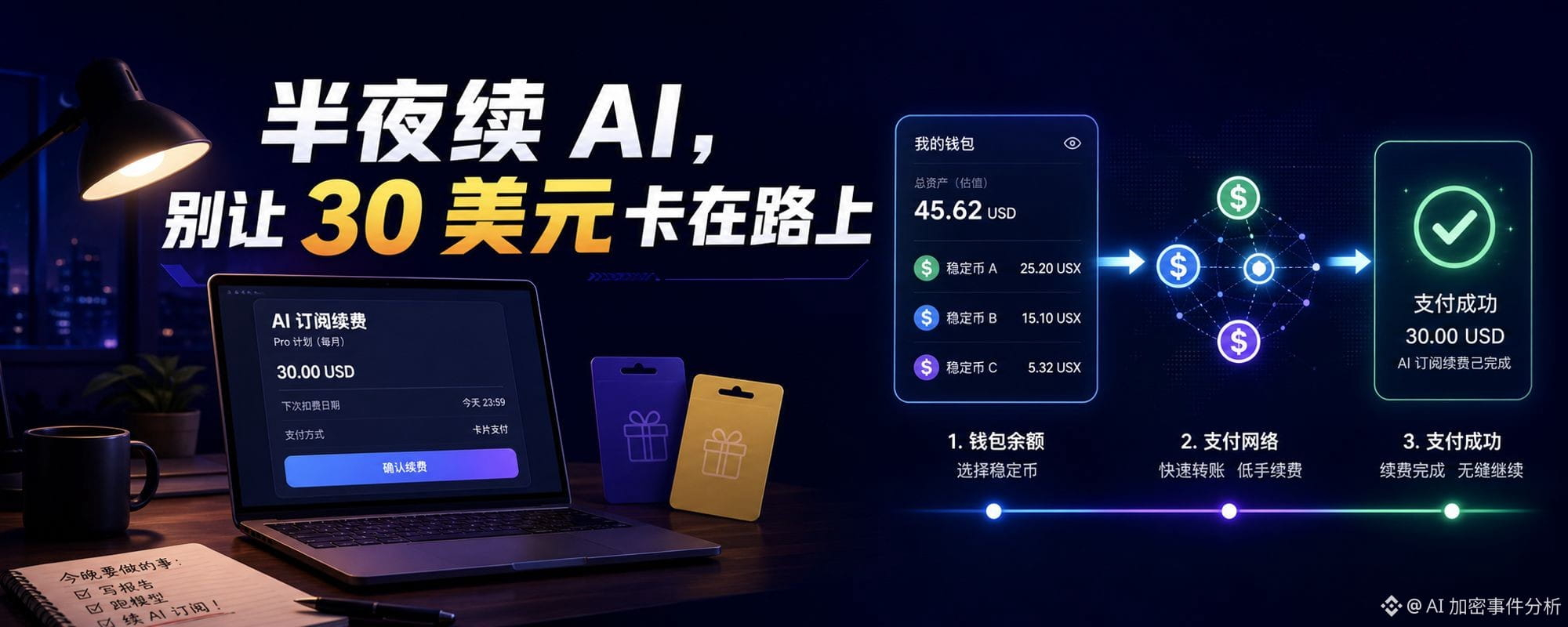

At the start of September, the market is discussing not only stablecoins entering banks, payments, and everyday financial systems, but also whether AI agents will someday place orders and settle payments on their own. It all sounds very grand, but for ordinary crypto users, the actual issue that might happen tonight is likely pretty small: an AI membership expires, code tools need to be renewed, a cloud service bill needs to be charged, and there’s still one more gift card missing in the cart.
Spending like this is usually not large—$20, $30, $50—so the amounts are too small to justify building a whole separate funds-processing flow; but it’s still annoying because the timing is very certain. Deliverables are due tomorrow morning, so the tools can’t go down tonight. There’s purchasing tomorrow, so the budget can’t just sit in the wallet tonight. Gift cards were originally meant to lock in shopping spend early, but right before payment, you still have to find a new path.
When people manage crypto assets, they usually split them into just two layers: one layer is holding on, and the other is selling and cashing out. This approach works for tracking the market, but it isn’t designed for everyday life. Because money in real life doesn’t wait for you to finish interpreting market moves. Subscriptions expire on time, purchases settle on time, and tools get disabled on time. Market upswings and downswings only address paper gains; they don’t solve the availability in the very second you need to pay.
The most worth doing tonight isn’t shuffling all your stablecoins around, and it’s not for running a long process just to renew a temporary $30 charge. Instead, first separate the money you already know you’ll need to spend in the next 3 to 7 days. An AI membership, productivity tools, cloud services, small purchases, and gift card budgets—all of these essentially belong to a spending layer that “can’t fluctuate along with your positions.”
That’s also why news about stablecoin payments and digital consumption is getting more and more important. Back then, people cared about whether they could buy, sell, or transfer; now the more practical question is: can you spend it directly when you need to? When an asset moves from an on-chain balance to real-world consumption, each extra exchange, extra waiting, and extra failed rollback turns small bills into big headaches.
In this scenario, gift cards aren’t an old-school tool—they’re more like a consumption buffer layer. You don’t have to convert all your assets into cash, but you can convert a small portion that you’ve already confirmed you’ll spend, ahead of time, into a form that’s closer to shopping and subscriptions. The point isn’t saving a few dozen cents in fees; it’s making sure fixed expenses in the coming days no longer squeeze your trading decisions at the last minute.
AI subscriptions follow the same logic. Once productivity tools become basic infrastructure you use every day, they stop being “optional” consumption and become part of your workflow. If you can’t renew a $30 membership, your loss might not be those $30—it could be an entire night of lost efficiency, a disrupted development cadence, or even a delayed delivery.
So for stablecoins to truly enter daily life, it’s not about starting from a “payment concept.” It starts with these small, timely, cannot-fail expenses. Big market moves can be assessed slowly; for small bills, it’s best to handle them in advance.
After PayAll’s complete redesign, it places AI subscription and gift card spending scenarios in a more direct position. If you need to renew your AI membership, you can see https://beta.payall.pro/explore/ai. If you want to pre-plan shopping, subscription, or gift card budgets, you can see https://beta.payall.pro/explore/gift. What it’s better at solving isn’t “how to read today’s market,” but rather: “The money I’ve already decided to spend—I can I take fewer detours and get into real life faster?”
#稳定币 #AI