What if shares stop living by the rules of the stock market? 👀
Imagine: you want exposure to NVIDIA or Tesla shares, but instead of a classic brokerage account — a token on the blockchain.
This is no longer science fiction.
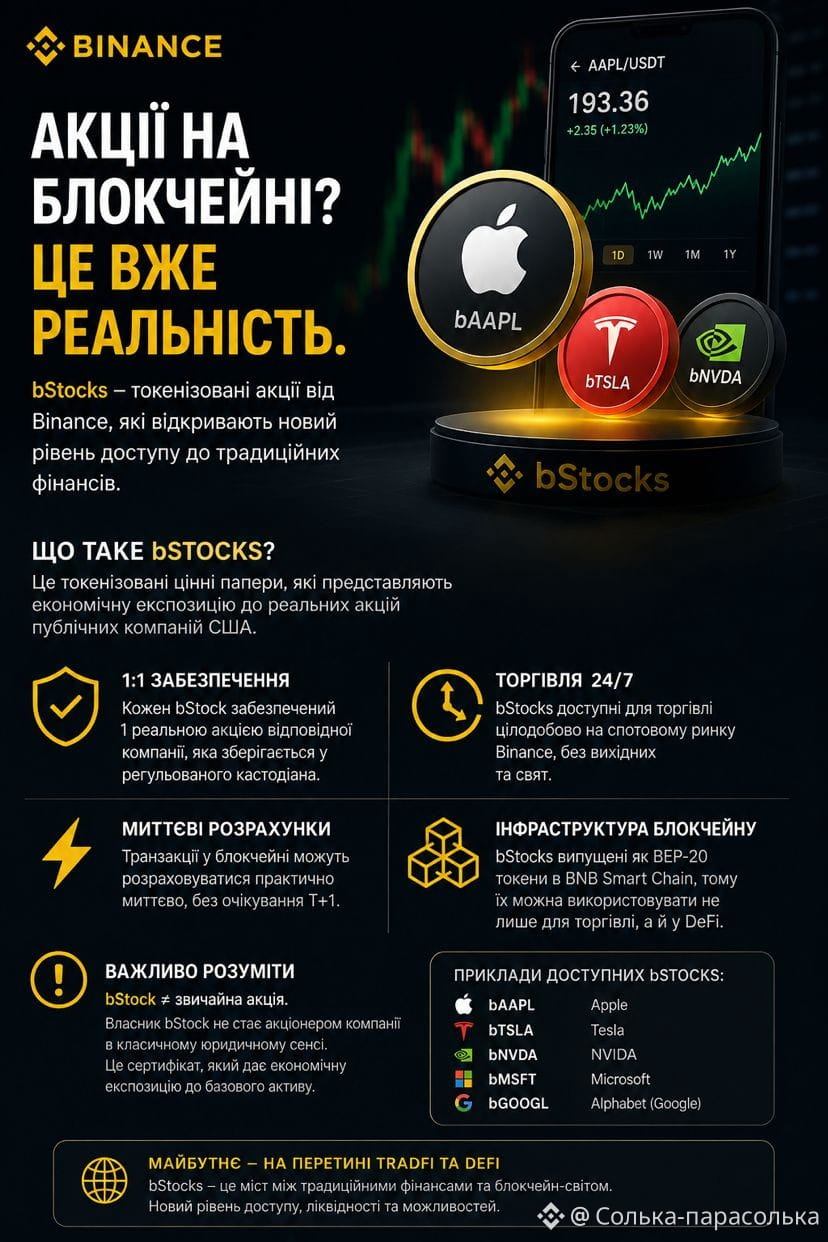
In 2026, Binance launched bStocks — tokenized securities that provide economic exposure to individual US stocks.
And here’s the most interesting part 👇
🔹 1 bStock is backed by 1 real share of the corresponding company, which is held by a regulated custodian.
🔹 bStocks can be traded 24/7 on Binance’s spot market — meaning you don’t have to wait for a traditional exchange to open.
🔹 Blockchain transactions can settle almost instantly, without the classic T+1 waiting period.
🔹 bStocks operate as BEP-20 tokens on BNB Smart Chain, so they could potentially be used not only for trading, but also in DeFi protocols.
But there’s an important nuance:
bStock ≠ a normal share.
An owner of a bStock does not become a shareholder of the company in the classical legal sense. It’s a certificate that provides economic exposure to the underlying asset.
And that’s where the most interesting part of the story begins.
TradFi gets a blockchain wrapper, while the crypto market gains access to assets from traditional finance.