
Muzamil Abbas⁷⁵ 穆扎米尔_阿巴斯
10k Posts
Muzamil Abbas⁷⁵ 穆扎米尔_阿巴斯
X ACC @Muzamil39825275 // BINANCE SQUARE CREATOR // CRYPTO TRADER // BITCOIN ENTHUSIAST // CALM MIND BIG DREAMS // BUILDING A FUTURE NOT CHASING ATTENTION✨
850 Following
16.5K+ Followers
23.8K+ Liked
Posts
All
Quotes
Videos
Live
PINNED
112 $TUT COIN GIVEAWAY 🎁
Want to win TUT? 🏆
✅ Follow me
❤️ Like this post
🔁 Repost this post
💬 Comment “1” to claim
#GOOD_LUCK_EVERYONE 🤞
#ExplosionsAtUSBasesInKuwait #IRGCSaysItStruckUSMarineCampInJordan
Want to win TUT? 🏆
✅ Follow me
❤️ Like this post
🔁 Repost this post
💬 Comment “1” to claim
#GOOD_LUCK_EVERYONE 🤞
#ExplosionsAtUSBasesInKuwait #IRGCSaysItStruckUSMarineCampInJordan

go

x_Rex
·
--
Remember yesterday when I said the SEC was voting on crypto regulation today? 😅🧧
They cancelled it.
One day notice. No explanation. No replacement date.
The vote that would have given crypto projects a legal path to raise up to $75M without securities registration - gone. Just like that.
Senate left for recess without voting on the Clarity Act. SEC cancelled Regulation Crypto. Commissioner Hester Peirce, the most crypto-friendly voice at the SEC, is leaving in November.
And yet BTC is still at $62,969. ETH at $1,872. Market barely moved 😂
This is actually the most important lesson in crypto , Regulation delays are annoying. But the market has stopped waiting for regulators to catch up. $1.82 trillion market cap. $678M in ETF inflows last week. BlackRock buying daily.
The builders kept building. The buyers kept buying.
With or without Washington's permission
Grab the Red Packet — crypto doesn't wait for anyone 🧧
#BinanceSquareFamily #BinanceSquareTalks #redpacket
$BTC $ETH
They cancelled it.
One day notice. No explanation. No replacement date.
The vote that would have given crypto projects a legal path to raise up to $75M without securities registration - gone. Just like that.
Senate left for recess without voting on the Clarity Act. SEC cancelled Regulation Crypto. Commissioner Hester Peirce, the most crypto-friendly voice at the SEC, is leaving in November.
And yet BTC is still at $62,969. ETH at $1,872. Market barely moved 😂
This is actually the most important lesson in crypto , Regulation delays are annoying. But the market has stopped waiting for regulators to catch up. $1.82 trillion market cap. $678M in ETF inflows last week. BlackRock buying daily.
The builders kept building. The buyers kept buying.
With or without Washington's permission
Grab the Red Packet — crypto doesn't wait for anyone 🧧
#BinanceSquareFamily #BinanceSquareTalks #redpacket
$BTC $ETH

go
Ahli Hidaya ya rabi ma he q
·
--
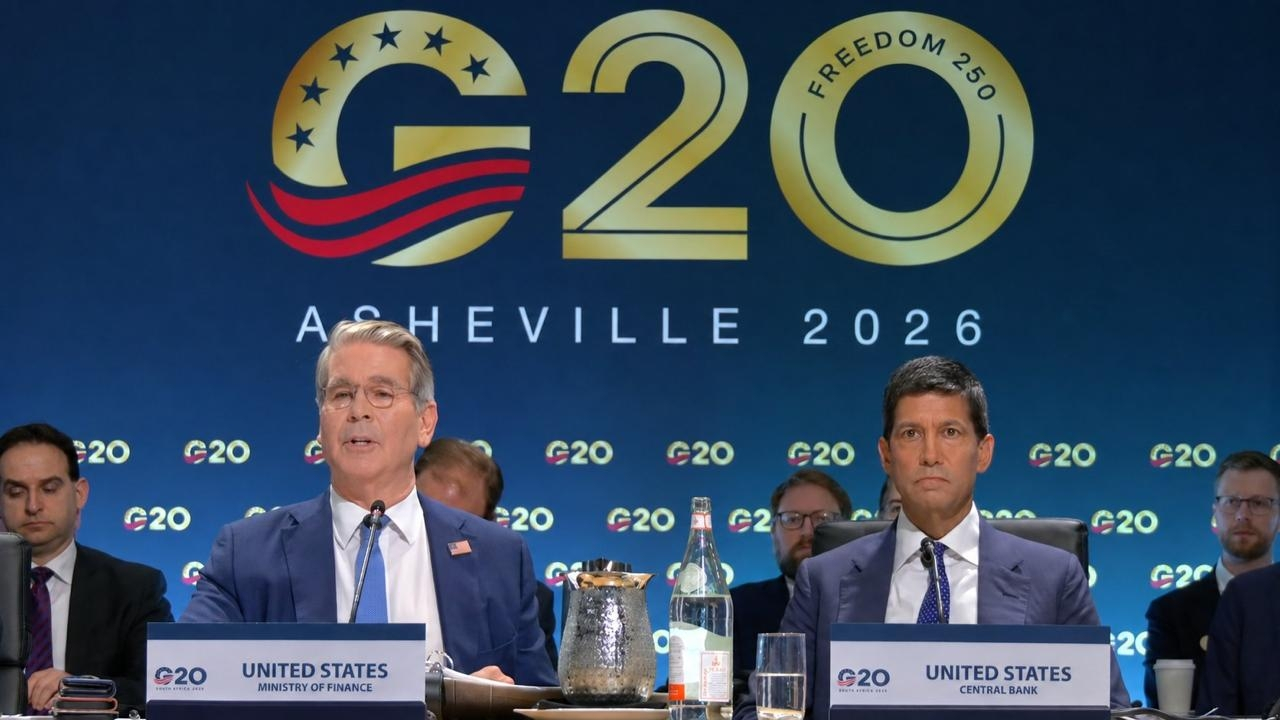
Bullish🚀 G20 Officially Recognizes Digital Assets' Role in Economic Growth! 🌍🔥
Massive macro shift unfolding for the crypto space! Finance chiefs and central bank governors from the G20 have formally acknowledged that digital assets possess the true potential to drive global economic growth.
Key highlights from the latest G20 statement:
🔹 Clear Regulatory Pathways: Pledging to build clear, standardized frameworks to support responsible innovation while reducing policy uncertainty.
🔹 Cross-Border Payments Upgrade: Major push to overhaul global payment systems—focusing on extended operating hours for banks, faster settlements, and adopting messaging standards like ISO 20022.
🔹 Mainstream Integration: Shifting from resistance to integration, paving the way for wider institutional participation and global stablecoin frameworks.
The barrier between traditional finance and crypto is officially getting thinner. Clearer rules mean reduced friction and a healthier path forward for adoption.
What are your thoughts on this? Drop them below! 👇
#G20 #CryptoRegulation #BinanceSquare #DigitalAssets #MacroEconomy #CryptoNews$BTC $ETH $USDC
#dyor
Massive macro shift unfolding for the crypto space! Finance chiefs and central bank governors from the G20 have formally acknowledged that digital assets possess the true potential to drive global economic growth.
Key highlights from the latest G20 statement:
🔹 Clear Regulatory Pathways: Pledging to build clear, standardized frameworks to support responsible innovation while reducing policy uncertainty.
🔹 Cross-Border Payments Upgrade: Major push to overhaul global payment systems—focusing on extended operating hours for banks, faster settlements, and adopting messaging standards like ISO 20022.
🔹 Mainstream Integration: Shifting from resistance to integration, paving the way for wider institutional participation and global stablecoin frameworks.
The barrier between traditional finance and crypto is officially getting thinner. Clearer rules mean reduced friction and a healthier path forward for adoption.
What are your thoughts on this? Drop them below! 👇
#G20 #CryptoRegulation #BinanceSquare #DigitalAssets #MacroEconomy #CryptoNews$BTC $ETH $USDC
#dyor
go

Z O N E P R I M E
·
--
Bullish🎁 ZONE PRIME BTC SURPRISE DROP! 🎁
✨ The Red Packet is full and ready to open! ✨
👇 Simple Steps to Participate 👇
❤️ Follow ZONE PRIME
🔁 Like & Share
💬 Comment “BTC”
🚀 Stay active for the next reward round!
#BTC #crypto #ZONEPRIME #RedPacket #Binance
✨ The Red Packet is full and ready to open! ✨
👇 Simple Steps to Participate 👇
❤️ Follow ZONE PRIME
🔁 Like & Share
💬 Comment “BTC”
🚀 Stay active for the next reward round!
#BTC #crypto #ZONEPRIME #RedPacket #Binance

#Cryptology $NVDAB claim
Cryptology_7
·
--
“Think beyond the candles.” 💙
Decode the market with patience.
Trust your strategy through volatility.
Control emotions protect your capital. 🎀
KEEP LEARNING
KEEP GROWING
KEEP W I N N I N G ✨
$SKR
#CryptoPatience #Cryptology_7
Decode the market with patience.
Trust your strategy through volatility.
Control emotions protect your capital. 🎀
KEEP LEARNING
KEEP GROWING
KEEP W I N N I N G ✨
$SKR
#CryptoPatience #Cryptology_7
go
Leo - F0
·
--
Bullish🧧🧧🔥GOOD MORNING FROM DUBAİ, FAMİLY. I'VE PREPARED A SPECIAL GİFT FOR YOU.🔥🧧🧧
"Keep your entry quiet while the numbers soar. Chasing the freedom on a private shore." #Dubái 🏝️🍹
$BTC 🔥🔥🧧🧧
$BNB $ETH #xrp #TRUMP
#1688家族family 💚 @周周1688
@Hawk自由哥 #doge
"Keep your entry quiet while the numbers soar. Chasing the freedom on a private shore." #Dubái 🏝️🍹
$BTC 🔥🔥🧧🧧
$BNB $ETH #xrp #TRUMP
#1688家族family 💚 @周周1688
@Hawk自由哥 #doge

go

AYESHA ABID 阿伊莎 阿比德
·
--
Bullish$SOL — Levels That Matter Right Now 👀
$SOL around $195 is sitting at a key decision point.
📈 Break & Hold: $198
🎯 Upside: $202 → $208 → $215
🟢 Major Support: $190
🔻 Breakdown: Below $190
🎯 Downside: $185 → $180
The setup is simple:
$198 reclaimed = buyers gain control
$190 lost = sellers gain control
No need to chase the candle. Let the level confirm the move.
$SOL
Are you watching $215 or $180 first?
#SOL #Solana
$SOL around $195 is sitting at a key decision point.
📈 Break & Hold: $198
🎯 Upside: $202 → $208 → $215
🟢 Major Support: $190
🔻 Breakdown: Below $190
🎯 Downside: $185 → $180
The setup is simple:
$198 reclaimed = buyers gain control
$190 lost = sellers gain control
No need to chase the candle. Let the level confirm the move.
$SOL
Are you watching $215 or $180 first?
#SOL #Solana
go
Ahli Hidaya ya rabi ma he q
·
--
Bullish🚀 G20 Officially Recognizes Digital Assets' Role in Economic Growth! 🌍🔥
Massive macro shift unfolding for the crypto space! Finance chiefs and central bank governors from the G20 have formally acknowledged that digital assets possess the true potential to drive global economic growth.
Key highlights from the latest G20 statement:
🔹 Clear Regulatory Pathways: Pledging to build clear, standardized frameworks to support responsible innovation while reducing policy uncertainty.
🔹 Cross-Border Payments Upgrade: Major push to overhaul global payment systems—focusing on extended operating hours for banks, faster settlements, and adopting messaging standards like ISO 20022.
🔹 Mainstream Integration: Shifting from resistance to integration, paving the way for wider institutional participation and global stablecoin frameworks.
The barrier between traditional finance and crypto is officially getting thinner. Clearer rules mean reduced friction and a healthier path forward for adoption.
What are your thoughts on this? Drop them below! 👇
#G20 #CryptoRegulation #BinanceSquare #DigitalAssets #MacroEconomy #CryptoNews$BTC $ETH $USDC
#dyor
Massive macro shift unfolding for the crypto space! Finance chiefs and central bank governors from the G20 have formally acknowledged that digital assets possess the true potential to drive global economic growth.
Key highlights from the latest G20 statement:
🔹 Clear Regulatory Pathways: Pledging to build clear, standardized frameworks to support responsible innovation while reducing policy uncertainty.
🔹 Cross-Border Payments Upgrade: Major push to overhaul global payment systems—focusing on extended operating hours for banks, faster settlements, and adopting messaging standards like ISO 20022.
🔹 Mainstream Integration: Shifting from resistance to integration, paving the way for wider institutional participation and global stablecoin frameworks.
The barrier between traditional finance and crypto is officially getting thinner. Clearer rules mean reduced friction and a healthier path forward for adoption.
What are your thoughts on this? Drop them below! 👇
#G20 #CryptoRegulation #BinanceSquare #DigitalAssets #MacroEconomy #CryptoNews$BTC $ETH $USDC
#dyor
go

@Elena神话MUA
is speaking[LIVE] 🎙️ Mythology MUA airdrop continues—everyone is welcome to come claim it
3.3k listens
🎁 60 $SUI COIN GIVEAWAY 🎁
Want to win SUI? 🏆
✅ Follow me
❤️ Like this post
🔁 Repost this post
💬 Comment “1” to claim
Good luck everyone 🔥
#SUI🔥 #SUIPricePrediction #ARBRises30%OnRobinhoodChainRevenue
Want to win SUI? 🏆
✅ Follow me
❤️ Like this post
🔁 Repost this post
💬 Comment “1” to claim
Good luck everyone 🔥
#SUI🔥 #SUIPricePrediction #ARBRises30%OnRobinhoodChainRevenue
🎁 50 $TRUMP COIN GIVEAWAY 🎁
Want to win TRUMP?
✅ Follow me
❤️ Like this post
🔁 Repost this post
💬 Comment “1” to claim
Good luck everyone 🔥
50 $TRUMP — Let’s go 🎁
#FOLLOW_ME_FOR_NEXT_GIFT #TrumpCryptoSupport
Want to win TRUMP?
✅ Follow me
❤️ Like this post
🔁 Repost this post
💬 Comment “1” to claim
Good luck everyone 🔥
50 $TRUMP — Let’s go 🎁
#FOLLOW_ME_FOR_NEXT_GIFT #TrumpCryptoSupport
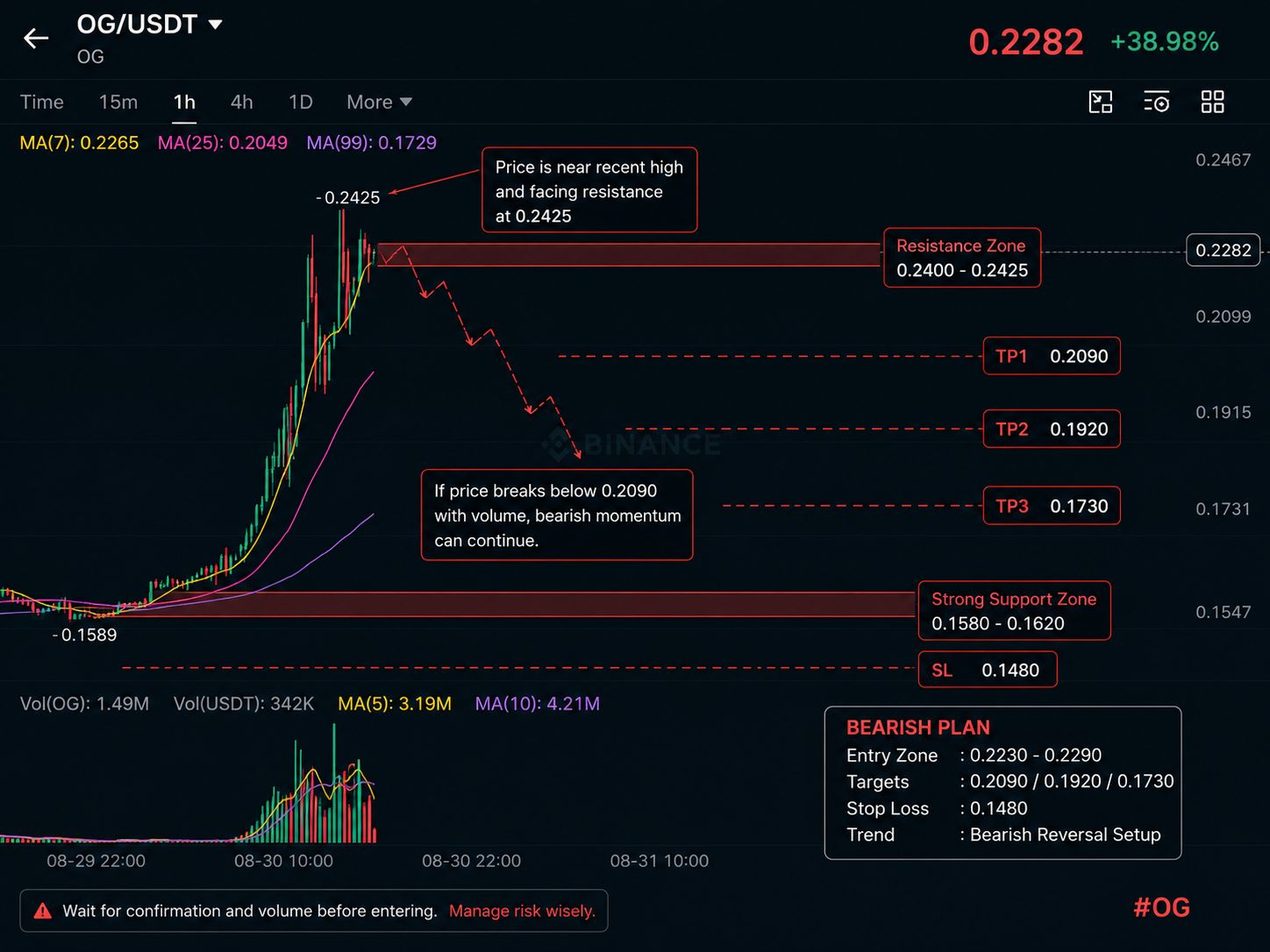
🔻 $0G Bearish Signal
Entry: $0.223–$0.229
🎯 TP1: $0.209
🎯 TP2: $0.192
🎯 TP3: $0.173
🛑 SL: $0.2425
$SKYAI $LAB #beraish
Entry: $0.223–$0.229
🎯 TP1: $0.209
🎯 TP2: $0.192
🎯 TP3: $0.173
🛑 SL: $0.2425
$SKYAI $LAB #beraish
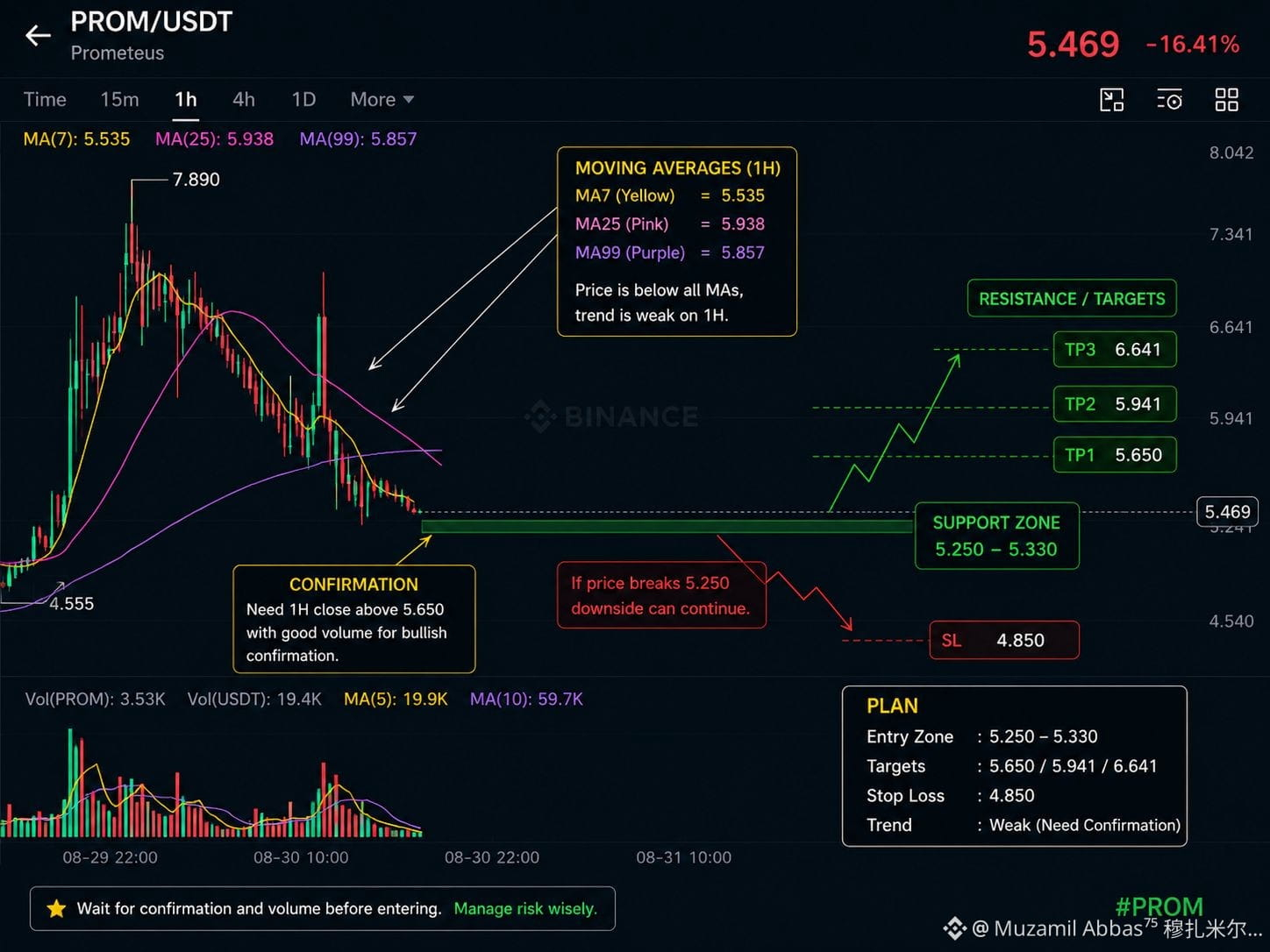
$PROM Bullish Signal
Entry: $5.25–$5.33
🎯 TP1: $5.65
🎯 TP2: $5.94
🎯 TP3: $6.64
🛑 SL: $4.85
Wait for confirmation + volume before entry. DYOR 📈
$GWEI $SKR
Entry: $5.25–$5.33
🎯 TP1: $5.65
🎯 TP2: $5.94
🎯 TP3: $6.64
🛑 SL: $4.85
Wait for confirmation + volume before entry. DYOR 📈
$GWEI $SKR
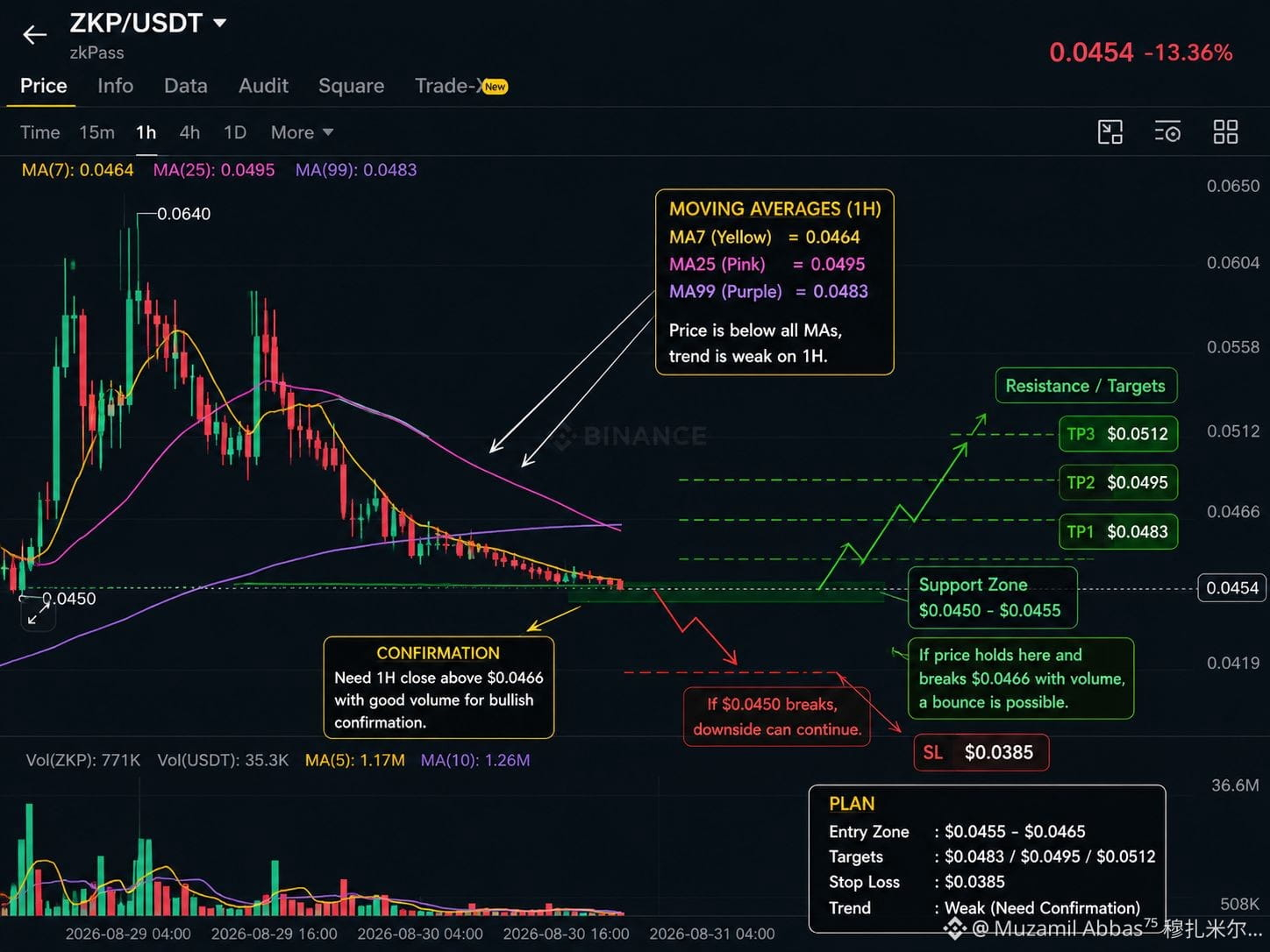
🎉 15K Followers Celebration Giveaway! 🎉
Alhamdulillah, we have reached 15K followers on Binance Square Thank you all for your support and trust. To celebrate this milestone, I'm giving away SOL Coin to lucky winners. 🔥
✅ Like this post
✅ Repost this post
✅ Comment 1
✅ Claim 🎁
The more support you show, the bigger the future giveaways can become.
Good luck everyone
#BinanceSquare #SOL #Giveaway #15KMilestone #ThankYou
Alhamdulillah, we have reached 15K followers on Binance Square Thank you all for your support and trust. To celebrate this milestone, I'm giving away SOL Coin to lucky winners. 🔥
✅ Like this post
✅ Repost this post
✅ Comment 1
✅ Claim 🎁
The more support you show, the bigger the future giveaways can become.
Good luck everyone
#BinanceSquare #SOL #Giveaway #15KMilestone #ThankYou

🎁 $SHIB GIVEAWAY WORTH $100 🎁
I’m giving away SHIB Gift Boxes to 3,000 lucky people! 🐕🔥
To participate:
❤️ Like this post ✅
🔁 Repost this post ✅
💬 Comment “1” below ✅
🎁 Claim your Gift Box ✅
Good luck everyone🚀✨
#SHIB #Giveaway #Binance #CryptoGiveaway
I’m giving away SHIB Gift Boxes to 3,000 lucky people! 🐕🔥
To participate:
❤️ Like this post ✅
🔁 Repost this post ✅
💬 Comment “1” below ✅
🎁 Claim your Gift Box ✅
Good luck everyone🚀✨
#SHIB #Giveaway #Binance #CryptoGiveaway

30D trade $DUSK 3.3K USDT
#dusk $DUSK @Dusk
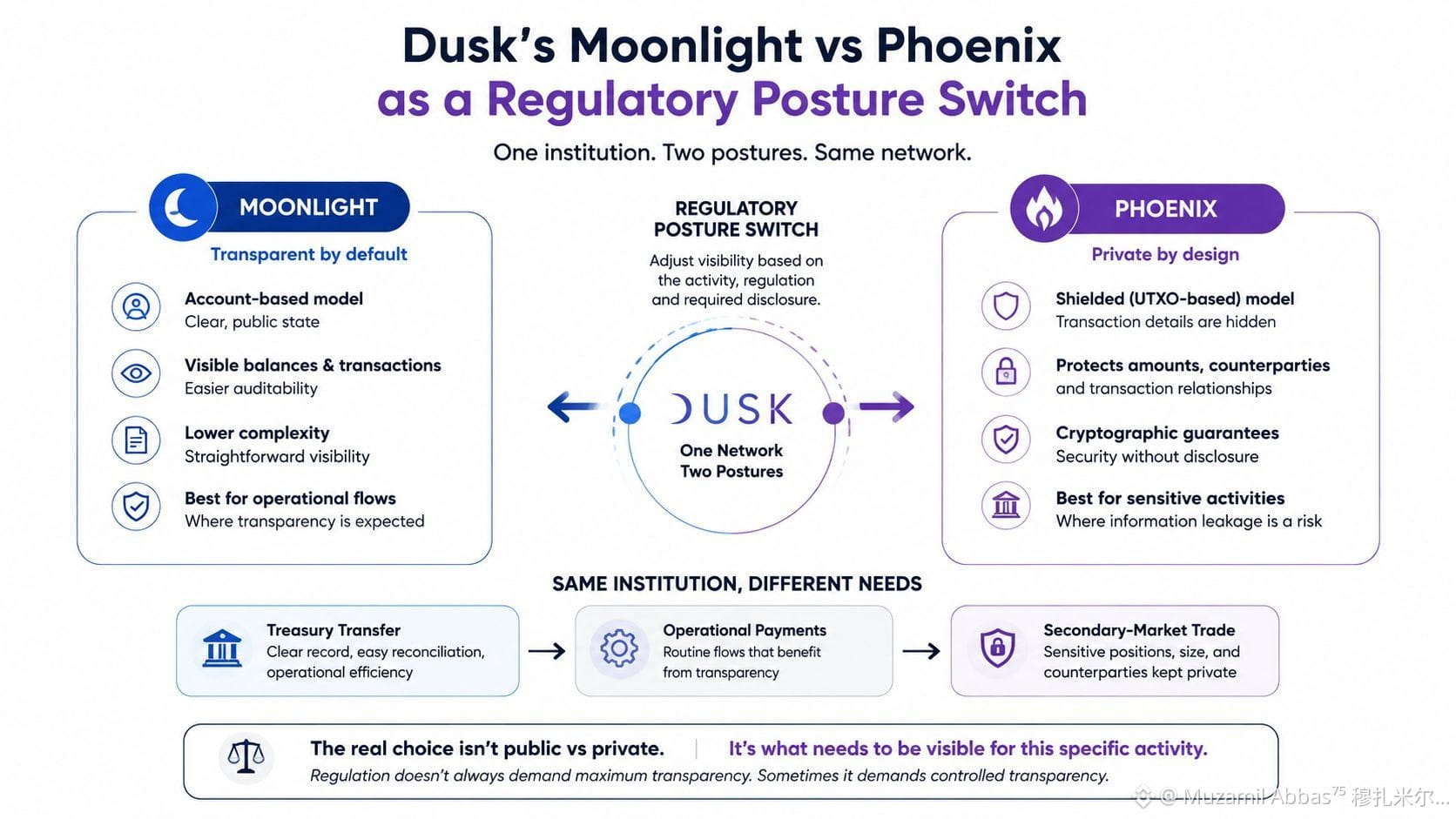
One thing I find interesting about @DuskNetwork is that Moonlight and Phoenix don’t have to be viewed as competing privacy models.
For the same institution, they could represent different regulatory postures.
A treasury transfer or operational payment might benefit from Moonlight’s account-based, transparent structure. There’s a clear record and less complexity around visibility.
But imagine that institution entering a sensitive secondary-market trade. Broadcasting the amount, counterparties or transaction relationships could reveal information that doesn’t need to be public.
That’s where Phoenix becomes more interesting.
Its shielded model can keep transaction details private while still supporting the cryptographic guarantees needed by the network.
So the real choice isn’t simply public vs private.
It’s more like:
What needs to be visible for this specific activity?
I think that’s a much more realistic institutional use of privacy.
Regulation doesn’t always demand maximum transparency.
Sometimes it demands controlled transparency.
And Dusk’s architecture seems designed around that distinction.
One thing I find interesting about @DuskNetwork is that Moonlight and Phoenix don’t have to be viewed as competing privacy models.
For the same institution, they could represent different regulatory postures.
A treasury transfer or operational payment might benefit from Moonlight’s account-based, transparent structure. There’s a clear record and less complexity around visibility.
But imagine that institution entering a sensitive secondary-market trade. Broadcasting the amount, counterparties or transaction relationships could reveal information that doesn’t need to be public.
That’s where Phoenix becomes more interesting.
Its shielded model can keep transaction details private while still supporting the cryptographic guarantees needed by the network.
So the real choice isn’t simply public vs private.
It’s more like:
What needs to be visible for this specific activity?
I think that’s a much more realistic institutional use of privacy.
Regulation doesn’t always demand maximum transparency.
Sometimes it demands controlled transparency.
And Dusk’s architecture seems designed around that distinction.
30D trade $DUSK 3.3K USDT
#dusk $DUSK @Dusk
I was reading through Dusk’s approach to security tokenization and one detail kept pulling my attention. Most blockchain transfers feel instant from the outside. Assets move, balances change, and the transaction is considered finished. But regulated assets do not always work that way.
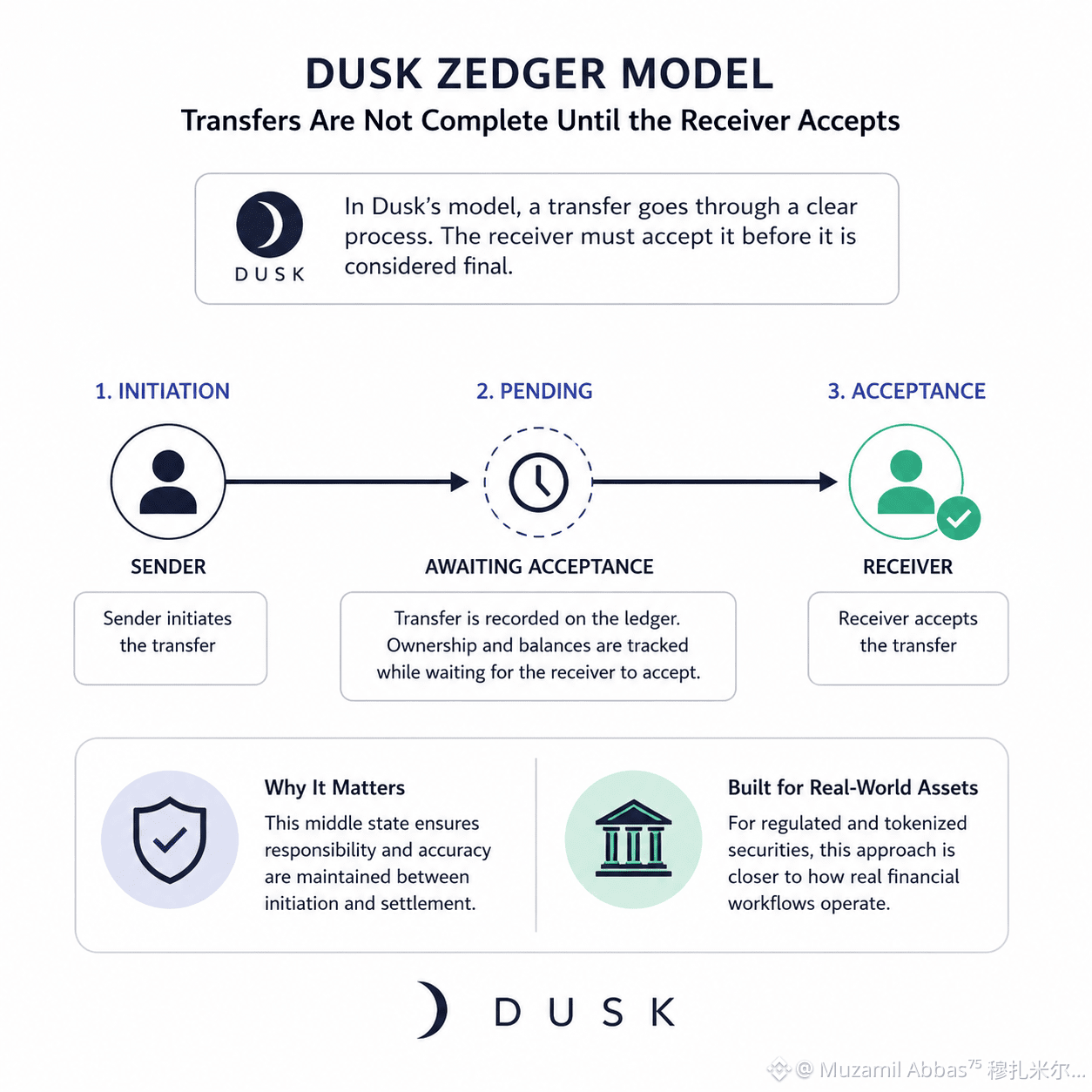
In Dusk’s Zedger model, a transfer is not automatically complete the moment it is sent. The receiver must explicitly accept it first. Until that happens, the transferred amount still needs to be accounted for correctly. That sounds like a small design choice, but it solves a surprisingly difficult problem.
I started thinking about situations where one side of a transaction is ready before the other. Maybe the sender has already initiated the transfer, but the receiver has not approved it yet. Traditional crypto systems usually focus on moving value as fast as possible. Dusk seems more focused on tracking responsibility during the period between initiation and settlement.
What I find interesting is that this middle state is treated as part of the process rather than an exception. The system keeps track of ownership and balances while waiting for the final approval step.
For tokenized securities and regulated assets, that feels much closer to how real financial workflows actually operate. The question is whether more blockchain systems will eventually need similar settlement logic as tokenization grows.
I was reading through Dusk’s approach to security tokenization and one detail kept pulling my attention. Most blockchain transfers feel instant from the outside. Assets move, balances change, and the transaction is considered finished. But regulated assets do not always work that way.
In Dusk’s Zedger model, a transfer is not automatically complete the moment it is sent. The receiver must explicitly accept it first. Until that happens, the transferred amount still needs to be accounted for correctly. That sounds like a small design choice, but it solves a surprisingly difficult problem.
I started thinking about situations where one side of a transaction is ready before the other. Maybe the sender has already initiated the transfer, but the receiver has not approved it yet. Traditional crypto systems usually focus on moving value as fast as possible. Dusk seems more focused on tracking responsibility during the period between initiation and settlement.
What I find interesting is that this middle state is treated as part of the process rather than an exception. The system keeps track of ownership and balances while waiting for the final approval step.
For tokenized securities and regulated assets, that feels much closer to how real financial workflows actually operate. The question is whether more blockchain systems will eventually need similar settlement logic as tokenization grows.
#dusk $DUSK @Dusk
i think privacy becomes much more useful when you can clearly understand what is actually being hidden.
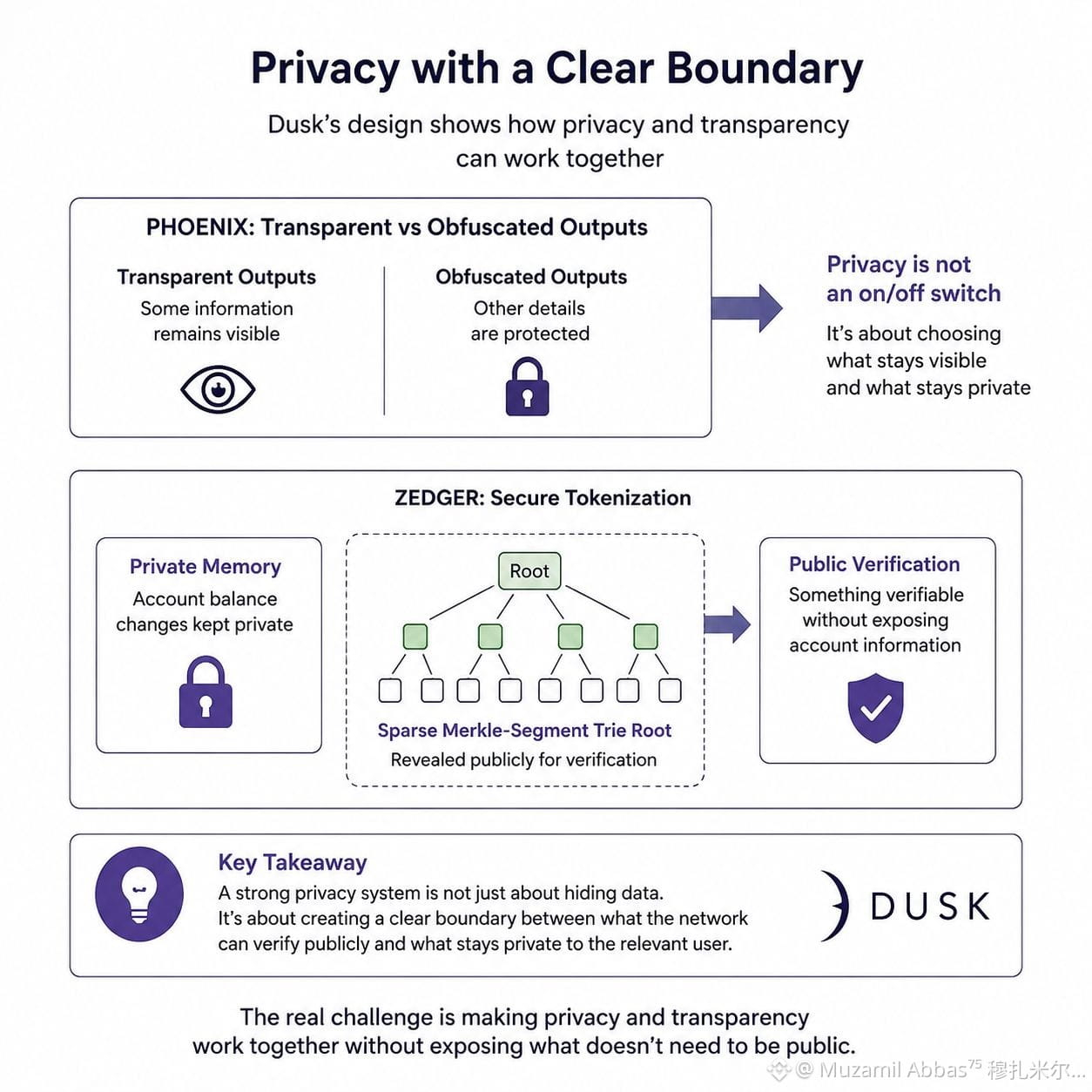
That is one reason Dusk’s design stands out to me. In Phoenix the whitepaper separates outputs into transparent and obfuscated types. So privacy is not treated as a simple switch where everything disappears. Some information can remain visible, while other details are protected.
Zedger takes this idea further for security tokenization. Account balance changes can be kept in private memory, while a Sparse Merkle Segment Trie root is revealed publicly. That gives the system something verifiable without exposing the underlying account information itself.
To me, that distinction is important. A privacy system is not only about hiding data. It also needs a clear boundary between what the network can verify publicly and what stays private to the relevant user.
That is where Dusk’s approach gets interesting. Privacy and transparency are not necessarily opposites. The real question is whether the protocol can make both work together without exposing information that does not need to be public.
i think privacy becomes much more useful when you can clearly understand what is actually being hidden.
That is one reason Dusk’s design stands out to me. In Phoenix the whitepaper separates outputs into transparent and obfuscated types. So privacy is not treated as a simple switch where everything disappears. Some information can remain visible, while other details are protected.
Zedger takes this idea further for security tokenization. Account balance changes can be kept in private memory, while a Sparse Merkle Segment Trie root is revealed publicly. That gives the system something verifiable without exposing the underlying account information itself.
To me, that distinction is important. A privacy system is not only about hiding data. It also needs a clear boundary between what the network can verify publicly and what stays private to the relevant user.
That is where Dusk’s approach gets interesting. Privacy and transparency are not necessarily opposites. The real question is whether the protocol can make both work together without exposing information that does not need to be public.
30D trade $DUSK 2.8K USDT
#dusk $DUSK @Dusk
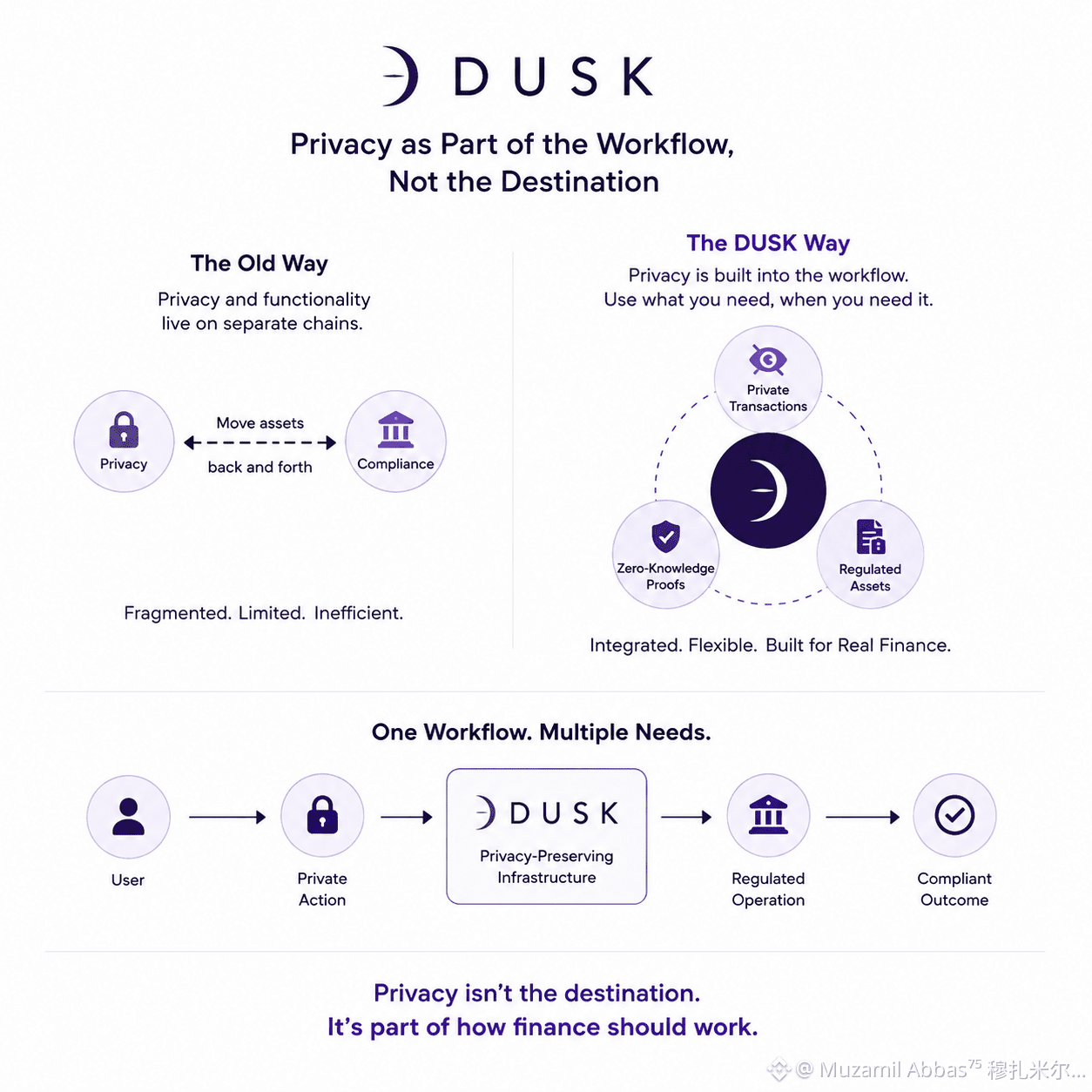
I was thinking about how most crypto discussions still treat privacy as something that belongs to a specific chain. If you want privacy, you move assets there. If you need compliance or other functionality, you move somewhere else. That separation has always felt a bit limiting to me.
What caught my attention with DUSK is the idea that privacy can become part of the workflow itself rather than the destination. The network was designed around confidential transactions, zero-knowledge proofs, and structures that can support regulated assets without exposing every detail publicly. Instead of forcing users to choose between transparency and privacy, the goal seems to be making both exist within the same environment depending on what the situation requires.
That feels more practical than the usual debate of private chain versus public chain. Real financial activity is rarely one-dimensional. Different participants need different levels of visibility, and a system that can adapt to that may be more useful than one built around a single rule for everyone.
The question is whether the market will eventually value privacy as infrastructure rather than a niche feature attached to a particular blockchain.
I was thinking about how most crypto discussions still treat privacy as something that belongs to a specific chain. If you want privacy, you move assets there. If you need compliance or other functionality, you move somewhere else. That separation has always felt a bit limiting to me.
What caught my attention with DUSK is the idea that privacy can become part of the workflow itself rather than the destination. The network was designed around confidential transactions, zero-knowledge proofs, and structures that can support regulated assets without exposing every detail publicly. Instead of forcing users to choose between transparency and privacy, the goal seems to be making both exist within the same environment depending on what the situation requires.
That feels more practical than the usual debate of private chain versus public chain. Real financial activity is rarely one-dimensional. Different participants need different levels of visibility, and a system that can adapt to that may be more useful than one built around a single rule for everyone.
The question is whether the market will eventually value privacy as infrastructure rather than a niche feature attached to a particular blockchain.
Log in to explore more content