
星禾-66
1.9k Posts

星禾-66
183 Following
19.3K+ Followers
2.8K+ Liked
Posts
All
Quotes
Live
PINNED
September has arrived; the summer feeling fades 🍂
Let go of纠结 and regret,
allow everything to happen, and look forward to everything coming.
Stay relaxed, and slowly shine.
Good morning Tuesday ☀️
#btc #ETH #俄罗斯9月1日启动数字卢布大规模推广 #MichaelSaylor暗示增持BTC $BTC $ETH $0G
Let go of纠结 and regret,
allow everything to happen, and look forward to everything coming.
Stay relaxed, and slowly shine.
Good morning Tuesday ☀️
#btc #ETH #俄罗斯9月1日启动数字卢布大规模推广 #MichaelSaylor暗示增持BTC $BTC $ETH $0G


BTC
星禾-66
·
--
September has arrived; the summer feeling fades 🍂
Let go of纠结 and regret,
allow everything to happen, and look forward to everything coming.
Stay relaxed, and slowly shine.
Good morning Tuesday ☀️
#btc #ETH #俄罗斯9月1日启动数字卢布大规模推广 #MichaelSaylor暗示增持BTC $BTC $ETH $0G
Let go of纠结 and regret,
allow everything to happen, and look forward to everything coming.
Stay relaxed, and slowly shine.
Good morning Tuesday ☀️
#btc #ETH #俄罗斯9月1日启动数字卢布大规模推广 #MichaelSaylor暗示增持BTC $BTC $ETH $0G

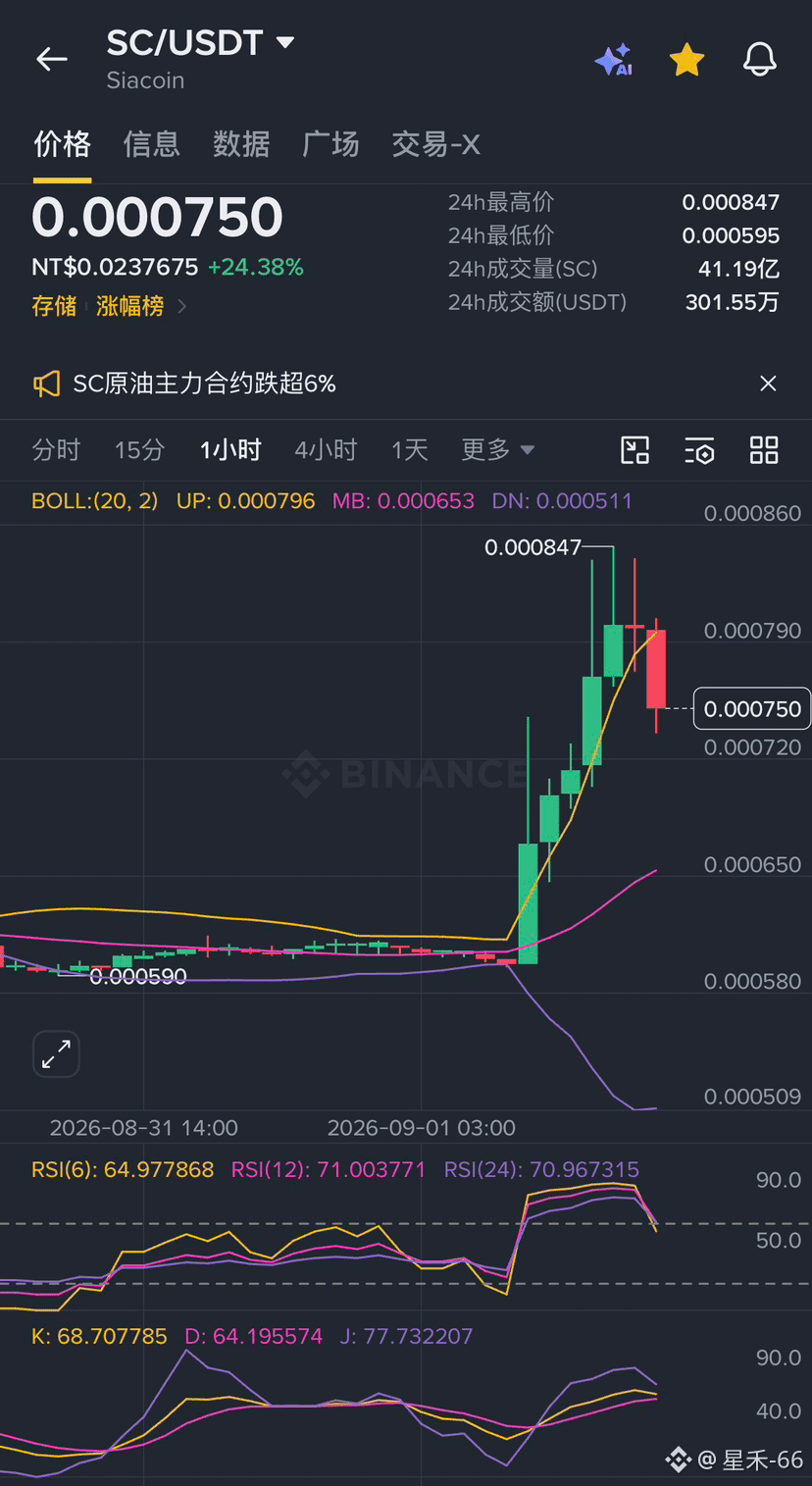
A one-night surge of 24%—the crypto world is playing out the familiar script again!
Take a look at the trend of <0>$SC </0>: it’s been trading sideways and silent like an ECG, then suddenly shoots up from the ground, straight to 0.000847! But before retail investors can react, a big red bearish candle slams down hard, and the price is now 0.000750. This “heaven-and-earth needle” doesn’t know how many people who chased at the highs got cut, and how many shorts got liquidated in an instant.
This is the most real scene in crypto: when it’s pumping, everyone online shouts “the bull run is coming back—return fast,” bullish indicators are cranked up everywhere, and the RSI jumps to above 70; but once the main force dumps to unload, anyone who chased higher can only stand at the top of the mountain blowing cold wind.
Don’t let a momentary gains leaderboard fool your eyes. A pullback from the high, a bearish engulfing candle—technicals are already showing fatigue. This kind of violent volatility right now is the meat grinder where institutions wash out and clean up positions.
Making money in crypto depends on discipline. No matter how tempting the market looks, position control is the bottom line. Do you think SC is using this move to shake out and build momentum this time, or to pump and distribute? See you in the comments!
⚠️ Disclaimer: This article is for information sharing only and does not constitute any investment advice. The risks of cryptocurrencies are extremely high—please make rational decisions at your own risk. #比特币守稳78000美元上方 #比特币8月上涨23%跑赢黄金股市 #俄罗斯9月1日启动数字卢布大规模推广 #SC $BTC $ETH
Take a look at the trend of <0>$SC </0>: it’s been trading sideways and silent like an ECG, then suddenly shoots up from the ground, straight to 0.000847! But before retail investors can react, a big red bearish candle slams down hard, and the price is now 0.000750. This “heaven-and-earth needle” doesn’t know how many people who chased at the highs got cut, and how many shorts got liquidated in an instant.
This is the most real scene in crypto: when it’s pumping, everyone online shouts “the bull run is coming back—return fast,” bullish indicators are cranked up everywhere, and the RSI jumps to above 70; but once the main force dumps to unload, anyone who chased higher can only stand at the top of the mountain blowing cold wind.
Don’t let a momentary gains leaderboard fool your eyes. A pullback from the high, a bearish engulfing candle—technicals are already showing fatigue. This kind of violent volatility right now is the meat grinder where institutions wash out and clean up positions.
Making money in crypto depends on discipline. No matter how tempting the market looks, position control is the bottom line. Do you think SC is using this move to shake out and build momentum this time, or to pump and distribute? See you in the comments!
⚠️ Disclaimer: This article is for information sharing only and does not constitute any investment advice. The risks of cryptocurrencies are extremely high—please make rational decisions at your own risk. #比特币守稳78000美元上方 #比特币8月上涨23%跑赢黄金股市 #俄罗斯9月1日启动数字卢布大规模推广 #SC $BTC $ETH
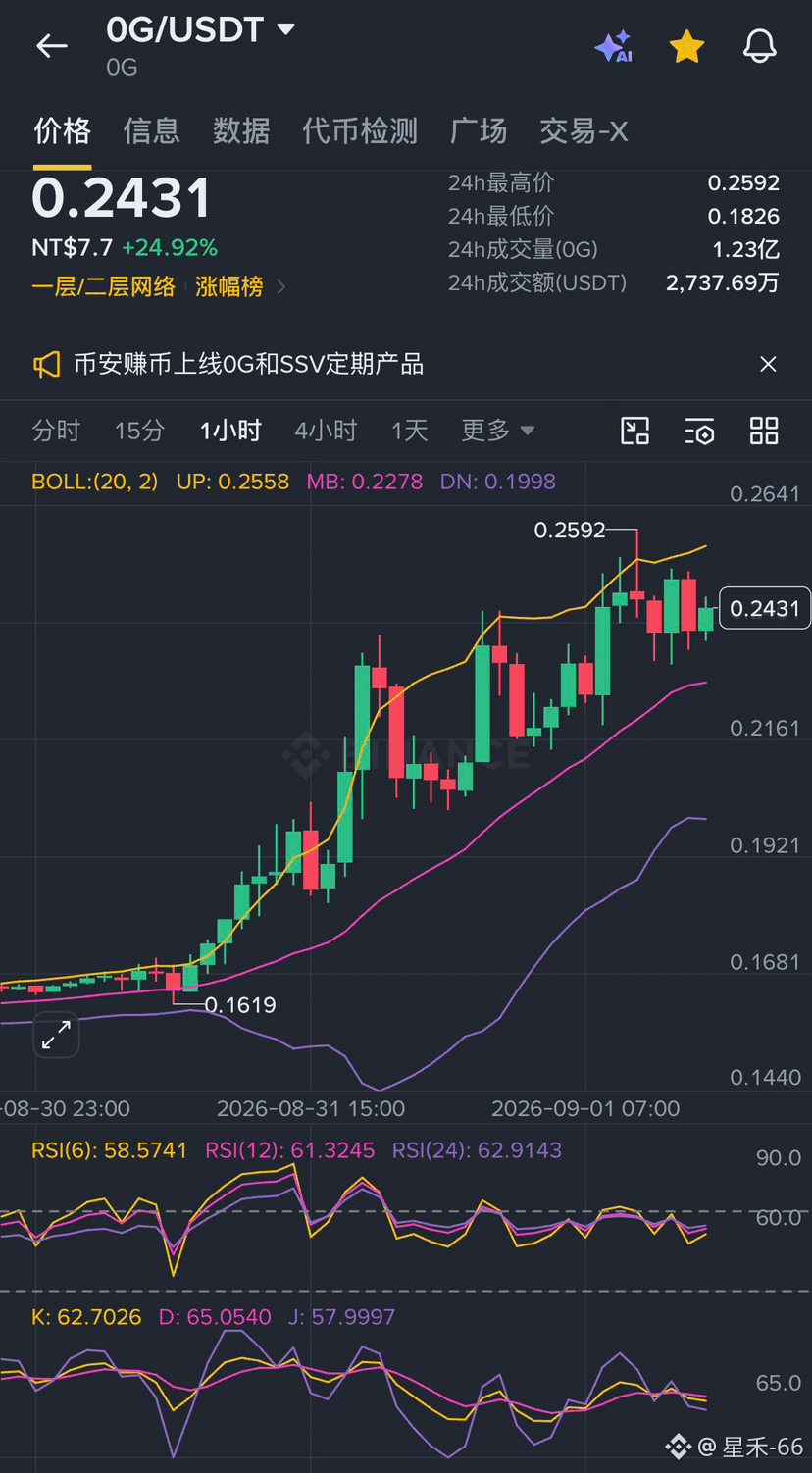
🚀 $0G surges 25% in a single day! A new star in the AI sector is exploding—can you still chase it now?
0G/USDT jumps 24.92% in 24 hours, hitting 0.2592 before pulling back to 0.2431. The key driver is its positioning as a decentralized AI L1 chain, which has gained market recognition. The “compute power equality” concept is viewed as crucial infrastructure for Web4.0, and listings on mainstream exchanges further amplify the hype.
Technically, the price has broken above the upper Bollinger Band, and RSI(12) is at 61.32, indicating a healthy zone. However, the KDJ is starting to form a bearish cross, suggesting short-term momentum is fading. The key support area is 0.2278–0.2350. Although capital flows are active, investors should still be wary of sell pressure from new tokens and competition within the sector.
Trading suggestion: For short-term, watch support at 0.2278—if it breaks, look to 0.1998. For the medium term, wait for a pullback to stabilize before entering in batches; do not blindly chase the highs. Respond rationally to volatility to go far.
⚠️ Disclaimer: This article only represents personal views and does not constitute investment advice. The crypto market is highly volatile—please make your own independent judgment and watch your risk.
#0g #比特币守稳78000美元上方 #比特币8月上涨23%跑赢黄金股市 #俄罗斯9月1日启动数字卢布大规模推广 $ETH $BTC
0G/USDT jumps 24.92% in 24 hours, hitting 0.2592 before pulling back to 0.2431. The key driver is its positioning as a decentralized AI L1 chain, which has gained market recognition. The “compute power equality” concept is viewed as crucial infrastructure for Web4.0, and listings on mainstream exchanges further amplify the hype.
Technically, the price has broken above the upper Bollinger Band, and RSI(12) is at 61.32, indicating a healthy zone. However, the KDJ is starting to form a bearish cross, suggesting short-term momentum is fading. The key support area is 0.2278–0.2350. Although capital flows are active, investors should still be wary of sell pressure from new tokens and competition within the sector.
Trading suggestion: For short-term, watch support at 0.2278—if it breaks, look to 0.1998. For the medium term, wait for a pullback to stabilize before entering in batches; do not blindly chase the highs. Respond rationally to volatility to go far.
⚠️ Disclaimer: This article only represents personal views and does not constitute investment advice. The crypto market is highly volatile—please make your own independent judgment and watch your risk.
#0g #比特币守稳78000美元上方 #比特币8月上涨23%跑赢黄金股市 #俄罗斯9月1日启动数字卢布大规模推广 $ETH $BTC
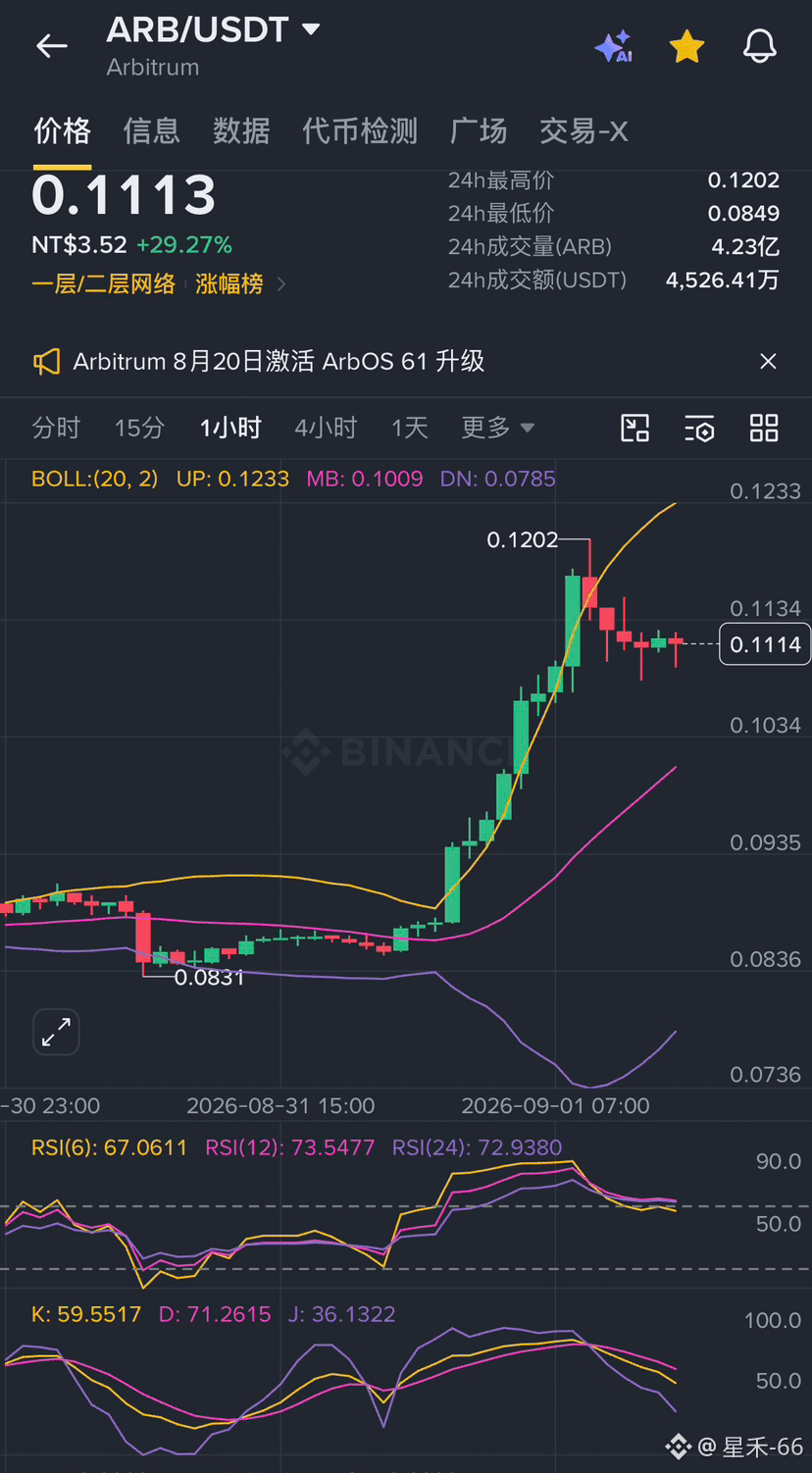
🚀 $ARB surges 30% in a single day! A technical upgrade ignites the market—can you still chase it now?
ARB/USDT rockets 29.27% in 24 hours, surging to 0.1202 before pulling back to 0.1113. The core catalyst is the ArbOS 61 upgrade, bringing compliant filtering, contract expansion, and fee optimization—solidifying its position as an L2 leader.
Technically, price has touched the upper Bollinger Band, RSI is overbought, and KDJ shows the early shape of a death cross. Short-term momentum is weakening, and 0.1134–0.1150 is key support. In terms of capital flows, RWA inflows and BTC stabilizing provide support, but watch out for unlock pressure and competition from rival projects.
Trading suggestions: For the short term, watch the 0.1100 support level; if it breaks, look at 0.1009. For the medium term, wait for a pullback and stabilization before scaling in gradually—don’t blindly chase high prices. Handle volatility rationally to move steadily forward.
⚠️ Disclaimer: This article represents only personal opinions and does not constitute investment advice. The crypto market is highly volatile—please make independent judgments and be mindful of risks.
#比特币守稳78000美元上方 #比特币8月上涨23%跑赢黄金股市 #ARB🔥🔥🔥 #ARB $BTC $ETH
ARB/USDT rockets 29.27% in 24 hours, surging to 0.1202 before pulling back to 0.1113. The core catalyst is the ArbOS 61 upgrade, bringing compliant filtering, contract expansion, and fee optimization—solidifying its position as an L2 leader.
Technically, price has touched the upper Bollinger Band, RSI is overbought, and KDJ shows the early shape of a death cross. Short-term momentum is weakening, and 0.1134–0.1150 is key support. In terms of capital flows, RWA inflows and BTC stabilizing provide support, but watch out for unlock pressure and competition from rival projects.
Trading suggestions: For the short term, watch the 0.1100 support level; if it breaks, look at 0.1009. For the medium term, wait for a pullback and stabilization before scaling in gradually—don’t blindly chase high prices. Handle volatility rationally to move steadily forward.
⚠️ Disclaimer: This article represents only personal opinions and does not constitute investment advice. The crypto market is highly volatile—please make independent judgments and be mindful of risks.
#比特币守稳78000美元上方 #比特币8月上涨23%跑赢黄金股市 #ARB🔥🔥🔥 #ARB $BTC $ETH
#dusk $DUSK @Dusk
In traditional financial systems, preventing the same instruction from being processed more than once relies on a very simple mechanism—an internal sequence number or a check number. Each instruction is assigned a unique identifier; the system only recognizes the first submission. Any subsequent duplicate submission is rejected. It’s a bit “plain” and unglamorous, but for decades, that’s what financial infrastructure has been built on—an unflashy approach that prevents most mishaps involving duplicate charges or duplicate clearing.
In Dusk’s Moonlight account model, it does essentially the same thing. Each account maintains a nonce (a counter). Every transaction must have a nonce exactly one greater than the current nonce. After submission, the nonce increments. So even if the same signed transaction is broadcast or submitted multiple times, the network will only accept the first one; the later duplicates are immediately rejected. It sounds like an ultra-basic design—so basic that many people might never notice it. But it’s precisely this kind of foundational mechanism that determines whether a blockchain can be trusted to process real, hard-money settlement instructions.
Over the years in this industry, I’ve seen this happen more than once: outdated systems mishandle repeated instructions, causing the same transfer to be charged multiple times, followed by long reconciliation and refund processes afterward. In traditional finance, such issues are often categorized as “operations incidents”—they rarely make the news. But for the involved institutions and customers, dealing with them is far from easy. If a chain is meant to serve institutional settlement and doesn’t solidly implement even this most basic anti-replay mechanism, then no matter how many zero-knowledge proofs you pile on later, it won’t matter—institutions don’t care how advanced your cryptography is. They first ask: “Will my money be charged twice?”
This design isn’t very exciting to talk about. There’s nothing particularly “tweetable.” But whether these simple mechanisms are implemented robustly is exactly where I start when judging how solid a chain’s foundations are—not where I end.
When you assess whether a chain is reliable, should you start by looking at these plain, basic mechanisms—or should you look first at how many flashy new technologies it has?
In traditional financial systems, preventing the same instruction from being processed more than once relies on a very simple mechanism—an internal sequence number or a check number. Each instruction is assigned a unique identifier; the system only recognizes the first submission. Any subsequent duplicate submission is rejected. It’s a bit “plain” and unglamorous, but for decades, that’s what financial infrastructure has been built on—an unflashy approach that prevents most mishaps involving duplicate charges or duplicate clearing.
In Dusk’s Moonlight account model, it does essentially the same thing. Each account maintains a nonce (a counter). Every transaction must have a nonce exactly one greater than the current nonce. After submission, the nonce increments. So even if the same signed transaction is broadcast or submitted multiple times, the network will only accept the first one; the later duplicates are immediately rejected. It sounds like an ultra-basic design—so basic that many people might never notice it. But it’s precisely this kind of foundational mechanism that determines whether a blockchain can be trusted to process real, hard-money settlement instructions.
Over the years in this industry, I’ve seen this happen more than once: outdated systems mishandle repeated instructions, causing the same transfer to be charged multiple times, followed by long reconciliation and refund processes afterward. In traditional finance, such issues are often categorized as “operations incidents”—they rarely make the news. But for the involved institutions and customers, dealing with them is far from easy. If a chain is meant to serve institutional settlement and doesn’t solidly implement even this most basic anti-replay mechanism, then no matter how many zero-knowledge proofs you pile on later, it won’t matter—institutions don’t care how advanced your cryptography is. They first ask: “Will my money be charged twice?”
This design isn’t very exciting to talk about. There’s nothing particularly “tweetable.” But whether these simple mechanisms are implemented robustly is exactly where I start when judging how solid a chain’s foundations are—not where I end.
When you assess whether a chain is reliable, should you start by looking at these plain, basic mechanisms—or should you look first at how many flashy new technologies it has?
A. 从基础机制看起,地基不稳一切白搭
100%
B. 看新技术,基础机制大家都差不多
0%
C. 两者都看,但基础机制该是一票否决项
0%
2 votes • Voting closed
#dusk $DUSK @Dusk
The handling of the so-called "holding limit breaches" in traditional securities markets is something I’m quite familiar with. Disclosures of changes in listed-company equity often come with a lag. Regulators or exchanges typically only discover that a shareholder’s holding ratio has exceeded the statutory cap from publicly released disclosure documents after the fact. Then they proceed with the full sequence of steps—investigations, interviews, and requiring the shareholder to reduce their holdings within a deadline. The process can be as short as a few weeks, or drag on for months. In the meantime, the non-compliant holdings have genuinely existed for a period of time.
Zedger’s approach to standardized securities contracts is different. Instead of relying on later enforcement, the holding limit is directly built into the contract rules. Any transfer that would cause a given address’s holdings to exceed the cap is outright rejected by the system at the moment the trade occurs—no waiting for someone to disclose, no waiting for someone to investigate, no need for interviews. The compliance judgment shifts from “retrospective enforcement” to “interception during the transaction.”
At first, this design sounds rather self-evident. But on closer thought, it changes not just efficiency—it changes the logic of where compliance responsibility lies. In the traditional model, issuers and regulators essentially operate on the premise of “tolerating a period of non-compliance.” The violation does occur; it’s just handled with a delay. Under an on-chain enforced model, a violation is not designed to “happen” in the first place. The compliance officer’s work focus therefore shifts from “accountability after the fact” to “setting the limit parameters correctly in advance.”
Over the years I’ve been in this industry, I’ve handled several cases where listed-company equity holding-limit breaches only drew media attention after the fact. Regulators’ lag isn’t because some institution isn’t working hard—it’s because the process structure itself inevitably creates a time gap between discovery and handling. Whether Zedger’s design can truly be implemented and promoted depends on whether regulators are willing to recognize the legal effect of this kind of proactive, on-chain enforced compliance—technically it works, but whether it is legally acknowledged is a completely different matter. I plan to keep watching how subsequent cases unfold.
Do you think “proactively forcing the rejection of non-compliant trades” is more progressive, in compliance terms, than “retrospective tracking and handling,” or is it just shifting responsibility to this new parameter-setting step?
The handling of the so-called "holding limit breaches" in traditional securities markets is something I’m quite familiar with. Disclosures of changes in listed-company equity often come with a lag. Regulators or exchanges typically only discover that a shareholder’s holding ratio has exceeded the statutory cap from publicly released disclosure documents after the fact. Then they proceed with the full sequence of steps—investigations, interviews, and requiring the shareholder to reduce their holdings within a deadline. The process can be as short as a few weeks, or drag on for months. In the meantime, the non-compliant holdings have genuinely existed for a period of time.
Zedger’s approach to standardized securities contracts is different. Instead of relying on later enforcement, the holding limit is directly built into the contract rules. Any transfer that would cause a given address’s holdings to exceed the cap is outright rejected by the system at the moment the trade occurs—no waiting for someone to disclose, no waiting for someone to investigate, no need for interviews. The compliance judgment shifts from “retrospective enforcement” to “interception during the transaction.”
At first, this design sounds rather self-evident. But on closer thought, it changes not just efficiency—it changes the logic of where compliance responsibility lies. In the traditional model, issuers and regulators essentially operate on the premise of “tolerating a period of non-compliance.” The violation does occur; it’s just handled with a delay. Under an on-chain enforced model, a violation is not designed to “happen” in the first place. The compliance officer’s work focus therefore shifts from “accountability after the fact” to “setting the limit parameters correctly in advance.”
Over the years I’ve been in this industry, I’ve handled several cases where listed-company equity holding-limit breaches only drew media attention after the fact. Regulators’ lag isn’t because some institution isn’t working hard—it’s because the process structure itself inevitably creates a time gap between discovery and handling. Whether Zedger’s design can truly be implemented and promoted depends on whether regulators are willing to recognize the legal effect of this kind of proactive, on-chain enforced compliance—technically it works, but whether it is legally acknowledged is a completely different matter. I plan to keep watching how subsequent cases unfold.
Do you think “proactively forcing the rejection of non-compliant trades” is more progressive, in compliance terms, than “retrospective tracking and handling,” or is it just shifting responsibility to this new parameter-setting step?
A. 更进步,把违规扼杀在发生前
67%
B. 只是转移了责任点,风险没消失
0%
C. 得看监管方认不认这套逻辑
33%
3 votes • Voting closed
#dusk $DUSK @Dusk
From the Dusk L1 bridge to DuskEVM, I recently took a close look at the detailed process and found that it’s not as simple as people imagine—it isn’t just about locking and minting one action. It’s about forcing you to choose between two completely different ledger identities.
On the native Dusk L1 side, DUSK exists either in the form of Moonlight (a transparent account, like a normal bank ledger) or in the form of Phoenix (a note-based shielding structure, which feels like a completely different asset type). After crossing over to DuskEVM, the token’s form of representation isn’t exactly the same either. This means that bridging is fundamentally deciding, “Which identity do I want this DUSK to exist in next?” rather than simply moving the assets from point A to point B. After the move, what you can do with this money (eligibility for staking, the level of privacy, and the kinds of operations you can take afterward) has already been determined by this choice.
The official website currently says that this conversion is “seamless,” and technically it does achieve the goal of not requiring complex operations—one bridge can complete it. But “seamless” and “clearly explained” are two different things. The process itself won’t tell you upfront about the specific differences between Moonlight and Phoenix—you have to figure it out during the operation, or check the documentation in advance.
The DuskEVM layer is still in testnet status right now, while the native L1 side is already live. The maturity levels of the two sides aren’t on the same stage.
In my view, this design of being “seamless technically but having a cognitive hurdle,” isn’t friendly to new users. Getting funds from a single bridge doesn’t necessarily mean you truly understand which side of the ledger you’ll end up on.
What do you think? Doesn’t the “seamless” cross-chain experience need to be paired with clearer explanations to be truly user-friendly?
From the Dusk L1 bridge to DuskEVM, I recently took a close look at the detailed process and found that it’s not as simple as people imagine—it isn’t just about locking and minting one action. It’s about forcing you to choose between two completely different ledger identities.
On the native Dusk L1 side, DUSK exists either in the form of Moonlight (a transparent account, like a normal bank ledger) or in the form of Phoenix (a note-based shielding structure, which feels like a completely different asset type). After crossing over to DuskEVM, the token’s form of representation isn’t exactly the same either. This means that bridging is fundamentally deciding, “Which identity do I want this DUSK to exist in next?” rather than simply moving the assets from point A to point B. After the move, what you can do with this money (eligibility for staking, the level of privacy, and the kinds of operations you can take afterward) has already been determined by this choice.
The official website currently says that this conversion is “seamless,” and technically it does achieve the goal of not requiring complex operations—one bridge can complete it. But “seamless” and “clearly explained” are two different things. The process itself won’t tell you upfront about the specific differences between Moonlight and Phoenix—you have to figure it out during the operation, or check the documentation in advance.
The DuskEVM layer is still in testnet status right now, while the native L1 side is already live. The maturity levels of the two sides aren’t on the same stage.
In my view, this design of being “seamless technically but having a cognitive hurdle,” isn’t friendly to new users. Getting funds from a single bridge doesn’t necessarily mean you truly understand which side of the ledger you’ll end up on.
What do you think? Doesn’t the “seamless” cross-chain experience need to be paired with clearer explanations to be truly user-friendly?
A. 必须搭配,无缝不等于好懂
75%
B. 不用,愿意用的人自己会查
0%
C. 看产品阶段,测试网可以先将就
25%
4 votes • Voting closed
#dusk $DUSK @Dusk
The more I read materials related to Dusk, the more I feel that the whole matter of "privacy" shouldn’t be attributed solely to Phoenix and zero-knowledge proofs. The whitepaper contains an additional layer of privacy protection that’s easy to overlook—coming directly from the P2P network layer itself, and unrelated to the encryption algorithms.
The P2P protocol Dusk uses is called Kadcast, based on the Kademlia distributed hash table structure. In Section 2.3 of the whitepaper, there’s a detail worth a closer look: Kadcast’s broadcasting mechanism doesn’t send a message all at once to every neighboring node. Instead, based on the XOR distance between nodes, it forwards the message only to a specific subset of nodes, and then those nodes continue forwarding it outward, cascading layer by layer. This structure brings a side effect: since the message isn’t passed directly from the sender to each receiver, but relayed through multiple layers, the difficulty of tracing a message back to the original sending node increases significantly. This design was originally intended to optimize bandwidth efficiency, but it also conveniently obscures the message source.
This made me reconsider how the three words “privacy chain” should really be evaluated. If only Phoenix provides privacy, then transaction contents are indeed kept confidential. But the way nodes broadcast messages—if the network layer were the kind of “one-to-many direct broadcast” structure—could still allow an observer who can locate nodes to perform traffic analysis and infer some information indirectly: who broadcast what, and when. Even if they can’t understand the content, the behavior patterns themselves are still a form of information leakage. Kadcast’s layered forwarding structure effectively adds a second layer of network-level obfuscation on top of cryptographic privacy. With both layers stacked together, breaking any single layer alone is not enough to truly pinpoint the source.
When everyone discusses privacy chains, people are used to focusing only on the encryption scheme—what zk-SNARK or what proof system is used. Very few people ask one more question: how is the P2P layer designed? This part is usually not perceptible in day-to-day use, but it is precisely where attacks like traffic analysis are the easiest to target.
What do you think—when evaluating a privacy chain, should the network-layer design be singled out and counted as a separate metric?
The more I read materials related to Dusk, the more I feel that the whole matter of "privacy" shouldn’t be attributed solely to Phoenix and zero-knowledge proofs. The whitepaper contains an additional layer of privacy protection that’s easy to overlook—coming directly from the P2P network layer itself, and unrelated to the encryption algorithms.
The P2P protocol Dusk uses is called Kadcast, based on the Kademlia distributed hash table structure. In Section 2.3 of the whitepaper, there’s a detail worth a closer look: Kadcast’s broadcasting mechanism doesn’t send a message all at once to every neighboring node. Instead, based on the XOR distance between nodes, it forwards the message only to a specific subset of nodes, and then those nodes continue forwarding it outward, cascading layer by layer. This structure brings a side effect: since the message isn’t passed directly from the sender to each receiver, but relayed through multiple layers, the difficulty of tracing a message back to the original sending node increases significantly. This design was originally intended to optimize bandwidth efficiency, but it also conveniently obscures the message source.
This made me reconsider how the three words “privacy chain” should really be evaluated. If only Phoenix provides privacy, then transaction contents are indeed kept confidential. But the way nodes broadcast messages—if the network layer were the kind of “one-to-many direct broadcast” structure—could still allow an observer who can locate nodes to perform traffic analysis and infer some information indirectly: who broadcast what, and when. Even if they can’t understand the content, the behavior patterns themselves are still a form of information leakage. Kadcast’s layered forwarding structure effectively adds a second layer of network-level obfuscation on top of cryptographic privacy. With both layers stacked together, breaking any single layer alone is not enough to truly pinpoint the source.
When everyone discusses privacy chains, people are used to focusing only on the encryption scheme—what zk-SNARK or what proof system is used. Very few people ask one more question: how is the P2P layer designed? This part is usually not perceptible in day-to-day use, but it is precisely where attacks like traffic analysis are the easiest to target.
What do you think—when evaluating a privacy chain, should the network-layer design be singled out and counted as a separate metric?
A. 该单独算,经常被忽略
100%
B. 不用,加密层够了
0%
C. 看具体资产敏感度
0%
1 votes • Voting closed
Verified
#dusk $DUSK @Dusk
When comparing Phoenix and Moonlight purely in terms of “which is more private,” you might be asking the wrong question—these two model stacks are not two answers to the same problem. They’re different tools designed for two completely different workflows, and comparing “privacy level” alone is not very meaningful.
First, let’s clarify the positioning issue. Many people hear “privacy blockchain” and immediately think of Zcash or Monero, but those systems focus on personally anonymous transfers. Dusk, on the other hand, targets financial smart contracts and institutional use cases. On top of privacy, it also adds compliance auditing capability—this is an entirely different scale of problem.
The underlying settlement relies on Succinct Attestation (SA). The whitepaper is very specific in Section 3: a committee-based PoS protocol, where the Provisioner of DUSK is staked and responsible for producing blocks and voting. Committees are selected via deterministic randomness (Section 3.5). Not all validators need to attest for the system to achieve fast deterministic settlement.
What’s truly worth paying attention to is the cost profile of Moonlight versus Phoenix. Moonlight uses a transparent account model, where balance transfers are publicly verifiable (whitepaper Section 4.1). The upside is simplicity and straightforward reconciliation—the trade-off is no privacy. Phoenix is built on ZK proofs (Section 4.2). Before each transfer is issued, it must first compute a proof. The proof generation itself consumes computational resources. If you don’t want to bear that burden yourself, the whitepaper suggests delegating two tasks—“which transactions to scan that are addressed to you” and “generating the proof”—to trusted third parties. Compared to Moonlight’s direct signature verification (which doesn’t require an extra proof-generation step), the complexity is clearly not on the same level. So choosing between the two models is fundamentally about whether you want to pay that complexity cost, not simply about who is “more private.”
On the developer ecosystem side: DuskEVM is compatible with OP-Stack and Solidity, so existing Ethereum contracts can be migrated directly. Hedger adds confidential transaction flows to the EVM environment. Native DuskVM supports writing confidential smart contracts in Rust/WASM, aligned with Dusk’s branded standard Confidential Security Contract (XSC). Developers can build ordinary public dApps, or—in the same chain—build institutional-grade applications that require confidentiality.
Do you think choosing a more complex but more private model like Phoenix is worth the additional cost?
When comparing Phoenix and Moonlight purely in terms of “which is more private,” you might be asking the wrong question—these two model stacks are not two answers to the same problem. They’re different tools designed for two completely different workflows, and comparing “privacy level” alone is not very meaningful.
First, let’s clarify the positioning issue. Many people hear “privacy blockchain” and immediately think of Zcash or Monero, but those systems focus on personally anonymous transfers. Dusk, on the other hand, targets financial smart contracts and institutional use cases. On top of privacy, it also adds compliance auditing capability—this is an entirely different scale of problem.
The underlying settlement relies on Succinct Attestation (SA). The whitepaper is very specific in Section 3: a committee-based PoS protocol, where the Provisioner of DUSK is staked and responsible for producing blocks and voting. Committees are selected via deterministic randomness (Section 3.5). Not all validators need to attest for the system to achieve fast deterministic settlement.
What’s truly worth paying attention to is the cost profile of Moonlight versus Phoenix. Moonlight uses a transparent account model, where balance transfers are publicly verifiable (whitepaper Section 4.1). The upside is simplicity and straightforward reconciliation—the trade-off is no privacy. Phoenix is built on ZK proofs (Section 4.2). Before each transfer is issued, it must first compute a proof. The proof generation itself consumes computational resources. If you don’t want to bear that burden yourself, the whitepaper suggests delegating two tasks—“which transactions to scan that are addressed to you” and “generating the proof”—to trusted third parties. Compared to Moonlight’s direct signature verification (which doesn’t require an extra proof-generation step), the complexity is clearly not on the same level. So choosing between the two models is fundamentally about whether you want to pay that complexity cost, not simply about who is “more private.”
On the developer ecosystem side: DuskEVM is compatible with OP-Stack and Solidity, so existing Ethereum contracts can be migrated directly. Hedger adds confidential transaction flows to the EVM environment. Native DuskVM supports writing confidential smart contracts in Rust/WASM, aligned with Dusk’s branded standard Confidential Security Contract (XSC). Developers can build ordinary public dApps, or—in the same chain—build institutional-grade applications that require confidentiality.
Do you think choosing a more complex but more private model like Phoenix is worth the additional cost?
A. 值,机构r级场景本来就该多付成本换隐私
50%
B. 不值,复杂度太高会劝退开发者
0%
C. 看资产类型,高敏感资产才值
50%
2 votes • Voting closed
When many people hear "privacy chain," the first thing that comes to mind is projects like Zcash and Monero that do personal anonymous transfers. If Dusk uses this framework to understand it, they’ll basically miss what it’s really doing. It targets financial smart contracts and institutional business, and on top of privacy it layers compliant audit capabilities—something Zcash and Monero never set out to solve.
First, look at the underlying settlement layer. The consensus uses Succinct Attestation (SA), and the whitepaper describes it very specifically: it’s a committee-based PoS protocol. Block production and voting are handled by the Provisioner that has staked DUSK. Members are selected through deterministic sortition. You don’t need all validators to attest to every block—only one committee is selected to vote. This enables fast deterministic finality, not something vague like “probably finalized.”
At the transaction layer, Dusk uses two models. Moonlight is a transparent account mode: balances and transfer records are publicly visible, suitable for scenarios that require direct bookkeeping and reconciliation. Its operational logic is very similar to the Ethereum account model. Phoenix, on the other hand, uses ZK proofs to obscure transactions: amounts and counterparties are not publicly disclosed by default, but you can delegate the task of “scanning to confirm whether this transaction is yours” via a view key. In the actual product, this capability also supports selective disclosure to auditors. You give the view key to the other party, and they can verify the relevant information without having to expose all transaction data to everyone. This is fundamentally different from the binary choice of “either fully public or fully hidden.”
On the developer ecosystem, DuskEVM is compatible with OP-Stack and Solidity, so most existing Ethereum contracts can be migrated directly. Hedger adds confidentiality-transaction support to the EVM environment. The native DuskVM supports building confidential smart contracts using Rust/WASM, corresponding to Dusk’s branded Confidential Security Contract (XSC) standard. In other words, developers can build ordinary public dApps and also deploy confidential securities and institutional financial applications on the same chain—without having to replace their entire technical stack just to get privacy.
#dusk $DUSK @Dusk
What do you think—how practical is a selective-disclosure approach like view keys?
First, look at the underlying settlement layer. The consensus uses Succinct Attestation (SA), and the whitepaper describes it very specifically: it’s a committee-based PoS protocol. Block production and voting are handled by the Provisioner that has staked DUSK. Members are selected through deterministic sortition. You don’t need all validators to attest to every block—only one committee is selected to vote. This enables fast deterministic finality, not something vague like “probably finalized.”
At the transaction layer, Dusk uses two models. Moonlight is a transparent account mode: balances and transfer records are publicly visible, suitable for scenarios that require direct bookkeeping and reconciliation. Its operational logic is very similar to the Ethereum account model. Phoenix, on the other hand, uses ZK proofs to obscure transactions: amounts and counterparties are not publicly disclosed by default, but you can delegate the task of “scanning to confirm whether this transaction is yours” via a view key. In the actual product, this capability also supports selective disclosure to auditors. You give the view key to the other party, and they can verify the relevant information without having to expose all transaction data to everyone. This is fundamentally different from the binary choice of “either fully public or fully hidden.”
On the developer ecosystem, DuskEVM is compatible with OP-Stack and Solidity, so most existing Ethereum contracts can be migrated directly. Hedger adds confidentiality-transaction support to the EVM environment. The native DuskVM supports building confidential smart contracts using Rust/WASM, corresponding to Dusk’s branded Confidential Security Contract (XSC) standard. In other words, developers can build ordinary public dApps and also deploy confidential securities and institutional financial applications on the same chain—without having to replace their entire technical stack just to get privacy.
#dusk $DUSK @Dusk
What do you think—how practical is a selective-disclosure approach like view keys?
A. 很实用,兼顾隐私和审计
100%
B. 略复杂,普通用户不好懂
0%
C. 得看场景,机构用更合适
0%
2 votes • Voting closed
Most people who look at cooperation-news like NPEX basically glance at the numbers when the announcement goes out, then move on. No one goes back to check whether that figure has really been increasing. That habit itself may cause people to miss more interesting information.
When it was officially announced in February, the scale of the NPEX track was 200 million euros. After that, in the website’s continually updated data, that number has risen to more than 300 million euros. Between them there’s been a gap of about half a year; the figure went up by roughly 50%. This growth wasn’t packaged as a separate “major cooperation announcement” by itself—it was quietly reflected in the website’s aggregated data updates.
My own judgment is that one-off cooperation announcement numbers can easily create the illusion that “this has already been finalized.” But what truly indicates whether the business is healthy is whether that number keeps moving upward. If, after NPEX had been live for half a year, the scale remained completely unchanged, it would suggest the model might only have completed a one-time transfer of assets, with no subsequent incremental addition. What we’re seeing now is continued growth—at least this suggests it’s not a one-time transfer, but an active pipeline that is still bringing assets in. This signal is more worth watching than the announcement itself, because announcements can only prove “it’s started,” while continued growth can demonstrate “it’s operating normally.”
That said, I can’t confirm how much of this 50% increase is due to new assets coming in versus accounting/book changes caused by valuation increases of existing assets. The website’s aggregated data doesn’t break it down to that level of granularity, so this is something I can’t calculate clearly at the moment.
What do you think—when assessing the health of this kind of cooperation, should we focus on the number at the moment the announcement is released, or should we keep tracking whether that number grows afterward?
#dusk $DUSK @Dusk
When it was officially announced in February, the scale of the NPEX track was 200 million euros. After that, in the website’s continually updated data, that number has risen to more than 300 million euros. Between them there’s been a gap of about half a year; the figure went up by roughly 50%. This growth wasn’t packaged as a separate “major cooperation announcement” by itself—it was quietly reflected in the website’s aggregated data updates.
My own judgment is that one-off cooperation announcement numbers can easily create the illusion that “this has already been finalized.” But what truly indicates whether the business is healthy is whether that number keeps moving upward. If, after NPEX had been live for half a year, the scale remained completely unchanged, it would suggest the model might only have completed a one-time transfer of assets, with no subsequent incremental addition. What we’re seeing now is continued growth—at least this suggests it’s not a one-time transfer, but an active pipeline that is still bringing assets in. This signal is more worth watching than the announcement itself, because announcements can only prove “it’s started,” while continued growth can demonstrate “it’s operating normally.”
That said, I can’t confirm how much of this 50% increase is due to new assets coming in versus accounting/book changes caused by valuation increases of existing assets. The website’s aggregated data doesn’t break it down to that level of granularity, so this is something I can’t calculate clearly at the moment.
What do you think—when assessing the health of this kind of cooperation, should we focus on the number at the moment the announcement is released, or should we keep tracking whether that number grows afterward?
#dusk $DUSK @Dusk
A. 该持续跟踪,一次性数字容易营造假象
100%
B. 公告数字够用,持续追踪意义不大
0%
C. 两个都要$看,起点和增速共同说明问题
0%
1 votes • Voting closed
Most staking offers just one option: lock, wait, and earn rewards. Hyperstaking doesn’t provide just one option—it gives you an entire set of composable staking logic you can build yourself: privacy-preserving staking, affiliate programs, delegated staking, liquid staking, and yield enhancement. In theory, developers can freely combine these modules with smart contracts.
From the data, the amount of DUSK staked on the network today exceeds 200 million coins, representing a significant share of the circulating supply. Clearly, this portion of capital is willing to stay in the network long-term. But with programmable staking, the complexity isn’t low for ordinary holders—you have to choose between privacy-preserving staking and liquid staking, and you may also need to figure out how affiliate programs and delegated staking differ in their yield structures and risk trade-offs.
When I first saw these options presented side by side, I was a bit hesitant: does this truly give users more freedom, or does it turn what used to be a simple matter—"lock-and-earn rewards"—into a choice question that requires some homework to answer correctly?
For institutions, though, the logic seems quite straightforward. If an asset management company wants to build a liquid staking product or a yield-enhancement strategy, it naturally needs this kind of programmable capability to assemble their own products. For them, complexity isn’t a burden—it’s a necessity. For retail users, that’s harder to say. Most holders probably won’t even bother researching the differences between these models. In the end, they will most likely just go with whichever is the simplest option. For them, this programmable capability is mostly something that exists, but they don’t end up using.
What do you think—over the long run, will finely detailed options like programmable staking be gradually adopted by retail users, or are they fundamentally designed mainly for institutions, with little practical use for retail holders?
#dusk $DUSK @Dusk
From the data, the amount of DUSK staked on the network today exceeds 200 million coins, representing a significant share of the circulating supply. Clearly, this portion of capital is willing to stay in the network long-term. But with programmable staking, the complexity isn’t low for ordinary holders—you have to choose between privacy-preserving staking and liquid staking, and you may also need to figure out how affiliate programs and delegated staking differ in their yield structures and risk trade-offs.
When I first saw these options presented side by side, I was a bit hesitant: does this truly give users more freedom, or does it turn what used to be a simple matter—"lock-and-earn rewards"—into a choice question that requires some homework to answer correctly?
For institutions, though, the logic seems quite straightforward. If an asset management company wants to build a liquid staking product or a yield-enhancement strategy, it naturally needs this kind of programmable capability to assemble their own products. For them, complexity isn’t a burden—it’s a necessity. For retail users, that’s harder to say. Most holders probably won’t even bother researching the differences between these models. In the end, they will most likely just go with whichever is the simplest option. For them, this programmable capability is mostly something that exists, but they don’t end up using.
What do you think—over the long run, will finely detailed options like programmable staking be gradually adopted by retail users, or are they fundamentally designed mainly for institutions, with little practical use for retail holders?
#dusk $DUSK @Dusk
A. 会用起来,收益差距拉开之后散户自然会去学
100%
B. 用不上,散户要的就是简单锁仓,复杂选项形同虚设
0%
C. 分层,平台会把复杂逻辑包装成简单入口给散户用
0%
1 votes • Voting closed
1 DUSK fee, about 15 minutes—this is the official cost and time for the BEP20 version that bridges native DUSK from the Dusk mainnet to the BSC chain. The number itself isn’t very interesting, but the design idea is worth looking at more closely.
The cross-chain mechanism is lock-and-mint: users send native DUSK to the bridge wallet on the mainnet, and only after the protocol verifies that on-chain lock does the BSC side trigger minting of the corresponding amount of BEP20 DUSK. Native DUSK is always treated as the single source of value; the version on BSC is merely wrapped assets. This setup has recently also opened up reverse operations—native DUSK and BEP20 DUSK can flow bidirectionally.
What I care about more is the role that must exist behind this mechanism: no matter how clean the process design is, there has to be a step that confirms “the mainnet side has indeed locked it,” and only then is minting allowed on the other chain. Behind that confirmation action is the signing authority that stands behind it—who controls it, how it’s controlled—this is more critical than whether the protocol logic itself is written elegantly.
Earlier this year, when a cross-chain bridge service had issues, the official notice was very clear: the mainnet protocol itself wasn’t affected; the problem was with the signing infrastructure around the mainnet. Put these two together, and I’m even more convinced of one thing: when assessing whether a cross-chain bridge is safe, it’s not enough to just check whether the lock-and-mint logic is correct. You also need to ask exactly how the signing authority that triggers minting is managed. Operational-level problems like this are often more likely to go wrong than the protocol code itself.
The fixed fee of 1 DUSK plus about 15 minutes of time—this pace isn’t exactly fast. But if it’s intentionally conservative to trade for a better security margin, I can understand that. When institutions handle cross-chain asset routing, they likely won’t treat bridge speed as the core metric; instead, they’ll care more about whether the signing authority management behind it holds up under scrutiny.
What do you think should be prioritized when evaluating a cross-chain bridge’s reliability: protocol code audits, or the signing authority management methods for triggering minting/allowing it?
#dusk $DUSK @Dusk
The cross-chain mechanism is lock-and-mint: users send native DUSK to the bridge wallet on the mainnet, and only after the protocol verifies that on-chain lock does the BSC side trigger minting of the corresponding amount of BEP20 DUSK. Native DUSK is always treated as the single source of value; the version on BSC is merely wrapped assets. This setup has recently also opened up reverse operations—native DUSK and BEP20 DUSK can flow bidirectionally.
What I care about more is the role that must exist behind this mechanism: no matter how clean the process design is, there has to be a step that confirms “the mainnet side has indeed locked it,” and only then is minting allowed on the other chain. Behind that confirmation action is the signing authority that stands behind it—who controls it, how it’s controlled—this is more critical than whether the protocol logic itself is written elegantly.
Earlier this year, when a cross-chain bridge service had issues, the official notice was very clear: the mainnet protocol itself wasn’t affected; the problem was with the signing infrastructure around the mainnet. Put these two together, and I’m even more convinced of one thing: when assessing whether a cross-chain bridge is safe, it’s not enough to just check whether the lock-and-mint logic is correct. You also need to ask exactly how the signing authority that triggers minting is managed. Operational-level problems like this are often more likely to go wrong than the protocol code itself.
The fixed fee of 1 DUSK plus about 15 minutes of time—this pace isn’t exactly fast. But if it’s intentionally conservative to trade for a better security margin, I can understand that. When institutions handle cross-chain asset routing, they likely won’t treat bridge speed as the core metric; instead, they’ll care more about whether the signing authority management behind it holds up under scrutiny.
What do you think should be prioritized when evaluating a cross-chain bridge’s reliability: protocol code audits, or the signing authority management methods for triggering minting/allowing it?
#dusk $DUSK @Dusk
A. 优先看签名权限管理,历史上出问题的桥大多栽在这一环
100%
B. 优先看协议代码,签名管理是运营细节,代码逻辑才是根本
0%
C. 两个都得看,单看一个都容易漏掉真正的风险点
0%
3 votes • Voting closed
Dusk’s team open-sourced a tool called Pituitary earlier this year. Officially, it’s positioned as “catch it before spec drift bites you back,” and it’s designed to watch for whether the code has quietly gone off-script from the original specification documents and decision records.
How does it work? I went and looked through the open-source repository: it turns the project’s specification documents and decision records into an index, then automatically detects overlaps, contradictions, outdated documents, and code that doesn’t match the decisions already made. More specifically, it distinguishes between “intentional deviation” and “accidental drift.” If the code includes WHY or HACK-style comments that provide rationale, the system treats it as a deliberate deviation and follows a different handling path—so it won’t lump intentional changes together with true accidental drift and handle them the same way.
This system is also integrated into the CI pipeline. Before every commit, it automatically runs compliance checks and document drift detection. It even includes a governance protocol layer specifically for AI programming assistants, reminding the assistant to check the current governance rules before modifying files or committing code—not only telling it how to change things, but also what it should verify first before making those changes.
In my view, the signal this tool releases is more worth accounting for in an organization’s due-diligence assessment than it looks at first glance. Reliability evaluation for many protocols focuses on whether the code has vulnerabilities, whether audit reports were written, but the more subtle risk is “the documentation says one thing, while the code actually runs another.” And with AI-assisted programming becoming increasingly common, the likelihood that specifications and implementations quietly diverge will only rise—not fall. Pituitary is open-sourced on GitHub, which means external auditors or due-diligence teams, in theory, can see how specification-drift detection actually works, rather than having to simply trust an internal commitment.
That said, this only proves that the tool exists and the mechanisms are sound—it doesn’t necessarily mean the team truly uses it strictly to gate every code change. No matter how well the tool is designed, outsiders can’t directly verify the enforcement strength and coverage right now.
#dusk $DUSK @Dusk
What do you think: when a team is willing to open-source its internal governance tooling for external inspection, how much does that transparency add to the reliability and weight of an organization’s assessment protocols?
How does it work? I went and looked through the open-source repository: it turns the project’s specification documents and decision records into an index, then automatically detects overlaps, contradictions, outdated documents, and code that doesn’t match the decisions already made. More specifically, it distinguishes between “intentional deviation” and “accidental drift.” If the code includes WHY or HACK-style comments that provide rationale, the system treats it as a deliberate deviation and follows a different handling path—so it won’t lump intentional changes together with true accidental drift and handle them the same way.
This system is also integrated into the CI pipeline. Before every commit, it automatically runs compliance checks and document drift detection. It even includes a governance protocol layer specifically for AI programming assistants, reminding the assistant to check the current governance rules before modifying files or committing code—not only telling it how to change things, but also what it should verify first before making those changes.
In my view, the signal this tool releases is more worth accounting for in an organization’s due-diligence assessment than it looks at first glance. Reliability evaluation for many protocols focuses on whether the code has vulnerabilities, whether audit reports were written, but the more subtle risk is “the documentation says one thing, while the code actually runs another.” And with AI-assisted programming becoming increasingly common, the likelihood that specifications and implementations quietly diverge will only rise—not fall. Pituitary is open-sourced on GitHub, which means external auditors or due-diligence teams, in theory, can see how specification-drift detection actually works, rather than having to simply trust an internal commitment.
That said, this only proves that the tool exists and the mechanisms are sound—it doesn’t necessarily mean the team truly uses it strictly to gate every code change. No matter how well the tool is designed, outsiders can’t directly verify the enforcement strength and coverage right now.
#dusk $DUSK @Dusk
What do you think: when a team is willing to open-source its internal governance tooling for external inspection, how much does that transparency add to the reliability and weight of an organization’s assessment protocols?
A. 分量很重,愿意开源治理工具本身就是自信和透明的信号
100%
B. 意义有限,工具再透明也只能看流程,看不出实际执行有多严
0%
C. 算加分项而非决定性,机构终归看审计报告和历史稳定性。
0%
1 votes • Voting closed
Most staking has just one option: lock, wait, and earn rewards. Hyperstaking doesn’t give you a single choice—it provides a whole set of staking logic that you can assemble yourself: privacy-preserving staking, affiliate programs, delegated staking, liquid staking, and yield enhancement. In theory, developers can use smart contracts to freely combine these modules.
From the data, we can see that there are now more than 200 million DUSK staked on the network, representing a significant portion of the circulating supply. Obviously, this capital is willing to stay in the network long-term.
But programmable staking isn’t simple for ordinary holders—the complexity isn’t low. You have to choose between privacy-preserving staking and liquid staking, and you may also need to understand how affiliate programs and delegated staking differ in their respective reward structures and risk points.
When I first saw these options laid out side by side, I was a little hesitant: does this really give users more freedom, or does it turn the original simple thing—"lock-and-earn rewards"—into a question that requires homework to answer correctly?
As for institutions, I think the logic is pretty straightforward. If an asset management company wants to build a liquid staking product or a yield-enhancement strategy, it needs this kind of programmability to put together its own offerings. For them, the complexity isn’t a burden—it’s a necessity. For retail users, though, that’s harder to say. Most holders probably won’t even research the differences between these modes. In the end, they’ll most likely just follow the crowd and choose the simplest option. So for them, this programmability is more like "it exists, but they won’t end up using it."
#dusk $DUSK @Dusk
What do you think—over the long run, will finely designed options like programmable staking gradually be adopted by retail users, or are they essentially meant for institutions, with retail users having little use for them?
From the data, we can see that there are now more than 200 million DUSK staked on the network, representing a significant portion of the circulating supply. Obviously, this capital is willing to stay in the network long-term.
But programmable staking isn’t simple for ordinary holders—the complexity isn’t low. You have to choose between privacy-preserving staking and liquid staking, and you may also need to understand how affiliate programs and delegated staking differ in their respective reward structures and risk points.
When I first saw these options laid out side by side, I was a little hesitant: does this really give users more freedom, or does it turn the original simple thing—"lock-and-earn rewards"—into a question that requires homework to answer correctly?
As for institutions, I think the logic is pretty straightforward. If an asset management company wants to build a liquid staking product or a yield-enhancement strategy, it needs this kind of programmability to put together its own offerings. For them, the complexity isn’t a burden—it’s a necessity. For retail users, though, that’s harder to say. Most holders probably won’t even research the differences between these modes. In the end, they’ll most likely just follow the crowd and choose the simplest option. So for them, this programmability is more like "it exists, but they won’t end up using it."
#dusk $DUSK @Dusk
What do you think—over the long run, will finely designed options like programmable staking gradually be adopted by retail users, or are they essentially meant for institutions, with retail users having little use for them?
A. 会用起来,收益差距拉开之后散户自然会去学
100%
B. 用不上,散户要的就是简单锁仓,复杂选项形同虚设
0%
C. 分层,平台会把复杂逻辑包装成简单入口给散户用
0%
1 votes • Voting closed
1000 DUSK is the minimum staking threshold for becoming a Dusk validator (provisioner). The number itself doesn’t have much of a story, but the access control structure behind it is worth doing the math on.
After staking, you can’t immediately participate in block proposal voting—there’s a designed maturation period. Your stake must go through the remaining time of an epoch (about 2,160 blocks), plus an entire full epoch, before it becomes a valid stake and can be included in the algorithm that selects validators. This means newly deposited funds can’t receive block-weight the same day they’re staked; they must first endure this waiting period. Objectively, this filters out short-term manipulation behavior where people try to temporarily inflate stake amounts, vote once, and then withdraw.
Paired with this mechanism is also a penalty design. Minor violations (for example, failing to produce a block when you should) will result in suspension of validator eligibility and a soft lockup. Major violations (such as broadcasting invalid blocks or double-voting) will directly result in the hard destruction of part of the staked principal. Moreover, the duration of suspension increases with the number of consecutive violations.
In my view, the 1000 DUSK threshold itself isn’t particularly high. What truly filters participants is the combination of this time-based maturation period and the penalty gradient. It doesn’t filter out people simply because they don’t have enough funds; instead, it filters out those who lack an intention to operate nodes long-term and only want to scalp staking rewards. This design approach differs from many PoS chains that rely purely on staking volume—where whoever has more money has more influence. Here, “being willing to operate a node responsibly over the long term” is also turned into a hard requirement.
For institutions, this is actually a positive signal. Those willing to outlast the maturation period and take on the risk of hard penalties when operating a node are, more likely than not, players who truly plan to participate in the network long-term—not opportunistic capital that fires once and moves elsewhere.
What do you think—does this combination of “time maturation period + penalty gradient” screen for better validators more effectively than an access mechanism that relies only on staking amount?
#dusk $DUSK @Dusk
After staking, you can’t immediately participate in block proposal voting—there’s a designed maturation period. Your stake must go through the remaining time of an epoch (about 2,160 blocks), plus an entire full epoch, before it becomes a valid stake and can be included in the algorithm that selects validators. This means newly deposited funds can’t receive block-weight the same day they’re staked; they must first endure this waiting period. Objectively, this filters out short-term manipulation behavior where people try to temporarily inflate stake amounts, vote once, and then withdraw.
Paired with this mechanism is also a penalty design. Minor violations (for example, failing to produce a block when you should) will result in suspension of validator eligibility and a soft lockup. Major violations (such as broadcasting invalid blocks or double-voting) will directly result in the hard destruction of part of the staked principal. Moreover, the duration of suspension increases with the number of consecutive violations.
In my view, the 1000 DUSK threshold itself isn’t particularly high. What truly filters participants is the combination of this time-based maturation period and the penalty gradient. It doesn’t filter out people simply because they don’t have enough funds; instead, it filters out those who lack an intention to operate nodes long-term and only want to scalp staking rewards. This design approach differs from many PoS chains that rely purely on staking volume—where whoever has more money has more influence. Here, “being willing to operate a node responsibly over the long term” is also turned into a hard requirement.
For institutions, this is actually a positive signal. Those willing to outlast the maturation period and take on the risk of hard penalties when operating a node are, more likely than not, players who truly plan to participate in the network long-term—not opportunistic capital that fires once and moves elsewhere.
What do you think—does this combination of “time maturation period + penalty gradient” screen for better validators more effectively than an access mechanism that relies only on staking amount?
#dusk $DUSK @Dusk
A. 能,长期承诺比资金量更能反映参与者质量
67%
B. 不能,资金量大的机构照样能熬过成熟期,门槛意义不大
0%
C. 关键看惩罚力度,现在这个梯度可能还不够狠
33%
3 votes • Voting closed
Having only privacy-related securities settlement capability isn’t enough. What Dusk has been doing over this period is to piece together, one license and infrastructure at a time, the missing pieces in the chain: “issuance—trading—payment.”
First, look at the trading layer: 21X is a digital asset exchange that has obtained permission under the EU DLT pilot regime. The cooperation direction with Dusk is to build market infrastructure for regulated tokenized securities—this fills in the “compliant trading venue” portion. Next, the payment layer: Quantoz provides regulated stablecoin infrastructure in Europe, supporting on-chain payment flows to move toward MiCA compliance—this fills the “compliant settlement currency” part.
The cross-chain layer is Chainlink’s CCIP, which provides cross-chain messaging infrastructure. It enables tokenized assets and applications to interoperate across ecosystems—not just simple “price feed” collaboration, but a real cross-chain communication layer. Add the NPEX line that’s already up and running, and the four puzzle pieces—issuance, trading, payment, and cross-chain—are basically in place.
My view is that if you look at each cooperation announcement on its own, it’s easy for people to treat it as ordinary “ecosystem expansion” news and move on. But if you look at these lines together, what they form is a complete closed-loop pipeline: assets can be issued, traded in licensed venues, settled using compliant stablecoins, and circulated cross-chain. That’s worth far more than isolated, single-point partnerships, because if any one link in the pipeline is missing, the entire process stalls. The risk is also quite straightforward: the partnerships with 21X and Quantoz are still in the推进阶段 (still being rolled out), not everything has been fully launched yet. Having the outline of the puzzle doesn’t mean it all fits perfectly.
What do you think—does this approach of “completing licenses across the whole chain” create more of a moat than cooperation models that simply spend money to buy traffic?
#dusk $DUSK @Dusk
First, look at the trading layer: 21X is a digital asset exchange that has obtained permission under the EU DLT pilot regime. The cooperation direction with Dusk is to build market infrastructure for regulated tokenized securities—this fills in the “compliant trading venue” portion. Next, the payment layer: Quantoz provides regulated stablecoin infrastructure in Europe, supporting on-chain payment flows to move toward MiCA compliance—this fills the “compliant settlement currency” part.
The cross-chain layer is Chainlink’s CCIP, which provides cross-chain messaging infrastructure. It enables tokenized assets and applications to interoperate across ecosystems—not just simple “price feed” collaboration, but a real cross-chain communication layer. Add the NPEX line that’s already up and running, and the four puzzle pieces—issuance, trading, payment, and cross-chain—are basically in place.
My view is that if you look at each cooperation announcement on its own, it’s easy for people to treat it as ordinary “ecosystem expansion” news and move on. But if you look at these lines together, what they form is a complete closed-loop pipeline: assets can be issued, traded in licensed venues, settled using compliant stablecoins, and circulated cross-chain. That’s worth far more than isolated, single-point partnerships, because if any one link in the pipeline is missing, the entire process stalls. The risk is also quite straightforward: the partnerships with 21X and Quantoz are still in the推进阶段 (still being rolled out), not everything has been fully launched yet. Having the outline of the puzzle doesn’t mean it all fits perfectly.
What do you think—does this approach of “completing licenses across the whole chain” create more of a moat than cooperation models that simply spend money to buy traffic?
#dusk $DUSK @Dusk
A. 绝对有,牌照和合规管道是机构资金入场的刚性门槛
100%
B. 难说,合规建设周期极长,容易错过Web3快速轮动的风口
0%
C. 关键看落地,只有业务量真正跑通,闭环才算有意义
0%
2 votes • Voting closed
€200 million—this is the size of the assets on the books of the Dutch NPEX exchange. It’s also the scale when it directly plugs its zero-knowledge proof custody solution into place—not a demo using a test account worth tens of thousands of dollars.
In January 2025, at the same time the mainnet went live, Zedger Beta also began running in sync. It provided a complete set of standards covering privacy-compliant asset tokenization, issuance, and management—working with partners to run real tests, not leaving everything at the “paper demo” stage. By February, Dusk collaborated with Cordial Systems and directly deployed its first RWA asset zero-trust custody solution on NPEX—NPEX is a regulated securities exchange. For exchanges like this, this is the first time they’ve truly integrated on-chain custody based on zero-knowledge proofs, not by connecting through some intermediary layer’s bridging curve.
I think the weight of this step is something many people miscalculate. A lot of RWA projects talk about partnerships in the market; when you break them down, it’s often just MOUs or letters of intent, with deployment timelines that are vague. This NPEX deal is different. It’s a licensed exchange with a real, tangible scale of €200 million, and its business runs directly on the Zedger model. Compliance actions like ownership-limit enforcement and whitelist checks are executed automatically as on-chain rules, without requiring approvals involving a middle-layer custody institution. That means the process from custody to settlement—which originally had to go through multiple intermediaries—could, in theory, be compressed into a single step.
The four words “zero-trust custody” sound abstract. At the operational level, it means: the auditor can verify whether a transaction is compliant, but cannot see who the counterparty is; the asset holder also doesn’t need to hand over commercial secrets to a third-party custodian. This is the real threshold institutions care about when deciding to move assets. No matter how flashy the technology is, if institutions don’t clear this bar, it’s just talk.
With this model of a licensed exchange connecting directly, do you think there will be a second, third, and more exchanges following suit?
@Dusk #dusk $DUSK
In January 2025, at the same time the mainnet went live, Zedger Beta also began running in sync. It provided a complete set of standards covering privacy-compliant asset tokenization, issuance, and management—working with partners to run real tests, not leaving everything at the “paper demo” stage. By February, Dusk collaborated with Cordial Systems and directly deployed its first RWA asset zero-trust custody solution on NPEX—NPEX is a regulated securities exchange. For exchanges like this, this is the first time they’ve truly integrated on-chain custody based on zero-knowledge proofs, not by connecting through some intermediary layer’s bridging curve.
I think the weight of this step is something many people miscalculate. A lot of RWA projects talk about partnerships in the market; when you break them down, it’s often just MOUs or letters of intent, with deployment timelines that are vague. This NPEX deal is different. It’s a licensed exchange with a real, tangible scale of €200 million, and its business runs directly on the Zedger model. Compliance actions like ownership-limit enforcement and whitelist checks are executed automatically as on-chain rules, without requiring approvals involving a middle-layer custody institution. That means the process from custody to settlement—which originally had to go through multiple intermediaries—could, in theory, be compressed into a single step.
The four words “zero-trust custody” sound abstract. At the operational level, it means: the auditor can verify whether a transaction is compliant, but cannot see who the counterparty is; the asset holder also doesn’t need to hand over commercial secrets to a third-party custodian. This is the real threshold institutions care about when deciding to move assets. No matter how flashy the technology is, if institutions don’t clear this bar, it’s just talk.
With this model of a licensed exchange connecting directly, do you think there will be a second, third, and more exchanges following suit?
@Dusk #dusk $DUSK
A. 会,NPEX 破局,机构降本是硬需求
100%
B. 难,欧洲牌照门槛高,监管跟不上
0%
C. 看效益,NPEX 运行没问题大机构才动
0%
1 votes • Voting closed
Log in to explore more content