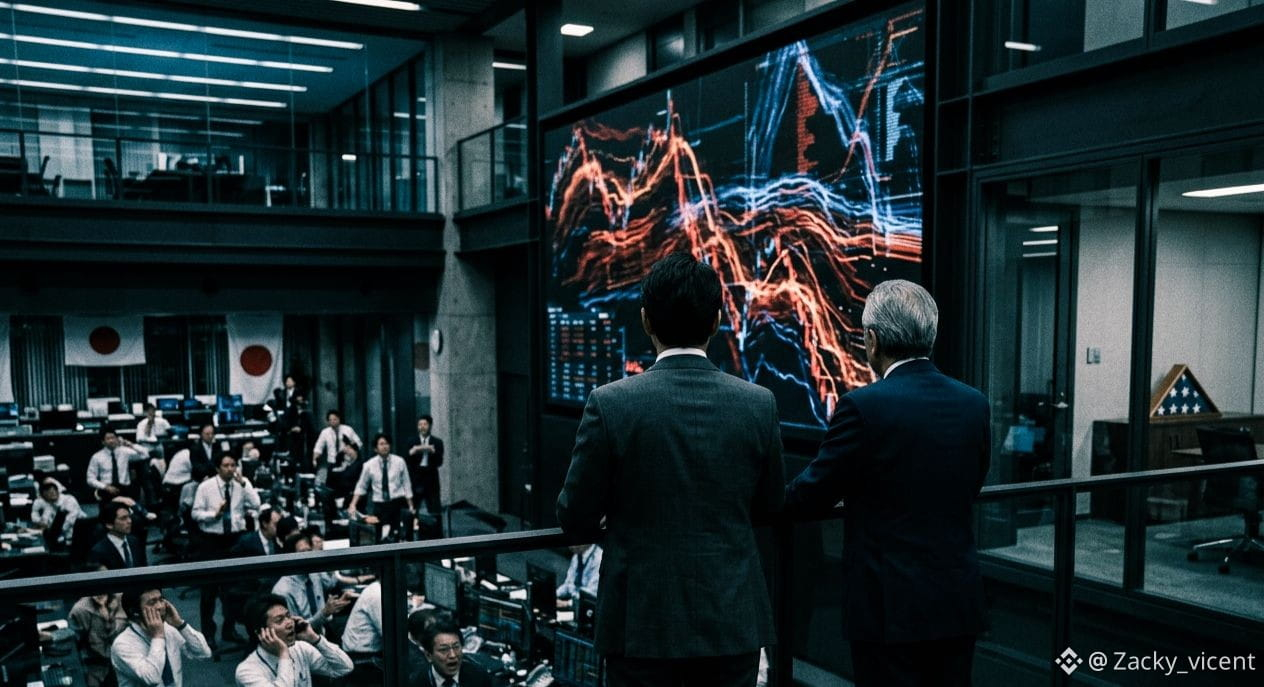
🇯🇵 JAPAN IS ENTERING DANGEROUS TERRITORY — AND THE YEN MAY BE NEXT
Japan's borrowing costs have just reached a level not seen in roughly three decades.
The yield on Japan's 10-year government bond climbed above 3% for the first time since 1996.
At the same time, the Japanese yen weakened beyond the psychologically critical 160-per-dollar level, increasing speculation that Tokyo could once again intervene aggressively in the currency market.
This is no longer just another currency story.
This is a warning signal coming from one of the most important financial systems on Earth.
THE OLD JAPAN IS DISAPPEARING
For decades, Japan lived in a world of ultra-low interest rates.
Cheap borrowing.
Massive government debt.
Deflation.
A weak yen.
And the Bank of Japan sitting at the center of one of the largest monetary experiments in modern history.
Now that system is being forced to change.
Japan's benchmark policy rate currently stands at 1%, but markets are increasingly pricing in further tightening. Some analysts expect the Bank of Japan to continue raising rates as the country attempts to normalize monetary policy and move permanently away from its deflationary past.
But here is the problem.
Japan is not simply raising interest rates.
Japan is raising interest rates while carrying one of the largest government debt burdens in the developed world.
That combination can become extremely dangerous.
Higher yields mean higher borrowing costs.
Higher borrowing costs mean more pressure on government finances.
More pressure on government finances means investors start asking the question governments hate the most:
How long can this continue?
THE YEN HAS BECOME A GLOBAL PROBLEM
The yen trading around 160 per dollar is not merely a domestic Japanese issue.
A weak yen makes imported energy and raw materials more expensive.
That feeds inflation.
That puts pressure on Japanese households.
And it increases political pressure on Tokyo to act.
$BTC
Japan's borrowing costs have just reached a level not seen in roughly three decades.
The yield on Japan's 10-year government bond climbed above 3% for the first time since 1996.
At the same time, the Japanese yen weakened beyond the psychologically critical 160-per-dollar level, increasing speculation that Tokyo could once again intervene aggressively in the currency market.
This is no longer just another currency story.
This is a warning signal coming from one of the most important financial systems on Earth.
THE OLD JAPAN IS DISAPPEARING
For decades, Japan lived in a world of ultra-low interest rates.
Cheap borrowing.
Massive government debt.
Deflation.
A weak yen.
And the Bank of Japan sitting at the center of one of the largest monetary experiments in modern history.
Now that system is being forced to change.
Japan's benchmark policy rate currently stands at 1%, but markets are increasingly pricing in further tightening. Some analysts expect the Bank of Japan to continue raising rates as the country attempts to normalize monetary policy and move permanently away from its deflationary past.
But here is the problem.
Japan is not simply raising interest rates.
Japan is raising interest rates while carrying one of the largest government debt burdens in the developed world.
That combination can become extremely dangerous.
Higher yields mean higher borrowing costs.
Higher borrowing costs mean more pressure on government finances.
More pressure on government finances means investors start asking the question governments hate the most:
How long can this continue?
THE YEN HAS BECOME A GLOBAL PROBLEM
The yen trading around 160 per dollar is not merely a domestic Japanese issue.
A weak yen makes imported energy and raw materials more expensive.
That feeds inflation.
That puts pressure on Japanese households.
And it increases political pressure on Tokyo to act.
$BTC