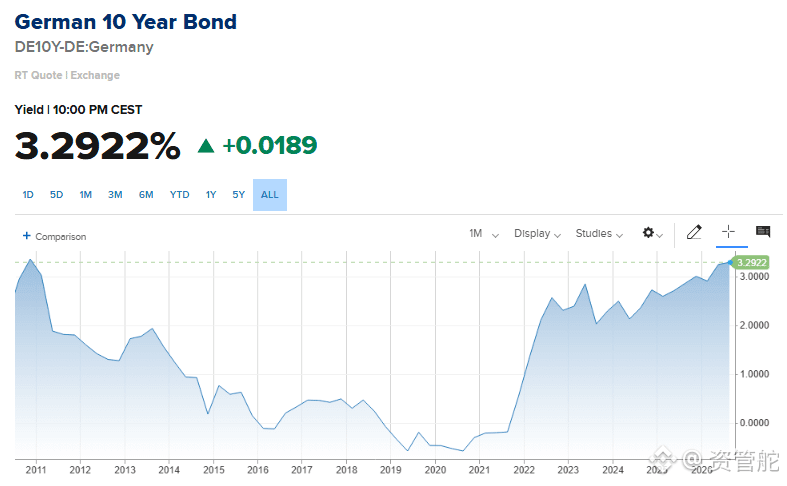
📈 Germany 10-year government bond yield, 3.2922%
Earlier, in the discussion about that piece on IKEA, I mentioned one angle: retail is using real cash to vote for an inflation peak.
But when you pull up the chart of Germany’s 10-year government bond, it feels like these two stories are fighting each other.
A few points you can read from this chart:
1) The 3.5% peak in 2011, then falling to nearly 0% by 2019, and now back to 3.29%—a full cycle completed over 13 years.
2) After 2022, this upswing has been very steep, almost like a straight climb.
3) It’s currently stuck around 3.29%; today it’s still +0.0189.
What is this chart saying? The bond market isn’t voting for rate cuts.
What a retailer like IKEA does—trading lower margins for higher sales—is different. On the consumer side, it sounds like people are hurting and want the central bank to loosen its grip. But the bond market is another story: it’s betting that “high interest rates will stay for a long time,” so money takes longer to get back, and that’s why it’s willing to accept these yields.
When two signals clash, look at whose money weighs more. The bond market is a real-money vote of tens of trillions of euros.
Back to the relationship in our circle: long-term government bonds have kept holding up without coming down, and the ceiling for risk assets has been kept pressed in place.
I’m not fortune-telling either—I’m just speaking based on what the chart shows.
Earlier, in the discussion about that piece on IKEA, I mentioned one angle: retail is using real cash to vote for an inflation peak.
But when you pull up the chart of Germany’s 10-year government bond, it feels like these two stories are fighting each other.
A few points you can read from this chart:
1) The 3.5% peak in 2011, then falling to nearly 0% by 2019, and now back to 3.29%—a full cycle completed over 13 years.
2) After 2022, this upswing has been very steep, almost like a straight climb.
3) It’s currently stuck around 3.29%; today it’s still +0.0189.
What is this chart saying? The bond market isn’t voting for rate cuts.
What a retailer like IKEA does—trading lower margins for higher sales—is different. On the consumer side, it sounds like people are hurting and want the central bank to loosen its grip. But the bond market is another story: it’s betting that “high interest rates will stay for a long time,” so money takes longer to get back, and that’s why it’s willing to accept these yields.
When two signals clash, look at whose money weighs more. The bond market is a real-money vote of tens of trillions of euros.
Back to the relationship in our circle: long-term government bonds have kept holding up without coming down, and the ceiling for risk assets has been kept pressed in place.
I’m not fortune-telling either—I’m just speaking based on what the chart shows.