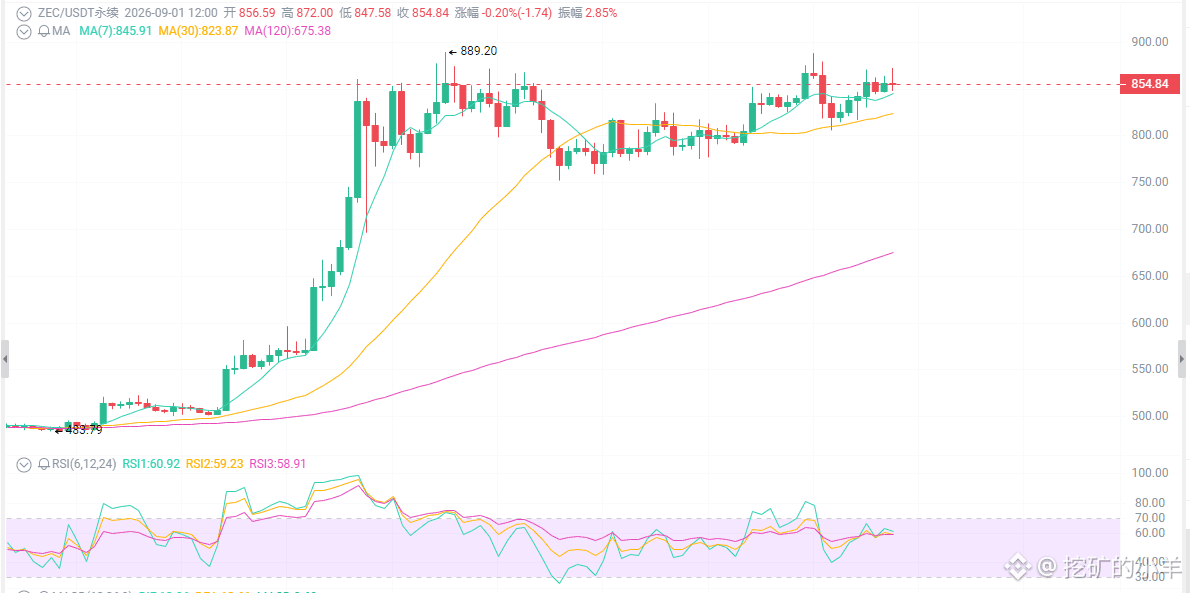
$855 ZEC—are you chasing it or waiting?
First, look at the surface: The ETF was listed on August 25, and privacy coins officially broke into the mainstream.
In the latter half of August, it surged relentlessly from the 500–600 range, topping out around 886–888 before pulling back. Now it’s trading sideways near 855. Market cap is about $14.0–14.5 billion, ranked in the top 11, with strong activity in the last 24 hours. The weekly head-and-shoulders bottom has broken out, the neckline is already cleared, volume is cooperating, and the measured target points to 1000–1300+.
First thing: the ETF has landed—but the story is only just beginning.
America’s first spot privacy-coin ETF (ZCSH) listed on NYSE Arca on August 25, and traditional capital channels are officially open. Fees are 2.5%, and Grayscale has even said it will spend the first year’s fees entirely on marketing.
This is the same kind of script as the 2024 Bitcoin ETF—back then nobody believed it, and BTC went from 40k to 70k.
Second thing: the Ironwood upgrade + the Zakura library—technical fundamentals changed at the core level.
On July 28, the Ironwood upgrade (NU6.3) went live. The Orchard vulnerability found by AI audits was permanently fixed. A new privacy pool + a turnover mechanism were introduced to verify supply integrity, and quantum recoverability was added as well. On August 29, the Zakura library was released, blocking transaction-proof speed targets below 200 milliseconds.
With the loophole fixed, no one can “infinitely mint” coins anymore.
Trades are faster, wallet experience feels smooth.
Even when quantum computers arrive, you don’t have to worry.
Third thing: a signal has appeared technically that must be taken seriously.
The weekly head-and-shoulders bottom breakout is the first in eight years. The measured target points to 1000–1300, even higher. The daily chart has held above the 20/50-day moving averages, and the medium- to long-term moving averages are in a bullish alignment.
But on the 4-hour timeframe—price is forming a symmetrical triangle consolidation between 850–870, near the upper band. Breakout with volume above 888: the next leg targets 1000–1300. If it breaks below 840–850, expect a retest toward 800–820.
Resistance: 870–888 → 900 → 1000 → 1300+
Support: 840–850 → 800–820 → 770–780 → 750
Trading strategies
Conservative longs:
Wait for the pullback to 800–820 to build positions (in 2–3 batches). Stop loss at 770. Target 1000–1100, then reassess toward 1300. If it breaks above 888 and holds 900, then chase long—the “right-side” entry.
Swing/short-term traders:
Reduce exposure around 870–888. If it breaks above 900, chase. Buy on a volume-assisted breakout near the top of the triangle; short on a breakdown below the lower edge. Use strict stop losses.
Watch the September FOMC and BTC direction—if BTC breaks 77k, reduce exposure.
Privacy coins are extremely volatile; single-day moves of 10%+ are common. Stop losses must be set.
First, look at the surface: The ETF was listed on August 25, and privacy coins officially broke into the mainstream.
In the latter half of August, it surged relentlessly from the 500–600 range, topping out around 886–888 before pulling back. Now it’s trading sideways near 855. Market cap is about $14.0–14.5 billion, ranked in the top 11, with strong activity in the last 24 hours. The weekly head-and-shoulders bottom has broken out, the neckline is already cleared, volume is cooperating, and the measured target points to 1000–1300+.
First thing: the ETF has landed—but the story is only just beginning.
America’s first spot privacy-coin ETF (ZCSH) listed on NYSE Arca on August 25, and traditional capital channels are officially open. Fees are 2.5%, and Grayscale has even said it will spend the first year’s fees entirely on marketing.
This is the same kind of script as the 2024 Bitcoin ETF—back then nobody believed it, and BTC went from 40k to 70k.
Second thing: the Ironwood upgrade + the Zakura library—technical fundamentals changed at the core level.
On July 28, the Ironwood upgrade (NU6.3) went live. The Orchard vulnerability found by AI audits was permanently fixed. A new privacy pool + a turnover mechanism were introduced to verify supply integrity, and quantum recoverability was added as well. On August 29, the Zakura library was released, blocking transaction-proof speed targets below 200 milliseconds.
With the loophole fixed, no one can “infinitely mint” coins anymore.
Trades are faster, wallet experience feels smooth.
Even when quantum computers arrive, you don’t have to worry.
Third thing: a signal has appeared technically that must be taken seriously.
The weekly head-and-shoulders bottom breakout is the first in eight years. The measured target points to 1000–1300, even higher. The daily chart has held above the 20/50-day moving averages, and the medium- to long-term moving averages are in a bullish alignment.
But on the 4-hour timeframe—price is forming a symmetrical triangle consolidation between 850–870, near the upper band. Breakout with volume above 888: the next leg targets 1000–1300. If it breaks below 840–850, expect a retest toward 800–820.
Resistance: 870–888 → 900 → 1000 → 1300+
Support: 840–850 → 800–820 → 770–780 → 750
Trading strategies
Conservative longs:
Wait for the pullback to 800–820 to build positions (in 2–3 batches). Stop loss at 770. Target 1000–1100, then reassess toward 1300. If it breaks above 888 and holds 900, then chase long—the “right-side” entry.
Swing/short-term traders:
Reduce exposure around 870–888. If it breaks above 900, chase. Buy on a volume-assisted breakout near the top of the triangle; short on a breakdown below the lower edge. Use strict stop losses.
Watch the September FOMC and BTC direction—if BTC breaks 77k, reduce exposure.
Privacy coins are extremely volatile; single-day moves of 10%+ are common. Stop losses must be set.