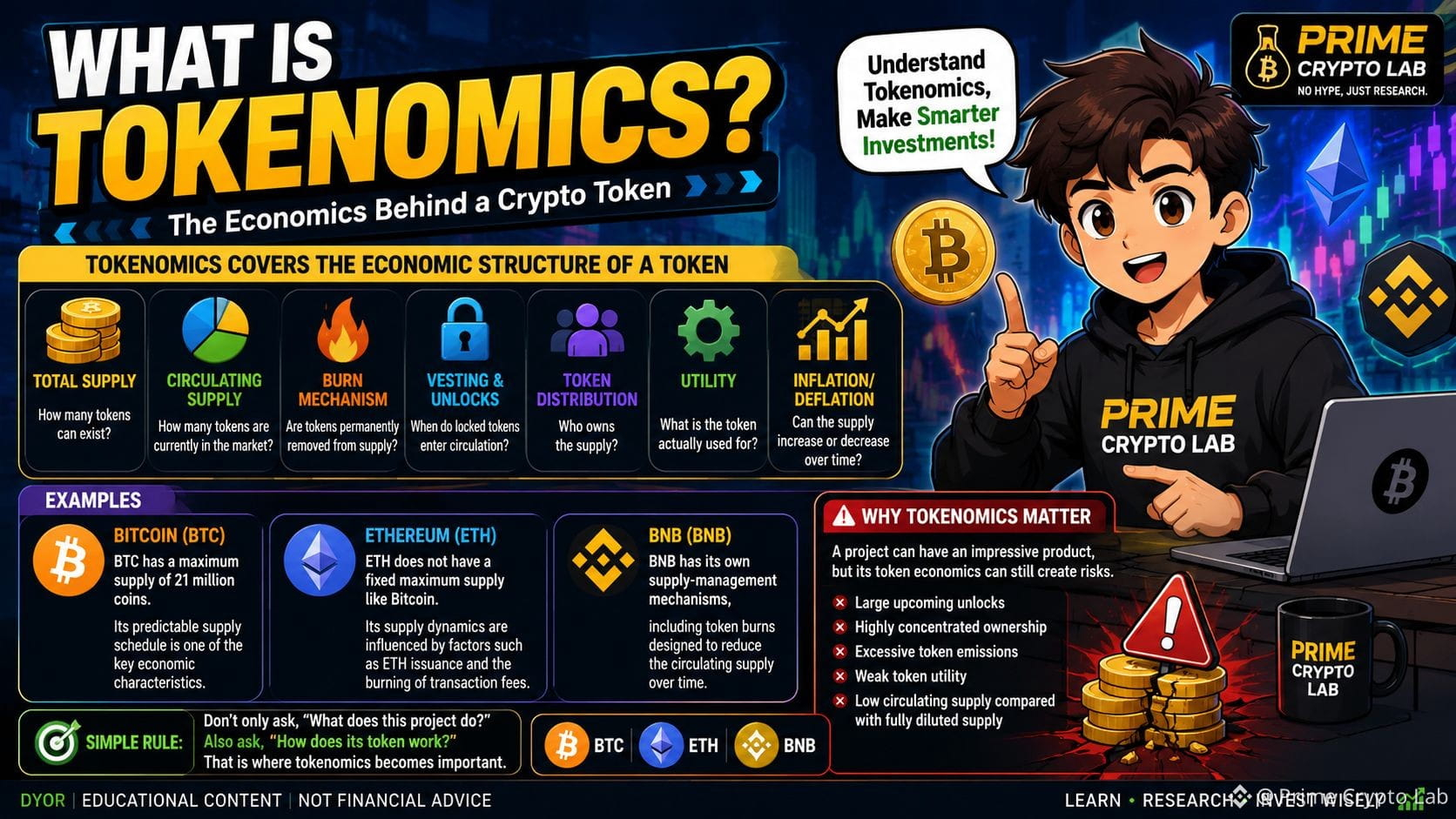
🪙 WHAT IS TOKENOMICS? — A BEGINNER’S GUIDE
Before buying or researching a crypto project, understanding its tokenomics can help you evaluate how its token is designed and how supply may affect its long-term value.
🔍 What does Tokenomics mean?
Tokenomics = Token + Economics
It covers the economic structure of a cryptocurrency, including:
• 🔢 Total Supply — How many tokens can exist?
• 📊 Circulating Supply — How many tokens are currently in the market?
• 🔥 Burn Mechanism — Are tokens permanently removed from supply?
• 🔓 Vesting & Unlocks — When do locked tokens enter circulation?
• 👥 Token Distribution — Who owns the supply?
• 💰 Utility — What is the token actually used for?
• 📈 Inflation/Deflation — Can the supply increase or decrease over time?
🟠 Example: Bitcoin
$BTC has a maximum supply of 21 million coins.
Its predictable supply schedule is one of the key economic characteristics researchers consider when studying Bitcoin.
🔷 Example: Ethereum
$ETH does not have a fixed maximum supply like Bitcoin.
Its supply dynamics are influenced by factors such as ETH issuance and the burning of transaction fees, making its tokenomics different from BTC.
🟡 Example: BNB
$BNB has its own supply-management mechanisms, including token burns designed to reduce the circulating supply over time.
⚠️ Why Tokenomics Matter
A project can have an impressive product, but its token economics can still create risks.
For example:
🚨 Large upcoming unlocks
🚨 Highly concentrated ownership
🚨 Excessive token emissions
🚨 Weak token utility
🚨 Low circulating supply compared with fully diluted supply
These factors can influence market supply and selling pressure.
📌 Simple rule:
Don’t only ask, “What does this project do?”
Also ask:
“How does its token work?”
That is where tokenomics becomes important.
Prime Crypto Lab — No Hype, Just Research.
DYOR | Educational Content | Not Financial Advice
#Binance #Crypto_Jobs🎯 #CryptoPatience #BTC🔥🔥🔥🔥🔥
Before buying or researching a crypto project, understanding its tokenomics can help you evaluate how its token is designed and how supply may affect its long-term value.
🔍 What does Tokenomics mean?
Tokenomics = Token + Economics
It covers the economic structure of a cryptocurrency, including:
• 🔢 Total Supply — How many tokens can exist?
• 📊 Circulating Supply — How many tokens are currently in the market?
• 🔥 Burn Mechanism — Are tokens permanently removed from supply?
• 🔓 Vesting & Unlocks — When do locked tokens enter circulation?
• 👥 Token Distribution — Who owns the supply?
• 💰 Utility — What is the token actually used for?
• 📈 Inflation/Deflation — Can the supply increase or decrease over time?
🟠 Example: Bitcoin
$BTC has a maximum supply of 21 million coins.
Its predictable supply schedule is one of the key economic characteristics researchers consider when studying Bitcoin.
🔷 Example: Ethereum
$ETH does not have a fixed maximum supply like Bitcoin.
Its supply dynamics are influenced by factors such as ETH issuance and the burning of transaction fees, making its tokenomics different from BTC.
🟡 Example: BNB
$BNB has its own supply-management mechanisms, including token burns designed to reduce the circulating supply over time.
⚠️ Why Tokenomics Matter
A project can have an impressive product, but its token economics can still create risks.
For example:
🚨 Large upcoming unlocks
🚨 Highly concentrated ownership
🚨 Excessive token emissions
🚨 Weak token utility
🚨 Low circulating supply compared with fully diluted supply
These factors can influence market supply and selling pressure.
📌 Simple rule:
Don’t only ask, “What does this project do?”
Also ask:
“How does its token work?”
That is where tokenomics becomes important.
Prime Crypto Lab — No Hype, Just Research.
DYOR | Educational Content | Not Financial Advice
#Binance #Crypto_Jobs🎯 #CryptoPatience #BTC🔥🔥🔥🔥🔥