
x_Rex
3.1k Posts

x_Rex
X @x_Rex_yhy |Social Butterfly🌸😋😸| Gold Trader😎✨🌼|
Open Trade
High-Frequency Trader
1.4 Years
319 Following
16.6K+ Followers
8.2K+ Liked
Posts
Portfolio
All
Quotes
Videos
Live
PINNED
30D trade $BTC 2.2K USDT
Remember yesterday when I said the SEC was voting on crypto regulation today? 😅🧧
They cancelled it.
One day notice. No explanation. No replacement date.
The vote that would have given crypto projects a legal path to raise up to $75M without securities registration - gone. Just like that.
Senate left for recess without voting on the Clarity Act. SEC cancelled Regulation Crypto. Commissioner Hester Peirce, the most crypto-friendly voice at the SEC, is leaving in November.
And yet BTC is still at $62,969. ETH at $1,872. Market barely moved 😂
This is actually the most important lesson in crypto , Regulation delays are annoying. But the market has stopped waiting for regulators to catch up. $1.82 trillion market cap. $678M in ETF inflows last week. BlackRock buying daily.
The builders kept building. The buyers kept buying.
With or without Washington's permission
Grab the Red Packet — crypto doesn't wait for anyone 🧧
#BinanceSquareFamily #BinanceSquareTalks #redpacket
$BTC $ETH
They cancelled it.
One day notice. No explanation. No replacement date.
The vote that would have given crypto projects a legal path to raise up to $75M without securities registration - gone. Just like that.
Senate left for recess without voting on the Clarity Act. SEC cancelled Regulation Crypto. Commissioner Hester Peirce, the most crypto-friendly voice at the SEC, is leaving in November.
And yet BTC is still at $62,969. ETH at $1,872. Market barely moved 😂
This is actually the most important lesson in crypto , Regulation delays are annoying. But the market has stopped waiting for regulators to catch up. $1.82 trillion market cap. $678M in ETF inflows last week. BlackRock buying daily.
The builders kept building. The buyers kept buying.
With or without Washington's permission
Grab the Red Packet — crypto doesn't wait for anyone 🧧
#BinanceSquareFamily #BinanceSquareTalks #redpacket
$BTC $ETH

go

x_Trader_
·
--
🧧Have a Good Day Everyone 🧧
Repost ✅
Claim Free Crypto tokens+ coins...✅🎉
@YUGEN优恩 @x_Rex
Repost ✅
Claim Free Crypto tokens+ coins...✅🎉
@YUGEN优恩 @x_Rex


30D trade $BTC 2.7K USDT
go get 🧧🧧🧧 $BTC

Luke_龙
·
--
Crypto Market Update 🧧 — August 31, 2026
$BTC is trading near $80,000, first time since May, breaking its bearish trend on the back of $1.92B in ETF inflows and a wave of short liquidations. Sentiment just hit "extreme greed" for the first time since late 2024. Counterweight: the Fed just signaled it may raise rates instead of cut them, so momentum and macro are pulling in opposite directions right now.
Strategy resumed Bitcoin purchases after a 10-week pause.
$ETH ETFs pulled in $226M in a single day, nearly matching BTC inflows.
$SOL — a Bitwise Solana ETF became the first SOL fund to cross $1B AUM.
Institutional crossover: DTCC partnered with BitGo on tokenized treasuries and equities. Sberbank, Russia's largest bank, plans to accept BTC as loan collateral, with ETH and USDT to follow. Vietnam is rolling out a regulated crypto market with tokenized assets.
Elsewhere: Polymarket is facing regulatory scrutiny right as it lands major sports league deals. Hong Kong's SFC flagged Star Bridge Capital Group as unlicensed.
Extreme greed + a hawkish Fed signal in the same week — worth watching which one wins out.
Markets are highly volatile so prices may vary by the time you read this. Not financial advice. DYOR 🙏
#BinanceSquareTalks #BinanceSquare #creatorpad
$BTC is trading near $80,000, first time since May, breaking its bearish trend on the back of $1.92B in ETF inflows and a wave of short liquidations. Sentiment just hit "extreme greed" for the first time since late 2024. Counterweight: the Fed just signaled it may raise rates instead of cut them, so momentum and macro are pulling in opposite directions right now.
Strategy resumed Bitcoin purchases after a 10-week pause.
$ETH ETFs pulled in $226M in a single day, nearly matching BTC inflows.
$SOL — a Bitwise Solana ETF became the first SOL fund to cross $1B AUM.
Institutional crossover: DTCC partnered with BitGo on tokenized treasuries and equities. Sberbank, Russia's largest bank, plans to accept BTC as loan collateral, with ETH and USDT to follow. Vietnam is rolling out a regulated crypto market with tokenized assets.
Elsewhere: Polymarket is facing regulatory scrutiny right as it lands major sports league deals. Hong Kong's SFC flagged Star Bridge Capital Group as unlicensed.
Extreme greed + a hawkish Fed signal in the same week — worth watching which one wins out.
Markets are highly volatile so prices may vary by the time you read this. Not financial advice. DYOR 🙏
#BinanceSquareTalks #BinanceSquare #creatorpad

go 🧧🧧🧧

BTC 222
·
--
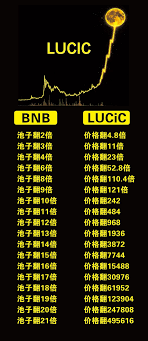
LUCIC——A Rising Star on BNBChain 🌟
$LUCIC is not just a token; it embodies the principles of transparency, fairness, and sustainability:
⚡ Fully open smart contracts, transparent and trustworthy
🔗 Clearly verifiable on-chain
🎨 NFT incentive mechanism to reward contributors
🔥 Deflationary model: 1.37 million tokens permanently destroyed
💥 Scarce supply, with potential for value increase
💎 Innovation-driven, attracting high-potential participants
🌍 Promoting the revival of meme culture on BNBChain
$LUCIC is not just a token; it embodies the principles of transparency, fairness, and sustainability:
⚡ Fully open smart contracts, transparent and trustworthy
🔗 Clearly verifiable on-chain
🎨 NFT incentive mechanism to reward contributors
🔥 Deflationary model: 1.37 million tokens permanently destroyed
💥 Scarce supply, with potential for value increase
💎 Innovation-driven, attracting high-potential participants
🌍 Promoting the revival of meme culture on BNBChain
30D trade $BTC 2.2K USDT
What's moving BTC right now:
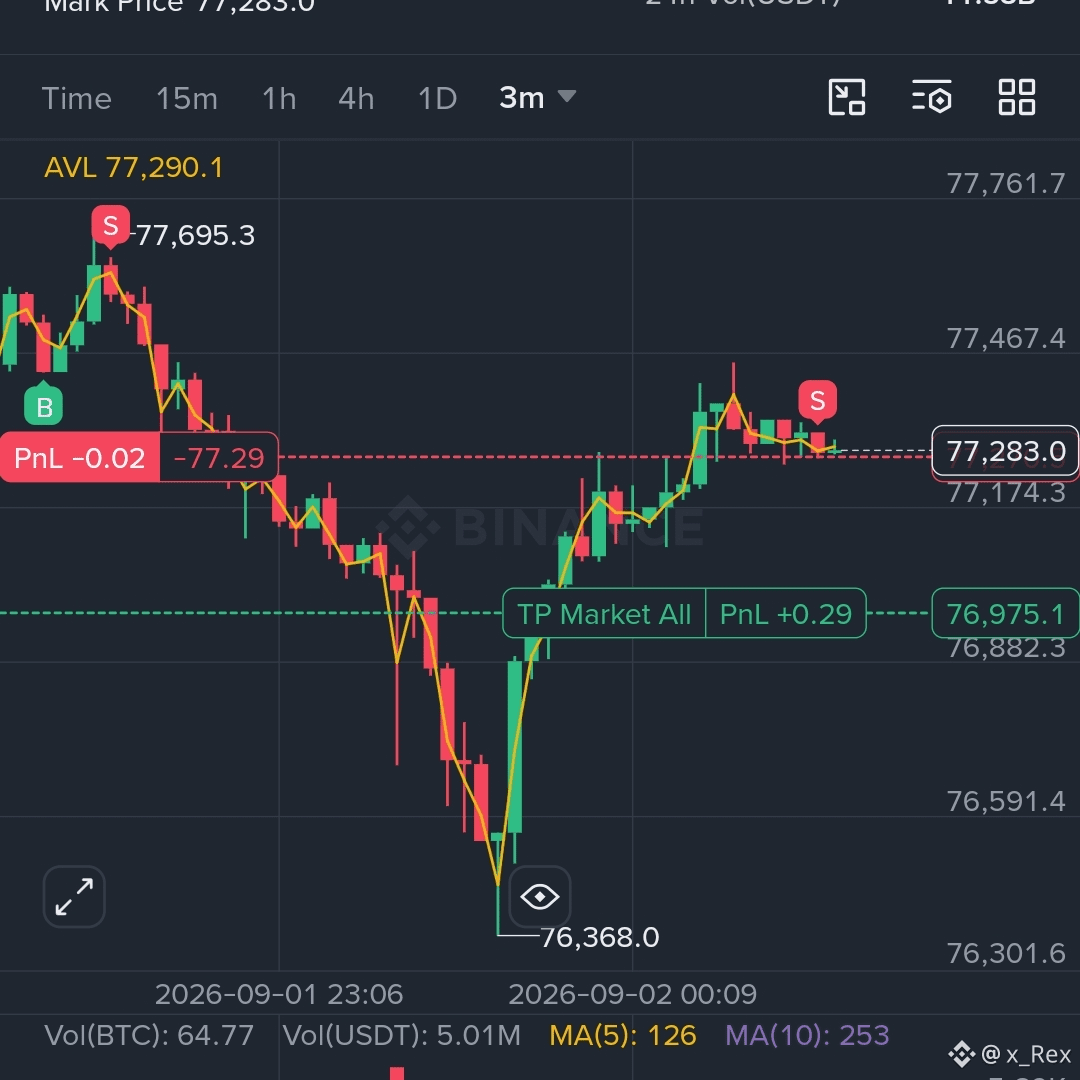
Trading Setup
Bias: Neutral, range-bound — no clean edge either direction until $77,000-$80,000 resolves
Entry (long, off support): $76,950 - $77,050
TP1: $77,467
TP2: $77,672
TP3: $78,078$BTC SL: $76,700
Entry (short, off resistance): $77,600 - $77,700
TP1: $77,283
TP2: $76,975
TP3: $76,368
SL: $77,850
What to Watch: A break below $76,800 opens a retest toward the low $70,000s. A break above $80,000 with resumed ETF inflows could send this back toward $81,500.
Game Changer: Sept 11 inflation data and the Fed's tone afterward — that's what actually breaks this range, not the chart alone.
Confidence: 4.5/10 — this is genuinely a "wait for the range to resolve" market right now, not a trending one. Not financial advice
- Just closed out one of its best months of 2026 — up roughly 24-25% in August — and is now digesting that move, chopping between $77,000-$80,000.
- A global bond sell-off is the real pressure point: 10-year Treasury yields just hit their highest level since January 2025, and that's dragging risk assets, BTC included.
- Fed Chair Kevin Warsh's hawkish comments at Jackson Hole raised the odds of a September rate hike, which is what actually knocked price below $78,000.
- Binance's BTC reserves climbed to ~687,000 BTC, the highest level all year, up from ~617,000 in April. Rising exchange reserves generally means more coins positioned to sell, not accumulation — a real structural headwind sitting under this chop.
- Leverage is already getting tested: crypto-wide, $102M in longs got liquidated vs $90.6M in shorts on Sept 1 alone.
- Sept 11 CPI data and the next jobs report are the next real catalysts — expect the chop to continue until then.
Market Structure
V-recovery off today's flush to $76,368, now consolidating right at $77,283 after failing to reclaim $77,672-78,078 on the bounce attempts.
Support: $76,975, then $76,368 (flush low)
Resistance: $77,467, then $77,672, then $78,078, then $79,196 (session high)
.
$BTC
Trading Setup
Bias: Neutral, range-bound — no clean edge either direction until $77,000-$80,000 resolves
Entry (long, off support): $76,950 - $77,050
TP1: $77,467
TP2: $77,672
TP3: $78,078$BTC SL: $76,700
Entry (short, off resistance): $77,600 - $77,700
TP1: $77,283
TP2: $76,975
TP3: $76,368
SL: $77,850
What to Watch: A break below $76,800 opens a retest toward the low $70,000s. A break above $80,000 with resumed ETF inflows could send this back toward $81,500.
Game Changer: Sept 11 inflation data and the Fed's tone afterward — that's what actually breaks this range, not the chart alone.
Confidence: 4.5/10 — this is genuinely a "wait for the range to resolve" market right now, not a trending one. Not financial advice
- Just closed out one of its best months of 2026 — up roughly 24-25% in August — and is now digesting that move, chopping between $77,000-$80,000.
- A global bond sell-off is the real pressure point: 10-year Treasury yields just hit their highest level since January 2025, and that's dragging risk assets, BTC included.
- Fed Chair Kevin Warsh's hawkish comments at Jackson Hole raised the odds of a September rate hike, which is what actually knocked price below $78,000.
- Binance's BTC reserves climbed to ~687,000 BTC, the highest level all year, up from ~617,000 in April. Rising exchange reserves generally means more coins positioned to sell, not accumulation — a real structural headwind sitting under this chop.
- Leverage is already getting tested: crypto-wide, $102M in longs got liquidated vs $90.6M in shorts on Sept 1 alone.
- Sept 11 CPI data and the next jobs report are the next real catalysts — expect the chop to continue until then.
Market Structure
V-recovery off today's flush to $76,368, now consolidating right at $77,283 after failing to reclaim $77,672-78,078 on the bounce attempts.
Support: $76,975, then $76,368 (flush low)
Resistance: $77,467, then $77,672, then $78,078, then $79,196 (session high)
.
$BTC
#repopo Go 🧧🧧🧧
Luke_龙
·
--
Crypto Market Update 🧧 — August 31, 2026
$BTC is trading near $80,000, first time since May, breaking its bearish trend on the back of $1.92B in ETF inflows and a wave of short liquidations. Sentiment just hit "extreme greed" for the first time since late 2024. Counterweight: the Fed just signaled it may raise rates instead of cut them, so momentum and macro are pulling in opposite directions right now.
Strategy resumed Bitcoin purchases after a 10-week pause.
$ETH ETFs pulled in $226M in a single day, nearly matching BTC inflows.
$SOL — a Bitwise Solana ETF became the first SOL fund to cross $1B AUM.
Institutional crossover: DTCC partnered with BitGo on tokenized treasuries and equities. Sberbank, Russia's largest bank, plans to accept BTC as loan collateral, with ETH and USDT to follow. Vietnam is rolling out a regulated crypto market with tokenized assets.
Elsewhere: Polymarket is facing regulatory scrutiny right as it lands major sports league deals. Hong Kong's SFC flagged Star Bridge Capital Group as unlicensed.
Extreme greed + a hawkish Fed signal in the same week — worth watching which one wins out.
Markets are highly volatile so prices may vary by the time you read this. Not financial advice. DYOR 🙏
#BinanceSquareTalks #BinanceSquare #creatorpad
$BTC is trading near $80,000, first time since May, breaking its bearish trend on the back of $1.92B in ETF inflows and a wave of short liquidations. Sentiment just hit "extreme greed" for the first time since late 2024. Counterweight: the Fed just signaled it may raise rates instead of cut them, so momentum and macro are pulling in opposite directions right now.
Strategy resumed Bitcoin purchases after a 10-week pause.
$ETH ETFs pulled in $226M in a single day, nearly matching BTC inflows.
$SOL — a Bitwise Solana ETF became the first SOL fund to cross $1B AUM.
Institutional crossover: DTCC partnered with BitGo on tokenized treasuries and equities. Sberbank, Russia's largest bank, plans to accept BTC as loan collateral, with ETH and USDT to follow. Vietnam is rolling out a regulated crypto market with tokenized assets.
Elsewhere: Polymarket is facing regulatory scrutiny right as it lands major sports league deals. Hong Kong's SFC flagged Star Bridge Capital Group as unlicensed.
Extreme greed + a hawkish Fed signal in the same week — worth watching which one wins out.
Markets are highly volatile so prices may vary by the time you read this. Not financial advice. DYOR 🙏
#BinanceSquareTalks #BinanceSquare #creatorpad
go 🧧🧧🧧
x_Trader_
·
--
🧧Have a Good Day Everyone 🧧
Repost ✅
Claim Free Crypto tokens+ coins...✅🎉
@YUGEN优恩 @x_Rex
Repost ✅
Claim Free Crypto tokens+ coins...✅🎉
@YUGEN优恩 @x_Rex
Verified
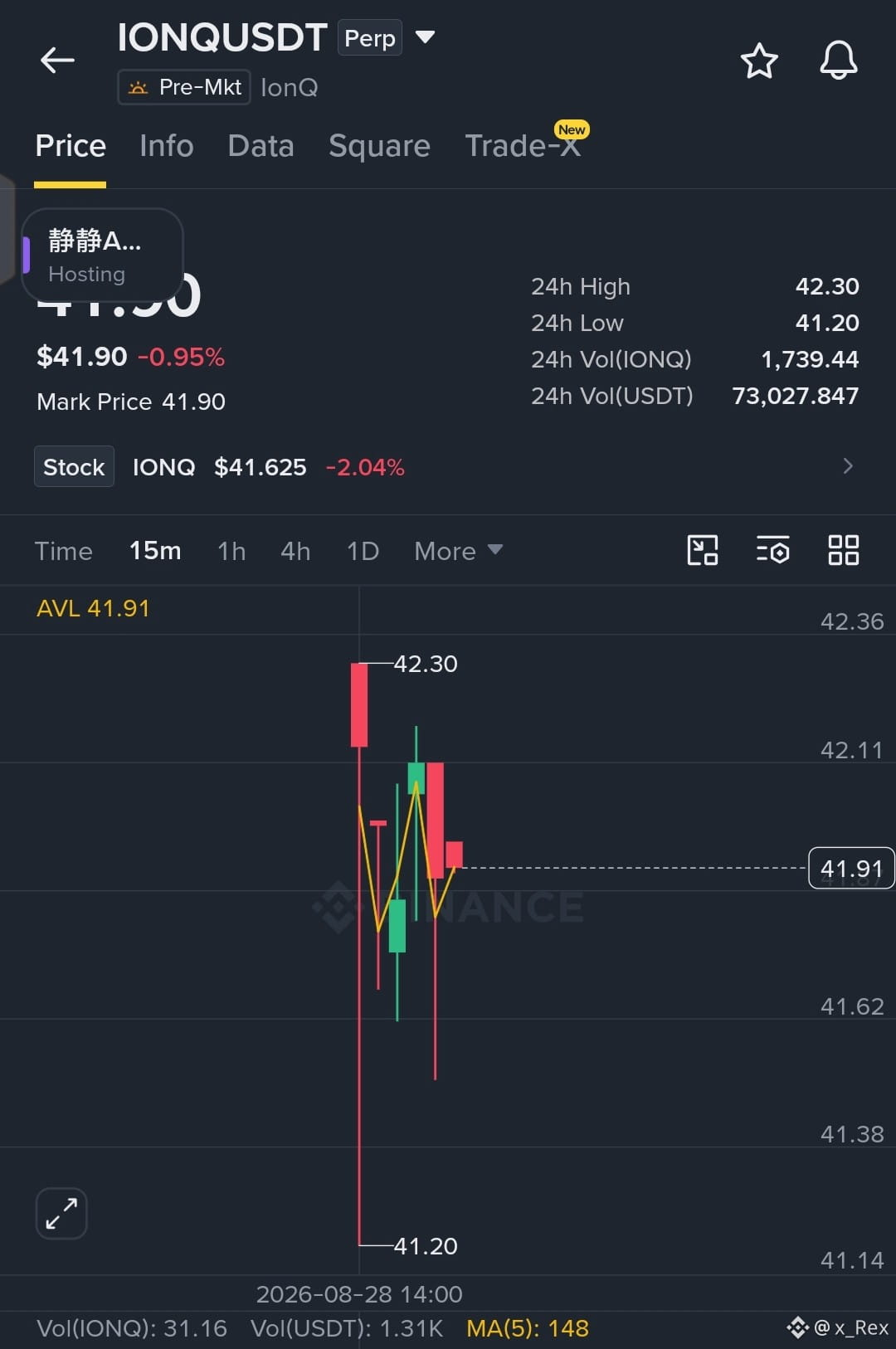
$IONQ — NEWS + TRADE SETUP 👀
IonQ just reported another record quarter.
Q2 revenue hit $80.1M, up 287% YoY, and full-year 2026 guidance was raised to $280–290M. The company also closed its SkyWater acquisition, expanding its full-stack quantum strategy.
But the valuation and volatility are still serious risks.
📈 LONG WATCH
I’d rather buy confirmation than chase.
Entry: $42.00–42.50 on support/confirmation
TP1: $44.50
TP2: $47.00
SL: $40.80
🚨 Bullish trigger: reclaim and hold $43.00+ with volume.
If $40.80 breaks, the long setup is invalid
.
Fundamentals: bullish.
Structure: volatile.
Confirmation > prediction.
Not financial advice.
IonQ just reported another record quarter.
Q2 revenue hit $80.1M, up 287% YoY, and full-year 2026 guidance was raised to $280–290M. The company also closed its SkyWater acquisition, expanding its full-stack quantum strategy.
But the valuation and volatility are still serious risks.
📈 LONG WATCH
I’d rather buy confirmation than chase.
Entry: $42.00–42.50 on support/confirmation
TP1: $44.50
TP2: $47.00
SL: $40.80
🚨 Bullish trigger: reclaim and hold $43.00+ with volume.
If $40.80 breaks, the long setup is invalid
.
Fundamentals: bullish.
Structure: volatile.
Confirmation > prediction.
Not financial advice.
$MRK — NEWS + TRADE SETUP 👀
📉 SHORT WATCH
Entry: $150.80–151.30 after rejection
TP1: $149.80
TP2: $148.20
SL: $152.70
Trigger: rejection around $151.50–152.00 + loss of $150.80.
If $152.57 breaks and holds, I would invalidate the short.
Fundamentals are bullish.
Short-term structure is giving a possible rejection trade.
Confirmation > prediction.
Merck is still getting attention after the positive Phase 3 melanoma vaccine data with Moderna + KEYTRUDA. The trial hit its recurrence-free and distant-metastasis-free survival endpoints — a major pipeline catalyst.
But the chart is showing a different short-term story.
$MRK spiked to $152.57 and is now around $151.02, with rejection from the high. Price is consolidating below the spike while the broader move remains extended.
Not financial advice.
📉 SHORT WATCH
Entry: $150.80–151.30 after rejection
TP1: $149.80
TP2: $148.20
SL: $152.70
Trigger: rejection around $151.50–152.00 + loss of $150.80.
If $152.57 breaks and holds, I would invalidate the short.
Fundamentals are bullish.
Short-term structure is giving a possible rejection trade.
Confirmation > prediction.
Merck is still getting attention after the positive Phase 3 melanoma vaccine data with Moderna + KEYTRUDA. The trial hit its recurrence-free and distant-metastasis-free survival endpoints — a major pipeline catalyst.
But the chart is showing a different short-term story.
$MRK spiked to $152.57 and is now around $151.02, with rejection from the high. Price is consolidating below the spike while the broader move remains extended.
Not financial advice.
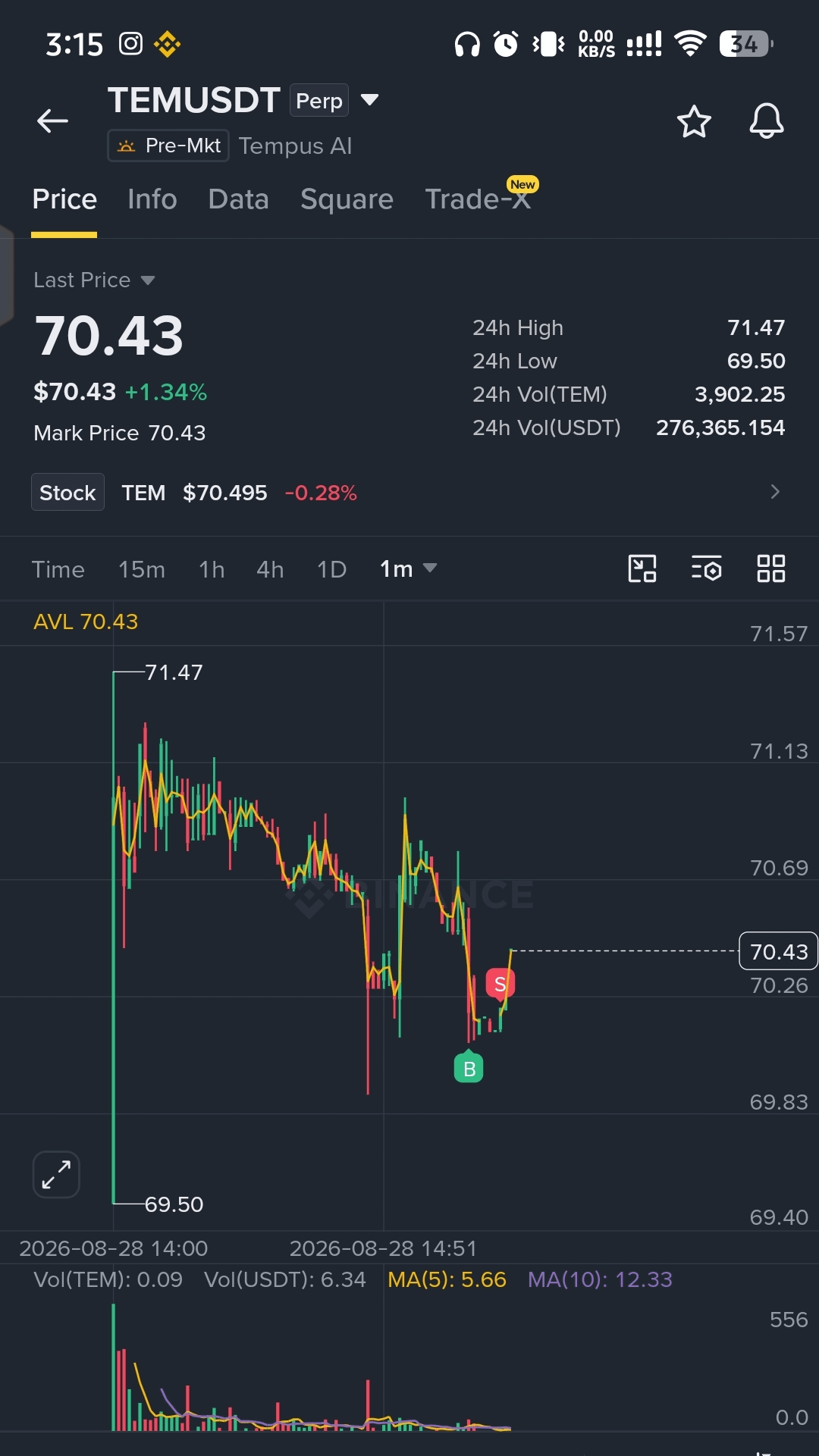
$TEM — NEWS + TRADE SETUP 👀
📉 #short 🔴
Entry: $70.20–70.60 after rejection
TP1: $69.85
TP2: $69.50
SL: $71.55
Trigger: rejection below $70.70 + loss of $70.20.
If $71.47 breaks and holds, I don't want the short. That's the invalidation.
News is bullish.
Structure is currently giving me a short-term rejection setup.
Confirmation > prediction.
Tempus AI just got another FDA tailwind.
On Aug. 24, Tempus received FDA 510(k) clearance for ECG-PH, its AI software designed to detect signs associated with pulmonary hypertension. Another addition to its FDA-cleared AI portfolio.
But the market isn't giving it a free pass.
$TEM pushed to $71.47 and is now around $70.43, showing rejection from the local high. Recent selling from Tempus' CEO and ARK Invest also adds some pressure.
Not financial advice
$TEM
📉 #short 🔴
Entry: $70.20–70.60 after rejection
TP1: $69.85
TP2: $69.50
SL: $71.55
Trigger: rejection below $70.70 + loss of $70.20.
If $71.47 breaks and holds, I don't want the short. That's the invalidation.
News is bullish.
Structure is currently giving me a short-term rejection setup.
Confirmation > prediction.
Tempus AI just got another FDA tailwind.
On Aug. 24, Tempus received FDA 510(k) clearance for ECG-PH, its AI software designed to detect signs associated with pulmonary hypertension. Another addition to its FDA-cleared AI portfolio.
But the market isn't giving it a free pass.
$TEM pushed to $71.47 and is now around $70.43, showing rejection from the local high. Recent selling from Tempus' CEO and ARK Invest also adds some pressure.
Not financial advice
$TEM
🧧 Happy Friday, everyone 🧧
Repost✅, + Claim✅
Type 👉 blessing .
Not gonna pretend today was easy, it wasn't. red days happen to all of us, and today hit harder than most. but Fridays have a way of resetting something in me, so here's a small red packet to pass a little good luck around.
First come first served.
Whatever kind of week you had, I hope your Friday is softer than mine was. we go again.
Repost✅, + Claim✅
Type 👉 blessing .
Not gonna pretend today was easy, it wasn't. red days happen to all of us, and today hit harder than most. but Fridays have a way of resetting something in me, so here's a small red packet to pass a little good luck around.
First come first served.
Whatever kind of week you had, I hope your Friday is softer than mine was. we go again.

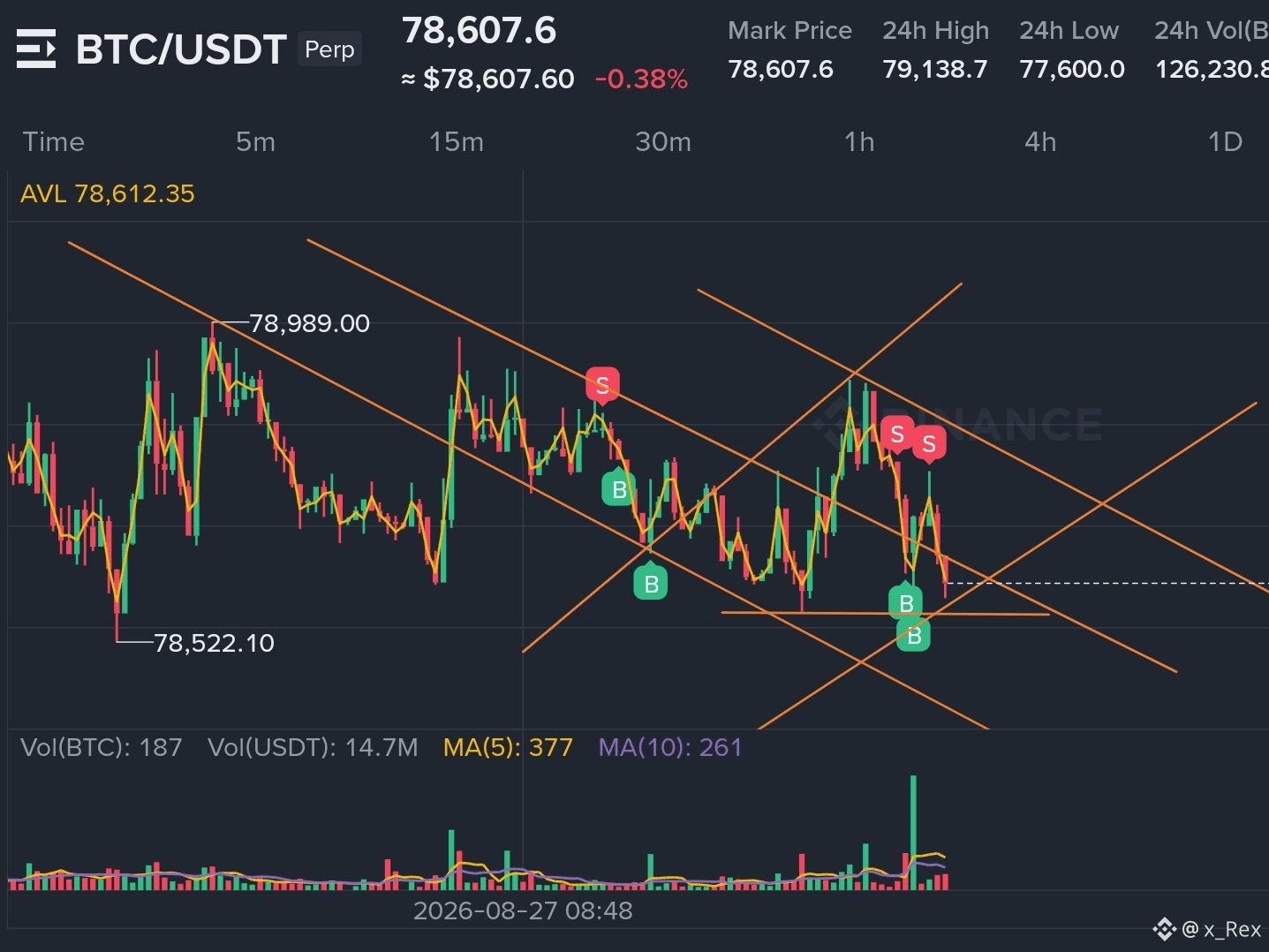
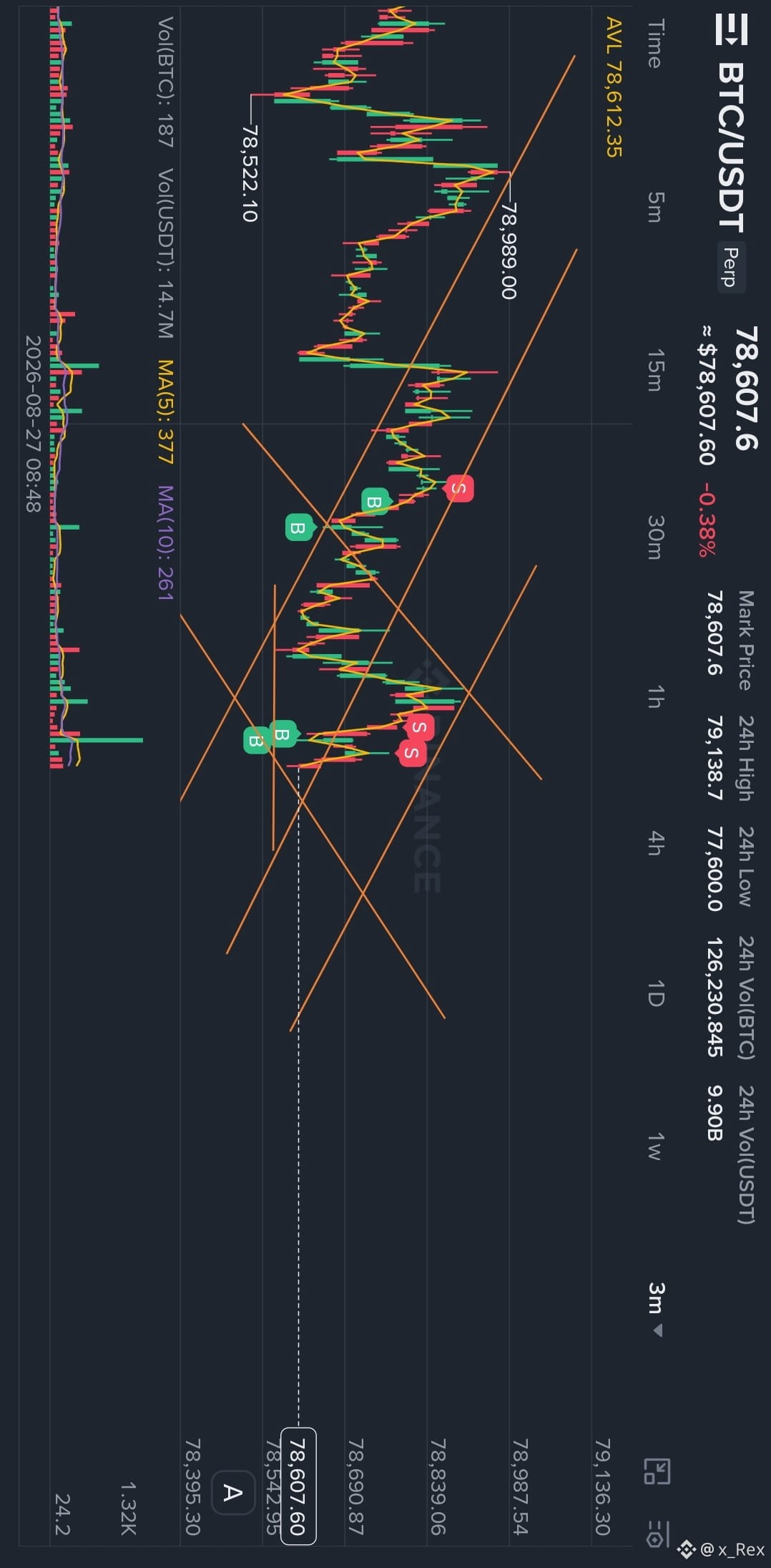
$BTC Does this make any sense. 😂😂
Trade Setup
Bias: Bullish (trend continuation, buy the dip)
Entry: $78,850 - $79,050
TP1: $79,136
TP2: $79,898
TP3: $80,667
SL: $78,380
Why: Price already V-recovered off today's flush low and is consolidating right under the same shelf it broke down from, not collapsing further. That matches the macro picture, a strong monthly trend digesting, not reversing.
Watch: A close above $79,136 with volume is the real confirmation this bounce extends.
Invalidation: Losing $78,380 breaks the recovery structure and opens room back toward $77,808
DYOR.
$BTC
Trade Setup
Bias: Bullish (trend continuation, buy the dip)
Entry: $78,850 - $79,050
TP1: $79,136
TP2: $79,898
TP3: $80,667
SL: $78,380
Why: Price already V-recovered off today's flush low and is consolidating right under the same shelf it broke down from, not collapsing further. That matches the macro picture, a strong monthly trend digesting, not reversing.
Watch: A close above $79,136 with volume is the real confirmation this bounce extends.
Invalidation: Losing $78,380 breaks the recovery structure and opens room back toward $77,808
DYOR.
$BTC
x_Rex
·
--
Trade Setup
Bias: Bullish (trend continuation, buy the dip)
Entry: $78,850 - $79,050
TP1: $79,136
TP2: $79,898
TP3: $80,667
SL: $78,380
Why: Price already V-recovered off today's flush low and is consolidating right under the same shelf it broke down from, not collapsing further. That matches the macro picture, a strong monthly trend digesting, not reversing.
Watch: A close above $79,136 with volume is the real confirmation this bounce extends.
Invalidation: Losing $78,380 breaks the recovery structure and opens room back toward $77,808.
Bitcoin just had its best month since April. Up roughly 23% in a week, cleared $80K for the first time in three months, touched $81,235 on Tuesday. The trigger wasn't crypto-native, it was the Treasury Department surprising markets with a move to double its long-term bond-buying program, and risk assets across the board caught the bid.
Since then it's cooled to the high $78Ks. Nothing broken, just digestion after a 20%+ monthly run. Worth watching: open interest has climbed 16% over the past week to $55.6B, and long liquidations have started outpacing shorts, meaning some of that bullish leverage is already getting tested.
Resistance between $77,500 and $80,000 hasn't been decisively cleared yet. Until it is, this reads as a strong trend taking a breather, not a confirmed breakout to new highs.
No financial advice. DYOR.
#bitcoin #Macro $BTC
Bias: Bullish (trend continuation, buy the dip)
Entry: $78,850 - $79,050
TP1: $79,136
TP2: $79,898
TP3: $80,667
SL: $78,380
Why: Price already V-recovered off today's flush low and is consolidating right under the same shelf it broke down from, not collapsing further. That matches the macro picture, a strong monthly trend digesting, not reversing.
Watch: A close above $79,136 with volume is the real confirmation this bounce extends.
Invalidation: Losing $78,380 breaks the recovery structure and opens room back toward $77,808.
Bitcoin just had its best month since April. Up roughly 23% in a week, cleared $80K for the first time in three months, touched $81,235 on Tuesday. The trigger wasn't crypto-native, it was the Treasury Department surprising markets with a move to double its long-term bond-buying program, and risk assets across the board caught the bid.
Since then it's cooled to the high $78Ks. Nothing broken, just digestion after a 20%+ monthly run. Worth watching: open interest has climbed 16% over the past week to $55.6B, and long liquidations have started outpacing shorts, meaning some of that bullish leverage is already getting tested.
Resistance between $77,500 and $80,000 hasn't been decisively cleared yet. Until it is, this reads as a strong trend taking a breather, not a confirmed breakout to new highs.
No financial advice. DYOR.
#bitcoin #Macro $BTC
Long $BTC 78.7 USDT
Trade Setup
Bias: Bullish (trend continuation, buy the dip)
Entry: $78,850 - $79,050
TP1: $79,136
TP2: $79,898
TP3: $80,667
SL: $78,380
Why: Price already V-recovered off today's flush low and is consolidating right under the same shelf it broke down from, not collapsing further. That matches the macro picture, a strong monthly trend digesting, not reversing.
Watch: A close above $79,136 with volume is the real confirmation this bounce extends.
Invalidation: Losing $78,380 breaks the recovery structure and opens room back toward $77,808.
Bitcoin just had its best month since April. Up roughly 23% in a week, cleared $80K for the first time in three months, touched $81,235 on Tuesday. The trigger wasn't crypto-native, it was the Treasury Department surprising markets with a move to double its long-term bond-buying program, and risk assets across the board caught the bid.
Since then it's cooled to the high $78Ks. Nothing broken, just digestion after a 20%+ monthly run. Worth watching: open interest has climbed 16% over the past week to $55.6B, and long liquidations have started outpacing shorts, meaning some of that bullish leverage is already getting tested.
Resistance between $77,500 and $80,000 hasn't been decisively cleared yet. Until it is, this reads as a strong trend taking a breather, not a confirmed breakout to new highs.
No financial advice. DYOR.
#bitcoin #Macro $BTC
Bias: Bullish (trend continuation, buy the dip)
Entry: $78,850 - $79,050
TP1: $79,136
TP2: $79,898
TP3: $80,667
SL: $78,380
Why: Price already V-recovered off today's flush low and is consolidating right under the same shelf it broke down from, not collapsing further. That matches the macro picture, a strong monthly trend digesting, not reversing.
Watch: A close above $79,136 with volume is the real confirmation this bounce extends.
Invalidation: Losing $78,380 breaks the recovery structure and opens room back toward $77,808.
Bitcoin just had its best month since April. Up roughly 23% in a week, cleared $80K for the first time in three months, touched $81,235 on Tuesday. The trigger wasn't crypto-native, it was the Treasury Department surprising markets with a move to double its long-term bond-buying program, and risk assets across the board caught the bid.
Since then it's cooled to the high $78Ks. Nothing broken, just digestion after a 20%+ monthly run. Worth watching: open interest has climbed 16% over the past week to $55.6B, and long liquidations have started outpacing shorts, meaning some of that bullish leverage is already getting tested.
Resistance between $77,500 and $80,000 hasn't been decisively cleared yet. Until it is, this reads as a strong trend taking a breather, not a confirmed breakout to new highs.
No financial advice. DYOR.
#bitcoin #Macro $BTC
30D trade $DUSK 256.1 USDT
#dusk $DUSK @Dusk
Read the genesis contracts section of the whitepaper twice this week.
First pass, skimmed past Zedger assuming it was just 'Phoenix, BUT for securities'.
Same privacy tech, different asset type.
Second pass, that assumption didn't hold up.
I'd been treating PRIVATE PAYMENT and PRIVATE SECURITY as needing the same guarantees.
They don't.
And the difference is the whole reason Zedger exists as its own protocol instead of just being Phoenix with a different label.
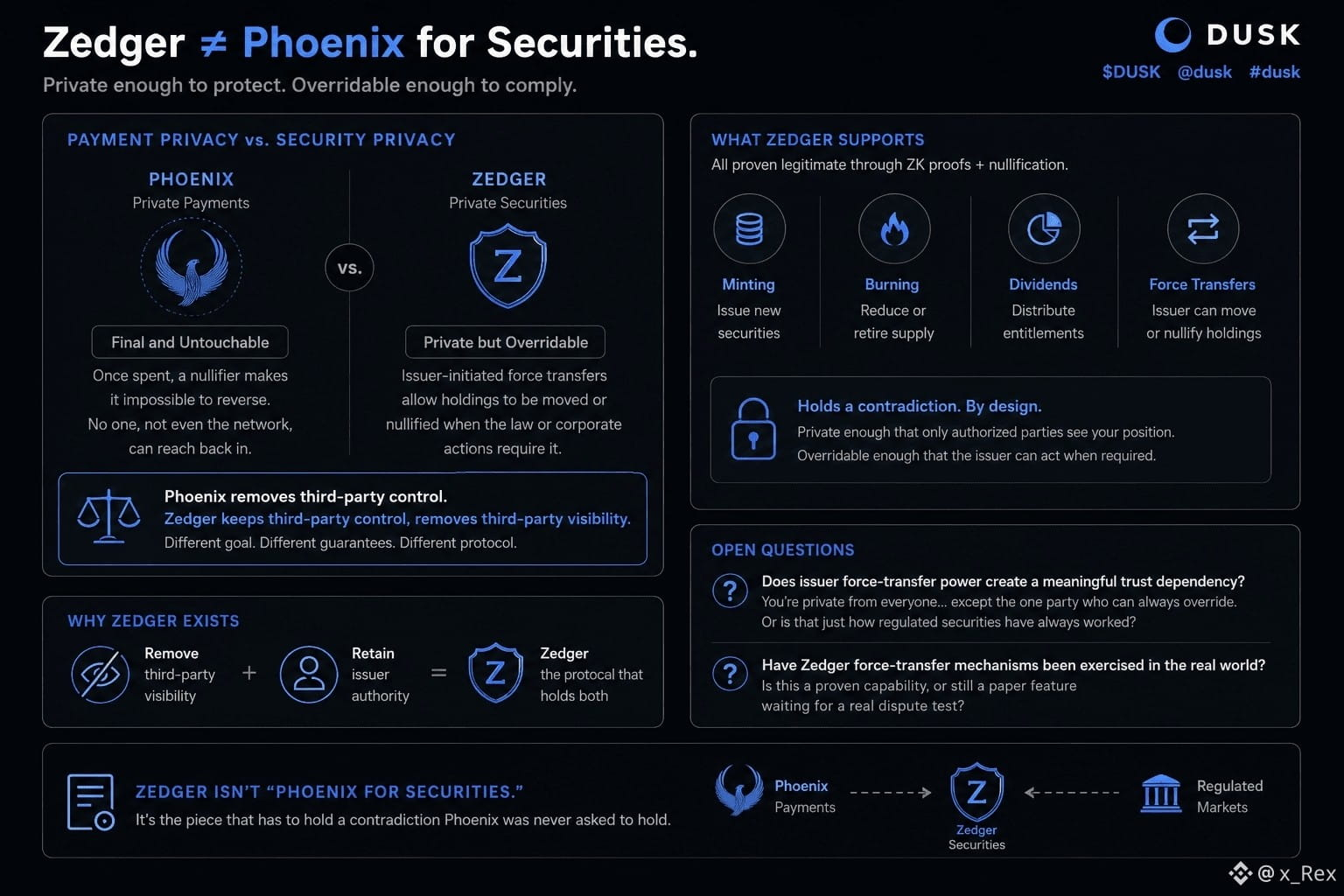
A private PAYMENT is supposed to be final and untouchable — that's the point of a nullifier, once it's spent nobody, not even the network, can reach back in and reverse it.
But a regulated security can't work that way. Zedger explicitly supports issuer-initiated force transfers.
Meaning the issuer retains the power to move or nullify a holding even when it's privacy-shielded, for things like corporate actions, fraud recovery, or a court-ordered transfer.
Minting, burning, dividends, force transfers, all proven legitimate through the same proof-and-nullification machinery Phoenix uses, but pointed at a completely DIFFERENT requirement.
Here's what I'd missed:
NORMAL privacy tech is designed to REMOVE third-party CONTROL as a feature.
Zedger is designed to keep third-party control while REMOVE the third-party VISIBILITY.
Those are NOT the same design goal wearing different clothes, they're almost opposite instincts, functionalities, and Zedger has to satisfy both at once — private enough that NOBODY EXCEPT authorized parties sees your position, but overridable enough that an issuer CAN still act on it when the law requires it.
That's the part that reframed it for me.
ZEDGER isn't PHOENIX for SECURITIES.
It's the piece that has to hold a contradiction Phoenix was never asked to hold.
I'm still Wondering, Has anyone actually seen a Zedger contract's force-transfer mechanism exercised, or is this still a paper capability nobody's tested against a real dispute yet?
Read the genesis contracts section of the whitepaper twice this week.
First pass, skimmed past Zedger assuming it was just 'Phoenix, BUT for securities'.
Same privacy tech, different asset type.
Second pass, that assumption didn't hold up.
I'd been treating PRIVATE PAYMENT and PRIVATE SECURITY as needing the same guarantees.
They don't.
And the difference is the whole reason Zedger exists as its own protocol instead of just being Phoenix with a different label.
A private PAYMENT is supposed to be final and untouchable — that's the point of a nullifier, once it's spent nobody, not even the network, can reach back in and reverse it.
But a regulated security can't work that way. Zedger explicitly supports issuer-initiated force transfers.
Meaning the issuer retains the power to move or nullify a holding even when it's privacy-shielded, for things like corporate actions, fraud recovery, or a court-ordered transfer.
Minting, burning, dividends, force transfers, all proven legitimate through the same proof-and-nullification machinery Phoenix uses, but pointed at a completely DIFFERENT requirement.
Here's what I'd missed:
NORMAL privacy tech is designed to REMOVE third-party CONTROL as a feature.
Zedger is designed to keep third-party control while REMOVE the third-party VISIBILITY.
Those are NOT the same design goal wearing different clothes, they're almost opposite instincts, functionalities, and Zedger has to satisfy both at once — private enough that NOBODY EXCEPT authorized parties sees your position, but overridable enough that an issuer CAN still act on it when the law requires it.
That's the part that reframed it for me.
ZEDGER isn't PHOENIX for SECURITIES.
It's the piece that has to hold a contradiction Phoenix was never asked to hold.
I'm still Wondering, Has anyone actually seen a Zedger contract's force-transfer mechanism exercised, or is this still a paper capability nobody's tested against a real dispute yet?
Long $BTC 78.9 USDT
$BTC #long
Trading Setup
Bias: Bullish (recovery continuation)
Entry: $78,850 - $79,050
TP1: $79,136
TP2: $79,898
TP3: $80,667
SL: $78,380
Risk: SL sits just under the most recent higher low; TP1 is close (the actual reclaim test), TP2/3 need real follow-through back into the pre-flush range.
Keep a close eye on a 15m close above $79,136 with volume is the real signal — that's the exact level this bounce needs to reclaim to prove it's not just a dead-cat recovery.
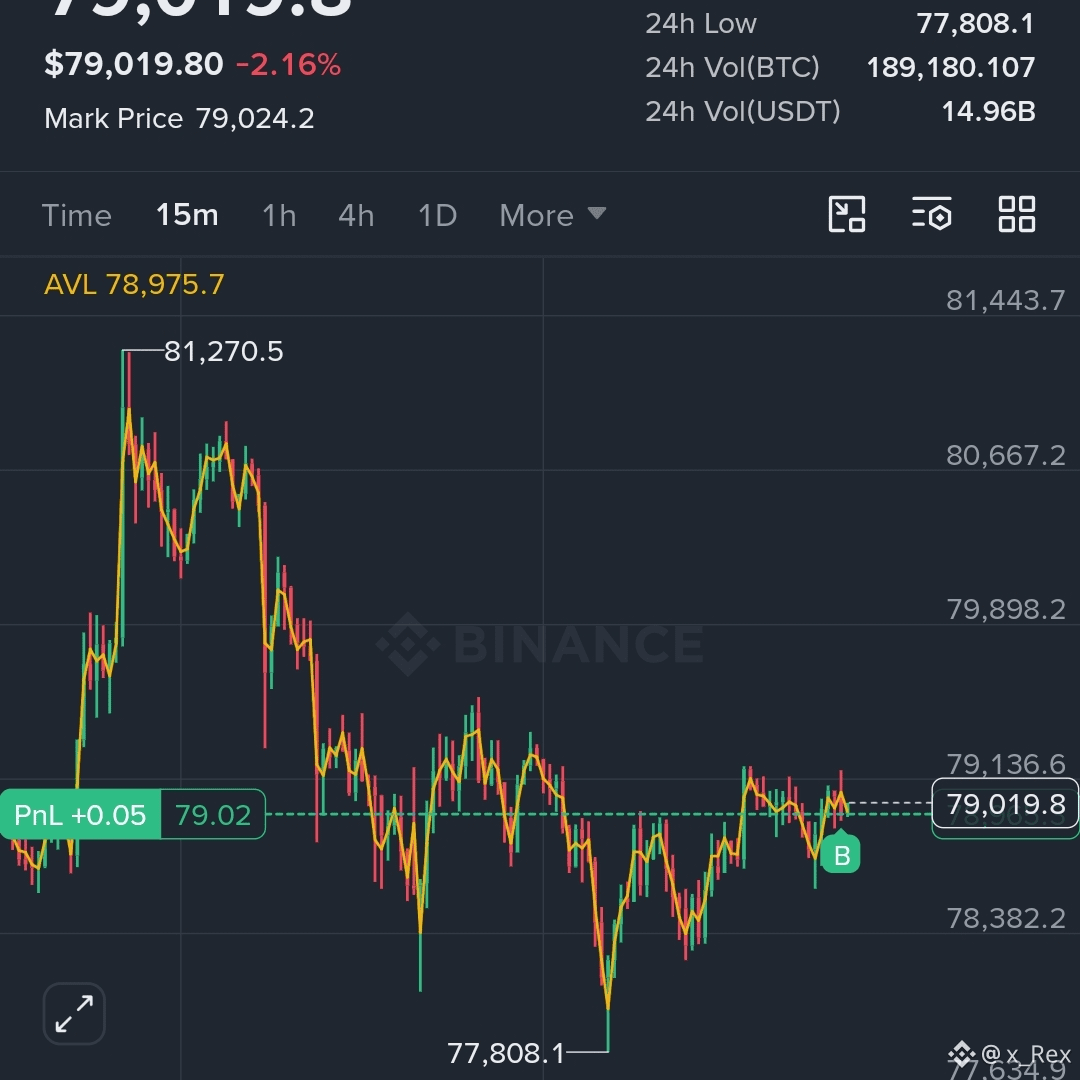
Today's Observation. The bounce off $77,808 is a genuine V, not a weak wick — but it's stalling exactly at proven resistance, so this is a "prove it" zone, not a confirmed breakout yet. Today's still red (-2.22%) on heavy volume, so treat this as a tactical bounce trade, not a reversal call.
Market Structure:
Sharp intraday flush followed by a real V-recovery that's now testing the underside of the zone it broke down from. Spiked to $81,270, crashed hard to $77,808, and has climbed back to $78,970 — currently consolidating right below the $79,136-79,898 shelf that was the pre-flush range.
Support: $78,382 (recent higher low in the recovery), then $77,808 (flush low)
Resistance: $79,136 (immediate), then $79,898, then $80,667, then $81,270 (session high)
Real recovery structure, but sitting right at the level that decides whether it continues or fails. Not financial advice.
👉DYOR.
Trading Setup
Bias: Bullish (recovery continuation)
Entry: $78,850 - $79,050
TP1: $79,136
TP2: $79,898
TP3: $80,667
SL: $78,380
Risk: SL sits just under the most recent higher low; TP1 is close (the actual reclaim test), TP2/3 need real follow-through back into the pre-flush range.
Keep a close eye on a 15m close above $79,136 with volume is the real signal — that's the exact level this bounce needs to reclaim to prove it's not just a dead-cat recovery.
Today's Observation. The bounce off $77,808 is a genuine V, not a weak wick — but it's stalling exactly at proven resistance, so this is a "prove it" zone, not a confirmed breakout yet. Today's still red (-2.22%) on heavy volume, so treat this as a tactical bounce trade, not a reversal call.
Market Structure:
Sharp intraday flush followed by a real V-recovery that's now testing the underside of the zone it broke down from. Spiked to $81,270, crashed hard to $77,808, and has climbed back to $78,970 — currently consolidating right below the $79,136-79,898 shelf that was the pre-flush range.
Support: $78,382 (recent higher low in the recovery), then $77,808 (flush low)
Resistance: $79,136 (immediate), then $79,898, then $80,667, then $81,270 (session high)
Real recovery structure, but sitting right at the level that decides whether it continues or fails. Not financial advice.
👉DYOR.
30D trade $DUSK 245.3 USDT
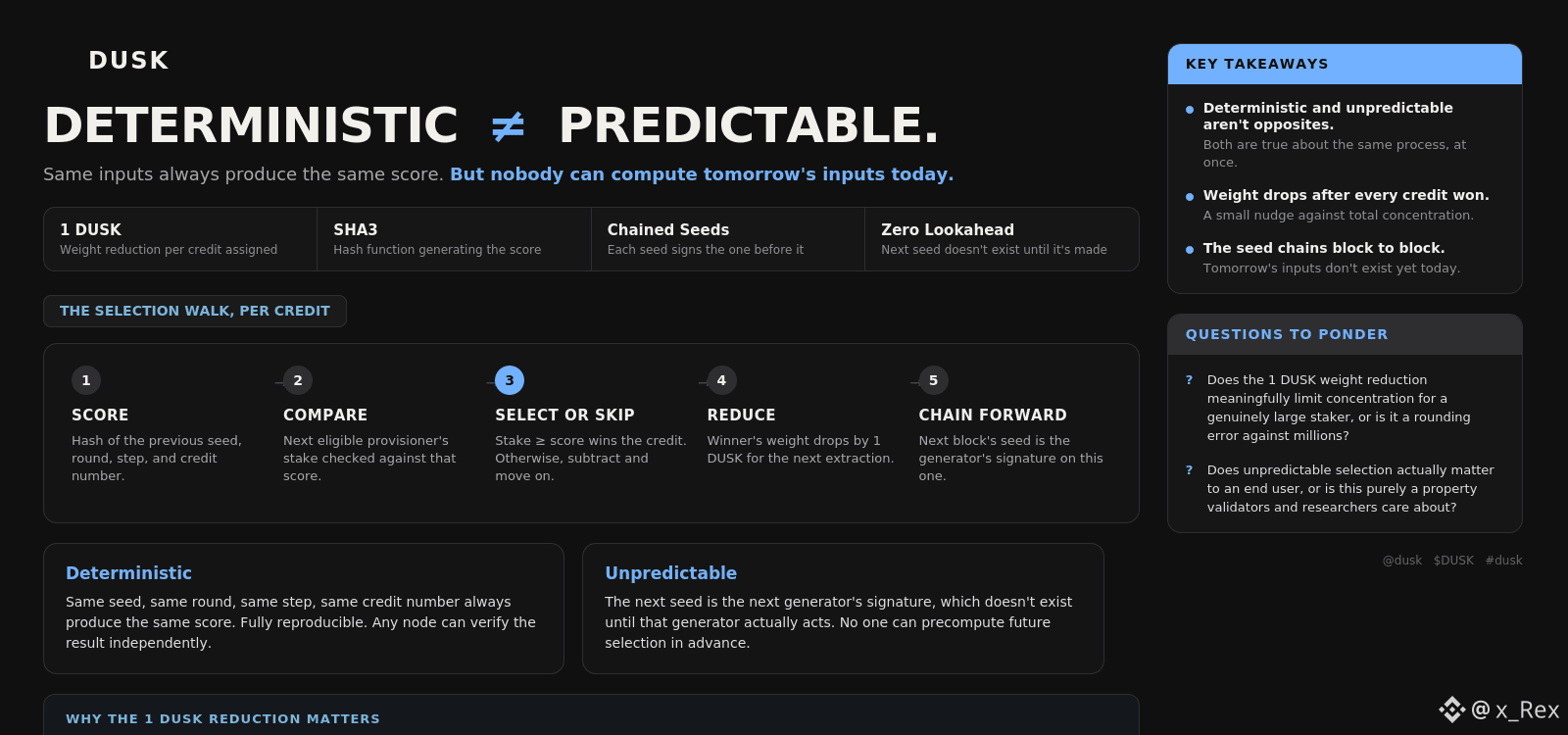
#dusk Picking deterministic sortition-the actual selection algorithm underneath staking
A generator can't know, two blocks from now, who's about to out-earn them.
Not because the process rolls dice.
It doesn't.
Every part of it is fully deterministic.
It's that the numbers determinism depends on haven't been created yet.
Let me explain.
I kept writing weighted by stake, but unpredictable in my earlier posts without ever explaining what actually is that.
A commenter asked in the replies how selection really works under the hood, so I went back to find the actual algorithm from he Mechanism docs, instead of repeating the same vague as everyone else.
The selection process is called deterministic sortition.
Here's the mechanism ⚙️.
Selection walks down the list of eligible provisioners in order.
Each one's stake gets checked against a score. Meet or beat it, you're in, credit assigned.
Fall short, your stake gets subtracted from the score, and the next provisioner in line gets checked instead.
The score itself comes from hashing four things together:
The previous block's seed, the current round, the current step, and which credit number is being handed out.
Feed it the same four inputs twice, you get the same score twice.
That's the deterministic half.
The unpredictable half is the seed.
Each block's seed is the generator's own signature on the seed before it.
Nothing about tomorrow's seed exists until tomorrow's generator actually signs it.
You can't front-run a number that hasn't been produced yet.
One more detail worth sitting with:
winning a credit costs you 1 DUSK of weight for the next extraction in that same round.
Small number, but it means a single enormous staker can't just sweep every credit in a committee outright.
The math leans, slightly, toward spreading it around.
I'm Curious whether that 1 $DUSK nudge actually does anything for a staker sitting on millions, or whether it's a rounding error dressed up as fairness
@Dusk
A generator can't know, two blocks from now, who's about to out-earn them.
Not because the process rolls dice.
It doesn't.
Every part of it is fully deterministic.
It's that the numbers determinism depends on haven't been created yet.
Let me explain.
I kept writing weighted by stake, but unpredictable in my earlier posts without ever explaining what actually is that.
A commenter asked in the replies how selection really works under the hood, so I went back to find the actual algorithm from he Mechanism docs, instead of repeating the same vague as everyone else.
The selection process is called deterministic sortition.
Here's the mechanism ⚙️.
Selection walks down the list of eligible provisioners in order.
Each one's stake gets checked against a score. Meet or beat it, you're in, credit assigned.
Fall short, your stake gets subtracted from the score, and the next provisioner in line gets checked instead.
The score itself comes from hashing four things together:
The previous block's seed, the current round, the current step, and which credit number is being handed out.
Feed it the same four inputs twice, you get the same score twice.
That's the deterministic half.
The unpredictable half is the seed.
Each block's seed is the generator's own signature on the seed before it.
Nothing about tomorrow's seed exists until tomorrow's generator actually signs it.
You can't front-run a number that hasn't been produced yet.
One more detail worth sitting with:
winning a credit costs you 1 DUSK of weight for the next extraction in that same round.
Small number, but it means a single enormous staker can't just sweep every credit in a committee outright.
The math leans, slightly, toward spreading it around.
I'm Curious whether that 1 $DUSK nudge actually does anything for a staker sitting on millions, or whether it's a rounding error dressed up as fairness
@Dusk
Is it really Four parts working as one!
Luke_龙
·
--
#dusk $DUSK
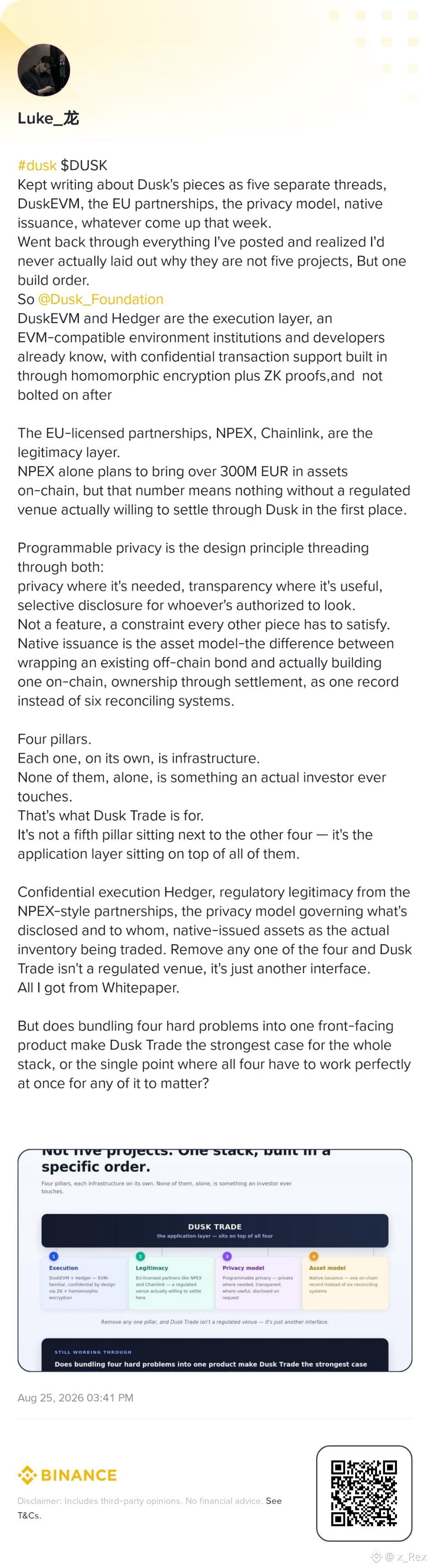
Kept writing about Dusk's pieces as five separate threads, DuskEVM, the EU partnerships, the privacy model, native issuance, whatever come up that week.
Went back through everything I've posted and realized I'd never actually laid out why they are not five projects, But one build order.
So @Dusk
DuskEVM and Hedger are the execution layer, an EVM-compatible environment institutions and developers already know, with confidential transaction support built in through homomorphic encryption plus ZK proofs,and not bolted on after
The EU-licensed partnerships, NPEX, Chainlink, are the legitimacy layer.
NPEX alone plans to bring over 300M EUR in assets on-chain, but that number means nothing without a regulated venue actually willing to settle through Dusk in the first place.
Programmable privacy is the design principle threading through both:
privacy where it's needed, transparency where it's useful, selective disclosure for whoever's authorized to look.
Not a feature, a constraint every other piece has to satisfy.
Native issuance is the asset model-the difference between wrapping an existing off-chain bond and actually building one on-chain, ownership through settlement, as one record instead of six reconciling systems.
Four pillars.
Each one, on its own, is infrastructure.
None of them, alone, is something an actual investor ever touches.
That's what Dusk Trade is for.
It's not a fifth pillar sitting next to the other four — it's the application layer sitting on top of all of them.
Confidential execution Hedger, regulatory legitimacy from the NPEX-style partnerships, the privacy model governing what's disclosed and to whom, native-issued assets as the actual inventory being traded. Remove any one of the four and Dusk Trade isn't a regulated venue, it's just another interface.
All I got from Whitepaper.
But does bundling four hard problems into one front-facing product make Dusk Trade the strongest case for the whole stack, or the single point where all four have to work perfectly at once for any of it to matter?
Kept writing about Dusk's pieces as five separate threads, DuskEVM, the EU partnerships, the privacy model, native issuance, whatever come up that week.
Went back through everything I've posted and realized I'd never actually laid out why they are not five projects, But one build order.
So @Dusk
DuskEVM and Hedger are the execution layer, an EVM-compatible environment institutions and developers already know, with confidential transaction support built in through homomorphic encryption plus ZK proofs,and not bolted on after
The EU-licensed partnerships, NPEX, Chainlink, are the legitimacy layer.
NPEX alone plans to bring over 300M EUR in assets on-chain, but that number means nothing without a regulated venue actually willing to settle through Dusk in the first place.
Programmable privacy is the design principle threading through both:
privacy where it's needed, transparency where it's useful, selective disclosure for whoever's authorized to look.
Not a feature, a constraint every other piece has to satisfy.
Native issuance is the asset model-the difference between wrapping an existing off-chain bond and actually building one on-chain, ownership through settlement, as one record instead of six reconciling systems.
Four pillars.
Each one, on its own, is infrastructure.
None of them, alone, is something an actual investor ever touches.
That's what Dusk Trade is for.
It's not a fifth pillar sitting next to the other four — it's the application layer sitting on top of all of them.
Confidential execution Hedger, regulatory legitimacy from the NPEX-style partnerships, the privacy model governing what's disclosed and to whom, native-issued assets as the actual inventory being traded. Remove any one of the four and Dusk Trade isn't a regulated venue, it's just another interface.
All I got from Whitepaper.
But does bundling four hard problems into one front-facing product make Dusk Trade the strongest case for the whole stack, or the single point where all four have to work perfectly at once for any of it to matter?
Verified
30D trade $DUSK 245.3 USDT
#dusk $DUSK @Dusk
Went back to the incentives section of the whitepaper after finishing the consensus part.
Skimmed it the first time, assumed block rewards were just whoever builds the block gets paid. Second pass, that assumption fell apart.
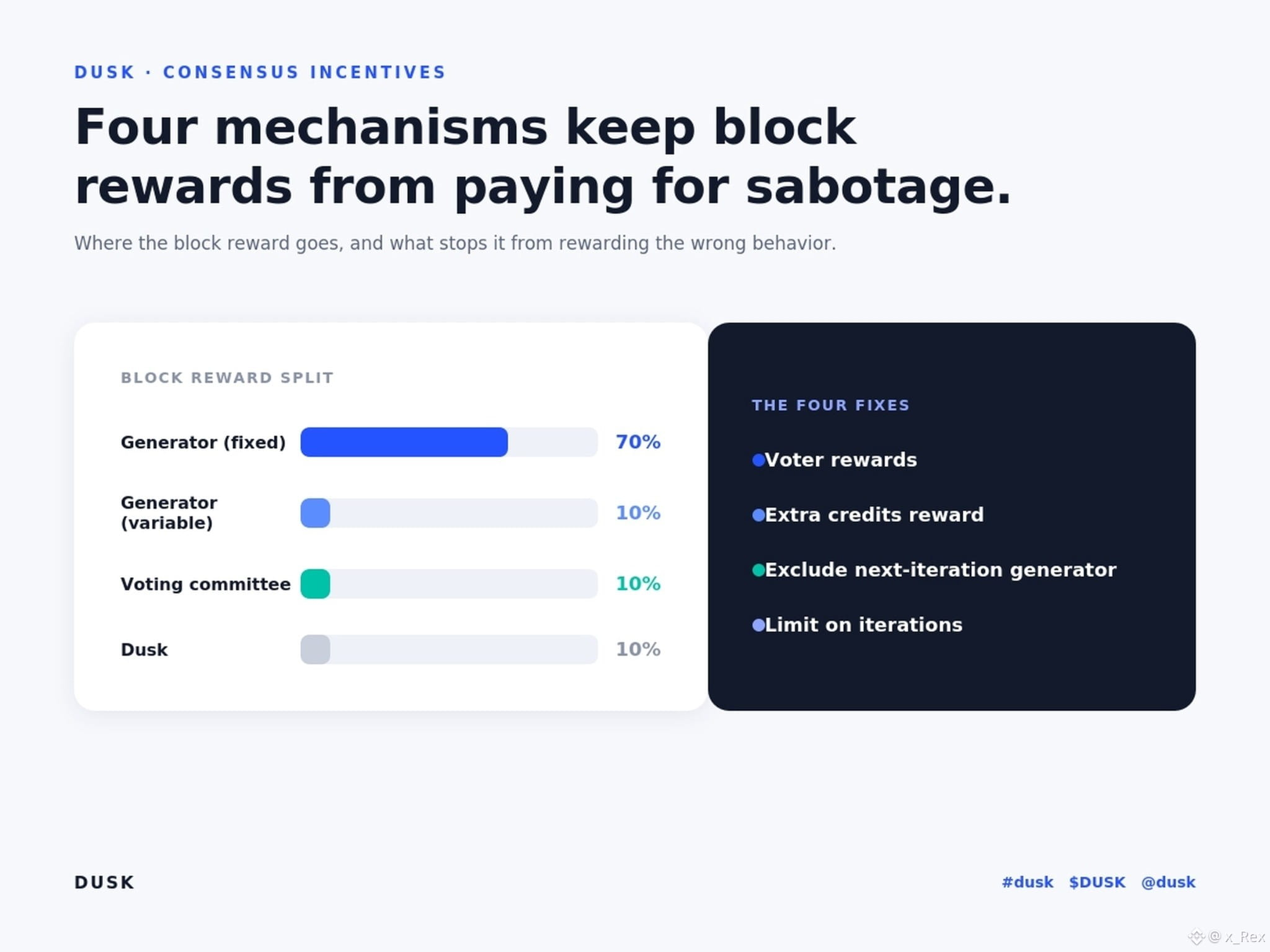
The reward split isn't flat. 80% to the generator, 10% to the voting committee, 10% to Dusk, but the generator's 80% is itself split into a fixed 70% and a variable 10% that depends on how many votes they actually bothered to include in the block certificate.
Skip votes = lose money.
That's not an accident, it's solving a specific problem.
Here's the PROBLEM:
Generators for every iteration in a round are knowable in advance.
Which means a generator scheduled for iteration 4 has a quiet incentive to just not show up for validation on iterations 1 through 3.
Let them fail, and iteration 4 becomes their payday instead of someone else's.
The protocol is essentially bribing its own future block producers not to sabotage the present ones.
The fix isn't one patch, it's FOUR stacked together:
voters get paid regardless of whether their vote wins, so participating beats waiting.
Generators lose reward share if they exclude known votes, so hiding votes costs them too.
Whoever's up next as generator is explicitly barred from voting in the current iteration, closing the most obvious version of the exploit. And the max number of iterations per round is capped, so there are only so many future generators worth sabotaging for.
What clicked for me is that none of these four mechanisms work alone, they're patching different angles of the same incentive gap, not one clean fix.
Selection decides who gets a shot at the reward.
Rewards then have to be shaped so that decision doesn't quietly reward bad behavior.
Still wondering: do these four mechanisms actually close the incentive gap, or just make sabotage less profitable?
Also Is needing four mitigations solid mechanism design—or evidence that the underlying predictability problem is harder to solve?
Went back to the incentives section of the whitepaper after finishing the consensus part.
Skimmed it the first time, assumed block rewards were just whoever builds the block gets paid. Second pass, that assumption fell apart.
The reward split isn't flat. 80% to the generator, 10% to the voting committee, 10% to Dusk, but the generator's 80% is itself split into a fixed 70% and a variable 10% that depends on how many votes they actually bothered to include in the block certificate.
Skip votes = lose money.
That's not an accident, it's solving a specific problem.
Here's the PROBLEM:
Generators for every iteration in a round are knowable in advance.
Which means a generator scheduled for iteration 4 has a quiet incentive to just not show up for validation on iterations 1 through 3.
Let them fail, and iteration 4 becomes their payday instead of someone else's.
The protocol is essentially bribing its own future block producers not to sabotage the present ones.
The fix isn't one patch, it's FOUR stacked together:
voters get paid regardless of whether their vote wins, so participating beats waiting.
Generators lose reward share if they exclude known votes, so hiding votes costs them too.
Whoever's up next as generator is explicitly barred from voting in the current iteration, closing the most obvious version of the exploit. And the max number of iterations per round is capped, so there are only so many future generators worth sabotaging for.
What clicked for me is that none of these four mechanisms work alone, they're patching different angles of the same incentive gap, not one clean fix.
Selection decides who gets a shot at the reward.
Rewards then have to be shaped so that decision doesn't quietly reward bad behavior.
Still wondering: do these four mechanisms actually close the incentive gap, or just make sabotage less profitable?
Also Is needing four mitigations solid mechanism design—or evidence that the underlying predictability problem is harder to solve?
30D trade $DUSK 45.1 USDT
#dusk $DUSK @Dusk
Kept running into the same word across a dozen different Dusk docs without ever actually reading what it DOES.
CITADEL.
Always mentioned in passing, always in a components table, but never explained on its own.
Finally sat down and read the actual identity protocol paper this weekend instead of skimming past it again for other topics in DUSK.
Most compliance checks work the blunt way. Prove you're accredited, hand over your entire financial history.
Prove you're old enough, hand over your full date of birth and government ID.
The system only needed one fact.
It gets your whole file instead.
Citadel is built around a narrower idea:
prove the specific attribute, not the document behind it.
Residency, age bracket, accreditation status, whatever a given workflow actually requires.
The Credential gets issued once, and after that you're proving a fact about yourself without handing over the paperwork that fact came from.
The part that took me longest to actually get: this isn't the same thing as a shielded transaction.
Phoenix hides TRANSACTION details.
Citadel hides IDENTITY details.
But still produces something a license contract can check and accept before letting you do whatever the workflow requires, staking, holding a regulated asset, whatever gate it's sitting behind.
Once I saw that distinction, the earlier posts clicked into place differently.
Selective disclosure for transfers is one problem.
Selective disclosure for the person doing the transfer is a Separate one, Sitting underneath it.
Same underlying design decision, two totally different pieces of a workflow.
But there's still a Question I want to Ask.
Is proving an attribute without the document actually stronger privacy, or does it just move the sensitive part somewhere else, to whoever issued the credential in the first place?
Kept running into the same word across a dozen different Dusk docs without ever actually reading what it DOES.
CITADEL.
Always mentioned in passing, always in a components table, but never explained on its own.
Finally sat down and read the actual identity protocol paper this weekend instead of skimming past it again for other topics in DUSK.
Most compliance checks work the blunt way. Prove you're accredited, hand over your entire financial history.
Prove you're old enough, hand over your full date of birth and government ID.
The system only needed one fact.
It gets your whole file instead.
Citadel is built around a narrower idea:
prove the specific attribute, not the document behind it.
Residency, age bracket, accreditation status, whatever a given workflow actually requires.
The Credential gets issued once, and after that you're proving a fact about yourself without handing over the paperwork that fact came from.
The part that took me longest to actually get: this isn't the same thing as a shielded transaction.
Phoenix hides TRANSACTION details.
Citadel hides IDENTITY details.
But still produces something a license contract can check and accept before letting you do whatever the workflow requires, staking, holding a regulated asset, whatever gate it's sitting behind.
Once I saw that distinction, the earlier posts clicked into place differently.
Selective disclosure for transfers is one problem.
Selective disclosure for the person doing the transfer is a Separate one, Sitting underneath it.
Same underlying design decision, two totally different pieces of a workflow.
But there's still a Question I want to Ask.
Is proving an attribute without the document actually stronger privacy, or does it just move the sensitive part somewhere else, to whoever issued the credential in the first place?

Verified
30D trade $DUSK 45.1 USDT
#dusk $DUSK @Dusk
Someone replied to my last Dusk post asking why I never explained the block reward split.
A FAIR CALLOUT👍.
So I went to whitepaper yesterday again, to answer it properly, and got stuck on a different section instead: how a block that just got voted on actually reaches everyone else fast enough to matter.
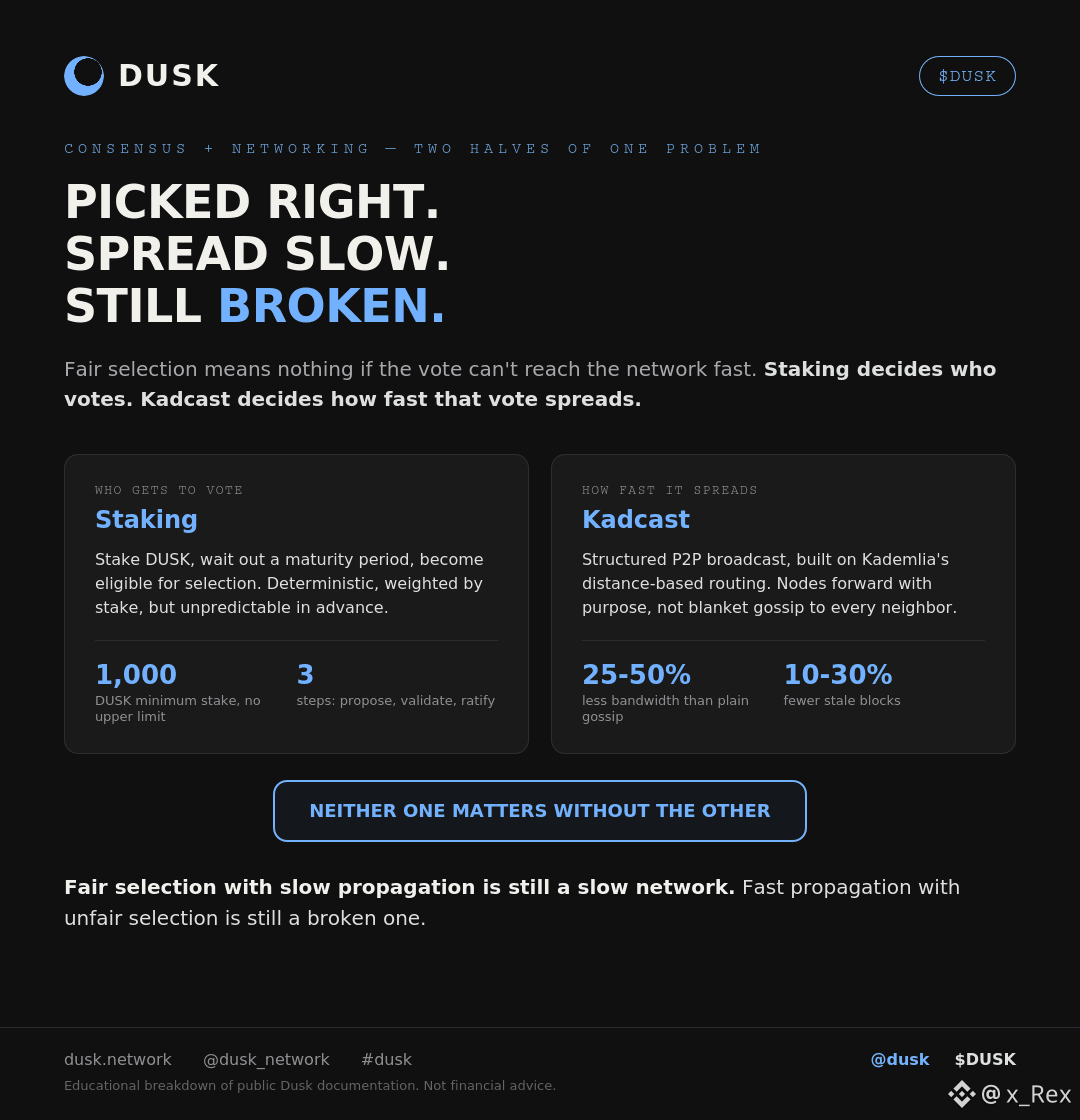
Staking decides who gets picked to vote.But picking the right validator solves nothing if their vote takes forever to reach the network.
That's what Kadcast is for.
Most blockchain networks broadcast the blunt way.
Gossip, where a node forwards to neighbors who forward to more neighbors, with a lot of duplicate transmission.
Kadcast is more structured.
It's built on Kademlia, the distributed hash table design used in peer-to-peer file systems, and routes messages based on how far nodes are from each other, not just who's nearby.
The number that surprised me: this gets roughly 25 to 50 percent less bandwidth usage than plain gossip, since nodes aren't blasting the same message at everyone in range.
There's a knock-on effect too, about a 10 to 30 percent drop in stale blocks, blocks that got produced but didn't make the final chain in time.
Less wasted propagation means fewer blocks that show up too late to count.
Once I connected the two, staking and Kadcast stopped looking like separate topics.
One decides who gets to vote.
The other decides how fast that vote spreads to everyone who needs it.
Fair selection with slow propagation is still a slow network.
Fast propagation with unfair selection is still a broken one.
Nobody writes threads about the P2P layer. Privacy gets threads. Compliance gets threads. But this is the piece deciding whether a fast consensus mechanism is fast in practice or just fast on paper.
Genuinely curious though Does Kadcast's advantage grow with network size, or shrink once validators are already few and well-connected?
Also.
Is bandwidth efficiency an actual edge for a financial-settlement chain, or is fast message propagation a solved problem industry-wide already?
Someone replied to my last Dusk post asking why I never explained the block reward split.
A FAIR CALLOUT👍.
So I went to whitepaper yesterday again, to answer it properly, and got stuck on a different section instead: how a block that just got voted on actually reaches everyone else fast enough to matter.
Staking decides who gets picked to vote.But picking the right validator solves nothing if their vote takes forever to reach the network.
That's what Kadcast is for.
Most blockchain networks broadcast the blunt way.
Gossip, where a node forwards to neighbors who forward to more neighbors, with a lot of duplicate transmission.
Kadcast is more structured.
It's built on Kademlia, the distributed hash table design used in peer-to-peer file systems, and routes messages based on how far nodes are from each other, not just who's nearby.
The number that surprised me: this gets roughly 25 to 50 percent less bandwidth usage than plain gossip, since nodes aren't blasting the same message at everyone in range.
There's a knock-on effect too, about a 10 to 30 percent drop in stale blocks, blocks that got produced but didn't make the final chain in time.
Less wasted propagation means fewer blocks that show up too late to count.
Once I connected the two, staking and Kadcast stopped looking like separate topics.
One decides who gets to vote.
The other decides how fast that vote spreads to everyone who needs it.
Fair selection with slow propagation is still a slow network.
Fast propagation with unfair selection is still a broken one.
Nobody writes threads about the P2P layer. Privacy gets threads. Compliance gets threads. But this is the piece deciding whether a fast consensus mechanism is fast in practice or just fast on paper.
Genuinely curious though Does Kadcast's advantage grow with network size, or shrink once validators are already few and well-connected?
Also.
Is bandwidth efficiency an actual edge for a financial-settlement chain, or is fast message propagation a solved problem industry-wide already?
Log in to explore more content