
最佳第6人
1.8k Posts

最佳第6人
 Square Verified+
以市场为师,与趋势为友。尊重常识,尊重规律,尊重市场,尊重人性,遵守纪律。我相信我就是万中无一的交易天才,币圈气运之子,Web3天命第六人。
Open Trade
Frequent Trader
5.3 Years
2.5K+ Following
61.0K+ Followers
36.0K+ Liked
Posts
Portfolio
All
Videos
Live
PINNED
PINNED
In the book, there is beauty like jade; in the book, there is a trove of gold.


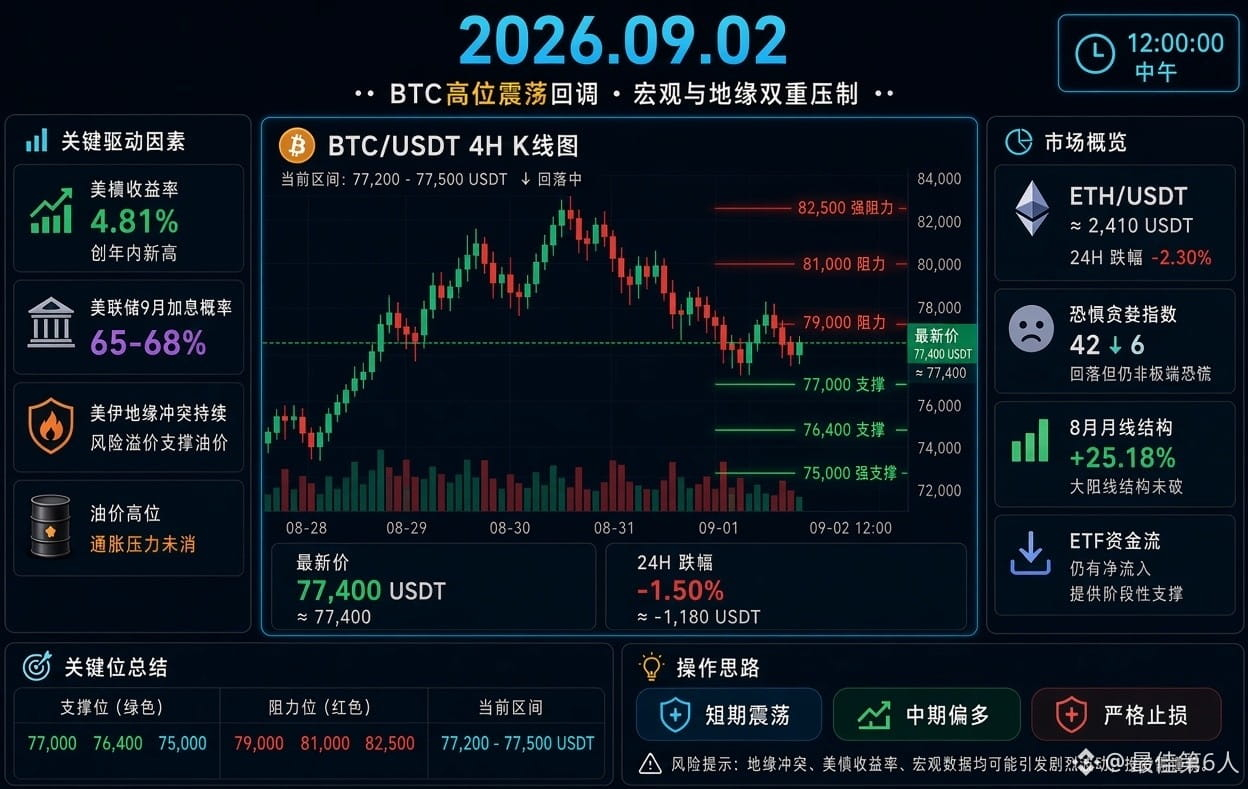
Bitcoin surged 25% in August. At the beginning of September, the overall trend is still slightly bullish, but this morning the price dipped a little due to some international conflicts and the broader macro environment. Don’t panic, though—this is just a normal “rest stop at high levels,” and there hasn’t been any panic-driven large-scale selloff.
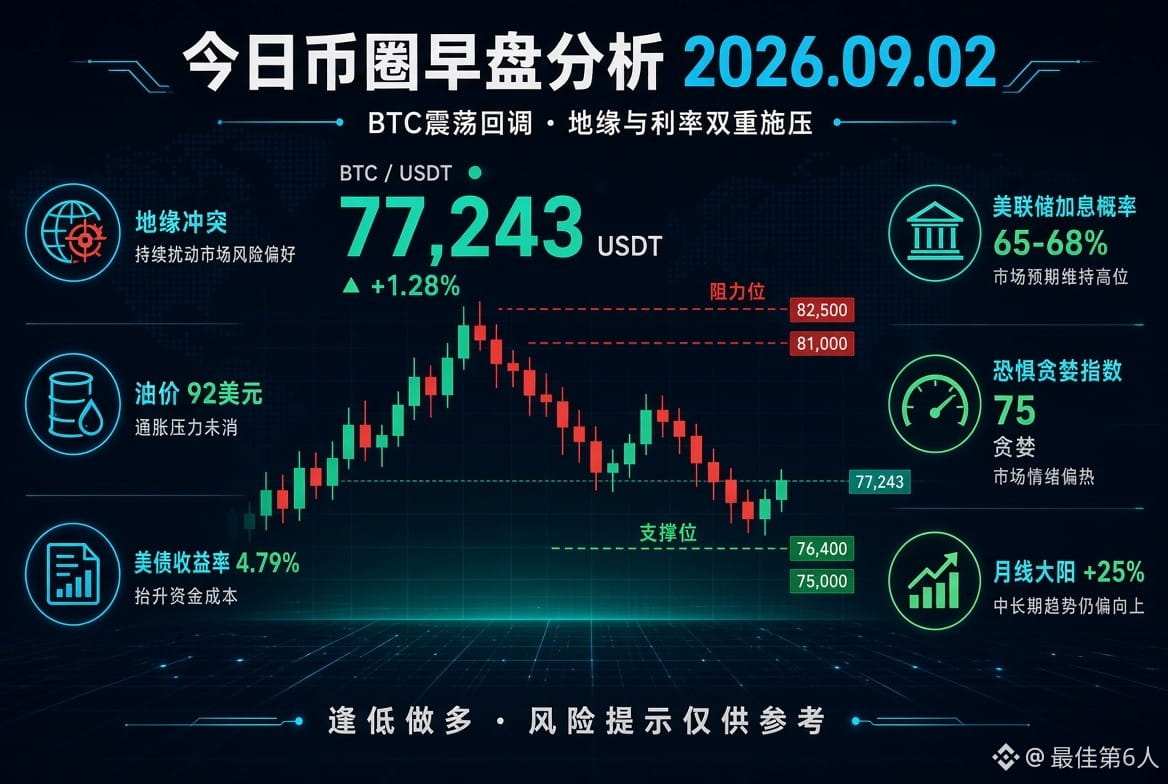
Bitcoin is currently trading around $76,400 to $79,200, down about 1% to 2.3% from yesterday. Ethereum also slipped a bit, roughly between $2,400 and $2,480. Other coins such as Solana, BNB, and so on are also down slightly—about 1% to 3%. The current market sentiment index is between 69 and 75.
Why is it falling today?
Mainly for two reasons. First, things are a bit tense internationally: the U.S. has taken military actions toward Iran, causing oil prices to spike. People are worried about inflation, so they’re less willing to touch assets like Bitcoin that don’t generate interest. Second, interest rates are too high. The U.S. 10-year Treasury yield has risen to 4.79%, and many believe there’s a high probability of the Fed hiking rates again in September. In a high-interest environment, Bitcoin doesn’t look as attractive. That said, it’s still good news that money is continuing to flow into the spot ETFs, which suggests big institutions are still paying attention.
If Bitcoin keeps falling, $76,400 and $75,000 are two key support levels. As long as it doesn’t break below $75,000, things should be okay. If it moves upward, it needs to first break through the resistance zone of $77,600 to $79,000. If it can hold above $80,000, there may be room for further big gains. Right now, it’s likely to range between $74,000 and $82,800. Overall, the trend is still slightly bullish, which makes it suitable for buying on dips.
If the broader market can hold the $75,000+ floor, there’s hope of pushing back toward $80,000. But if it breaks below that floor, it may dip further. September is likely to be a choppy back-and-forth market. Everyone can pay extra attention to the U.S. nonfarm payrolls data on September 5. In short, this is a “orderly pullback,” not a breakdown. For short-term trading, focus on risk control; the logic for buying on dips in the medium term still holds.
The crypto market’s up-and-down swings are even more exciting than a roller coaster. International developments and Fed policy can change the market’s face at any time. What I shared above is only meant to help everyone make sense of the current market—it’s absolutely not investment advice telling you to rush in with your eyes closed. Everyone should act according to the thickness of their own wallet. Don’t get carried away! $BTC
Bitcoin is currently trading around $76,400 to $79,200, down about 1% to 2.3% from yesterday. Ethereum also slipped a bit, roughly between $2,400 and $2,480. Other coins such as Solana, BNB, and so on are also down slightly—about 1% to 3%. The current market sentiment index is between 69 and 75.
Why is it falling today?
Mainly for two reasons. First, things are a bit tense internationally: the U.S. has taken military actions toward Iran, causing oil prices to spike. People are worried about inflation, so they’re less willing to touch assets like Bitcoin that don’t generate interest. Second, interest rates are too high. The U.S. 10-year Treasury yield has risen to 4.79%, and many believe there’s a high probability of the Fed hiking rates again in September. In a high-interest environment, Bitcoin doesn’t look as attractive. That said, it’s still good news that money is continuing to flow into the spot ETFs, which suggests big institutions are still paying attention.
If Bitcoin keeps falling, $76,400 and $75,000 are two key support levels. As long as it doesn’t break below $75,000, things should be okay. If it moves upward, it needs to first break through the resistance zone of $77,600 to $79,000. If it can hold above $80,000, there may be room for further big gains. Right now, it’s likely to range between $74,000 and $82,800. Overall, the trend is still slightly bullish, which makes it suitable for buying on dips.
If the broader market can hold the $75,000+ floor, there’s hope of pushing back toward $80,000. But if it breaks below that floor, it may dip further. September is likely to be a choppy back-and-forth market. Everyone can pay extra attention to the U.S. nonfarm payrolls data on September 5. In short, this is a “orderly pullback,” not a breakdown. For short-term trading, focus on risk control; the logic for buying on dips in the medium term still holds.
The crypto market’s up-and-down swings are even more exciting than a roller coaster. International developments and Fed policy can change the market’s face at any time. What I shared above is only meant to help everyone make sense of the current market—it’s absolutely not investment advice telling you to rush in with your eyes closed. Everyone should act according to the thickness of their own wallet. Don’t get carried away! $BTC





Verified
In my view, Dusk Network has managed to stand out among numerous privacy public chains primarily because it precisely addresses the most difficult contradiction in real-world asset (RWA) tokenization: how to meet stringent regulatory compliance requirements while ensuring commercial privacy. After taking a deep dive into its underlying architecture, I’ve found that this isn’t a simple stacking of features, but a deep native integration from the consensus layer all the way to the application layer.
First, Dusk’s Succinct Attestation (SA) consensus mechanism lays the foundation for enterprise-grade applications. Unlike the probabilistic finality of traditional public chains, SA provides deterministic finality—meaning once a transaction is confirmed, it becomes irreversible. This perfectly matches the strict need for settlement certainty in traditional finance. Even better, its introduced “blind attestation” mechanism uses zero-knowledge proofs to verify the eligibility of validators. While safeguarding network security, it also completely hides validators’ staked amounts and identities, preventing leakage of commercial intent at the foundational level.
On the execution layer, Dusk, through the combination of the Zedger architecture and the Piecrust virtual machine, achieves truly confidential smart contracts. Zedger is designed specifically for regulated assets, with transfer restrictions, corporate actions such as profit distributions, and other behaviors directly encoded on-chain. Meanwhile, the Piecrust virtual machine—by optimizing cryptographic primitives—significantly reduces the verification cost of zero-knowledge proofs. With this design, complex financial logic can run inside a “black box”; the network only verifies the correctness of results without exposing sensitive holdings or strategy data.
However, what truly sets Dusk apart from other privacy chains is its brilliant real-world capability for “selective disclosure.” Relying on the Citadel identity protocol and the Phoenix privacy model, Dusk builds a complete zero-knowledge compliance system. In RWA trading scenarios, institutions don’t need to publicly disclose trade details to the entire network. They only need to provide zero-knowledge proofs to regulators or auditors, thereby proving compliance with regulatory requirements such as KYC/AML and MiCA without revealing specific amounts and identities. This mechanism of “confidentiality to the public, transparency to regulators” is precisely the key that enables Dusk to carry trillion-level compliant financial assets.
#dusk $DUSK @Dusk
First, Dusk’s Succinct Attestation (SA) consensus mechanism lays the foundation for enterprise-grade applications. Unlike the probabilistic finality of traditional public chains, SA provides deterministic finality—meaning once a transaction is confirmed, it becomes irreversible. This perfectly matches the strict need for settlement certainty in traditional finance. Even better, its introduced “blind attestation” mechanism uses zero-knowledge proofs to verify the eligibility of validators. While safeguarding network security, it also completely hides validators’ staked amounts and identities, preventing leakage of commercial intent at the foundational level.
On the execution layer, Dusk, through the combination of the Zedger architecture and the Piecrust virtual machine, achieves truly confidential smart contracts. Zedger is designed specifically for regulated assets, with transfer restrictions, corporate actions such as profit distributions, and other behaviors directly encoded on-chain. Meanwhile, the Piecrust virtual machine—by optimizing cryptographic primitives—significantly reduces the verification cost of zero-knowledge proofs. With this design, complex financial logic can run inside a “black box”; the network only verifies the correctness of results without exposing sensitive holdings or strategy data.
However, what truly sets Dusk apart from other privacy chains is its brilliant real-world capability for “selective disclosure.” Relying on the Citadel identity protocol and the Phoenix privacy model, Dusk builds a complete zero-knowledge compliance system. In RWA trading scenarios, institutions don’t need to publicly disclose trade details to the entire network. They only need to provide zero-knowledge proofs to regulators or auditors, thereby proving compliance with regulatory requirements such as KYC/AML and MiCA without revealing specific amounts and identities. This mechanism of “confidentiality to the public, transparency to regulators” is precisely the key that enables Dusk to carry trillion-level compliant financial assets.
#dusk $DUSK @Dusk
·
--
🎙️ Superman 100U fixed investment in BTC on day 12, DUSK long or short

End
02 h 23 m 12 s
7.5k
15
Today, as the public-chain track grows increasingly crowded, Dusk Network has chosen an exceptionally difficult path: trying to completely solve the zero-sum game of “compliance and privacy” at the very base of Layer 1. This is not a simple technical upgrade, but a full-scale rearchitecture of traditional public-chain design.
Dusk’s core ambition is “auditable privacy.” Unlike Oasis, which isolates privacy within ParaTime, Dusk embeds zero-knowledge proofs into the protocol layer, enabling default-confidential financial logic through confidential smart contracts (XSC). This means regulators can verify the legitimacy of transactions via cryptography without peeking into commercial secrets. This “do hard privacy first, then talk compliance” approach precisely targets the pain points of RWA (real-world asset) tokenization, offering what is, in theory, a perfect solution for regulated on-chain finance.
However, ideals are full and reality is harsh. This kind of underlying rework brings extremely high engineering friction. By abandoning the EVM state model and switching to the UTXO-based Rusk virtual machine, developers must relearn an entirely new programming paradigm—debugging can feel like “groping for an elephant in a dark box.” Even more fatal are the performance bottlenecks: the high computational cost of zero-knowledge proofs rapidly inflates the ledger, makes node synchronization difficult, and still leaves a significant gap from institutional-grade high-frequency clearing.
Looking back at token value, $DUSK faces a severe test. Its long, 36-year token release schedule creates persistent inflation pressure. Without sufficient real RWA settlement volume to generate enough Gas burn, the token is all too likely to become merely a PoS staking tool. Although the team is working to reduce friction—by collaborating with the Dutch exchange NPEX and launching DuskEVM to bring in real business—the high concentration of the stakes remains the ever-hanging sword of Damocles.
Dusk isn’t just racing for throughput; it is seriously answering a fundamental question: can on-chain finance be both verifiable and hideable? Can it become “basic, boring infrastructure” in the eyes of regulated institutions? In the end, it doesn’t depend on the technical whitepaper—it depends on whether it can make financial institutions willing to pay for this “compliant privacy” and truly run massive settlement volumes. Until real clearing volume arrives, maintaining due reverence may be the best strategy for investors.
#dusk $DUSK @Dusk
Dusk’s core ambition is “auditable privacy.” Unlike Oasis, which isolates privacy within ParaTime, Dusk embeds zero-knowledge proofs into the protocol layer, enabling default-confidential financial logic through confidential smart contracts (XSC). This means regulators can verify the legitimacy of transactions via cryptography without peeking into commercial secrets. This “do hard privacy first, then talk compliance” approach precisely targets the pain points of RWA (real-world asset) tokenization, offering what is, in theory, a perfect solution for regulated on-chain finance.
However, ideals are full and reality is harsh. This kind of underlying rework brings extremely high engineering friction. By abandoning the EVM state model and switching to the UTXO-based Rusk virtual machine, developers must relearn an entirely new programming paradigm—debugging can feel like “groping for an elephant in a dark box.” Even more fatal are the performance bottlenecks: the high computational cost of zero-knowledge proofs rapidly inflates the ledger, makes node synchronization difficult, and still leaves a significant gap from institutional-grade high-frequency clearing.
Looking back at token value, $DUSK faces a severe test. Its long, 36-year token release schedule creates persistent inflation pressure. Without sufficient real RWA settlement volume to generate enough Gas burn, the token is all too likely to become merely a PoS staking tool. Although the team is working to reduce friction—by collaborating with the Dutch exchange NPEX and launching DuskEVM to bring in real business—the high concentration of the stakes remains the ever-hanging sword of Damocles.
Dusk isn’t just racing for throughput; it is seriously answering a fundamental question: can on-chain finance be both verifiable and hideable? Can it become “basic, boring infrastructure” in the eyes of regulated institutions? In the end, it doesn’t depend on the technical whitepaper—it depends on whether it can make financial institutions willing to pay for this “compliant privacy” and truly run massive settlement volumes. Until real clearing volume arrives, maintaining due reverence may be the best strategy for investors.
#dusk $DUSK @Dusk
Partly True
I reran Dusk’s testnet—not to look at the prices, but to confirm one thing: when compliance and privacy are hard-coded into Layer 1, has the ledger structure really changed?
In the past, we always treated confidentiality and compliance as mortal enemies. But Dusk is trying to sort out this relationship from the ground up. Traditional public chains rely on “full transparency” to reduce verification costs; however, real-world financial markets simply can’t afford the cost of having order flow and positions exposed. Dusk’s Confidential Security Contracts (XSC) provide the answer: using zero-knowledge proofs, automatic enforcement of compliance rules such as eligibility and limits without exposing sensitive data.
But privacy isn’t magic—it brings very high engineering hurdles. Dusk’s Rusk virtual machine completely abandons EVM’s state model. Writing transfer contracts now requires rethinking the underlying note structure. When debugging confidential transfers, event logs automatically hide amounts—great for audits, but troubleshooting feels like trying to find your way in a black box.
I compared Oasis and Concordium as well. Oasis isolates confidential state within the ParaTime layer; the main chain remains transparent and it is EVM-compatible, so migration costs are low. Concordium, on the other hand, handles on-chain identity first and only then discusses privacy. Dusk goes the opposite way: it insists that the entire settlement layer runs in encrypted state. This path—“hard privacy first, then compliance interfaces”—does fit the settlement logic of security tokens, but the trade-off is heavy: during node synchronization, the ledger grows extremely fast, and the zero-knowledge proof delay is on the order of seconds even on standard machines, still far from institutional-grade high-frequency settlement.
So Dusk’s real test isn’t benchmark scores. It’s whether it can become “basic, boring infrastructure” in the eyes of regulated institutions—not some exotic frontier technology. And how much friction cost are financial users actually willing to pay for this kind of privacy?
Coming back to the token itself, the logic behind $DUSK doesn’t deviate. If there isn’t real institutional settlement volume to back it up, it can only be a staking-yield instrument. I won’t ignore that risk just because the technical approach looks clean. Dusk isn’t racing to maximize throughput—it’s seriously answering this question: can on-chain finance be both verifiable and private? As for the answer, we’ll have to wait for real settlement volume to verify.
#dusk $DUSK @Dusk
In the past, we always treated confidentiality and compliance as mortal enemies. But Dusk is trying to sort out this relationship from the ground up. Traditional public chains rely on “full transparency” to reduce verification costs; however, real-world financial markets simply can’t afford the cost of having order flow and positions exposed. Dusk’s Confidential Security Contracts (XSC) provide the answer: using zero-knowledge proofs, automatic enforcement of compliance rules such as eligibility and limits without exposing sensitive data.
But privacy isn’t magic—it brings very high engineering hurdles. Dusk’s Rusk virtual machine completely abandons EVM’s state model. Writing transfer contracts now requires rethinking the underlying note structure. When debugging confidential transfers, event logs automatically hide amounts—great for audits, but troubleshooting feels like trying to find your way in a black box.
I compared Oasis and Concordium as well. Oasis isolates confidential state within the ParaTime layer; the main chain remains transparent and it is EVM-compatible, so migration costs are low. Concordium, on the other hand, handles on-chain identity first and only then discusses privacy. Dusk goes the opposite way: it insists that the entire settlement layer runs in encrypted state. This path—“hard privacy first, then compliance interfaces”—does fit the settlement logic of security tokens, but the trade-off is heavy: during node synchronization, the ledger grows extremely fast, and the zero-knowledge proof delay is on the order of seconds even on standard machines, still far from institutional-grade high-frequency settlement.
So Dusk’s real test isn’t benchmark scores. It’s whether it can become “basic, boring infrastructure” in the eyes of regulated institutions—not some exotic frontier technology. And how much friction cost are financial users actually willing to pay for this kind of privacy?
Coming back to the token itself, the logic behind $DUSK doesn’t deviate. If there isn’t real institutional settlement volume to back it up, it can only be a staking-yield instrument. I won’t ignore that risk just because the technical approach looks clean. Dusk isn’t racing to maximize throughput—it’s seriously answering this question: can on-chain finance be both verifiable and private? As for the answer, we’ll have to wait for real settlement volume to verify.
#dusk $DUSK @Dusk
Over the past few days, I went through privacy chains and RWA-related projects again, and the more I looked, the more I felt that Dusk’s approach is quite distinctive. Most projects either push privacy to the extreme (like Monero, Zcash—nearly completely anonymous), or scale up size and liquidity (like Ondo, Centrifuge). But the bottleneck that institutions often run into is this: they don’t want their holdings and trading details fully exposed, yet they must still be able to work with regulatory audits. With pure privacy coins, the privacy is strong, but there’s basically no smart contracts or compliance tooling—so it’s hard for institutions to use.
General-purpose privacy platforms are more flexible for computation and DeFi, but they don’t offer enough support for financial scenarios like securities issuance and admission control.
Mainstream RWA projects are ahead in scale, yet most on-chain data is still transparent, with limited protection for sensitive information. Dusk gives me the impression that it’s deliberately taking the middle path. It uses zero-knowledge proofs so transactions can be confidential by default, while still preserving the ability to disclose when needed. Add an identity system and a finance-grade settlement design, and it looks like it’s aiming straight at “making it truly usable by institutions.” Of course, we should also be clear that its current ecosystem size and real usage data aren’t that big yet, and the rollout pace still needs further observation. But its positioning is very clear—especially in a European compliance environment, I think this “can be hidden and still governed” direction is more targeted than simply trying to outdo others on privacy strength or on TVL. Have you been paying attention to projects in this privacy-compliance direction recently? Do you like the ones that already have scale, or the ones with a more precise positioning? Let’s discuss in the comments.
Which kind of privacy/RWA projects do you like more?
#dusk $DUSK @Dusk
General-purpose privacy platforms are more flexible for computation and DeFi, but they don’t offer enough support for financial scenarios like securities issuance and admission control.
Mainstream RWA projects are ahead in scale, yet most on-chain data is still transparent, with limited protection for sensitive information. Dusk gives me the impression that it’s deliberately taking the middle path. It uses zero-knowledge proofs so transactions can be confidential by default, while still preserving the ability to disclose when needed. Add an identity system and a finance-grade settlement design, and it looks like it’s aiming straight at “making it truly usable by institutions.” Of course, we should also be clear that its current ecosystem size and real usage data aren’t that big yet, and the rollout pace still needs further observation. But its positioning is very clear—especially in a European compliance environment, I think this “can be hidden and still governed” direction is more targeted than simply trying to outdo others on privacy strength or on TVL. Have you been paying attention to projects in this privacy-compliance direction recently? Do you like the ones that already have scale, or the ones with a more precise positioning? Let’s discuss in the comments.
Which kind of privacy/RWA projects do you like more?
#dusk $DUSK @Dusk
定位精准、强调隐私+合规的(如 Dusk 类)
100%
规模和流动性已经起来的(如 Ondo 类)
0%
还在观望,看落地再说
0%
4 votes • Voting closed
Scumbags in Wall Street suits, stop drooling over my PPT—take a look at the four “trump cards” in my pocket first.
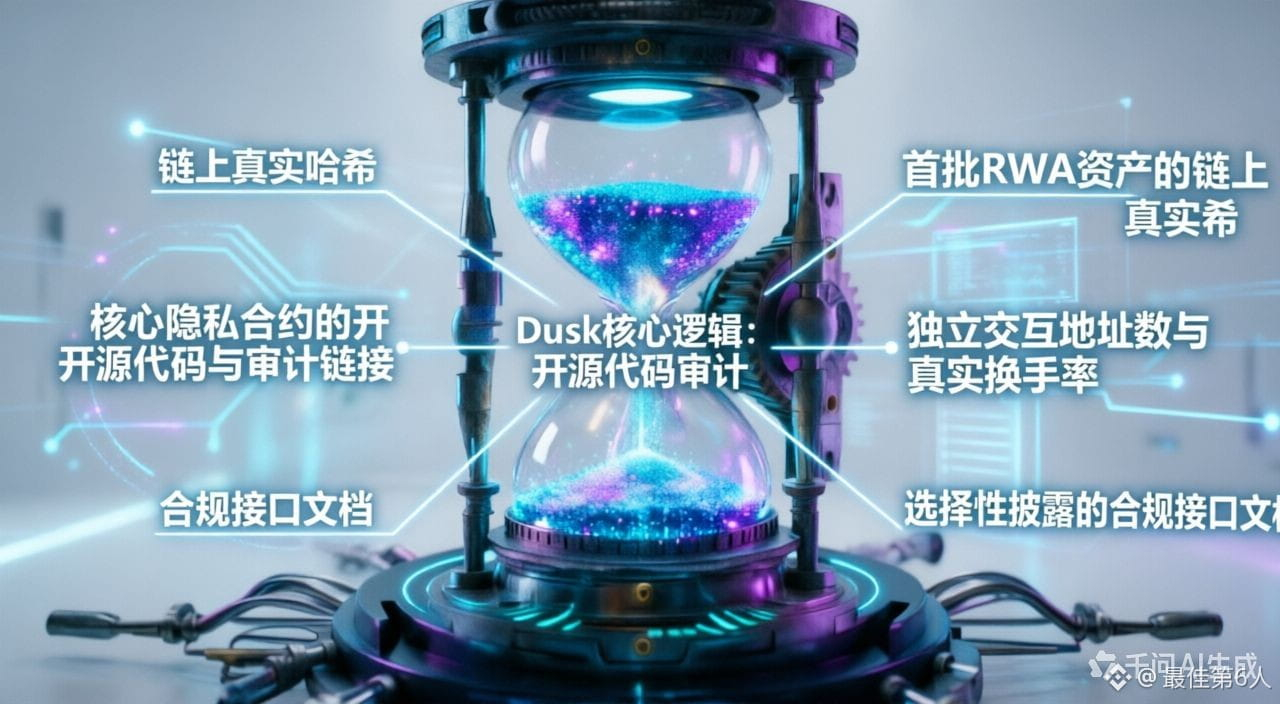
I’m Dusk Network. In this industry where everyone keeps shouting “compliance” while secretly playing cat-and-mouse, I’ve become a paradox: too transparent—privacy is meaningless; too black-box—then you say I’m making money out of thin air. Now you’re coming at me with magnifying glasses, even with sniper scopes, looking for flaws on my body. Fine. If you don’t believe “code is law,” then I’ll put the ledgers under a full spotlight for you to see.
First card: I flip the table. The source code of the Phoenix privacy contract and the Hedger trading module—along with Trail of Bits’s audit report—is now posted on-chain. Don’t tell me “zero-knowledge proofs are too elegant.” I just know this: without backing from top-tier security institutions, your eyes see my PlonK algorithm as a black box that could blow up at any moment. Now the box is dismantled. You verify it yourselves.
Second card: a money-counter test. Don’t bring up that €300 million paper subscription—that’s a mirage in the slides. Look on-chain: the asset hash from the very first mint via the Quantoz channel is already sitting in the Vault. Real on-chain transfers—those are the steel needles that pop the bubbles. The money isn’t just being painted into your PPT; it’s already on-chain, the channel is connected. Don’t believe me? Check the hash yourself.
Third card: a lie detector. No matter how big the plate is, if nobody’s playing, it’s stagnant water. I’m publishing the deduplicated independent wallet addresses and Hedger’s actual turnover rate. If only a few institutional addresses are standing still and pretending, then I’m just a joke. But right now, the real number of trade records is ticking—liquidity isn’t “blown up”; it’s being slammed in one trade at a time.
Finally, the last card—the one you want most: the “back door.” I’ve prepared a selective-disclosure API and regulatory nodes. I won’t hand over private keys or plaintext ledgers, but I will use cryptography to prove to the regulator: this money is clean. Privacy is the bottom line, compliance is the passport—I want both.
Now my trump cards are on the table. Whether they’re a black box or gold—judge for yourselves.
Vote: For Dusk taking down Wall Street, which of these four trump cards is the most lethal?
#dusk $DUSK @Dusk
I’m Dusk Network. In this industry where everyone keeps shouting “compliance” while secretly playing cat-and-mouse, I’ve become a paradox: too transparent—privacy is meaningless; too black-box—then you say I’m making money out of thin air. Now you’re coming at me with magnifying glasses, even with sniper scopes, looking for flaws on my body. Fine. If you don’t believe “code is law,” then I’ll put the ledgers under a full spotlight for you to see.
First card: I flip the table. The source code of the Phoenix privacy contract and the Hedger trading module—along with Trail of Bits’s audit report—is now posted on-chain. Don’t tell me “zero-knowledge proofs are too elegant.” I just know this: without backing from top-tier security institutions, your eyes see my PlonK algorithm as a black box that could blow up at any moment. Now the box is dismantled. You verify it yourselves.
Second card: a money-counter test. Don’t bring up that €300 million paper subscription—that’s a mirage in the slides. Look on-chain: the asset hash from the very first mint via the Quantoz channel is already sitting in the Vault. Real on-chain transfers—those are the steel needles that pop the bubbles. The money isn’t just being painted into your PPT; it’s already on-chain, the channel is connected. Don’t believe me? Check the hash yourself.
Third card: a lie detector. No matter how big the plate is, if nobody’s playing, it’s stagnant water. I’m publishing the deduplicated independent wallet addresses and Hedger’s actual turnover rate. If only a few institutional addresses are standing still and pretending, then I’m just a joke. But right now, the real number of trade records is ticking—liquidity isn’t “blown up”; it’s being slammed in one trade at a time.
Finally, the last card—the one you want most: the “back door.” I’ve prepared a selective-disclosure API and regulatory nodes. I won’t hand over private keys or plaintext ledgers, but I will use cryptography to prove to the regulator: this money is clean. Privacy is the bottom line, compliance is the passport—I want both.
Now my trump cards are on the table. Whether they’re a black box or gold—judge for yourselves.
Vote: For Dusk taking down Wall Street, which of these four trump cards is the most lethal?
#dusk $DUSK @Dusk
A. 掀桌子(开源代码与顶级审计)
50%
B. 验钞机(链上真实哈希与余额)
50%
C. 测谎仪(独立地址与真实换手率)
0%
D. 通行证(选择性披露合规接口)
0%
2 votes • Voting closed
Don’t use that so-called paper subscription of €300 million to blow smoke about being the privacy-track leader. In the eyes of institutions, any intent-to-sign that isn’t supported by a real hash is nothing but a watered-down story. If Dusk wants to break the accusations of “building wealth with PPTs,” stop talking about how elegant zero-knowledge proofs are and slam these four back-pocket cards onto the table—right now.
First card: publish the open-source code and audit links for the core privacy contracts. During due diligence, what institutions fear most is “invisibility.” Dusk must disclose the code address for the Phoenix privacy accounts and the Hedger transaction module, and produce audit reports from top-tier security firms. This is a “confidence booster” for compliance officers—proof that your PlonK proving system doesn’t hide any logical loopholes. It’s the first step from a “mathematical black box” to “verifiable trust.”
Second card: reveal the real on-chain hashes of the first batch of RWA assets. No matter how high the paper chips are, they’re still fake. Dusk must publish the hash of the assets genuinely minted and sent into the on-chain Vault for the first time—either via the Quantoz stablecoin channel or through trades on the NPEX exchange. This is the “cash verifier” for funding parties: a real on-chain transaction record in gold and silver form that directly punctures the claim that “the pipeline isn’t connected,” proving that the funds no longer just sit in PPT form.
Third card: report the count of independent interaction addresses and the actual turnover rate. If that €300 million pool only has a few institutional addresses parked in place, that’s dead water. Only the number of de-duplicated independent wallet addresses and the real transaction count in the Hedger module can prove that this privacy settlement system has at least basic liquidity-carrying capacity.
Final card: hand over the compliance interface documentation for selective disclosure. Faced with the ultimate question of “whether there’s a backdoor,” Dusk must disclose the operating mechanism of the Regulator Node or its compliance review API. Proving to specific authorized parties that transactions comply with AML rules is the passport to untangle the deadlock between “privacy and regulation.”
What matters here was never whose voice is louder—it’s whose ledger gets washed so transparently. Once these four cards are fully on display, then we can talk about taking over traditional finance’s pricing power. Now? First, let the cash verifier start running. #dusk $DUSK @Dusk
First card: publish the open-source code and audit links for the core privacy contracts. During due diligence, what institutions fear most is “invisibility.” Dusk must disclose the code address for the Phoenix privacy accounts and the Hedger transaction module, and produce audit reports from top-tier security firms. This is a “confidence booster” for compliance officers—proof that your PlonK proving system doesn’t hide any logical loopholes. It’s the first step from a “mathematical black box” to “verifiable trust.”
Second card: reveal the real on-chain hashes of the first batch of RWA assets. No matter how high the paper chips are, they’re still fake. Dusk must publish the hash of the assets genuinely minted and sent into the on-chain Vault for the first time—either via the Quantoz stablecoin channel or through trades on the NPEX exchange. This is the “cash verifier” for funding parties: a real on-chain transaction record in gold and silver form that directly punctures the claim that “the pipeline isn’t connected,” proving that the funds no longer just sit in PPT form.
Third card: report the count of independent interaction addresses and the actual turnover rate. If that €300 million pool only has a few institutional addresses parked in place, that’s dead water. Only the number of de-duplicated independent wallet addresses and the real transaction count in the Hedger module can prove that this privacy settlement system has at least basic liquidity-carrying capacity.
Final card: hand over the compliance interface documentation for selective disclosure. Faced with the ultimate question of “whether there’s a backdoor,” Dusk must disclose the operating mechanism of the Regulator Node or its compliance review API. Proving to specific authorized parties that transactions comply with AML rules is the passport to untangle the deadlock between “privacy and regulation.”
What matters here was never whose voice is louder—it’s whose ledger gets washed so transparently. Once these four cards are fully on display, then we can talk about taking over traditional finance’s pricing power. Now? First, let the cash verifier start running. #dusk $DUSK @Dusk
Verified
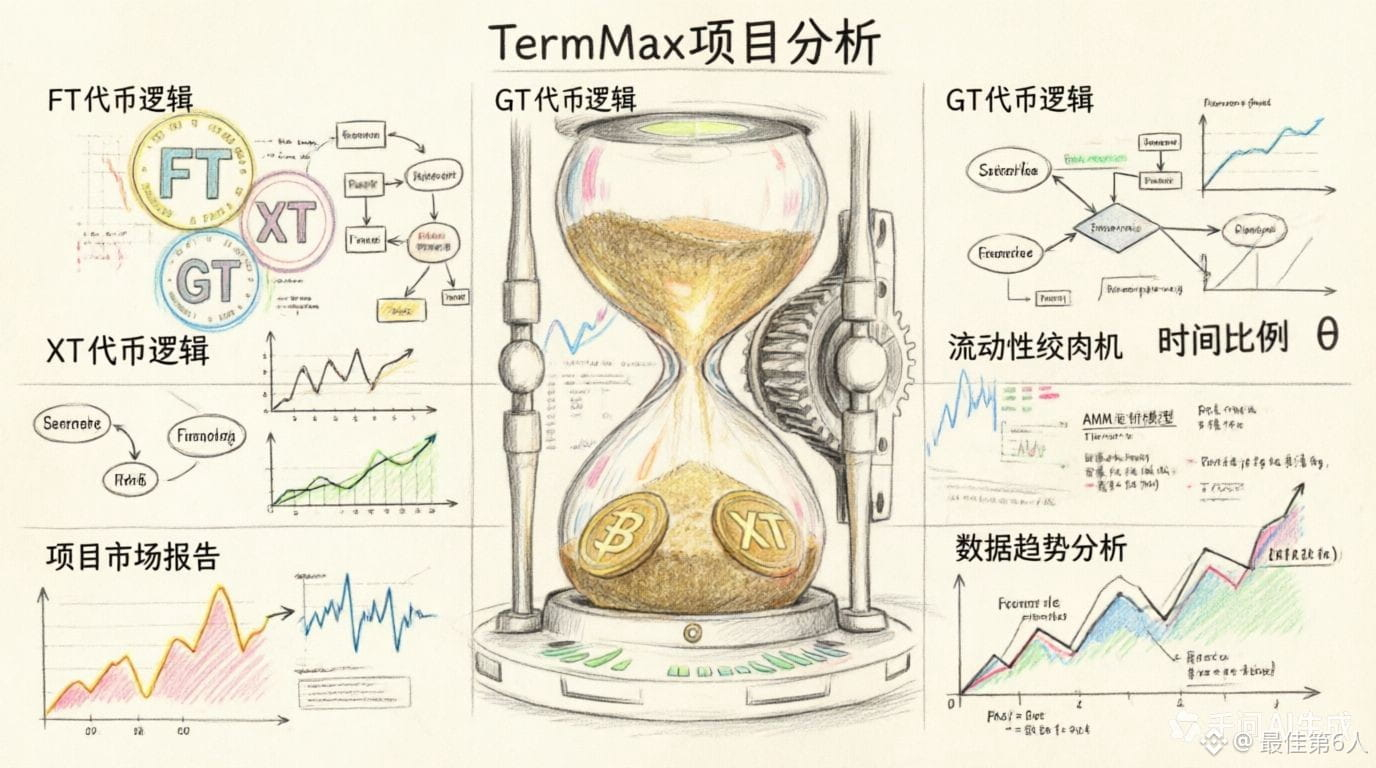
Everyone treats TermMax’s TGE like a celebration, but what I see is a brutal countdown meat grinder.
In this meat grinder, time isn’t there to wait for returns—it’s there to slaughter liquidity.
You think TermMax is doing fixed-rate lending? Wrong. It’s running a ruthless experiment about “time.” The three tokens—FT, XT, and GT—aren’t just simple loan instruments. Instead, they’re three scalpels, slicing a single debt into tradable components.
What is XT? It’s the conveyor belt in this meat grinder. When funds are locked inside the fixed-rate cage, XT is responsible for extracting the interest portion and throwing it into the secondary market to replace liquidity. The capital looks dead, but in reality it’s going crazy on XT’s conveyor belt.
The cruelest part is that TermMax directly writes the time proportion (θ) into the AMM pricing model. This means that as the maturity date approaches, the price curve isn’t static—it evolves in sync with the countdown. You’re racing the countdown; every passing second changes the exchange relationship between FT and XT.
So stop staring at those tiny instant subsidies through the eyes of “farmers.” After the TGE, the selling pressure is just the mandatory road where chips move from retail hands to institutional hands. What truly determines TermMax’s fate is its cross-cycle Rollover data—plus the real matching depth of XT in the secondary market.
While others are still panicking about that 3% sell pressure, you should be seeing this: a protocol that can keep liquidity alive during the countdown is quietly taking over the pricing power of traditional finance.
That’s TermMax’s true killing move.
#termmax @TermMax
In this meat grinder, time isn’t there to wait for returns—it’s there to slaughter liquidity.
You think TermMax is doing fixed-rate lending? Wrong. It’s running a ruthless experiment about “time.” The three tokens—FT, XT, and GT—aren’t just simple loan instruments. Instead, they’re three scalpels, slicing a single debt into tradable components.
What is XT? It’s the conveyor belt in this meat grinder. When funds are locked inside the fixed-rate cage, XT is responsible for extracting the interest portion and throwing it into the secondary market to replace liquidity. The capital looks dead, but in reality it’s going crazy on XT’s conveyor belt.
The cruelest part is that TermMax directly writes the time proportion (θ) into the AMM pricing model. This means that as the maturity date approaches, the price curve isn’t static—it evolves in sync with the countdown. You’re racing the countdown; every passing second changes the exchange relationship between FT and XT.
So stop staring at those tiny instant subsidies through the eyes of “farmers.” After the TGE, the selling pressure is just the mandatory road where chips move from retail hands to institutional hands. What truly determines TermMax’s fate is its cross-cycle Rollover data—plus the real matching depth of XT in the secondary market.
While others are still panicking about that 3% sell pressure, you should be seeing this: a protocol that can keep liquidity alive during the countdown is quietly taking over the pricing power of traditional finance.
That’s TermMax’s true killing move.
#termmax @TermMax


Log in to explore more content