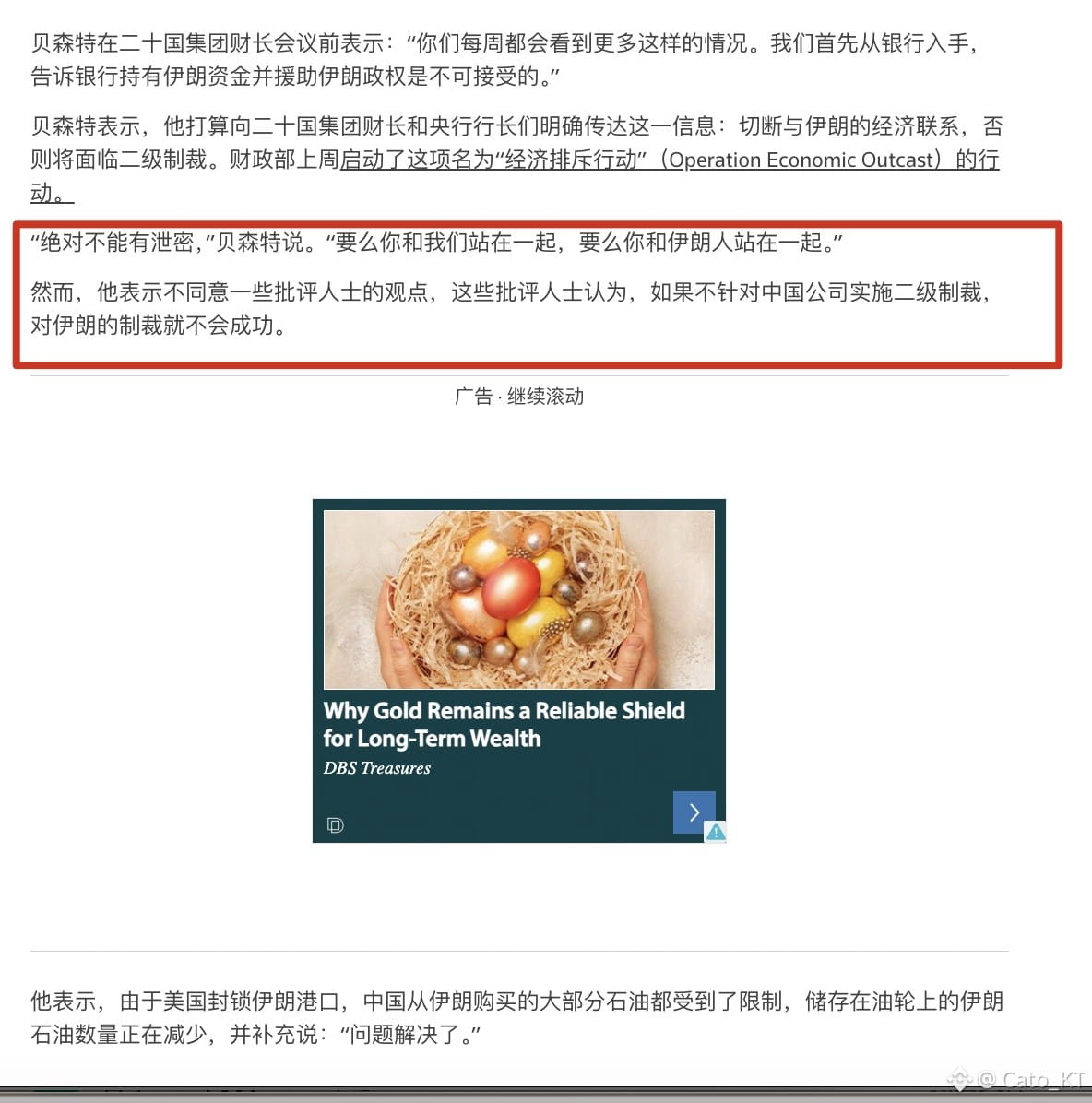
Bessent described this round of economic sanctions on Iran as an economic “Normandy landing,” but it is clear the actual effect is far from ideal—more like unilateral economic pressure by the United States rather than coordinated action by multiple countries.
After the economic plan was announced, the UK and NATO countries, including Turkey, showed a clear silence. Pakistan even stated that it has no obligation to respond to such unilateral sanctions.
Clearly, the United States’ declining trajectory in its global military and economic posture is becoming increasingly evident. It cannot guarantee allies’ interests. The practice of “sucking the life” out of allies has long sparked dissatisfaction; silence and isolation are only the beginning. If Trump continues to act with reckless disregard, a coordinated counteroffensive may well follow.
In his report, Bessent explicitly said that unless Chinese companies are subjected to secondary sanctions, it would be difficult to achieve a “victory” over Iran’s actions.
He certainly pinpointed the core of the problem, but the question is: should the United States do this? Would Trump allow it? With September just around the corner and a planned visit by China’s leadership to the United States, it’s possible to “fabricate cards in midair,” but turning it into diplomatic hostility—can Trump bear the consequences?
Although the war risk between the U.S. and Iran has not yet expanded to a global scale, the resulting rise in energy prices has already pushed the world into a high-inflation era. If oil prices spin out of control—especially among the U.S. system’s allies—pressure from inflation would be even greater. While they would be forced to raise interest rates to curb inflation, they would also have to bear greater risks of possible economic recession. The United States cannot take those risks on their behalf.
When pursuing mutual benefit, things seem aligned; but once the gains run out, they fall apart. If Trump cannot secure enough benefits for allies, why would the allies keep helping you?
Especially European countries—they’re not fools either. Russia and Ukraine are already fighting, and now the Middle East’s oil situation is a tangled mess. While that happens, the U.S. is selling Europe energy business at a booming pace. The intent to profit from “bleeding and fighting” is far too obvious. European gentlemen are not idiots either. Deeply tied to the United States, they will eventually be sucked dry into “jerky,” sent into the pyramid!#WTI原油突破85美元
After the economic plan was announced, the UK and NATO countries, including Turkey, showed a clear silence. Pakistan even stated that it has no obligation to respond to such unilateral sanctions.
Clearly, the United States’ declining trajectory in its global military and economic posture is becoming increasingly evident. It cannot guarantee allies’ interests. The practice of “sucking the life” out of allies has long sparked dissatisfaction; silence and isolation are only the beginning. If Trump continues to act with reckless disregard, a coordinated counteroffensive may well follow.
In his report, Bessent explicitly said that unless Chinese companies are subjected to secondary sanctions, it would be difficult to achieve a “victory” over Iran’s actions.
He certainly pinpointed the core of the problem, but the question is: should the United States do this? Would Trump allow it? With September just around the corner and a planned visit by China’s leadership to the United States, it’s possible to “fabricate cards in midair,” but turning it into diplomatic hostility—can Trump bear the consequences?
Although the war risk between the U.S. and Iran has not yet expanded to a global scale, the resulting rise in energy prices has already pushed the world into a high-inflation era. If oil prices spin out of control—especially among the U.S. system’s allies—pressure from inflation would be even greater. While they would be forced to raise interest rates to curb inflation, they would also have to bear greater risks of possible economic recession. The United States cannot take those risks on their behalf.
When pursuing mutual benefit, things seem aligned; but once the gains run out, they fall apart. If Trump cannot secure enough benefits for allies, why would the allies keep helping you?
Especially European countries—they’re not fools either. Russia and Ukraine are already fighting, and now the Middle East’s oil situation is a tangled mess. While that happens, the U.S. is selling Europe energy business at a booming pace. The intent to profit from “bleeding and fighting” is far too obvious. European gentlemen are not idiots either. Deeply tied to the United States, they will eventually be sucked dry into “jerky,” sent into the pyramid!#WTI原油突破85美元