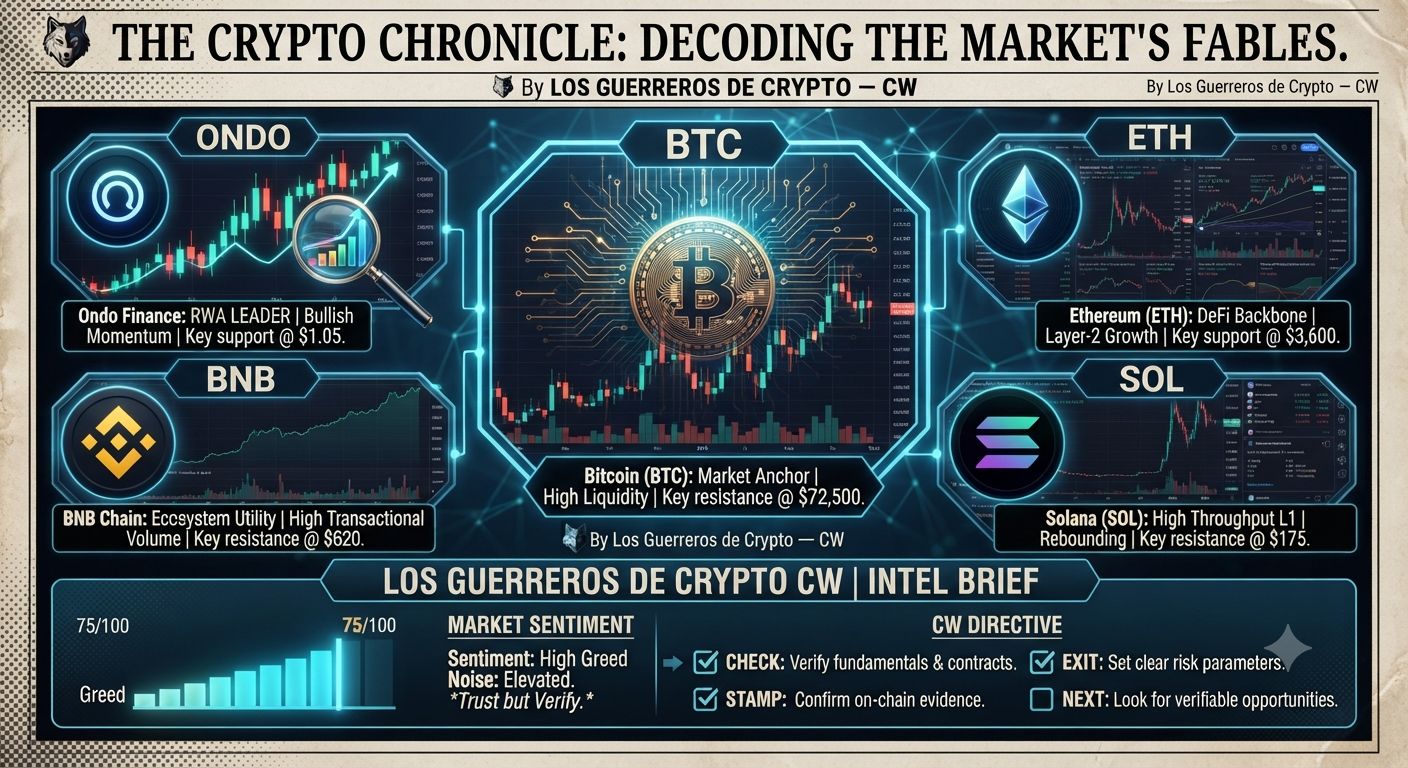

Crypto Warriors Macro & Major Asset Positioning Dossier
No Hype. No Noise. Just Signal.
There is a moment in every fast crypto move when the chart stops being the story.
The liquidity becomes the story.
Bitcoin has pushed aggressively higher. Institutional ETF demand has returned. Treasury policy is influencing the dollar and bond market. Ethereum, Solana and BNB Chain are competing for increasingly important pieces of on-chain financial activity.
And meanwhile, ONDO is sitting directly inside one of the biggest structural narratives in crypto:
the tokenization of real-world assets.
But here's the edge:
A strong narrative does not automatically mean a strong token.
That's where Crypto Warriors starts digging.
1. BITCOIN — FOLLOW THE LIQUIDITY, NOT THE CANDLE
BTC recently pushed above $80,000 before consolidating back toward the upper-$70K area.
That move wasn't happening in isolation.
U.S. spot Bitcoin ETFs recorded approximately $3.3 billion of net inflows during August through August 28, with August 20 alone bringing roughly $606 million.
That gives us something more useful than a green candle:
evidence of institutional demand.
At the same time, the U.S. Treasury has been increasing long-duration bond buybacks in an attempt to support liquidity and reduce pressure in the long-end Treasury market. Reuters reported that the Treasury doubled long-end repurchases to at least $4 billion per operation.
The market interpreted those developments as potentially supportive for risk assets and Bitcoin.
But don't confuse:
liquidity support
with
guaranteed upside.
The immediate technical battlefield remains important.
BTC Watch
Resistance: ~$80K–$82K
Immediate support: ~$75.5K–$76K
Confirmation: sustained liquidity + ETF demand + market structure
If BTC loses the support zone, the conversation changes.
If BTC breaks resistance with genuine volume and continued institutional inflows, the market has another question to answer:
Was this merely a squeeze—or the beginning of another expansion leg?
We don't predict.
We observe.
2. ETHEREUM — THE QUIET LIQUIDITY ENGINE
Ethereum has benefited from the broader market rotation, but the deeper story is infrastructure.
Ethereum remains one of the primary settlement layers for stablecoins, RWAs and DeFi.
Institutional participation is also evolving beyond simply holding ETH.
For example, Fidelity has pursued staking functionality for its Ethereum ETF, highlighting how institutional products are increasingly looking at Ethereum not only as an asset but as an asset with native network economics.
That distinction matters.
Bitcoin's institutional story is heavily connected to:
scarcity + ETF access.
Ethereum's institutional story increasingly includes:
network usage + staking + settlement + tokenization.
So the question isn't simply:
"Is ETH following BTC?"
The better question is:
"Is Ethereum capturing enough economic activity to justify the liquidity flowing through its ecosystem?"
That's the metric worth tracking.
3. SOLANA — WHERE TOKENIZATION MEETS SPEED
Solana is showing another type of strength.
Its relevance isn't only price action.
Tokenized-equity activity has become one of the most interesting signals.
Solana recorded approximately $5.8 billion in tokenized-stock DEX volume during Q2 2026, a reported 114% quarterly increase. The same data indicated that Solana represented roughly 95% of global on-chain equity trading during that period.
That's significant.
Because tokenization isn't just about creating a token.
It's about creating a market around that token:
issuance → liquidity → trading → lending → collateral → settlement.
And Solana is competing directly for that entire pipeline.
The network also recently conducted its first on-chain governance vote, covering its governance framework, inflation schedule and transaction-fee structure.
That gives us another signal:
Solana is no longer just being evaluated as a high-throughput blockchain.
It is increasingly being evaluated as financial infrastructure.
4. BNB CHAIN — WATCH WHAT ACTUALLY GETS TRADED
BNB Chain deserves attention for a different reason:
tokenized equity activity.
Recent reporting found that the seven most actively traded tokenized stocks were hosted on either BNB Chain or Robinhood Chain, collectively generating approximately $4.3 billion in DEX volume over 30 days. BNB Chain accounted for the overwhelming majority of the reported activity.
BNB Chain itself previously reported more than 709 tokenized stocks and ETFs available across its ecosystem, with cumulative tokenized-stock volume exceeding $5 billion.
Here's the important distinction:
Token count is not the signal.
Economic activity is the signal.
A blockchain can announce 1,000 tokenized assets.
That doesn't mean anybody is using them.
When assets begin generating:
DEX volume
liquidity
holders
collateral demand
settlement activity
the narrative becomes measurable.
That's what CWIU watches.
5. ONDO — THE MOST INTERESTING CASE STUDY
Now we get to the asset that requires the most discipline.
ONDO.
The fundamental Ondo ecosystem is expanding aggressively.
Ondo Finance currently reports approximately $2.16 billion TVL for USDY, backed primarily by short-term U.S. Treasuries, while DeFiLlama currently reports approximately $3.49 billion total Ondo Finance TVL across multiple chains.
Ondo has also expanded USDY across networks including Ethereum, Solana, BNB Chain, Sui, Aptos, Noble, Arbitrum, Stellar, Sei and Tempo.
Ondo Stocks also crossed $1 billion TVL, according to Ondo, with more than 260 tokenized U.S. stocks and ETFs across Solana, Ethereum and BNB Chain.
That is a serious RWA infrastructure story.
But here's where the investigation gets interesting.
PROTOCOL ≠ TOKEN
A protocol can grow.
Its TVL can grow.
Its revenue can grow.
Its products can gain adoption.
And the governance token can still face supply pressure.
DeFiLlama currently shows ONDO with a 10 billion maximum supply and approximately 4.87 billion circulating, while significant unlock allocations remain scheduled.
That means we cannot simply say:
"Ondo is growing, therefore ONDO must go up."
That's narrative thinking.
Crypto Warriors wants the mechanism.
6. THE ONDO FEE-SWITCH QUESTION
This is where the dossier gets particularly interesting.
A community governance discussion has proposed activating an ONDO fee switch, potentially directing protocol economics toward mechanisms such as buybacks and burns.
But this needs to be treated correctly:
It is a governance proposal/discussion—not a guaranteed future outcome.
That distinction is critical.
If governance eventually creates meaningful value capture for ONDO holders, the token economics could change.
But until that mechanism is formally approved and implemented:
it remains a catalyst to monitor, not a fact to price as guaranteed.
That's the difference between research and promotion.
7. THE MACRO CROSS-REFERENCE
Now connect the pieces.
The market isn't operating in five separate boxes.
BTC
↓
ETF liquidity
↓
Treasury / dollar conditions
↓
Risk appetite
↓
ETH / SOL / BNB rotation
↓
RWA activity
↓
Tokenized assets
↓
On-chain liquidity
That's the larger system.
The Treasury's bond-buyback strategy has already influenced market expectations around liquidity and the dollar, while officials and investors continue debating whether these interventions address structural fiscal problems or simply provide temporary relief.
That creates a complicated environment.
A liquidity-supportive policy signal can help risk assets.
But persistent fiscal pressure can also create volatility.
So don't reduce the macro picture to:
"Treasury buys bonds = Bitcoin goes up."
Markets aren't that simple.
8. THE REAL SIGNAL
Here's what Crypto Warriors sees right now:
BTC
Institutional demand is measurable.
ETH
Institutional infrastructure is expanding beyond simple exposure.
SOL
On-chain capital markets are becoming increasingly relevant.
BNB
Tokenized-equity trading is generating measurable activity.
ONDO
RWA fundamentals are expanding—but token economics still require investigation.
That last sentence matters.
Because the strongest research question isn't:
"Which coin will pump?"
It's:
"Where is actual economic activity moving, and who captures the value?"
That's the investigation.
CWIU FIELD CHECK
Before touching a narrative, run the protocol:
CHECK
What actually happened?
STAMP
Can the claim be verified through primary data, blockchain explorers, protocol dashboards, governance records or reputable reporting?
EXIT
If the evidence doesn't support the thesis, walk away.
NEXT
Move to the next piece of evidence.
And underneath that:
CLUE → OBSERVE → QUESTION → SEARCH → TRACE → DOCUMENT → ANALYZE → REPORT → CASE CLOSED
THE EDGE
The market wants you to stare at the candle.
The investigator watches the plumbing.
ETF flows.
Treasury liquidity.
Stablecoins.
DEX volume.
TVL.
Tokenized assets.
Unlock schedules.
Governance proposals.
Smart contracts.
Wallet activity.
That's where the information advantage begins.
Not because we know what happens next.
Because we're measuring what is happening now.
FINAL CW SIGNAL
The current market environment is powerful—but fast markets are exactly where confirmation matters most.
BTC strength does not automatically validate every altcoin.
RWA adoption does not automatically guarantee token appreciation.
TVL does not automatically equal token value capture.
A governance proposal does not equal an approved mechanism.
And a green candle is not evidence by itself.
No Hype.
No Noise.
Just Signal.
CHECK → STAMP → EXIT → NEXT.
Educational and investigative content only. Not financial advice. Always verify current market data, contract addresses, token supply, governance status and liquidity before making financial decisions.
$BTC $SOL $ETH
#CryptoWarriors99 #ONDO #Tokenization #Write2Earn #BinanceSquare