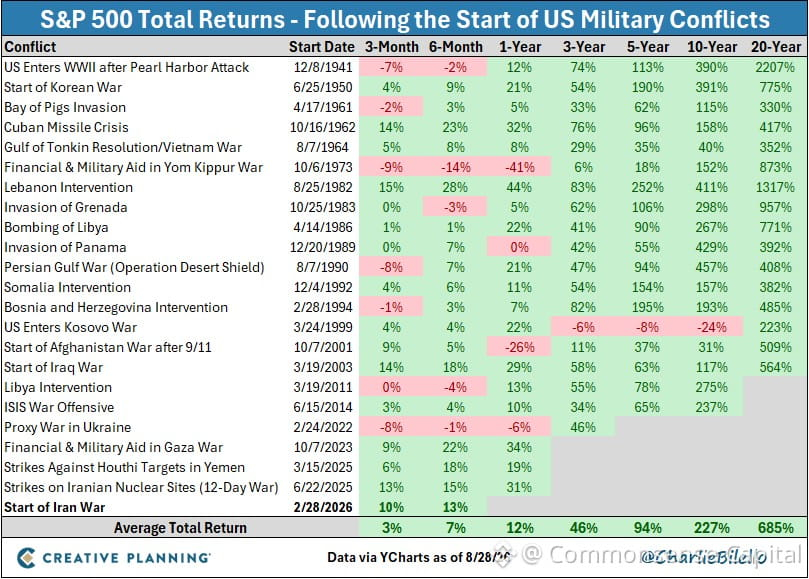
Here's what history actually tells us about markets during military conflicts:
With enough time, stocks tend to go up. The longer the timeframe, the more they've risen.
Why does this happen?
Two simple reasons:
1) Every war ends eventually
2) The economy and corporate earnings — even when disrupted short-term — have still grown over the long run despite these conflicts
This doesn't mean markets ignore wars or that volatility disappears. It means that over time, the fundamentals reassert themselves. Businesses adapt, economies recover, and growth resumes.
The lesson isn't to ignore geopolitical risk. It's to understand that panic selling during crises has historically been the wrong move if your time horizon is measured in years, not weeks.
Perspective matters more than prediction.
With enough time, stocks tend to go up. The longer the timeframe, the more they've risen.
Why does this happen?
Two simple reasons:
1) Every war ends eventually
2) The economy and corporate earnings — even when disrupted short-term — have still grown over the long run despite these conflicts
This doesn't mean markets ignore wars or that volatility disappears. It means that over time, the fundamentals reassert themselves. Businesses adapt, economies recover, and growth resumes.
The lesson isn't to ignore geopolitical risk. It's to understand that panic selling during crises has historically been the wrong move if your time horizon is measured in years, not weeks.
Perspective matters more than prediction.