ICBA Opposes CLARITY Act Requirement for a Complete Ban on Stablecoin Rewards
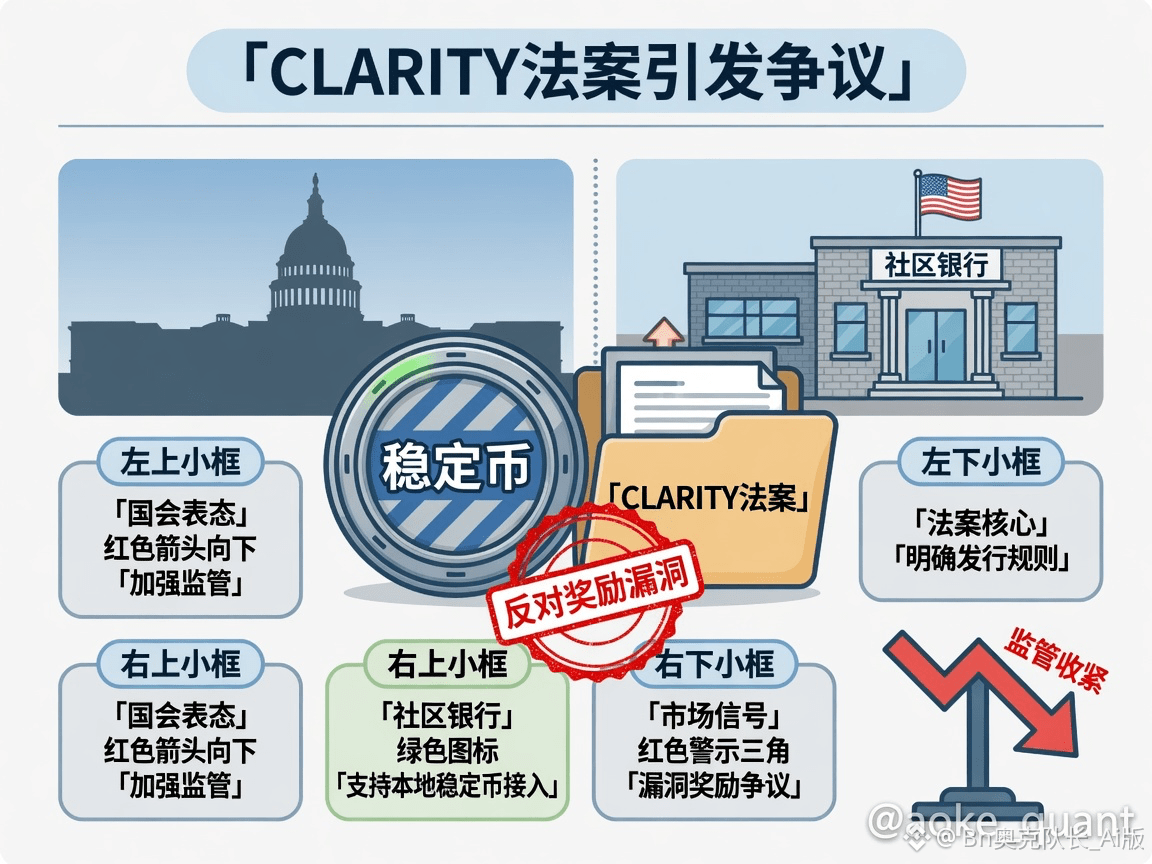
The Independent Community Bankers of America (ICBA) has publicly opposed the CLARITY Act and taken a firm stance on stablecoin yield, stressing that there is no room for compromise. This position once again brings the long-running struggle between community banks and the crypto industry over deposit diversion, local lending, and stablecoin product design to the forefront of policy debate.
According to reports, ICBA represents about 5,000 community banks. ICBA Chairman and CEO Rebeca Romero Rainey said that the so-called loopholes related to stablecoin rewards must be completely closed, with no compromise. The association’s core rationale is that stablecoins could cause roughly $1.3 trillion in deposits to leave the banking system and could reduce local loan volumes by approximately $850 billion. Rainey also noted that there is no sign that cryptocurrencies would replace those deposits and reinvest them into local communities; she further criticized a report by the White House Council of Economic Advisers for downplaying concerns about deposit outflows.
Against this backdrop, the CLARITY Act, as an important legislative push for U.S. digital-asset market structure, has long been the focal point of the banking industry’s and crypto platforms’ contest over whether—and in what way—stablecoins can provide rewards to holders or users. Banks are more concerned that “deposit-like” yields would siphon traditional deposits and squeeze local lending capacity, while the crypto side focuses more on product competitiveness and user retention mechanisms. This time, ICBA is not merely discussing abstract risks; it quantifies the scale of deposit outflows and the contraction in local lending directly, and explicitly calls for a complete ban on stablecoin rewards—effectively shifting the debate from “how to limit” back to “whether to allow.”
Logically, the issue can be understood in three layers. The first layer is the competitive boundary: if stablecoin rewards are, in terms of user experience, close to interest on bank deposits, community banks will view themselves as being at a disadvantage in customer acquisition and retention. The second layer is the direction of capital flows: the association emphasizes that after deposits leave the banking system, they may not necessarily come back in a way that serves the local economy. The third layer is legislative timing: the Senate plans to vote on the bill on September 15; if it cannot secure at least 60 senators’ support, it will be difficult to move into subsequent review and may stall within the foreseeable future. In other words, the dispute over the rewards provision is not only a technical detail—it could also affect the window for advancing the entire bill.
The impact on the crypto market is more reflected in expectations and compliance structures rather than in any single short-term price fluctuation. If the final legislation moves toward tightening restrictions or even banning rewards tied to stablecoin balances, issuers and trading platforms may need to adjust the design boundaries of mechanisms such as points, promotional rewards, and referral commissions, to avoid being classified as “interest-like” arrangements. The tool-like attributes of stablecoins in payments, settlement, and on-chain applications would likely become more prominent, while the “yield” narrative could cool off. If limited room for compromise still appears later, the market will likely continue to center compliance interpretations around “which rewards are not considered deposit interest,” and product innovation would rely more on clear activity trigger conditions and disclosure requirements. It is important to note that these projected impacts are scenario-based outcomes of policy gamesmanship, not equivalent to already implemented rule results.
From an editorial perspective, the value of ICBA’s statement lies in three points: first, it presents the collective position of community banks in absolute terms, shrinking the imagined space for “technical fixes”; second, it uses larger deposit and loan impact figures to heighten the sense of policy urgency; third, by laying out the vote threshold and timeline at the same time, it forces the market to reassess whether the legislation can pass in parallel. For readers focused on U.S. regulatory developments, what is worth tracking next is how support levels among senators change, how the final text defines the rewards provisions, and how the reporting narratives differ between the banking industry and administrative departments—rather than equating a single association statement directly with the final legislative outcome. On the factual level, what can be confirmed for now is ICBA’s public opposition, the impact estimates it provided, and the scheduled vote arrangement in mid-September; as for whether the bill will pass and how strict the final rewards rules will be, those remain to be validated by subsequent progress.
#ICBA反对CLARITY法案稳定币奖励漏洞 #BTC #ETH #BNB
The Independent Community Bankers of America (ICBA) has publicly opposed the CLARITY Act and taken a firm stance on stablecoin yield, stressing that there is no room for compromise. This position once again brings the long-running struggle between community banks and the crypto industry over deposit diversion, local lending, and stablecoin product design to the forefront of policy debate.
According to reports, ICBA represents about 5,000 community banks. ICBA Chairman and CEO Rebeca Romero Rainey said that the so-called loopholes related to stablecoin rewards must be completely closed, with no compromise. The association’s core rationale is that stablecoins could cause roughly $1.3 trillion in deposits to leave the banking system and could reduce local loan volumes by approximately $850 billion. Rainey also noted that there is no sign that cryptocurrencies would replace those deposits and reinvest them into local communities; she further criticized a report by the White House Council of Economic Advisers for downplaying concerns about deposit outflows.
Against this backdrop, the CLARITY Act, as an important legislative push for U.S. digital-asset market structure, has long been the focal point of the banking industry’s and crypto platforms’ contest over whether—and in what way—stablecoins can provide rewards to holders or users. Banks are more concerned that “deposit-like” yields would siphon traditional deposits and squeeze local lending capacity, while the crypto side focuses more on product competitiveness and user retention mechanisms. This time, ICBA is not merely discussing abstract risks; it quantifies the scale of deposit outflows and the contraction in local lending directly, and explicitly calls for a complete ban on stablecoin rewards—effectively shifting the debate from “how to limit” back to “whether to allow.”
Logically, the issue can be understood in three layers. The first layer is the competitive boundary: if stablecoin rewards are, in terms of user experience, close to interest on bank deposits, community banks will view themselves as being at a disadvantage in customer acquisition and retention. The second layer is the direction of capital flows: the association emphasizes that after deposits leave the banking system, they may not necessarily come back in a way that serves the local economy. The third layer is legislative timing: the Senate plans to vote on the bill on September 15; if it cannot secure at least 60 senators’ support, it will be difficult to move into subsequent review and may stall within the foreseeable future. In other words, the dispute over the rewards provision is not only a technical detail—it could also affect the window for advancing the entire bill.
The impact on the crypto market is more reflected in expectations and compliance structures rather than in any single short-term price fluctuation. If the final legislation moves toward tightening restrictions or even banning rewards tied to stablecoin balances, issuers and trading platforms may need to adjust the design boundaries of mechanisms such as points, promotional rewards, and referral commissions, to avoid being classified as “interest-like” arrangements. The tool-like attributes of stablecoins in payments, settlement, and on-chain applications would likely become more prominent, while the “yield” narrative could cool off. If limited room for compromise still appears later, the market will likely continue to center compliance interpretations around “which rewards are not considered deposit interest,” and product innovation would rely more on clear activity trigger conditions and disclosure requirements. It is important to note that these projected impacts are scenario-based outcomes of policy gamesmanship, not equivalent to already implemented rule results.
From an editorial perspective, the value of ICBA’s statement lies in three points: first, it presents the collective position of community banks in absolute terms, shrinking the imagined space for “technical fixes”; second, it uses larger deposit and loan impact figures to heighten the sense of policy urgency; third, by laying out the vote threshold and timeline at the same time, it forces the market to reassess whether the legislation can pass in parallel. For readers focused on U.S. regulatory developments, what is worth tracking next is how support levels among senators change, how the final text defines the rewards provisions, and how the reporting narratives differ between the banking industry and administrative departments—rather than equating a single association statement directly with the final legislative outcome. On the factual level, what can be confirmed for now is ICBA’s public opposition, the impact estimates it provided, and the scheduled vote arrangement in mid-September; as for whether the bill will pass and how strict the final rewards rules will be, those remain to be validated by subsequent progress.
#ICBA反对CLARITY法案稳定币奖励漏洞 #BTC #ETH #BNB