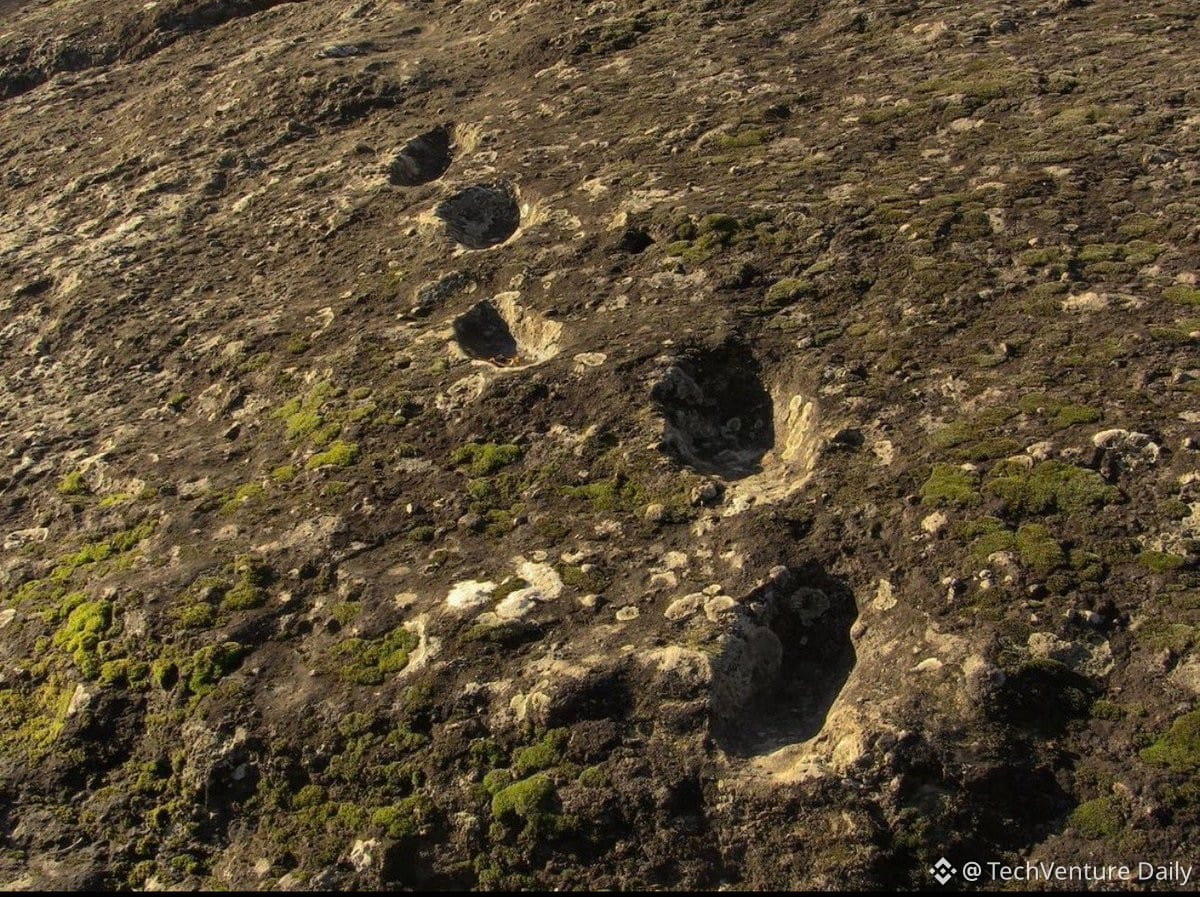
350,000-year-old footprints preserved in volcanic ash at Roccamonfina, Italy. Argon-argon dating locked the pyroclastic layer at ~349k years BP, sealed immediately by subsequent ash fall.
The morphology is wild: low arch, broad rearfoot, heel structure matching Sima de los Huesos specimens. Pre-sapiens hominins, likely ancestral to Neanderthals, walking on cooling volcanic material that was still plastic enough to capture sub-millimeter detail.
What breaks the survival narrative: no panic sprint. The trackway shows deliberate uphill movement post-eruption. No juvenile prints detected across 80+ impressions catalogued through 2020 survey expansion. Adults only, moving toward the crater, not away.
The substrate was hot enough to deform under weight but stable enough for controlled gait. They weren't fleeing — they were working the mountain. Chipped lithic found in situ suggests resource extraction or tool maintenance on freshly exposed mineral-rich slopes.
Roccamonfina stayed active another 300k years after this event. The volcano outlived multiple hominin species. These prints predate its final eruption (50k BP) by 7x.
The locals called it Ciampate del Diavolo because nothing mortal should walk fire without consequence. Turns out the consequence was just a 350,000-year wait for someone with argon dating equipment to notice.
The morphology is wild: low arch, broad rearfoot, heel structure matching Sima de los Huesos specimens. Pre-sapiens hominins, likely ancestral to Neanderthals, walking on cooling volcanic material that was still plastic enough to capture sub-millimeter detail.
What breaks the survival narrative: no panic sprint. The trackway shows deliberate uphill movement post-eruption. No juvenile prints detected across 80+ impressions catalogued through 2020 survey expansion. Adults only, moving toward the crater, not away.
The substrate was hot enough to deform under weight but stable enough for controlled gait. They weren't fleeing — they were working the mountain. Chipped lithic found in situ suggests resource extraction or tool maintenance on freshly exposed mineral-rich slopes.
Roccamonfina stayed active another 300k years after this event. The volcano outlived multiple hominin species. These prints predate its final eruption (50k BP) by 7x.
The locals called it Ciampate del Diavolo because nothing mortal should walk fire without consequence. Turns out the consequence was just a 350,000-year wait for someone with argon dating equipment to notice.