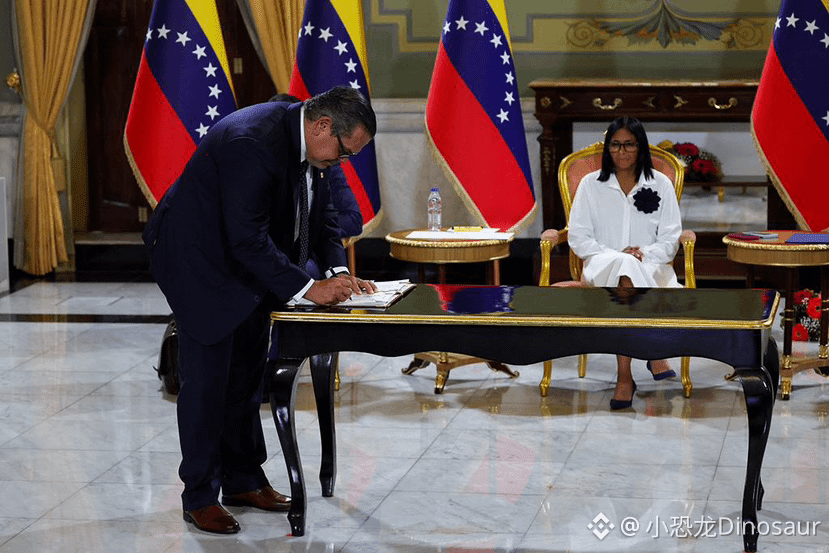

#委内瑞拉美国签25年石油合作协议
The 2025 oil agreement: This is not just a contract—it’s a re-binding of interests between the United States and Venezuela.
In 2025, this number is worth pondering more than the “17 oilfields.”
Venezuela’s interim President, Delcy Rodríguez, said the U.S.-Venezuela energy cooperation plan will run for 25 years. Its goal is to develop 17 strategic oilfields and raise production to more than 1.5 million barrels per day. The agreement also includes developing eight new greenfield oil zones.
Why do I pay special attention to “25 years”?
Because this is no longer a policy cycle of a single administration.
It may cover multiple U.S. presidential terms, multiple oil-price cycles, and even an entire energy-structure transformation cycle.
This means what both sides are truly trying to lock in isn’t just today’s oil price, but their interests for the next several decades.
What does Venezuela need?
Capital, technology, infrastructure, and stable export markets.
What does the United States need?
More controllable sources of crude oil, while also seeking to lower domestic energy costs and strengthen its energy influence in the Western Hemisphere.
So the logic behind this deal is actually quite simple:
You have resources, I have capital and a market—then we tie our interests together.
Of course, there are still many uncertainties here.
For example, whether future U.S. administrations will adjust policies, whether Venezuela’s domestic politics will remain stable, how much it will cost to restore production capacity in the oilfields, and whether international oil prices can ultimately deliver sufficient returns to investors.
More importantly, many of the agreement’s specific legal and commercial terms have not yet been fully disclosed. Media reports also vary on details such as the term length and the control structure.
So declaring that “the United States has completely taken over Venezuelan oil” right now is a bit too early.
But one trend is already clear:
Energy is increasingly turning from a simple commodity into a geopolitical asset.
The 25 years is not just about making money today.
It’s about locking in the energy supply chain for decades to come.
That’s what this agreement is really worth the market’s attention.
The 2025 oil agreement: This is not just a contract—it’s a re-binding of interests between the United States and Venezuela.
In 2025, this number is worth pondering more than the “17 oilfields.”
Venezuela’s interim President, Delcy Rodríguez, said the U.S.-Venezuela energy cooperation plan will run for 25 years. Its goal is to develop 17 strategic oilfields and raise production to more than 1.5 million barrels per day. The agreement also includes developing eight new greenfield oil zones.
Why do I pay special attention to “25 years”?
Because this is no longer a policy cycle of a single administration.
It may cover multiple U.S. presidential terms, multiple oil-price cycles, and even an entire energy-structure transformation cycle.
This means what both sides are truly trying to lock in isn’t just today’s oil price, but their interests for the next several decades.
What does Venezuela need?
Capital, technology, infrastructure, and stable export markets.
What does the United States need?
More controllable sources of crude oil, while also seeking to lower domestic energy costs and strengthen its energy influence in the Western Hemisphere.
So the logic behind this deal is actually quite simple:
You have resources, I have capital and a market—then we tie our interests together.
Of course, there are still many uncertainties here.
For example, whether future U.S. administrations will adjust policies, whether Venezuela’s domestic politics will remain stable, how much it will cost to restore production capacity in the oilfields, and whether international oil prices can ultimately deliver sufficient returns to investors.
More importantly, many of the agreement’s specific legal and commercial terms have not yet been fully disclosed. Media reports also vary on details such as the term length and the control structure.
So declaring that “the United States has completely taken over Venezuelan oil” right now is a bit too early.
But one trend is already clear:
Energy is increasingly turning from a simple commodity into a geopolitical asset.
The 25 years is not just about making money today.
It’s about locking in the energy supply chain for decades to come.
That’s what this agreement is really worth the market’s attention.