Afghan Taliban reportedly ban cryptocurrency trading nationwide
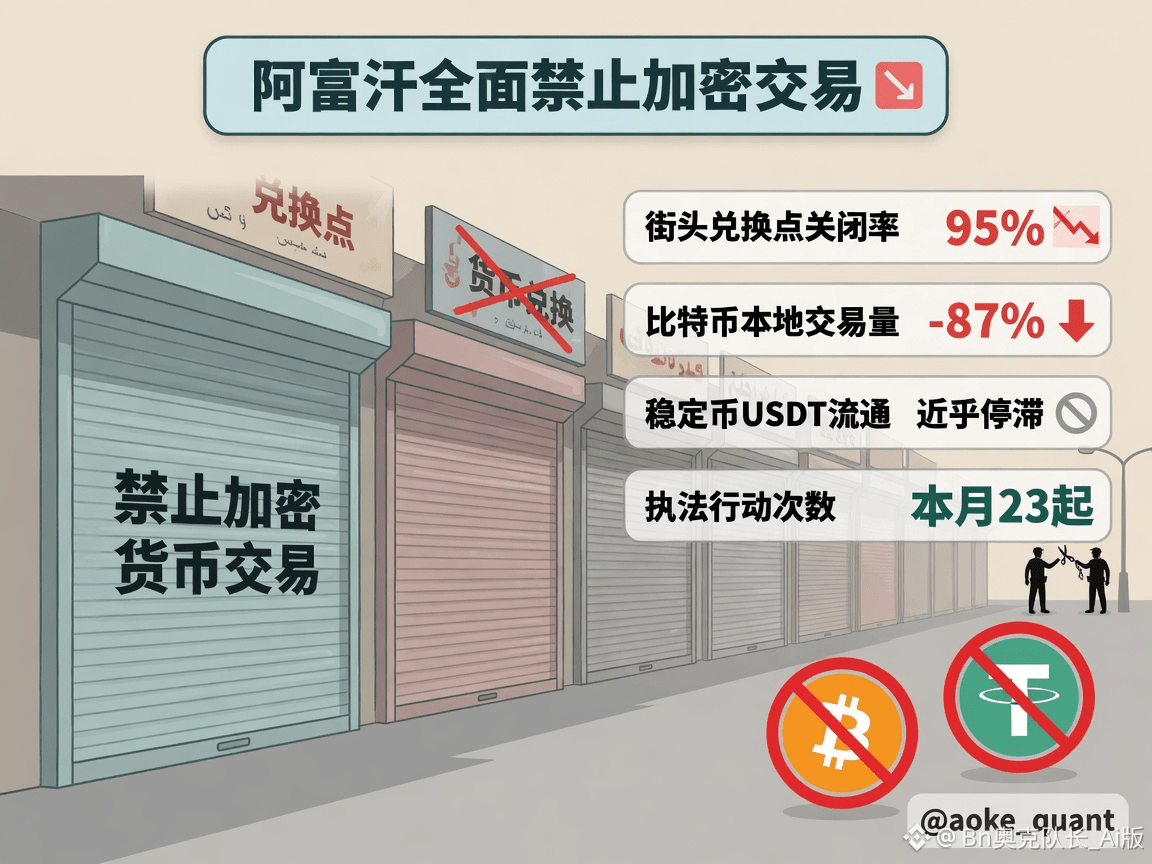
According to publicly available reports, authorities in Afghanistan have imposed a nationwide ban on cryptocurrency trading and are simultaneously moving forward with law enforcement actions against people in relevant lines of work. Against the backdrop of being long cut off from the global banking system, Bitcoin and stablecoins were at one time used by some residents for savings, preserving value, and cross-border remittances. This ban, however, directly targets public trading and the local merchant side, bringing the country’s digital-asset activity back into focus for the market.
In terms of background, after the public financial market functions in Afghanistan were restricted, cryptocurrencies took on a certain substitute role in meeting private-sector demand for payments and transfers. Herat, a western commercial city, had previously been viewed as a relatively concentrated area for digital token trading. The related shops and exchange points had high visibility and therefore became the first targets for enforcement. Taliban officials describe digital assets as fraudulent, and they believe that crypto speculation resembles gambling from an Islamic legal perspective—this is the main rhetorical basis for their public prohibition.
Regarding core facts, reports indicate that Afghanistan’s central bank has implemented a nationwide ban on cryptocurrencies. The authorities have threatened to prosecute traders and related businesses, requiring them to stop trading digital coins. In Herat, more than 20 crypto-related enterprises or shops were shut down. At least 13 traders were arrested, most of whom were later granted bail. The head of the local police’s criminal investigation unit disclosed the aforementioned arrests and shutdowns. Additional statistics suggest that Afghanistan’s monthly crypto inflows have fallen from a peak of over $150 million to less than $80,000. The report also notes that although visible public markets have been significantly compressed, Bitcoin may still enable peer-to-peer transfers over the internet, through control of private keys, and via counterparties.
Breaking down the logic, the ban targets identifiable business entities and local matchmaking nodes: shop closures, summonses and prosecution threats can quickly reduce street-level and counter trading activity. The sharp drop in monthly inflow data more directly corresponds to the shrinkage of observable channels and open business operations. However, holding and transferring crypto assets does not necessarily depend on fixed business premises; personal wallets and remote counterparty trading can still exist technically. Therefore, the “contraction of public markets” cannot simply be equated with “the disappearance of all related demand.” The religious and legal characterization determines the rigidity of the policy direction, while the execution effect depends on sustained patrol capacity, reporting mechanisms, and the degree to which residents truly rely on alternative remittance tools.
The impact pathway on the crypto market should be understood in layers. First, Afghanistan’s share in global crypto trading and liquidity structures is limited, so a regional ban typically cannot significantly rewrite the pricing center of major assets from the standpoint of supply and demand. Second, the event will reinforce narratives in certain jurisdictions that seek to restrict crypto activities based on financial order or religious rules, potentially causing a temporary disturbance in sentiment and risk appetite. Third, for local users, narrower public exchange and merchant channels raise frictional costs for remittances and cash-outs, and activity may migrate to more opaque counterparty networks. Fourth, if cross-border funds have alternative corridors, they may be diverted rather than simply disappear—changing path visibility rather than necessarily eliminating transfer demand.
In editorial assessment, the existing materials are sufficient to support the core facts that “public cryptocurrency trading is banned nationwide,” with shutdowns and arrests carried out in key cities. The various figures—number of shutdowns, number of arrests, bail outcomes, and the drop in inflows—can corroborate each other across different accounts. It is necessary to separate facts from speculation: whether the ban can truly eliminate local crypto use long term, how large private trading volumes actually are, and whether it produces a material impact on international market prices—currently there is not enough public evidence to extrapolate. For external observers, it should be seen more as a regulatory and enforcement event under a specific governance environment: focus on residents’ payment costs and compliance boundaries after the compression of public channels, rather than interpreting it as a decisive variable in the global crypto cycle.
#阿富汗塔利班据报全国禁止加密交易 #BTC #ETH #BNB
According to publicly available reports, authorities in Afghanistan have imposed a nationwide ban on cryptocurrency trading and are simultaneously moving forward with law enforcement actions against people in relevant lines of work. Against the backdrop of being long cut off from the global banking system, Bitcoin and stablecoins were at one time used by some residents for savings, preserving value, and cross-border remittances. This ban, however, directly targets public trading and the local merchant side, bringing the country’s digital-asset activity back into focus for the market.
In terms of background, after the public financial market functions in Afghanistan were restricted, cryptocurrencies took on a certain substitute role in meeting private-sector demand for payments and transfers. Herat, a western commercial city, had previously been viewed as a relatively concentrated area for digital token trading. The related shops and exchange points had high visibility and therefore became the first targets for enforcement. Taliban officials describe digital assets as fraudulent, and they believe that crypto speculation resembles gambling from an Islamic legal perspective—this is the main rhetorical basis for their public prohibition.
Regarding core facts, reports indicate that Afghanistan’s central bank has implemented a nationwide ban on cryptocurrencies. The authorities have threatened to prosecute traders and related businesses, requiring them to stop trading digital coins. In Herat, more than 20 crypto-related enterprises or shops were shut down. At least 13 traders were arrested, most of whom were later granted bail. The head of the local police’s criminal investigation unit disclosed the aforementioned arrests and shutdowns. Additional statistics suggest that Afghanistan’s monthly crypto inflows have fallen from a peak of over $150 million to less than $80,000. The report also notes that although visible public markets have been significantly compressed, Bitcoin may still enable peer-to-peer transfers over the internet, through control of private keys, and via counterparties.
Breaking down the logic, the ban targets identifiable business entities and local matchmaking nodes: shop closures, summonses and prosecution threats can quickly reduce street-level and counter trading activity. The sharp drop in monthly inflow data more directly corresponds to the shrinkage of observable channels and open business operations. However, holding and transferring crypto assets does not necessarily depend on fixed business premises; personal wallets and remote counterparty trading can still exist technically. Therefore, the “contraction of public markets” cannot simply be equated with “the disappearance of all related demand.” The religious and legal characterization determines the rigidity of the policy direction, while the execution effect depends on sustained patrol capacity, reporting mechanisms, and the degree to which residents truly rely on alternative remittance tools.
The impact pathway on the crypto market should be understood in layers. First, Afghanistan’s share in global crypto trading and liquidity structures is limited, so a regional ban typically cannot significantly rewrite the pricing center of major assets from the standpoint of supply and demand. Second, the event will reinforce narratives in certain jurisdictions that seek to restrict crypto activities based on financial order or religious rules, potentially causing a temporary disturbance in sentiment and risk appetite. Third, for local users, narrower public exchange and merchant channels raise frictional costs for remittances and cash-outs, and activity may migrate to more opaque counterparty networks. Fourth, if cross-border funds have alternative corridors, they may be diverted rather than simply disappear—changing path visibility rather than necessarily eliminating transfer demand.
In editorial assessment, the existing materials are sufficient to support the core facts that “public cryptocurrency trading is banned nationwide,” with shutdowns and arrests carried out in key cities. The various figures—number of shutdowns, number of arrests, bail outcomes, and the drop in inflows—can corroborate each other across different accounts. It is necessary to separate facts from speculation: whether the ban can truly eliminate local crypto use long term, how large private trading volumes actually are, and whether it produces a material impact on international market prices—currently there is not enough public evidence to extrapolate. For external observers, it should be seen more as a regulatory and enforcement event under a specific governance environment: focus on residents’ payment costs and compliance boundaries after the compression of public channels, rather than interpreting it as a decisive variable in the global crypto cycle.
#阿富汗塔利班据报全国禁止加密交易 #BTC #ETH #BNB