#越南试点加密资产市场
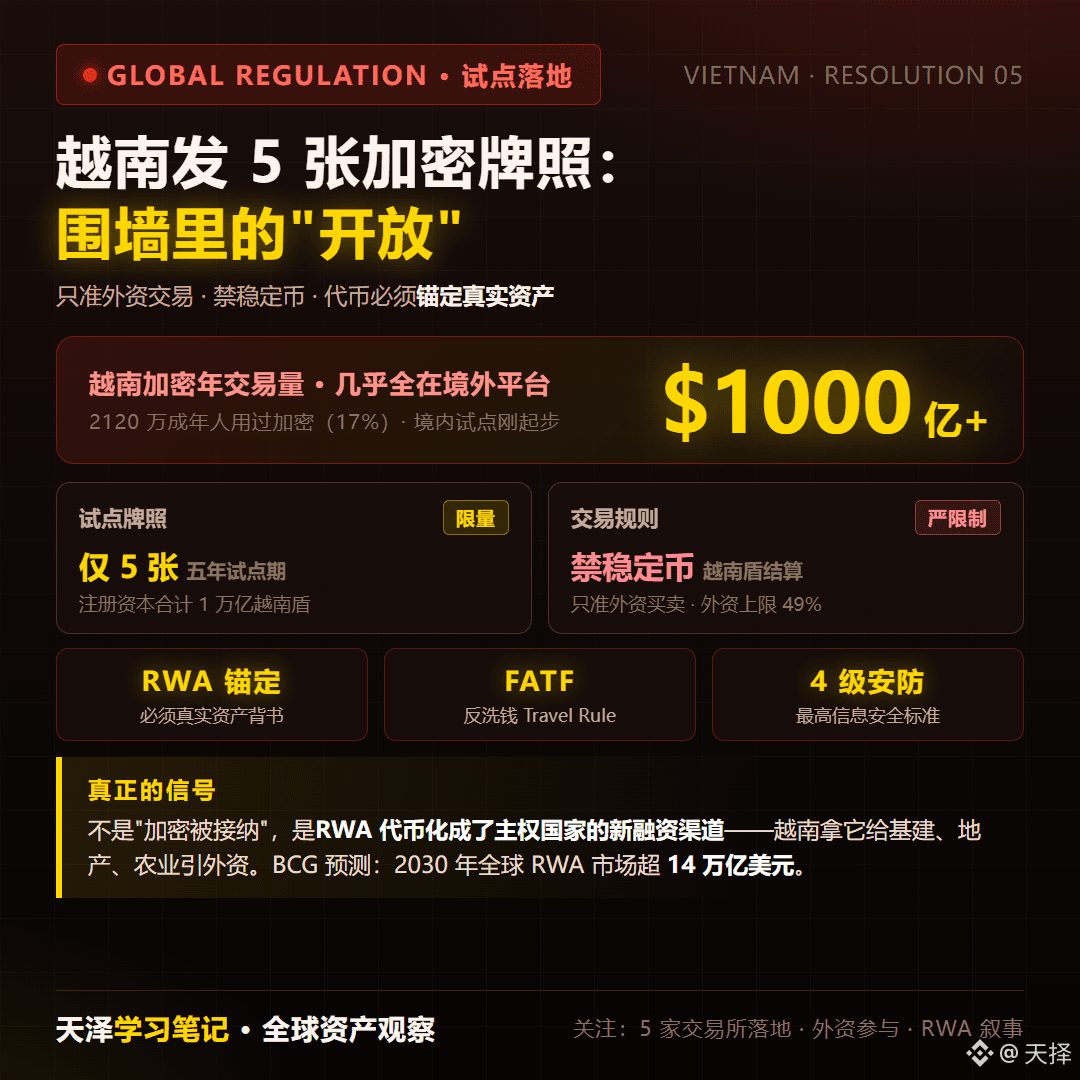
Vietnam has issued encrypted license plates; one time 5 licenses, a five-year pilot.
First, look at the numbers: Vietnam has 21.2 million adults who have used cryptocurrencies, accounting for 17% of the adult population. Annual trading volume is over $100 billion—yet almost all of it is on overseas platforms.
Now Vietnam wants to build a licensed, domestic market, and the rules are as follows:
▪️ Only 5 licenses will be issued in the pilot; total registered capital is 1 trillion VND (about $400 million) ▪️ Settlement is allowed only in VND; stablecoins (USDT) are directly banned
▪️ Only Vietnamese companies can issue tokens, and they must be backed by real assets (real estate, infrastructure, agricultural products, etc.), not “air”
▪️ In the initial stage, only foreign investors may trade; the cap on foreign ownership is 49%—keeping domestic retail users out first
It looks open on the surface, but it’s an “open” inside walls.
The real signal isn’t “Vietnam embracing crypto,” but RWA (tokenization of real-world assets) becoming a new financing tool for sovereign countries. Vietnam isn’t short on projects—real estate, infrastructure, and agriculture all want money from around the world, and tokenization is their new channel. BCG predicts the global RWA market will exceed $1.4 trillion by 2030.
For crypto traders’ perspective:
$100 billion is still mainly overseas. Vietnamese people have already been trading on platforms like Binance—domestic issuance of 5 licenses won’t divert much in the short term. But this is the first sign of an “official diversion”; the long-term trend still needs close watching.
Stablecoins continue to be pushed to the margins by regulation. Vietnam bans USDT domestically, and Hong Kong is also tightening. Within the compliance framework, stablecoins’ space is getting narrower. Overseas markets keep playing as usual, but there’s no place for them in the “compliant narrative.”
RWA may be one of the next main storylines. Hong Kong and Vietnam are both betting on “putting real assets on-chain.” This aligns with the direction in which governments are willing to grant legitimacy. The narrative space for “air coins” will gradually be squeezed out by things that have “asset backing.”
Next to watch: when the five exchanges officially launch, how foreign capital participates, and whether there are new compliant listings in the RWA direction.
This “openness” inside the walls—do you think it’s a positive development, or just another tightening spell?
$BTC $ETH