
#特朗普达成委内瑞拉17油田开发协议
What Trump is targeting this time isn’t just a few oil tankers—it’s the underground oil in Venezuela that has been there for decades.
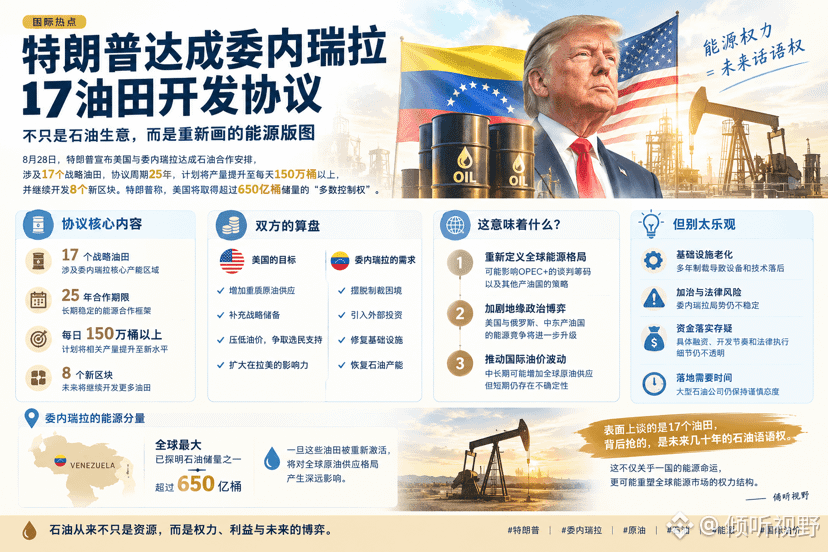
The latest news is that the United States and Venezuela have reached a large-scale energy cooperation agreement involving 17 strategic oilfields. The deal will last 25 years, and there are plans to further develop 8 new blocks afterward. Even more astonishingly, Trump has directly stated that the U.S. will gain “majority control” over Venezuela’s oil reserves of more than 65 billion barrels.
When I read this, my first reaction was:
This isn’t merely an oil business—it’s clearly redrawing the energy map.
Venezuela holds one of the largest proven oil reserves in the world, but over the years, due to sanctions, aging equipment, and insufficient investment, there is oil underground—but it has been difficult to extract it on the surface. Now, U.S. capital is preparing to re-enter with hundreds of billions of dollars, aiming to push production above 1.5 million barrels per day.
For Trump, this equation is too good to pass up.
On one side, bring more heavy crude back to U.S. refineries; on the other, replenish strategic reserves. And he can also use the narrative of “lowering oil prices” and “reducing gasoline prices” to tell a story to American voters.
But what’s truly worth worrying about is the other side.
What does 6.5 billion barrels mean? This isn’t about buying a few shipments of oil anymore—it’s about competing for supply rights and pricing influence for decades to come.
So I don’t really believe this will only affect Venezuela.
If these oilfields are actually reactivated, the future global crude oil supply landscape, OPEC+ negotiating leverage, and even the bargaining position of Russia and Middle Eastern oil-producing countries vis-à-vis the United States could all change.
Of course, signing an agreement doesn’t mean they can start pumping crazy amounts overnight. Venezuela’s infrastructure has been in poor shape for years, and political and legal risks haven’t disappeared. Large oil companies are still being cautious.
But the direction is already very clear: Trump is upgrading “energy security” from simply buying oil to controlling oil sources.
On the surface, it’s about 17 oilfields.
Behind the scenes, what’s being fought for is energy clout and bargaining power over the next several decades.
#特朗普 #委内瑞拉 #原油 #oil
What Trump is targeting this time isn’t just a few oil tankers—it’s the underground oil in Venezuela that has been there for decades.
The latest news is that the United States and Venezuela have reached a large-scale energy cooperation agreement involving 17 strategic oilfields. The deal will last 25 years, and there are plans to further develop 8 new blocks afterward. Even more astonishingly, Trump has directly stated that the U.S. will gain “majority control” over Venezuela’s oil reserves of more than 65 billion barrels.
When I read this, my first reaction was:
This isn’t merely an oil business—it’s clearly redrawing the energy map.
Venezuela holds one of the largest proven oil reserves in the world, but over the years, due to sanctions, aging equipment, and insufficient investment, there is oil underground—but it has been difficult to extract it on the surface. Now, U.S. capital is preparing to re-enter with hundreds of billions of dollars, aiming to push production above 1.5 million barrels per day.
For Trump, this equation is too good to pass up.
On one side, bring more heavy crude back to U.S. refineries; on the other, replenish strategic reserves. And he can also use the narrative of “lowering oil prices” and “reducing gasoline prices” to tell a story to American voters.
But what’s truly worth worrying about is the other side.
What does 6.5 billion barrels mean? This isn’t about buying a few shipments of oil anymore—it’s about competing for supply rights and pricing influence for decades to come.
So I don’t really believe this will only affect Venezuela.
If these oilfields are actually reactivated, the future global crude oil supply landscape, OPEC+ negotiating leverage, and even the bargaining position of Russia and Middle Eastern oil-producing countries vis-à-vis the United States could all change.
Of course, signing an agreement doesn’t mean they can start pumping crazy amounts overnight. Venezuela’s infrastructure has been in poor shape for years, and political and legal risks haven’t disappeared. Large oil companies are still being cautious.
But the direction is already very clear: Trump is upgrading “energy security” from simply buying oil to controlling oil sources.
On the surface, it’s about 17 oilfields.
Behind the scenes, what’s being fought for is energy clout and bargaining power over the next several decades.
#特朗普 #委内瑞拉 #原油 #oil