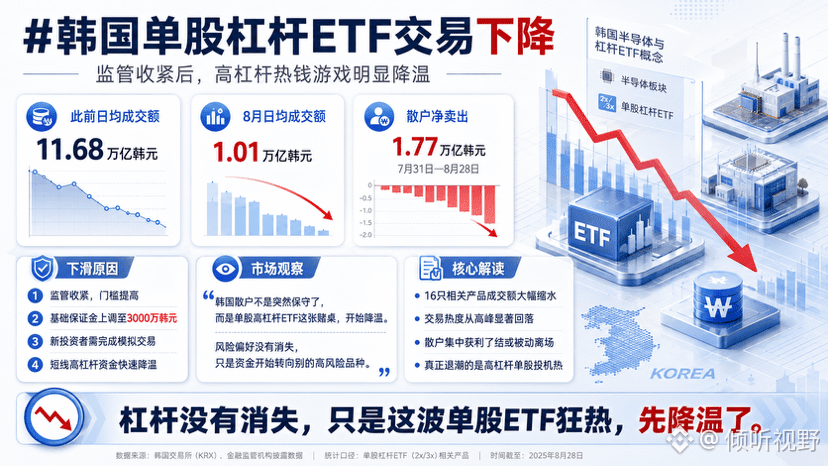

#韩国单股杠杆ETF交易下降
This time, Korean retail investors have truly been “educated” by leverage.
A few months ago, when Samsung Electronics and SK hynix were rallying hard, the 2x leveraged ETFs for individual Korean stocks nearly became the hottest tables in the casino. Daily trading value would often top 100 trillion won, and many retail investors had a simple thought: if chips rise 10%, why not make 20%?
Now the answer is here.
After regulators tightened oversight, these 16 single-stock leveraged and inverse ETFs saw their average daily trading value drop from roughly 116.8 trillion won beforehand to around 1 trillion won in August—down to just 8% of the prior level. In just one month, retail investors net sold about 1.77 trillion won worth of these products. Of that, products related to SK hynix alone were sold for more than 1.24 trillion won.
But I think the most interesting part isn’t that “Koreans suddenly stopped gambling.”
It’s that the gambling table changed.
Regulators raised the initial margin requirement from 10 million won to 30 million won, and also required new investors to complete simulated trading—definitely keeping a large amount of short-term capital out of the door. At the same time, some funds started to move into leveraged index ETFs, and even directly shifted into overseas high-leverage products.
So what does that show?
Risk appetite hasn’t disappeared—it’s just been pushed elsewhere.
The most painful part is that these 16 products have been listed for less than three months, and on average they’re already down about 46%. For SK hynix–related leveraged products, average losses even exceed 53%. Even the short-selling 2x inverse products couldn’t escape the “back-and-forth whipsaw plus daily compounding decay” beatdown.
So where leverage is easiest to fool people is right here:
You think you’re just multiplying your returns by 2—but in reality, you’re also multiplying volatility, decay, and the cost of making mistakes by 2.
Now that trading volume for Korea’s single-stock leveraged ETFs has plunged by around 90%, I actually don’t think that’s necessarily a bad thing.
A truly healthy bull market shouldn’t rely on everyone taking leverage to force the index higher.
After the tide goes out, the money that can still stay put is what’s really worth watching.
#etf #三星电子 #sk海力士 #杠杆ETF
This time, Korean retail investors have truly been “educated” by leverage.
A few months ago, when Samsung Electronics and SK hynix were rallying hard, the 2x leveraged ETFs for individual Korean stocks nearly became the hottest tables in the casino. Daily trading value would often top 100 trillion won, and many retail investors had a simple thought: if chips rise 10%, why not make 20%?
Now the answer is here.
After regulators tightened oversight, these 16 single-stock leveraged and inverse ETFs saw their average daily trading value drop from roughly 116.8 trillion won beforehand to around 1 trillion won in August—down to just 8% of the prior level. In just one month, retail investors net sold about 1.77 trillion won worth of these products. Of that, products related to SK hynix alone were sold for more than 1.24 trillion won.
But I think the most interesting part isn’t that “Koreans suddenly stopped gambling.”
It’s that the gambling table changed.
Regulators raised the initial margin requirement from 10 million won to 30 million won, and also required new investors to complete simulated trading—definitely keeping a large amount of short-term capital out of the door. At the same time, some funds started to move into leveraged index ETFs, and even directly shifted into overseas high-leverage products.
So what does that show?
Risk appetite hasn’t disappeared—it’s just been pushed elsewhere.
The most painful part is that these 16 products have been listed for less than three months, and on average they’re already down about 46%. For SK hynix–related leveraged products, average losses even exceed 53%. Even the short-selling 2x inverse products couldn’t escape the “back-and-forth whipsaw plus daily compounding decay” beatdown.
So where leverage is easiest to fool people is right here:
You think you’re just multiplying your returns by 2—but in reality, you’re also multiplying volatility, decay, and the cost of making mistakes by 2.
Now that trading volume for Korea’s single-stock leveraged ETFs has plunged by around 90%, I actually don’t think that’s necessarily a bad thing.
A truly healthy bull market shouldn’t rely on everyone taking leverage to force the index higher.
After the tide goes out, the money that can still stay put is what’s really worth watching.
#etf #三星电子 #sk海力士 #杠杆ETF