
The Robotaxi story of Tesla, officially moving from the “PPT” phase to “mass production.”
Latest solid confirmation (8/29–8/30):
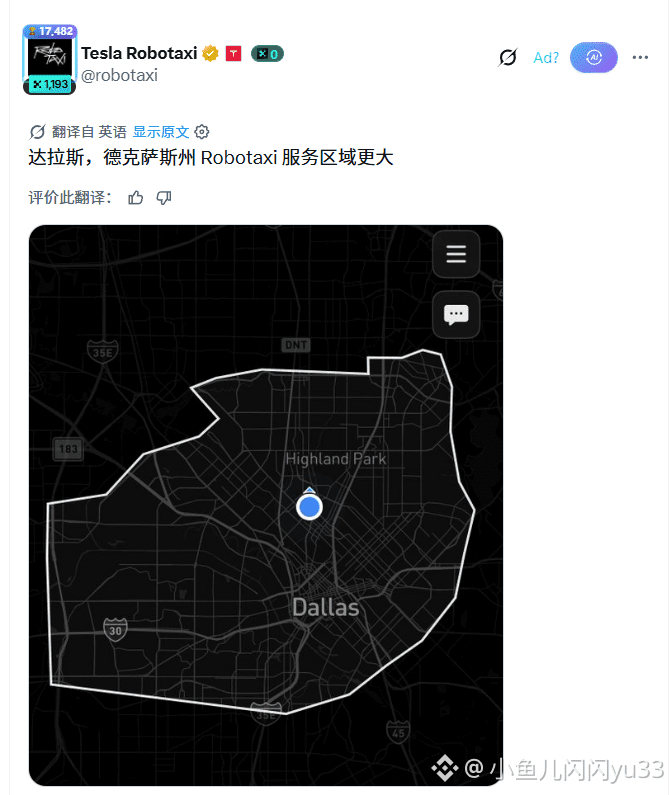
The production version of the Cybercab has been spotted on the streets of downtown Dallas: no steering wheel, no pedals, and no one inside the car. It is equipped with an approximately 219 hp front electric motor, an approximately 48 kWh battery, and consumes about 165 Wh per mile—viewed as one of Tesla’s most energy-efficient models. The service area of the Dallas Robotaxi has expanded by 158%. In the early hours of September 4 (Beijing time), Tesla will hold a Cybercab launch event in Austin, Texas, and stream it globally.
More key information:
Musk’s goal is to drive the price down to under $30,000; the company is more focused on incorporating it into a Robotaxi fleet rather than selling it to private customers. Revenue expectations at scale are projected for 2027 and beyond. According to an 8/20 meeting between Tesla and JPMorgan Chase: FSD v15 is a “step-change,” and the current HW4 hardware is already sufficient to support autonomous driving; Optimus is expected to begin external sales as early as the second half of 2027.
The logic is straightforward: FSD v15 + HW4 autonomous driving capability + a complete vehicle under $30,000 = marginal costs that could undercut the taxi industry for a Robotaxi fleet. The launch event on September 4 may be one of the most important nights for Tesla in 2026. $TSLA
Latest solid confirmation (8/29–8/30):
The production version of the Cybercab has been spotted on the streets of downtown Dallas: no steering wheel, no pedals, and no one inside the car. It is equipped with an approximately 219 hp front electric motor, an approximately 48 kWh battery, and consumes about 165 Wh per mile—viewed as one of Tesla’s most energy-efficient models. The service area of the Dallas Robotaxi has expanded by 158%. In the early hours of September 4 (Beijing time), Tesla will hold a Cybercab launch event in Austin, Texas, and stream it globally.
More key information:
Musk’s goal is to drive the price down to under $30,000; the company is more focused on incorporating it into a Robotaxi fleet rather than selling it to private customers. Revenue expectations at scale are projected for 2027 and beyond. According to an 8/20 meeting between Tesla and JPMorgan Chase: FSD v15 is a “step-change,” and the current HW4 hardware is already sufficient to support autonomous driving; Optimus is expected to begin external sales as early as the second half of 2027.
The logic is straightforward: FSD v15 + HW4 autonomous driving capability + a complete vehicle under $30,000 = marginal costs that could undercut the taxi industry for a Robotaxi fleet. The launch event on September 4 may be one of the most important nights for Tesla in 2026. $TSLA