

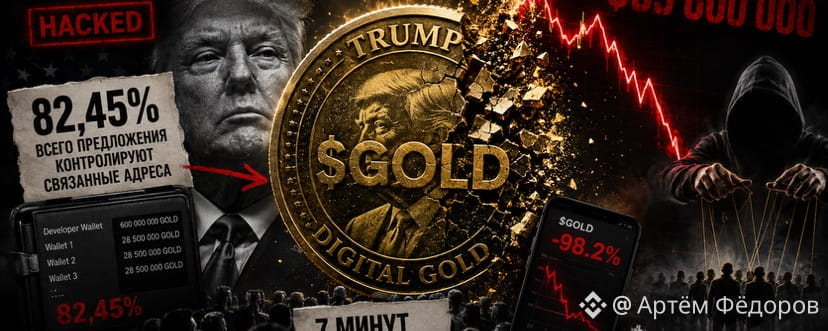

Seven minutes. Minus $62,100.
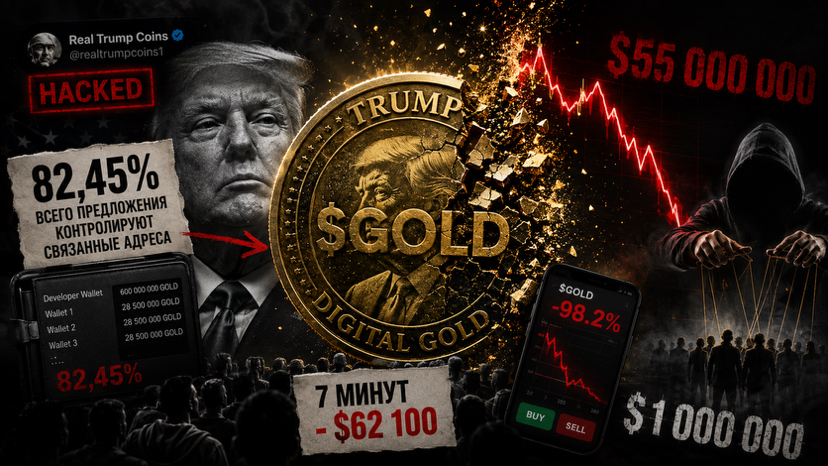
That’s exactly how long it took one trader who bought Trump Digital Gold ($GOLD) during a pump to lose tens of thousands of dollars. He saw a token rising rapidly. A familiar brand. An account with tens of thousands of followers. A market cap soaring into the tens of millions. It seemed like all you had to do was be quick and get in. But while some rushed to enter, others were already preparing to exit. And you could tell even before the crash. You just had to look at one number:
82.45%.
That’s how much all $GOLD turned out to be under the control of a small group of linked addresses.
What happened
On August 29, Trump Digital Gold appeared on Solana. Soon after, the X account @realtrumpcoins1, associated with the collector coin seller Real Trump Coins, published the $GOLD contract. Everything looked convincing enough. The Real Trump Coins brand really existed long before this story and had previously been publicly promoted by Donald Trump. The account had tens of thousands of followers. On the realtrumpcoins.com website, a $GOLD page appeared promising to direct 99% of trading fees to a token buyback. The stated goal was even louder: to move $GOLD into the top ten largest cryptocurrencies in the world. Buyers saw the loud name and a fast-growing chart.
On-chain, it showed something else.
The red flag was visible in advance
Lookonchain analysts noticed an extremely unusual distribution of tokens. The developer wallet controlled:
600 million $GOLD.
15 more just-created wallets spent just $18,657, receiving:
224.5 million $GOLD.
Together, this group controlled approximately:
82.45% of the entire supply.
And these data appeared before the final collapse. High concentration by itself doesn’t prove fraud. In a normal project, large volumes can be in treasury, vesting contracts, liquidity pools, and other publicly explainable structures. But here the picture was different:
developer wallet + a group of fresh addresses + 82% of the supply.
That’s already a reason at least to remove your finger from the Buy button and figure out what’s happening.
$18,657 → $330,000
Waiting wasn’t long. Those very 15 wallets sold their 224.5 million $GOLD for about 3,178 SOL—around $330,000.
Estimated profit:
about $312,000.
Nearly 17x on the initially invested money. But in crypto there’s a simple thing that’s easy to forget during a pump:
for someone to sell for $330,000, someone else must buy.
For an early wallet, it’s the exit. For a late buyer, it’s the entry. Hence the unpleasant phrase “exit liquidity”: the liquidity for exiting is provided by people who arrived later. One of them was a trader who lost about $62,100 in just seven minutes.
And then it all ended in 30 seconds
According to on-chain analysis, $GOLD was created around 07:38. Around 09:00, @realtrumpcoins1 published the token contract. At its peak, the market cap of $GOLD reached approximately:
$66 million.
Around 11:48, the post disappeared. The linked addresses began concentrated selling. And then the main thing happened:
$55 million → about $1 million in roughly 30 seconds.
In the end, a group of addresses controlling about 824.54 million $GOLD—82.454% of the supply—sold the tokens for about 9,784.6 SOL, valued at approximately $1.01 million. After that, the market cap dropped to about $700k—almost 99% below the peak.
Where did the $65 million go?
Here’s where the $GOLD story becomes more useful than the usual news about yet another rug pull. If the token’s market cap reached $66 million, why did the owners of 82% of the supply get only about $1 million when they sold? Because:
market cap is not the same as money inside the project.
Market cap—roughly speaking—is the token’s current price multiplied by the number of tokens issued. If the last $GOLD sells for $0.066, then a billion tokens yield a $66 million market cap. But that absolutely doesn’t mean there are $66 million worth of buyers on the market who are ready to purchase that entire billion at $0.066. Start selling hundreds of millions of tokens, and the price of each next token will be lower. That’s why, in a low-liquidity market, a relatively small amount of real money can draw an enormous market cap. And then it can disappear almost instantly. That’s exactly what we saw:
$55 million → $1 million in half a minute.
Not because someone literally stole $54 million from the cashbox. Those $54 million were never sitting there.
But then there was another twist
At first, it might have seemed that Real Trump Coins itself launched a dubious token. Now there’s more important information. Real Trump Coins stated that it never launched, promoted, or authorized the issuance of digital tokens. The company claims that what happened was a malicious act by a third party and that it is currently cooperating with law enforcement. GoPlus Security also reported that the website realtrumpcoins.com and the account @realtrumpcoins1 were taken over by attackers. According to their on-chain analysis, the initial funding of the developer wallet traces back to KuCoin, and the funding of the 15 related addresses traces back to Binance. Researchers also link this group to another token—PLATINUM. Here, it’s necessary to separate what’s established from what’s assumed.On-chain data lets you see token and fund movements. But a Binance or KuCoin address alone does not reveal the identity of the owner. Exchanges know their customers; the public blockchain does not. So the investigation into who specifically stood behind the operation could still continue. But now the main thing is known:
$GOLD was not authorized by Real Trump Coins.
And that makes the story far more interesting.
What if the scam looks official?
A common piece of advice goes like this: “Buy only via links from official sources.” Good advice. But $GOLD pushes it to its limit. What if the very source people are used to trusting has been compromised? You can check the account. You can go to the website. You can see the familiar brand. You can see the contract right there. And still buy a token that, within a few hours, is practically reduced to zero. That means in crypto, one check of the source isn’t enough. There’s a second level of verification:
the blockchain itself.
And in the case of $GOLD, it showed what the ads didn’t:
82% of the supply was held by a small group of linked wallets.
Five minutes until the Buy button
You don’t have to be a professional on-chain analyst. Before buying a small, unknown token, it’s enough to do at least a few checks:
Who owns the supply?
Look at the largest wallets and find out what those addresses are.
When did they appear?
A group of fresh wallets that simultaneously built a huge position before the ad campaign is a serious red flag.
Where did the money come from?
Allegedly, “independent” addresses sometimes turn out to be part of the same funding chain.
What is the real liquidity?
A $50 million market cap doesn’t mean there are $50 million worth of available money.
Who are you buying the exit from?
If the early addresses already made huge profits and you’re entering after a vertical candle, it’s worth asking: why are they willing to sell me the tokens right now?
And there’s a sixth check that costs absolutely nothing:
if it feels like there are only ten seconds left to decide because otherwise there will be an x100 without you—don’t press Buy in those ten seconds.
The blockchain didn’t promise anything. It just showed everything
In the $GOLD story, what’s especially interesting isn’t that the token crashed. Memecoins crash all the time. What’s more interesting is this:
what could be seen before the drop?
A developer wallet with 600 million tokens.
15 fresh addresses with another 224.5 million.
82.45% of the supply in the hands of one linked group.
On the other hand, there’s a beautiful website, a loud name, and a vertically rising chart. One signal said:
“Be quick and buy.”
Another:
“First look at who’s selling to you.”
After a few hours, the market showed which one was more important.
In crypto, it’s not enough to ask: “Who is advertising this?”
You need to ask one more question:
“Who owns the coins?”
Sometimes the answer saves the whole deposit. And sometimes it’s minus $62,100 in seven minutes.
❓Before buying a new token, do you check the wallet distribution—or first look at the chart?
#crypto #Solana #Onchain #CryptoSecurity
The material is for informational purposes only and is not an investment recommendation.