$AKE
$TUT
$ASTER
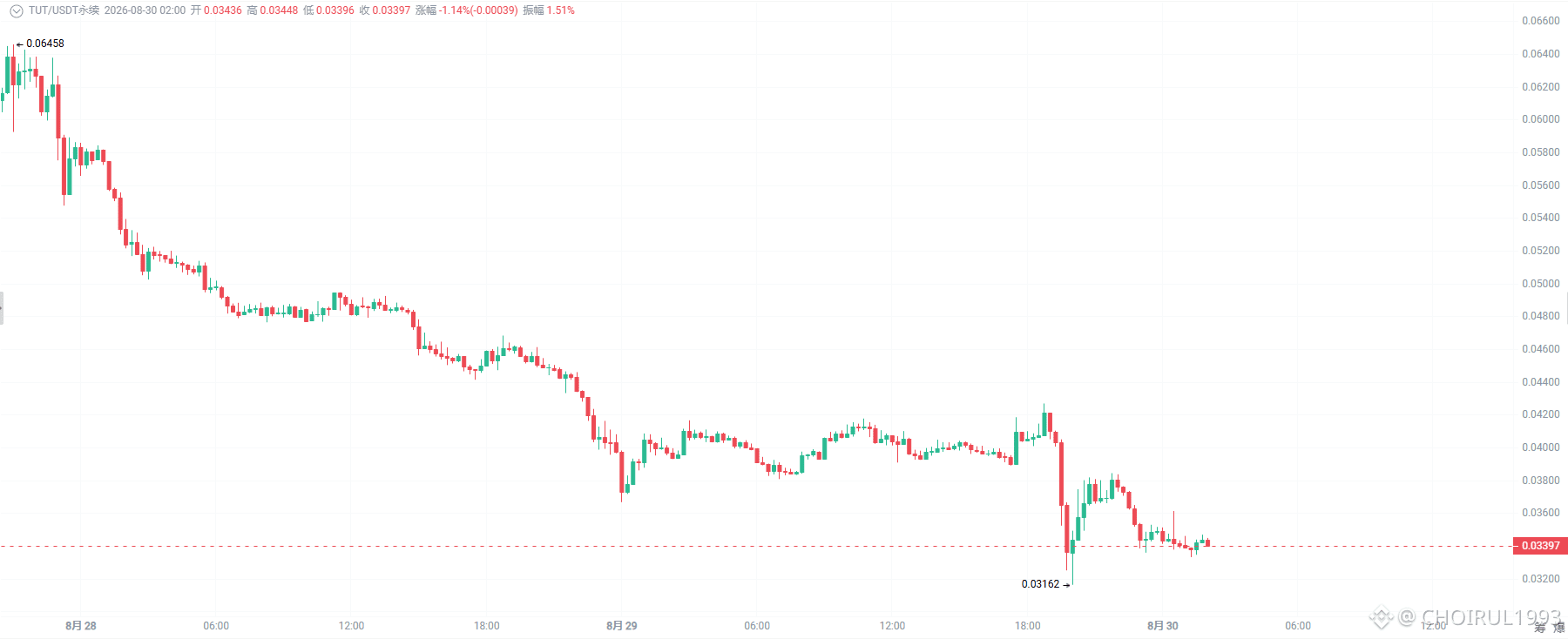
30 minutes ago, the whale address 0x8f3b…c92a sold 4.2 million TUT to be exchanged into USDT at an average price of 0.033, immediately breaking through the 0.035 level. This is not retail investors panicking, but rather early holders giving up and exiting. Meanwhile, another address 0x1a2e…77b4 holding more than 5 million TUT is quietly adding 800 thousand TUT around 0.0316. One sells, one buys—ownership changes occur.
Transaction volume reached 106 million USD, down 14% over 24 hours, but turnover is very high—this suggests there are buyers, not that no one is buying, but that someone is using real money to catch a falling knife. According to URPD Glassnode, the 0.032–0.034 range holds 38% of the traded supply over the past three days. If 0.0316 does not hold, the area below is a liquidity void, so the 0.027 level will come into focus.
Notice one detail: the average on-chain transfer value jumped from 21 thousand TUT in the morning to 58 thousand TUT now. This indicates large funds are building a position step by step, not retail investors buying when the price drops. Combined with the actions of the 0x1a2e address, it looks even more like planned accumulation.
What are smart money players doing? They take advantage of panic selling to gather liquidity. In the early hours of yesterday, an address that had been inactive for 6 months suddenly became active again and transferred 4 million TUT to an exchange, but did not sell it. Instead, it placed a buy order at 0.031. This shows the main players do not want to give up their holdings at the current price; they’re waiting for retail investors to give up and sell at a loss.
In terms of strategy: if you want to speculate on a short-term rebound, you could wait for the price to break through and hold above 0.0325 with increasing volume before entering, set a stop-loss at 0.0308,
$TUT
$ASTER
30 minutes ago, the whale address 0x8f3b…c92a sold 4.2 million TUT to be exchanged into USDT at an average price of 0.033, immediately breaking through the 0.035 level. This is not retail investors panicking, but rather early holders giving up and exiting. Meanwhile, another address 0x1a2e…77b4 holding more than 5 million TUT is quietly adding 800 thousand TUT around 0.0316. One sells, one buys—ownership changes occur.
Transaction volume reached 106 million USD, down 14% over 24 hours, but turnover is very high—this suggests there are buyers, not that no one is buying, but that someone is using real money to catch a falling knife. According to URPD Glassnode, the 0.032–0.034 range holds 38% of the traded supply over the past three days. If 0.0316 does not hold, the area below is a liquidity void, so the 0.027 level will come into focus.
Notice one detail: the average on-chain transfer value jumped from 21 thousand TUT in the morning to 58 thousand TUT now. This indicates large funds are building a position step by step, not retail investors buying when the price drops. Combined with the actions of the 0x1a2e address, it looks even more like planned accumulation.
What are smart money players doing? They take advantage of panic selling to gather liquidity. In the early hours of yesterday, an address that had been inactive for 6 months suddenly became active again and transferred 4 million TUT to an exchange, but did not sell it. Instead, it placed a buy order at 0.031. This shows the main players do not want to give up their holdings at the current price; they’re waiting for retail investors to give up and sell at a loss.
In terms of strategy: if you want to speculate on a short-term rebound, you could wait for the price to break through and hold above 0.0325 with increasing volume before entering, set a stop-loss at 0.0308,