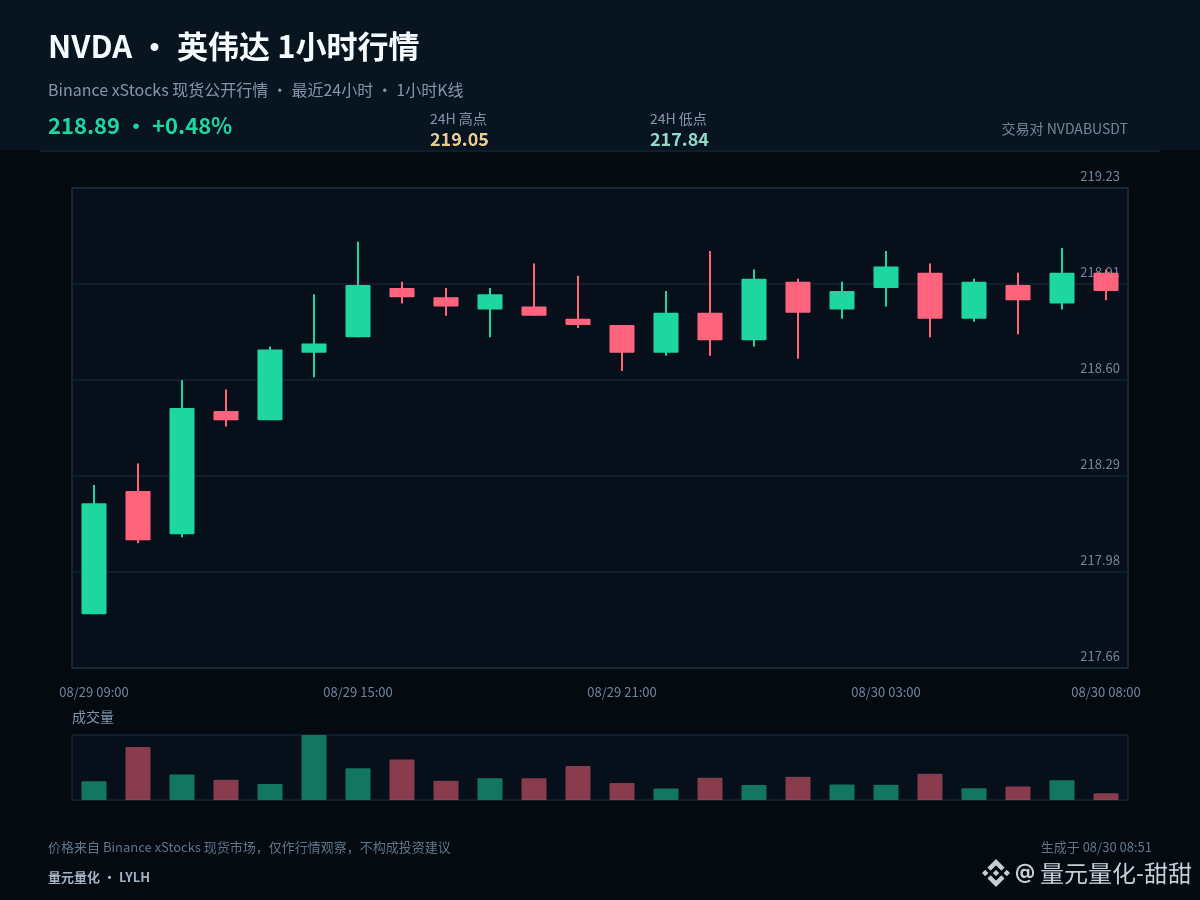
$NVDAB #NVDA Over the past 24 hours, the high-low amplitude is about 0.6%, and the current price is 218.91. This is not a calm range suitable for casually opening a position. When volatility expands, you should adjust your position first, before discussing direction.
$NVDAB #NVDA has already moved to the upper edge of the last-24-hours range. What needs to be confirmed most right now is whether there is a valid breakout, or whether it’s just a push higher followed by a pullback.
The current price is near the upper edge of the 24-hour volatility band: 1-hour -0.02%, 24-hour +0.49%. At the highs, the most important thing is to confirm the market’s acceptance after a breakout: if price can stay above the upper edge, it indicates the market is认可 of a higher range. If it only briefly pierces and quickly retreats, you need to guard against a false breakout.
For the short term, first watch whether 217.84 can form continuous support/acceptance, then whether 218.445 can be reclaimed. The former determines whether the downside is likely to slow; the latter determines whether the rebound can strengthen. Without confirmation of both, it’s not advisable to rely solely on the size of the drop to judge opportunity.
In high-volatility phases, the execution principle is to reduce single-trade exposure, avoid chasing prices back and forth in the middle of the range, and write the invalidation conditions before entering. If price does not provide confirmation, it’s better to do one fewer trade than to compensate for uncertainty with a larger position.
Going forward, there are three possible ways to handle it: if it can validly hold above 219.05, wait for a pullback that does not break and then reassess continuation; if it breaks down below 217.84, prioritize risk control and wait for new support; if it continues to chop around 218.445, treat it as range rotation—don’t repeatedly chase a direction in the middle of the range.
The key focus of short-term positioning is not to predict every single candlestick, but to ensure there are grounds for entry, de-risking, and exit. Do less until confirmed; if a key level fails, redo the plan. Control single-trade risk first, and then talk about upside/bottom potential.
#TrumpSaysUSReachedVenezuelaOilDeal
$NVDAB #NVDA has already moved to the upper edge of the last-24-hours range. What needs to be confirmed most right now is whether there is a valid breakout, or whether it’s just a push higher followed by a pullback.
The current price is near the upper edge of the 24-hour volatility band: 1-hour -0.02%, 24-hour +0.49%. At the highs, the most important thing is to confirm the market’s acceptance after a breakout: if price can stay above the upper edge, it indicates the market is认可 of a higher range. If it only briefly pierces and quickly retreats, you need to guard against a false breakout.
For the short term, first watch whether 217.84 can form continuous support/acceptance, then whether 218.445 can be reclaimed. The former determines whether the downside is likely to slow; the latter determines whether the rebound can strengthen. Without confirmation of both, it’s not advisable to rely solely on the size of the drop to judge opportunity.
In high-volatility phases, the execution principle is to reduce single-trade exposure, avoid chasing prices back and forth in the middle of the range, and write the invalidation conditions before entering. If price does not provide confirmation, it’s better to do one fewer trade than to compensate for uncertainty with a larger position.
Going forward, there are three possible ways to handle it: if it can validly hold above 219.05, wait for a pullback that does not break and then reassess continuation; if it breaks down below 217.84, prioritize risk control and wait for new support; if it continues to chop around 218.445, treat it as range rotation—don’t repeatedly chase a direction in the middle of the range.
The key focus of short-term positioning is not to predict every single candlestick, but to ensure there are grounds for entry, de-risking, and exit. Do less until confirmed; if a key level fails, redo the plan. Control single-trade risk first, and then talk about upside/bottom potential.
#TrumpSaysUSReachedVenezuelaOilDeal