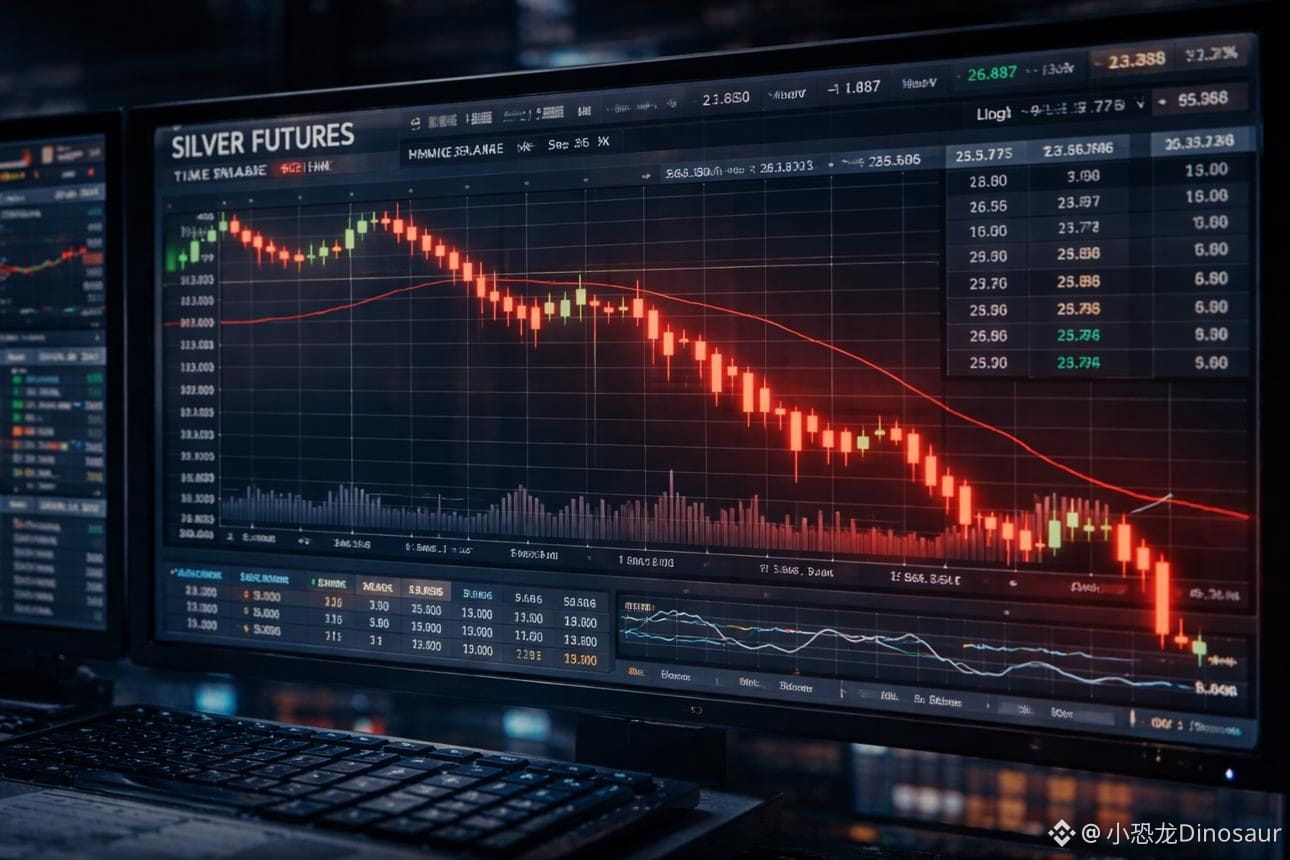

#纽约白银期货跌3%
Silver is down 3%. I actually think it’s more worth examining than gold’s drop.
Because silver is a very interesting asset.
One foot of it stands in precious metals, while the other foot steps onto industrial demand. So it trades not only alongside gold for hedging and interest rates, but also gets influenced by the economic cycle, manufacturing, and industrial demand.
After this remarks from Wosh, silver was clearly under pressure. Spot silver at one point fell more than 4%, and the decline was even noticeably larger than gold’s.
Why? It’s simple.
When interest-rate expectations rise and the U.S. dollar strengthens, non-yielding assets suffer first.
But silver faces a second layer of pressure: if the market starts worrying that high rates will suppress the economy and industrial demand, then silver will naturally be more sensitive than gold.
So I won’t simply interpret this silver selloff as “the precious metals rally is over.”
Quite the opposite—this looks more like the market has started pricing the two things separately:
Gold is priced with a currency attribute, while silver is priced with a combination of currency attribute plus industrial attribute.
That’s also why, when facing the same backdrop of a stronger dollar and rate-hike expectations, silver often drops faster and harder.
Of course, silver’s prior rally was also substantial. Profit-taking positioning was already fairly thick, so a correction of around 3% isn’t strange.
What traders should really watch is this: when the dollar continues strengthening, will silver keep making new lows—or after the drop, will it quickly find support and bounce?
If the latter happens, it suggests funds are just washing out short-term positions.
If the former holds true, then be careful—this may not be a simple pullback. It could mean the market is starting to reassess industrial demand and the interest-rate cycle.
Silver is down 3%. I actually think it’s more worth examining than gold’s drop.
Because silver is a very interesting asset.
One foot of it stands in precious metals, while the other foot steps onto industrial demand. So it trades not only alongside gold for hedging and interest rates, but also gets influenced by the economic cycle, manufacturing, and industrial demand.
After this remarks from Wosh, silver was clearly under pressure. Spot silver at one point fell more than 4%, and the decline was even noticeably larger than gold’s.
Why? It’s simple.
When interest-rate expectations rise and the U.S. dollar strengthens, non-yielding assets suffer first.
But silver faces a second layer of pressure: if the market starts worrying that high rates will suppress the economy and industrial demand, then silver will naturally be more sensitive than gold.
So I won’t simply interpret this silver selloff as “the precious metals rally is over.”
Quite the opposite—this looks more like the market has started pricing the two things separately:
Gold is priced with a currency attribute, while silver is priced with a combination of currency attribute plus industrial attribute.
That’s also why, when facing the same backdrop of a stronger dollar and rate-hike expectations, silver often drops faster and harder.
Of course, silver’s prior rally was also substantial. Profit-taking positioning was already fairly thick, so a correction of around 3% isn’t strange.
What traders should really watch is this: when the dollar continues strengthening, will silver keep making new lows—or after the drop, will it quickly find support and bounce?
If the latter happens, it suggests funds are just washing out short-term positions.
If the former holds true, then be careful—this may not be a simple pullback. It could mean the market is starting to reassess industrial demand and the interest-rate cycle.