
Dream Spicer 梦想家
11.3k Posts

Dream Spicer 梦想家
Dream big, earn smart | Crypto learner | Airdrop Hunter | Charts on, stress gone | Let’s grow 🚀
504 Following
25.1K+ Followers
16.4K+ Liked
Posts
All
Quotes
Videos
Live
PINNED
25K Followers Completed Now I'm Looking Saalar ki Imama😂❤️
We’ve officially reached 25,000 followers on Binance Square.
Honestly, this milestone feels special because it was built one post, one discussion, and one interaction at a time.
I’ve always tried to share research and ideas that are actually worth reading not just chase numbers.
To celebrate, I’m sharing a Red Packet with the community. 🧧
Thank you to everyone who has been part of the journey.
25K today. Let’s see where we can take it next.
Good luck, everyone. ❤️
To Claim Red Packet
📌 Follow
📌 Repost
📌 Like
📌 Comment
#BinanceSquare #25K #CryptoCommunity
$SOL
We’ve officially reached 25,000 followers on Binance Square.
Honestly, this milestone feels special because it was built one post, one discussion, and one interaction at a time.
I’ve always tried to share research and ideas that are actually worth reading not just chase numbers.
To celebrate, I’m sharing a Red Packet with the community. 🧧
Thank you to everyone who has been part of the journey.
25K today. Let’s see where we can take it next.
Good luck, everyone. ❤️
To Claim Red Packet
📌 Follow
📌 Repost
📌 Like
📌 Comment
#BinanceSquare #25K #CryptoCommunity
$SOL

PINNED
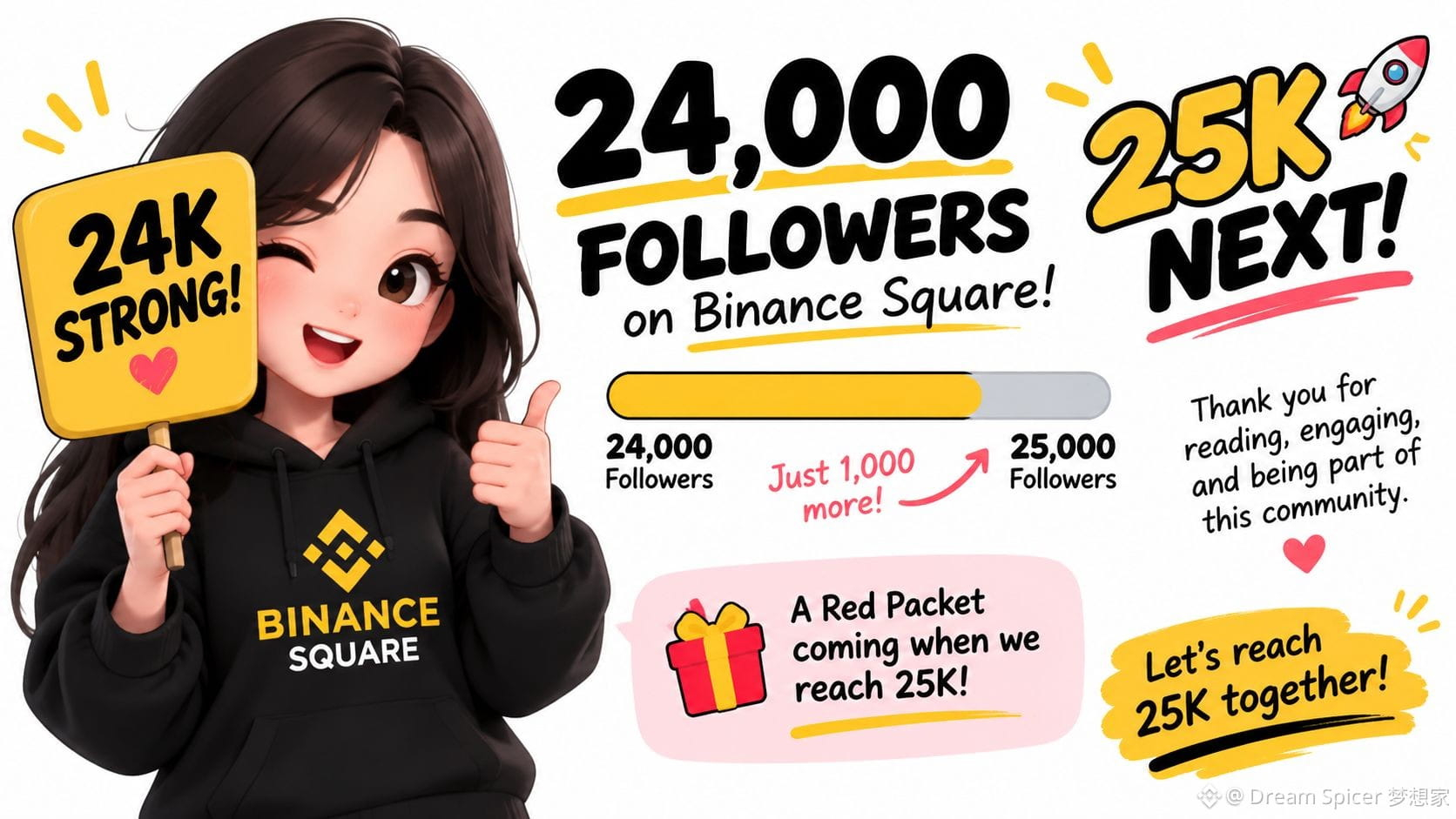
24K Strong. 25K Next.
We’ve officially reached 24,000 followers on Binance Square.
What started as sharing research, insights, and ideas with the community has grown into something much bigger.
Now, we’re just 500 followers away from 25K.
To celebrate everyone who has supported the journey, I’ll be sharing a Red Packet when we reach the milestone. 🎁
Thank you for reading, engaging, and being part of this community.
Let’s reach 25K together.
$BNB
We’ve officially reached 24,000 followers on Binance Square.
What started as sharing research, insights, and ideas with the community has grown into something much bigger.
Now, we’re just 500 followers away from 25K.
To celebrate everyone who has supported the journey, I’ll be sharing a Red Packet when we reach the milestone. 🎁
Thank you for reading, engaging, and being part of this community.
Let’s reach 25K together.
$BNB
Claim!

Mr Max
·
--
🎁 Claim your Gift 🎁
🧧🧧🧧🧧🧧
🧧🧧🧧🧧🧧
Join chat Group for Daily 🧧....
Hint:- { 786 }...................
$SNDK $BTC $ETH
#ETH🔥🔥🔥🔥🔥🔥 #SNDKUSDT #BTC走势分析 #HEMI #CaliforniaBillWouldBarOfficialMemeCoins
🧧🧧🧧🧧🧧
🧧🧧🧧🧧🧧
Join chat Group for Daily 🧧....
Hint:- { 786 }...................
$SNDK $BTC $ETH
#ETH🔥🔥🔥🔥🔥🔥 #SNDKUSDT #BTC走势分析 #HEMI #CaliforniaBillWouldBarOfficialMemeCoins



静心1688
·
--
💥 The towering tree begins from the tiniest sprout; the nine-tiered platform rises from piled earth; a journey of a thousand miles starts beneath your feet.
Great matters grow from small accumulations—take it slow, and keep doing it.
#美元创近四周最大涨幅 #中国反对美国拟加征7.5%关税
Great matters grow from small accumulations—take it slow, and keep doing it.
#美元创近四周最大涨幅 #中国反对美国拟加征7.5%关税

Goo

大仁Jaron
·
--
Powell turns hawkish, reigniting rate-hike expectations: September hike probability rises to nearly 60%, with possibly two hikes before March 2027
The Federal Reserve chair Powell on Friday reignited market expectations for rate hikes with remarks at the Jackson Hole annual symposium. While he did not directly provide policy guidance for the September meeting, he clearly said that policymakers must be confident that underlying inflation is falling back toward the 2% target in a “clear and sufficiently rapid” manner; otherwise, the Fed “still has work to do.”
The statement quickly changed pricing in the interest-rate market. Media reports said market moves indicated traders restarted bets on a single 25-basis-point rate hike later this year, and leaned toward expecting two hikes by March 2027. CME-related data showed the probability of a September hike rose from about 35% before Powell’s remarks to 50%, while other market data at one point suggested the probability increased to around 55%. Later reporting also said market data showed the probability briefly reached about 60%.
The statement quickly changed pricing in the interest-rate market. Media reports said market moves indicated traders restarted bets on a single 25-basis-point rate hike later this year, and leaned toward expecting two hikes by March 2027. CME-related data showed the probability of a September hike rose from about 35% before Powell’s remarks to 50%, while other market data at one point suggested the probability increased to around 55%. Later reporting also said market data showed the probability briefly reached about 60%.

Goo
Virus钻石
·
--
Life is like tea. It won’t stay bitter forever, but it will be bitter for a while. When the bitterness passes, sweetness comes—and everything gets better and better.


claim
ETHcryptohub
·
--
🎁🎁🎁🎁 Gifts for Everyone 🎁🎁🎁🎁
Comment: Yes
LIKE + Follow + Repost
🎉🎉🎉🎉🎉🎉🎉🎉🎉🎉🎉
#Ethcryptohub
$BNB $BTC
Comment: Yes
LIKE + Follow + Repost
🎉🎉🎉🎉🎉🎉🎉🎉🎉🎉🎉
#Ethcryptohub
$BNB $BTC
Gooo

Frenzy _13
·
--
Hello crypto friends 🤗✨
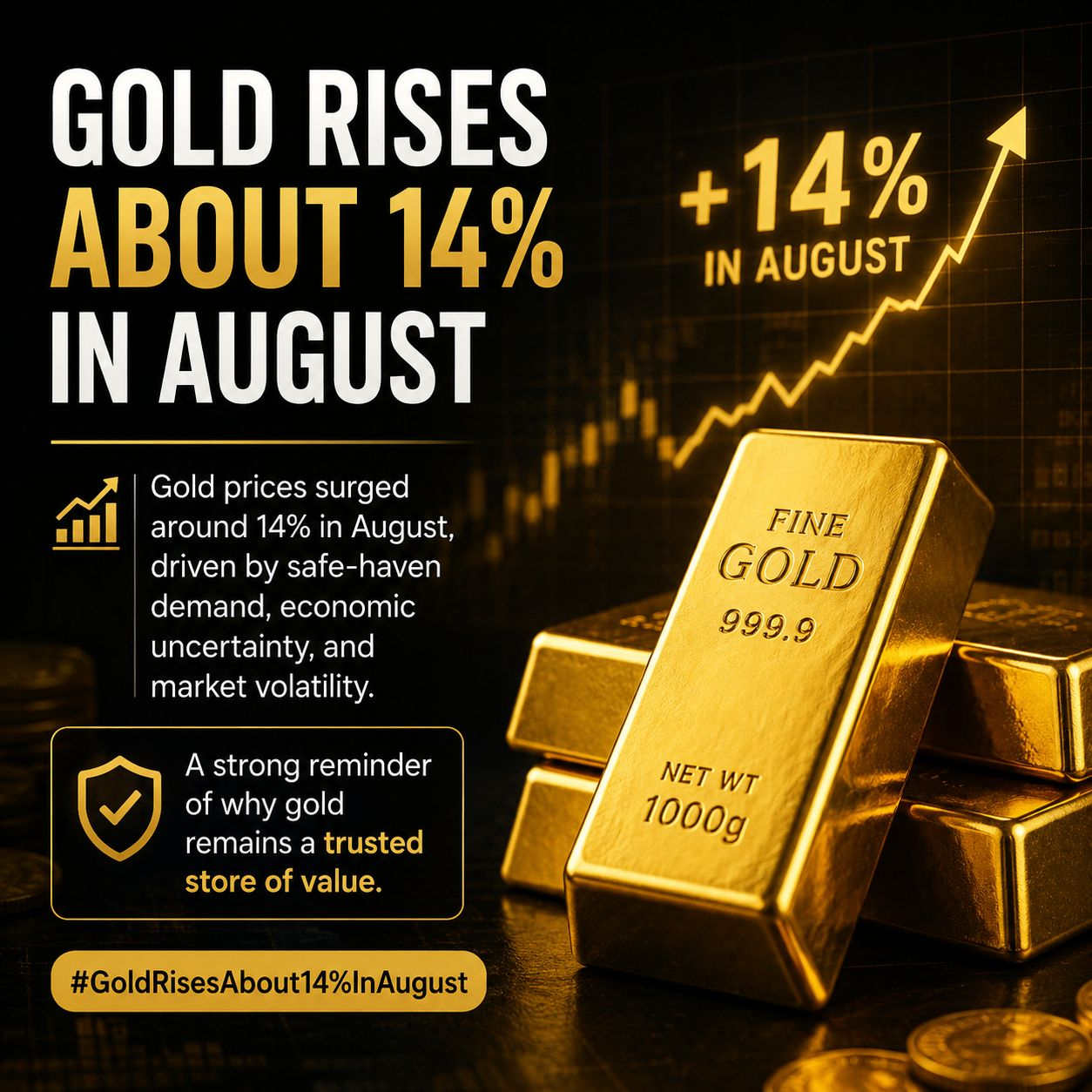
Gold is up around 14% in August, and that’s definitely caught my attention. To me, this move looks bigger than just a short-term price pump. It shows how much interest investors still have in safe-haven assets. Now I’m watching to see if this momentum can carry into September.
$XAU
Gold is up around 14% in August, and that’s definitely caught my attention. To me, this move looks bigger than just a short-term price pump. It shows how much interest investors still have in safe-haven assets. Now I’m watching to see if this momentum can carry into September.
$XAU
claim

远方1688 BNB
·
--
₿ $BTC Price Prediction — 2026 → 2035 🚀
Where might BTC go over the next ten years?👀
2026 → $125K
2027 → $100K
2028 → $140K
2029 → $200K
2030 → $300K
2031 → $250K
2032 → $350K
2033 → $450K
2034 → $550K
2035 → $700K+ 🔥🔥🔥
📌 If adoption and demand continue to grow, Bitcoin could reach more than $500K to $700K by 2035.
This journey won’t be smooth sailing—major pullbacks, bear markets, and explosive rebounds are expected along the way.
Will you keep holding BTC until 2035?👁️👁️
#BTC #Bitcoin #Crypto #CryptoPrediction #Bitcoin2035
Where might BTC go over the next ten years?👀
2026 → $125K
2027 → $100K
2028 → $140K
2029 → $200K
2030 → $300K
2031 → $250K
2032 → $350K
2033 → $450K
2034 → $550K
2035 → $700K+ 🔥🔥🔥
📌 If adoption and demand continue to grow, Bitcoin could reach more than $500K to $700K by 2035.
This journey won’t be smooth sailing—major pullbacks, bear markets, and explosive rebounds are expected along the way.
Will you keep holding BTC until 2035?👁️👁️
#BTC #Bitcoin #Crypto #CryptoPrediction #Bitcoin2035

24K followers. 😮💨
Okay… apparently some people actually enjoy reading my crypto thoughts. 😂
Now we’re only 1,000 followers away from 25K — and I want to make the final push a little more fun.
🧧 RED PACKET coming at 25K!
If you’ve been following, reading, commenting, or quietly watching me overthink crypto charts… this one is for you. 😂
Help me close the final 1K:
❤️ Like
🔁 Share
👥 Invite a crypto friend
💬 Comment 25K
Let’s make 25K happen together.
Okay… apparently some people actually enjoy reading my crypto thoughts. 😂
Now we’re only 1,000 followers away from 25K — and I want to make the final push a little more fun.
🧧 RED PACKET coming at 25K!
If you’ve been following, reading, commenting, or quietly watching me overthink crypto charts… this one is for you. 😂
Help me close the final 1K:
❤️ Like
🔁 Share
👥 Invite a crypto friend
💬 Comment 25K
Let’s make 25K happen together.

🎙️ Let's start to share Dusk live Trading Session
End
01 h 08 m 52 s
302

BNB
Holding
-1.69
0
🎙️ Talk About Dusk, live Trade, live Analysis
End
01 h 18 m 19 s
288
DUSK/USDT
Market/Sell
Filled
0
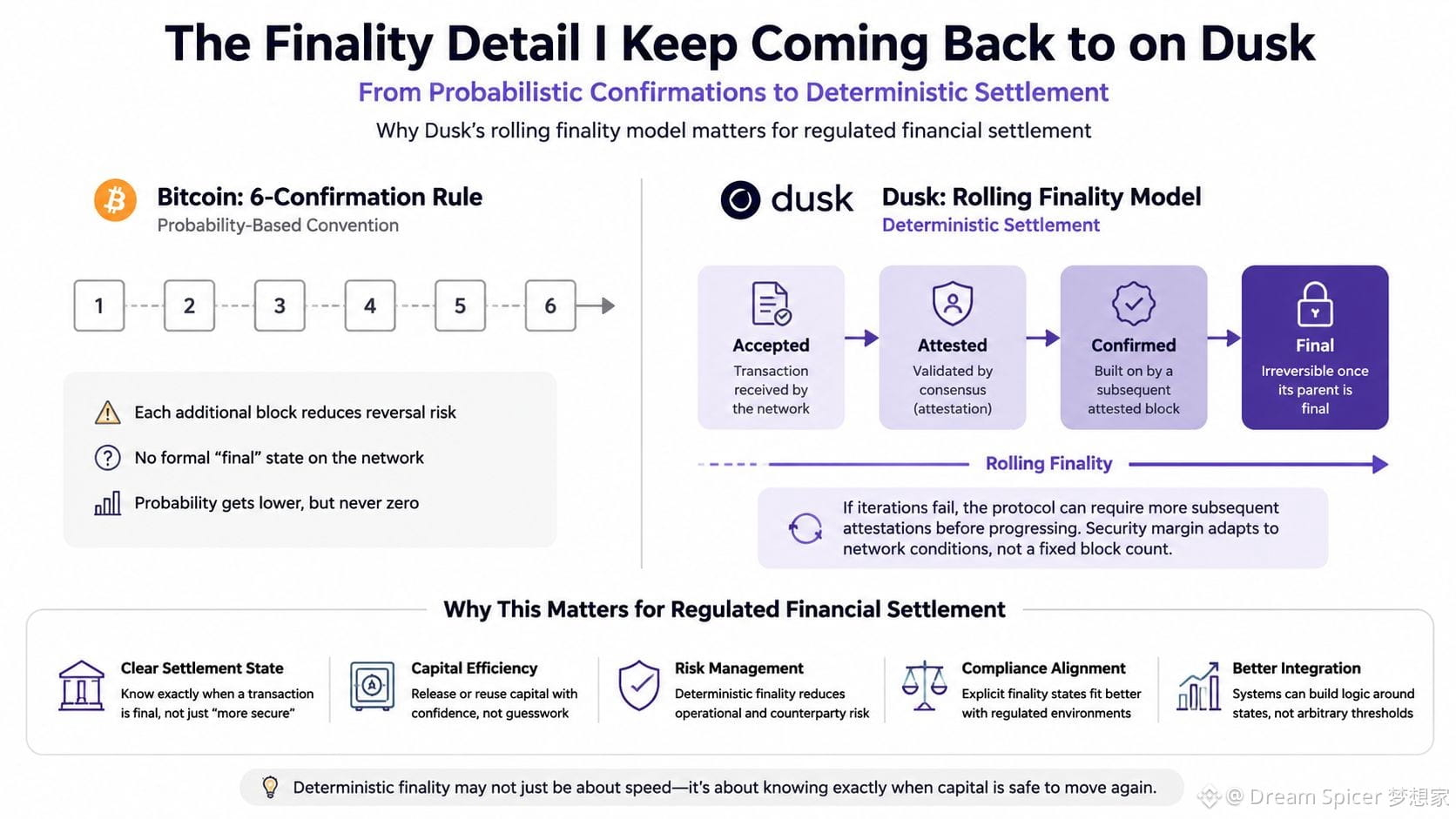
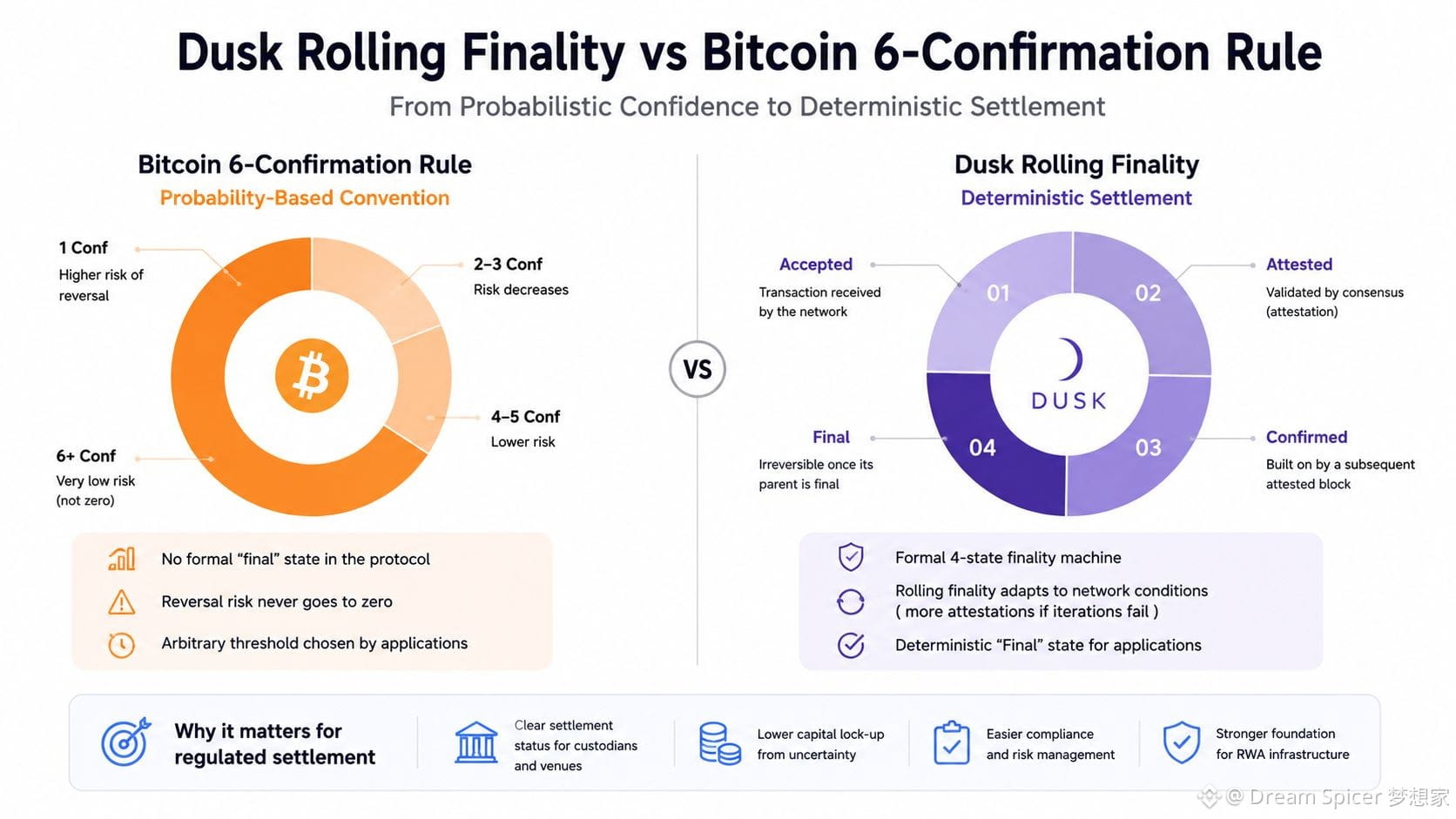
The more I study @Dusk , the more I think its rolling finality is easy to underestimate.
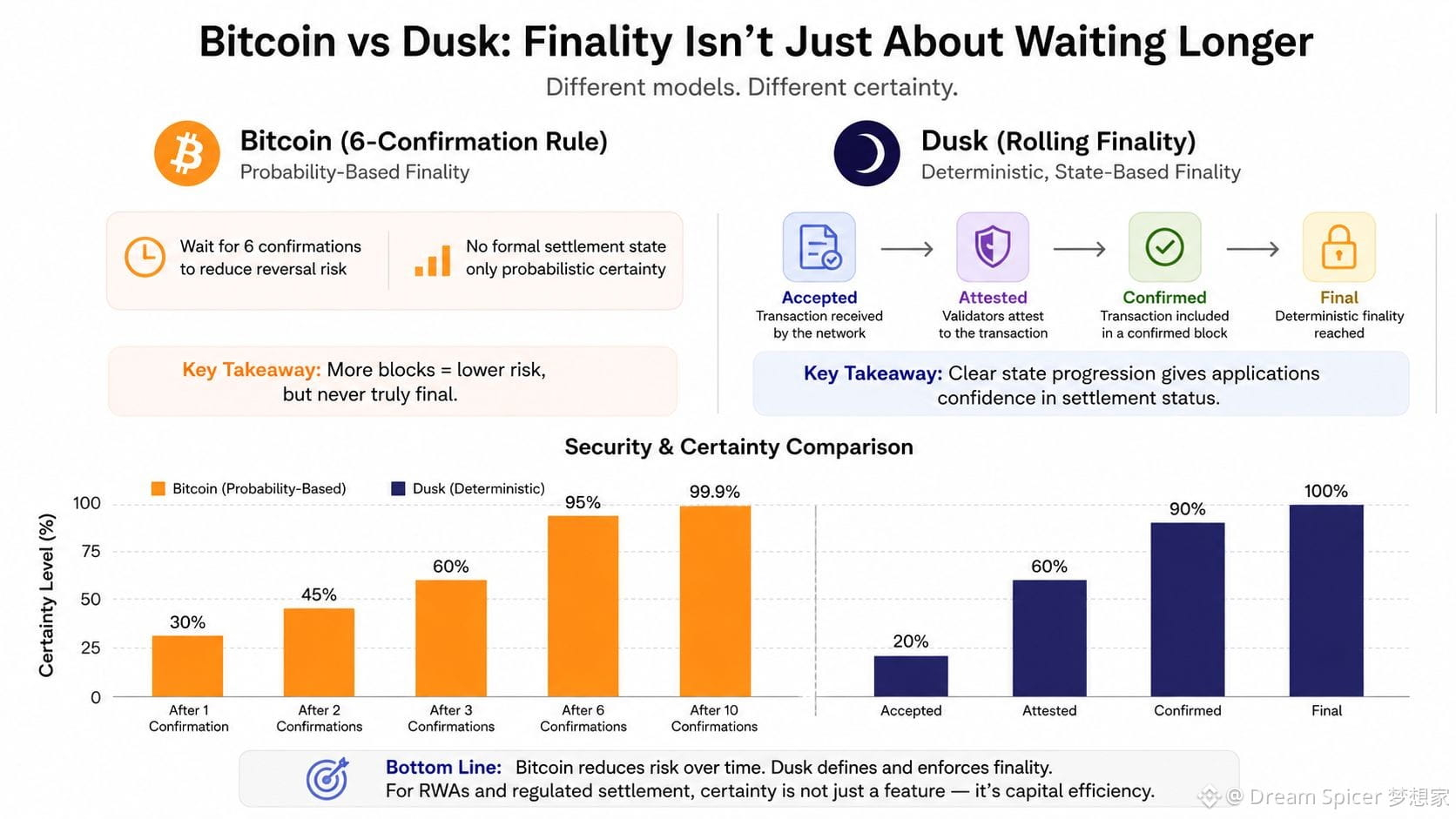
Bitcoin’s familiar 6 confirmation rule is really a probability based convention. Waiting longer reduces the chance of a reversal, but the network doesn’t move through a formal settlement state called final.
$DUSK takes a different approach.
Accepted → Attested → Confirmed → Final
I like this distinction because it gives applications a clearer idea of where a transaction actually stands. A custodian or financial venue can treat final differently from simply seeing a transaction included or confirmed.
The rolling part matters too. If iterations fail, the protocol can require more subsequent attestations before progressing. So the security margin isn’t just an arbitrary block count.
There’s an obvious trade off. Applications now need to understand the state machine instead of reducing everything to wait six blocks.
But that complexity may be worthwhile for regulated settlement, where uncertainty has a real capital cost.
If deterministic finality can make settlement status more predictable. I wonder whether its biggest advantage for RWAs will ultimately be speed or simply knowing exactly when capital is safe to move again.
#dusk #DUSK #Dusk
Bitcoin’s familiar 6 confirmation rule is really a probability based convention. Waiting longer reduces the chance of a reversal, but the network doesn’t move through a formal settlement state called final.
$DUSK takes a different approach.
Accepted → Attested → Confirmed → Final
I like this distinction because it gives applications a clearer idea of where a transaction actually stands. A custodian or financial venue can treat final differently from simply seeing a transaction included or confirmed.
The rolling part matters too. If iterations fail, the protocol can require more subsequent attestations before progressing. So the security margin isn’t just an arbitrary block count.
There’s an obvious trade off. Applications now need to understand the state machine instead of reducing everything to wait six blocks.
But that complexity may be worthwhile for regulated settlement, where uncertainty has a real capital cost.
If deterministic finality can make settlement status more predictable. I wonder whether its biggest advantage for RWAs will ultimately be speed or simply knowing exactly when capital is safe to move again.
#dusk #DUSK #Dusk
🎙️ Dusk Live Trading, Real analysis, Real Trade 📌
End
01 h 27 m 02 s
429
DUSK/USDT
Market/Sell
Filled
1
Verified
The Dusk consensus problem I didn’t notice at first.
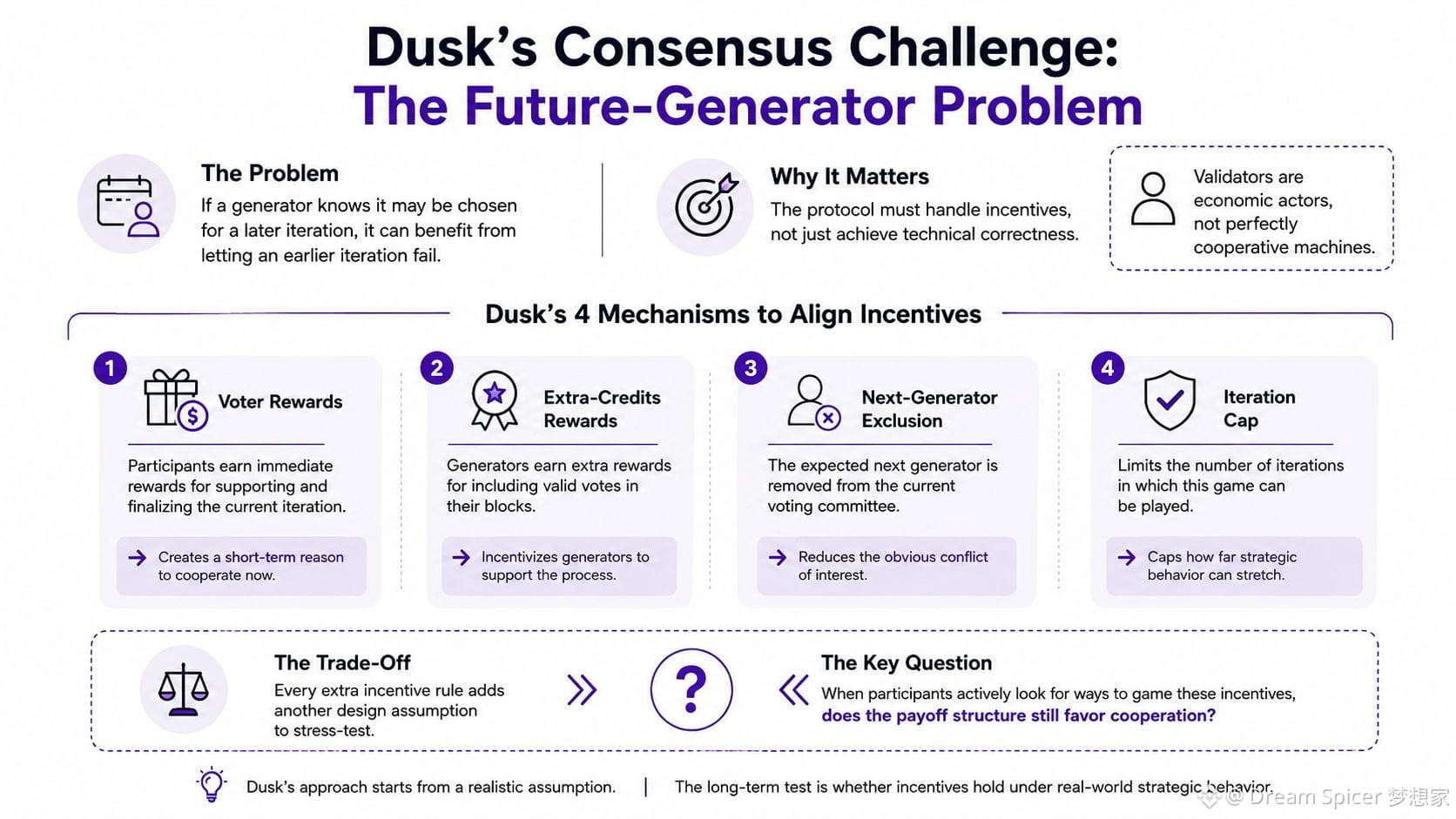
While going deeper into @Dusk , I found the future generator problem more interesting than the usual consensus discussion.
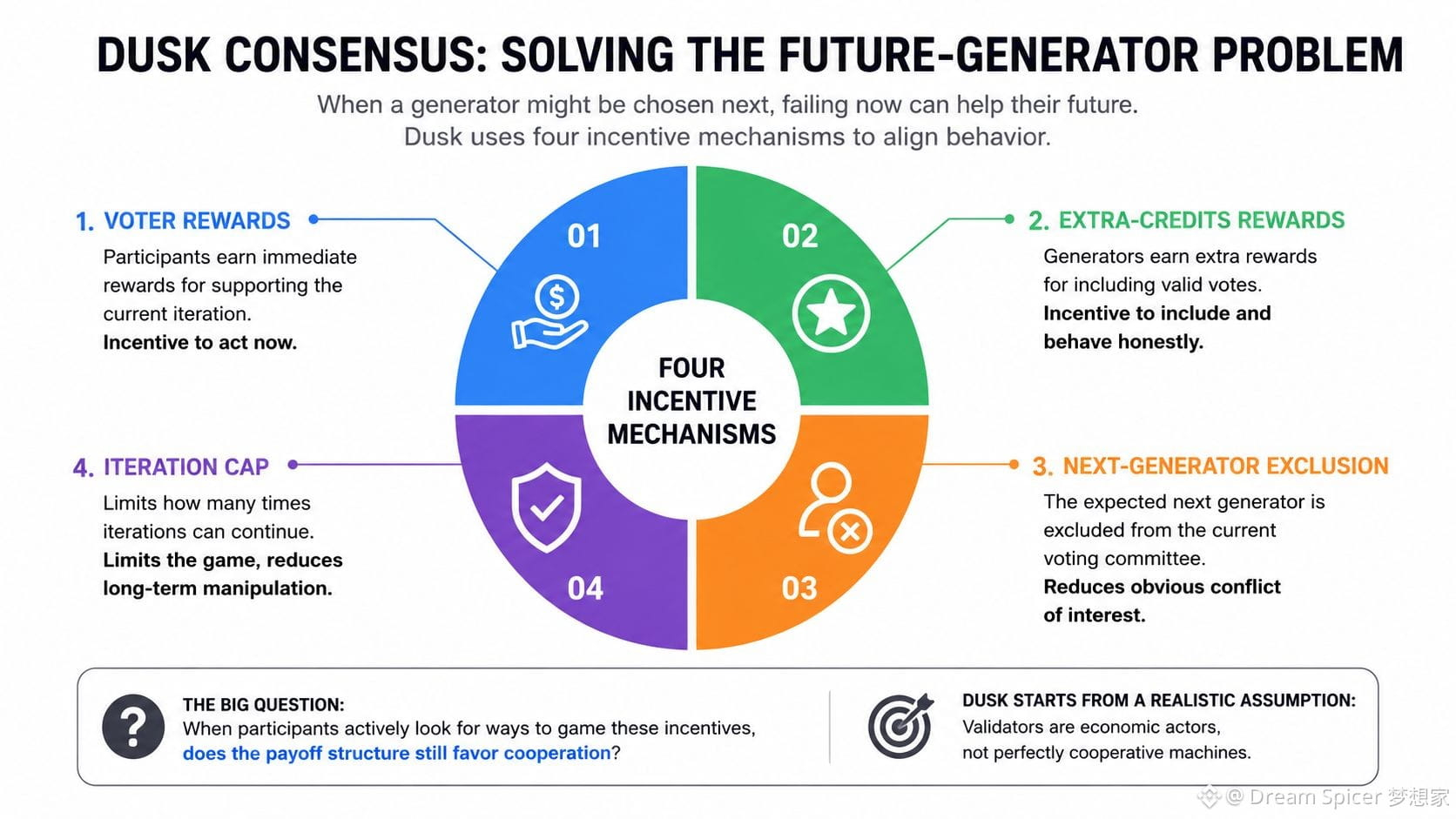
The basic issue is pretty simple. If a generator knows it may be chosen for a later iteration, there can be a reason to let an earlier iteration fail. That failure could improve its own chance to become the next useful generator. So the protocol has to deal with incentives, not just technical correctness.
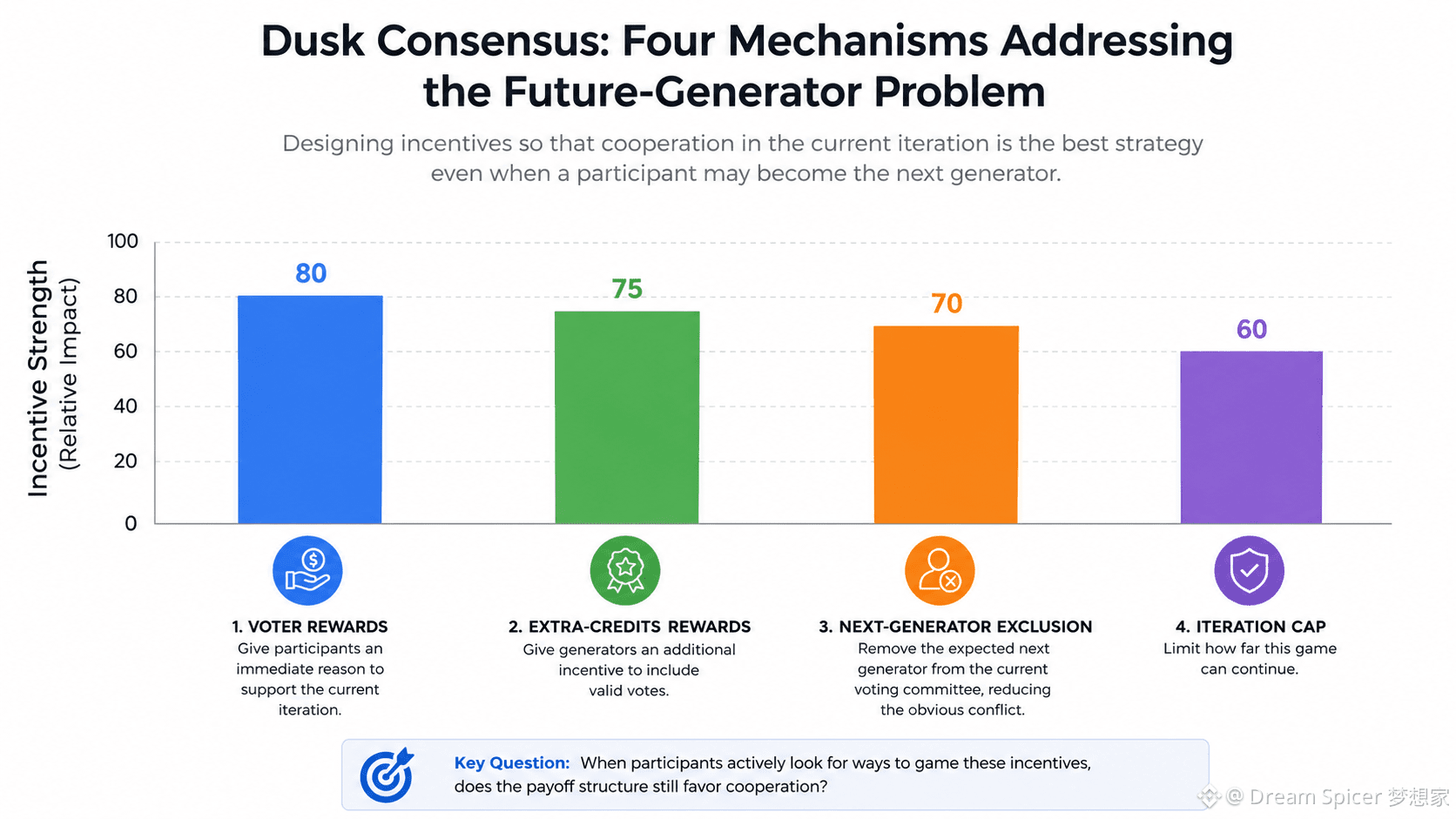
$DUSK approaches it with four mechanisms.
Voter rewards give participants an immediate reason to support the current iteration.
Extra credits rewards give generators another incentive to include valid votes.
Next generator exclusion removes the expected next generator from the current voting committee, reducing the obvious conflict.
And the iteration cap limits how far this game can continue.
I like this because it starts from a realistic assumption validators are economic actors, not perfectly cooperative machines.
The trade off is that every extra incentive rule adds another design assumption to stress test.
So the question I’m left with is.
When participants actively look for ways to game these incentives, does the payoff structure still favor cooperation?
That’s the part of Dusk consensus I’ll be watching.
#dusk #DUSK #Dusk
While going deeper into @Dusk , I found the future generator problem more interesting than the usual consensus discussion.
The basic issue is pretty simple. If a generator knows it may be chosen for a later iteration, there can be a reason to let an earlier iteration fail. That failure could improve its own chance to become the next useful generator. So the protocol has to deal with incentives, not just technical correctness.
$DUSK approaches it with four mechanisms.
Voter rewards give participants an immediate reason to support the current iteration.
Extra credits rewards give generators another incentive to include valid votes.
Next generator exclusion removes the expected next generator from the current voting committee, reducing the obvious conflict.
And the iteration cap limits how far this game can continue.
I like this because it starts from a realistic assumption validators are economic actors, not perfectly cooperative machines.
The trade off is that every extra incentive rule adds another design assumption to stress test.
So the question I’m left with is.
When participants actively look for ways to game these incentives, does the payoff structure still favor cooperation?
That’s the part of Dusk consensus I’ll be watching.
#dusk #DUSK #Dusk

Verified
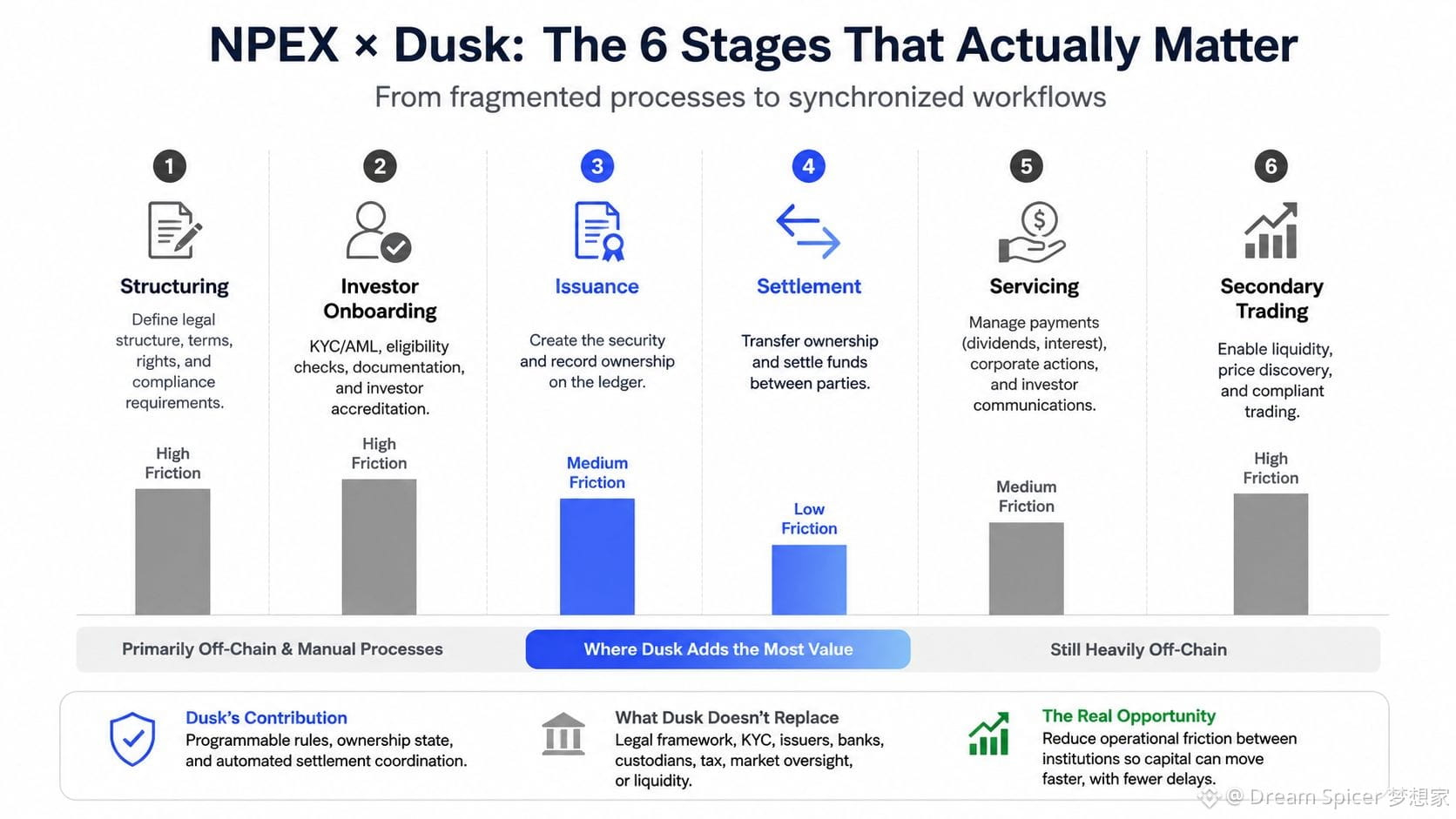
I’ve been looking at the NPEX × Dusk partnership less from the tokenized securities angle and more from a workflow perspective.
That changes the picture.
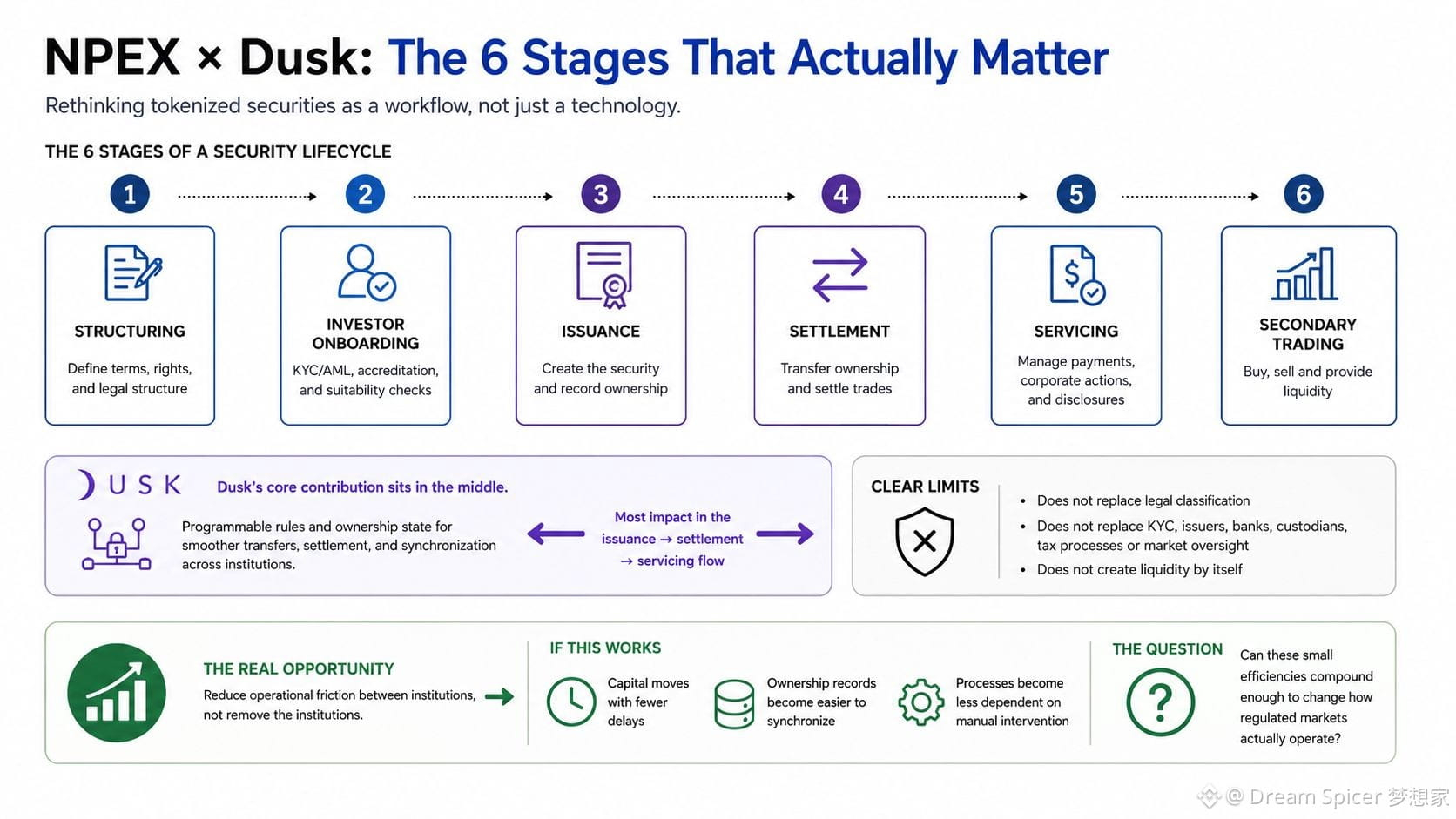
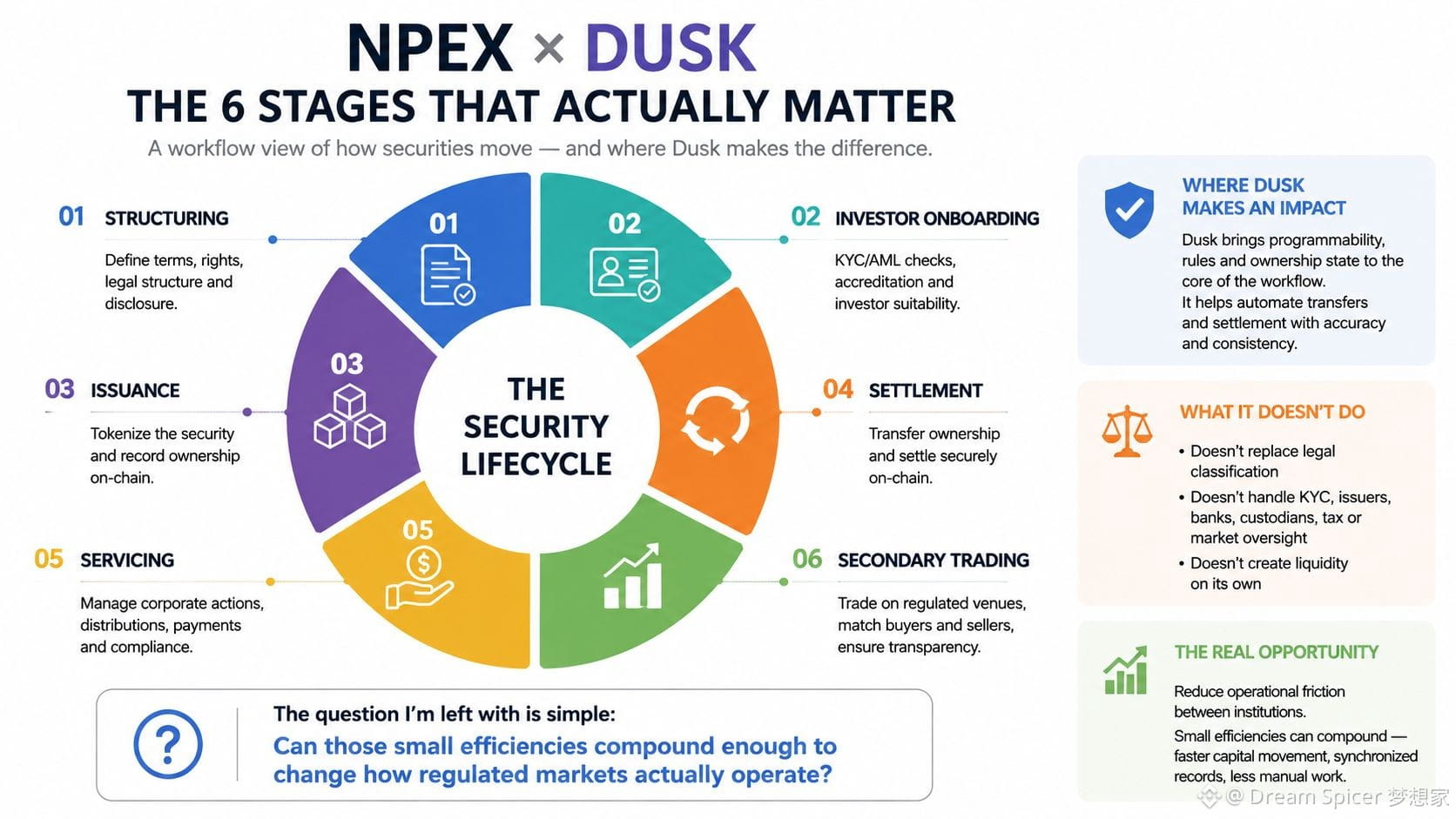
Before $DUSK , a security can move through six separate stages. Structuring, investor onboarding, issuance, settlement, servicing and secondary trading. Each can involve different systems, records and manual reconciliation.
@Dusk ’s contribution is mainly in the middle of that mess. Some rules and ownership state can become programmable, making transfers and settlement easier to coordinate.
But there’s a clear limit.
Dusk doesn’t replace legal classification, KYC, issuers, banks, custodians, tax processes or market oversight. It also can’t create liquidity simply because an asset becomes tokenized.
That distinction is important.
The real opportunity, in my view, is reducing the operational friction between institutions rather than trying to remove the institutions themselves.
If that works, capital could move with fewer delays. Ownership records become easier to synchronize, and certain processes become less dependent on manual intervention.
The question I’m left with is simple.
Can those small efficiencies compound enough to change how regulated markets actually operate?
#dusk #DUSK #Dusk
That changes the picture.
Before $DUSK , a security can move through six separate stages. Structuring, investor onboarding, issuance, settlement, servicing and secondary trading. Each can involve different systems, records and manual reconciliation.
@Dusk ’s contribution is mainly in the middle of that mess. Some rules and ownership state can become programmable, making transfers and settlement easier to coordinate.
But there’s a clear limit.
Dusk doesn’t replace legal classification, KYC, issuers, banks, custodians, tax processes or market oversight. It also can’t create liquidity simply because an asset becomes tokenized.
That distinction is important.
The real opportunity, in my view, is reducing the operational friction between institutions rather than trying to remove the institutions themselves.
If that works, capital could move with fewer delays. Ownership records become easier to synchronize, and certain processes become less dependent on manual intervention.
The question I’m left with is simple.
Can those small efficiencies compound enough to change how regulated markets actually operate?
#dusk #DUSK #Dusk
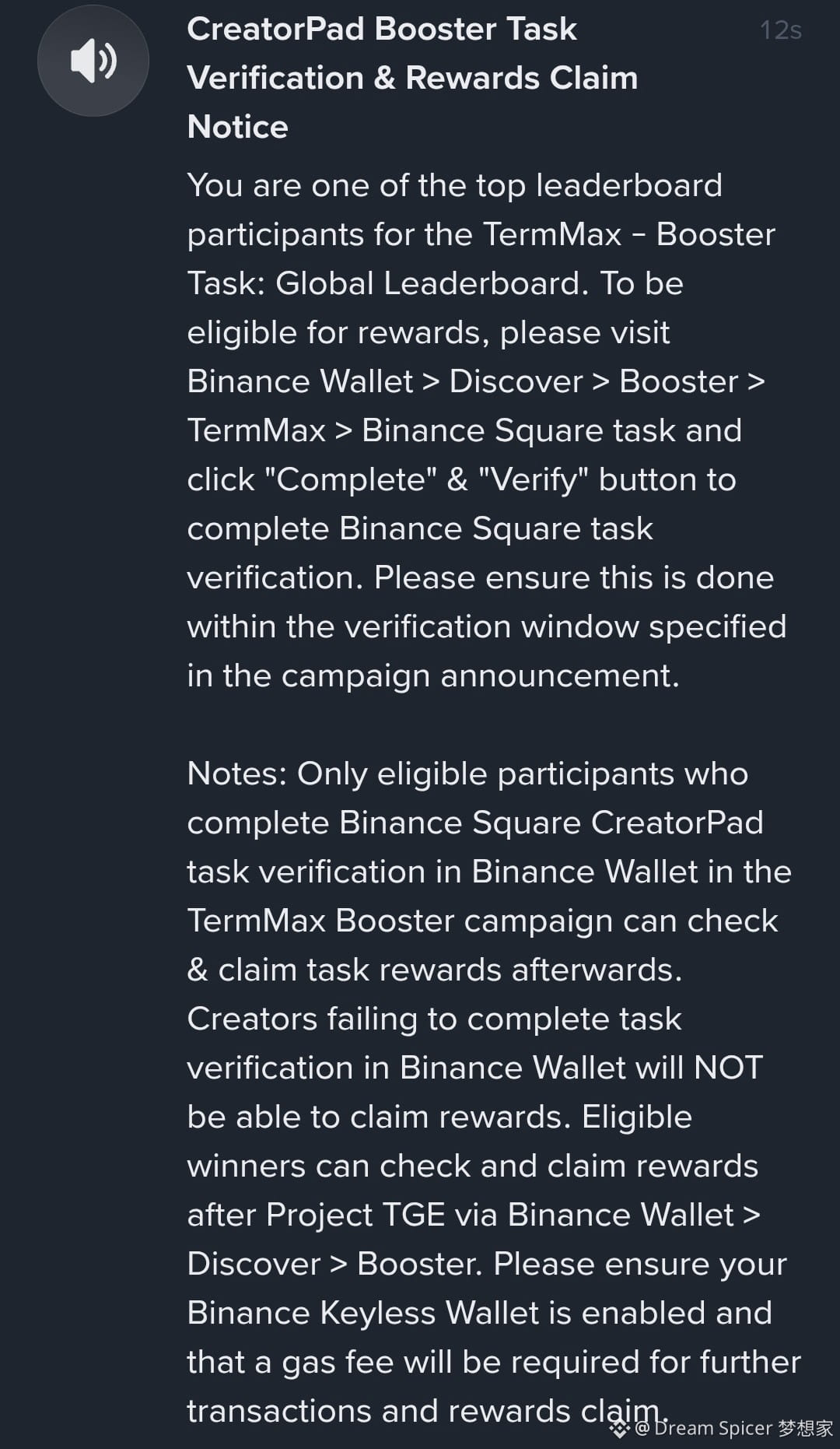
Notification Received Alhamdulliah I'm on Top 50🙌🏻✨
If you are also eligible, verify the task now.
Waiting For TMX listing. . . . . 😅
$SPK $KII $PUBLIC
#SolanaGovernanceVoteToDoubleDeflationRate #GoldNearsThreeMonthHigh #SamsungFalls6.4%OnReturnPlanMiss #CanadaUSTradeTalksCollapse #BitcoinStrongestWeekSinceMarch2023
If you are also eligible, verify the task now.
Waiting For TMX listing. . . . . 😅
$SPK $KII $PUBLIC
#SolanaGovernanceVoteToDoubleDeflationRate #GoldNearsThreeMonthHigh #SamsungFalls6.4%OnReturnPlanMiss #CanadaUSTradeTalksCollapse #BitcoinStrongestWeekSinceMarch2023


Log in to explore more content