
Chip stocks were wiped out by a broad sell-off—so why did Micron only fall 0.27%?
How bad was the U.S. stock market last night?
The Philadelphia Semiconductor Index plunged 3.47%, with every constituent stock wiped out.
Micron’s rival may have dropped 10.28%, Intel fell 7%, Arm slid 6%, and Nvidia fell 4.57%—the entire chip sector was a sea of blood.
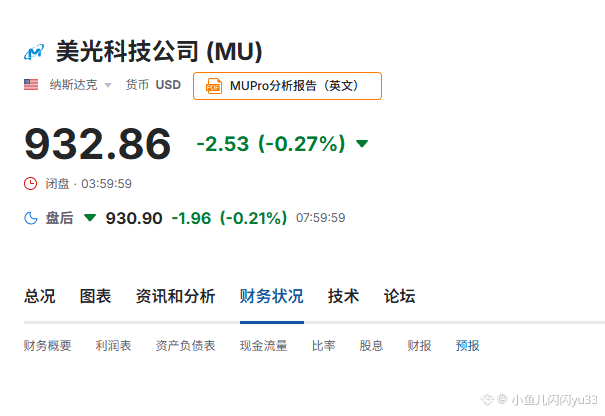
But look at Micron: it only fell 0.27%, closing at $932.86.
During the session, it even surged as high as $946.8, pulling itself back from a low of $909.
While storage stocks across the market sank together—Seagate -2%, Western Digital -0.5%, SK hynix -0.35%—only Micron barely moved.
Why?
Because its story is no longer just about “chips”—it’s about the “blood of computing.”
Gartner projects the storage market will reach $837 billion in 2026, with Micron, Samsung, and SK hynix taking the lion’s share.
Micron’s HBM capacity was snapped up as early as 2026 supply-out, with demand exceeding capacity by 50%—that’s what last week’s earnings report said itself.
Even more astonishing is the analyst camp: 43 analysts, 43 buys, 0 sells—everyone is bullish.
The average price target is $1,513, implying 62% upside from the current price.
But don’t rush in yet—the other side of the story is also scary:
Micron’s market cap is already $1.05 trillion. It has run from $114 at the start of the year up to $1,255, before pulling back to $932.
This year it’s up 227%, and over the past 12 months it’s up 664%.
For the Sept. 30 earnings report, the market expects an earnings move of ±14.85%—a single earnings report can wipe out an AMD. On 8/25, Mizuho even cut its target price from $1,375 to $1,300.
Resilience is real—and so is the premium valuation.
In a chip bull market, the most “tough-to-kill” stock is often also the one that admits its mistakes the latest in a bear market.
Is this Micron move a “golden pit” opportunity, or the last stronghold? The Sept. 30 earnings report will tell.
$MU
How bad was the U.S. stock market last night?
The Philadelphia Semiconductor Index plunged 3.47%, with every constituent stock wiped out.
Micron’s rival may have dropped 10.28%, Intel fell 7%, Arm slid 6%, and Nvidia fell 4.57%—the entire chip sector was a sea of blood.
But look at Micron: it only fell 0.27%, closing at $932.86.
During the session, it even surged as high as $946.8, pulling itself back from a low of $909.
While storage stocks across the market sank together—Seagate -2%, Western Digital -0.5%, SK hynix -0.35%—only Micron barely moved.
Why?
Because its story is no longer just about “chips”—it’s about the “blood of computing.”
Gartner projects the storage market will reach $837 billion in 2026, with Micron, Samsung, and SK hynix taking the lion’s share.
Micron’s HBM capacity was snapped up as early as 2026 supply-out, with demand exceeding capacity by 50%—that’s what last week’s earnings report said itself.
Even more astonishing is the analyst camp: 43 analysts, 43 buys, 0 sells—everyone is bullish.
The average price target is $1,513, implying 62% upside from the current price.
But don’t rush in yet—the other side of the story is also scary:
Micron’s market cap is already $1.05 trillion. It has run from $114 at the start of the year up to $1,255, before pulling back to $932.
This year it’s up 227%, and over the past 12 months it’s up 664%.
For the Sept. 30 earnings report, the market expects an earnings move of ±14.85%—a single earnings report can wipe out an AMD. On 8/25, Mizuho even cut its target price from $1,375 to $1,300.
Resilience is real—and so is the premium valuation.
In a chip bull market, the most “tough-to-kill” stock is often also the one that admits its mistakes the latest in a bear market.
Is this Micron move a “golden pit” opportunity, or the last stronghold? The Sept. 30 earnings report will tell.
$MU