
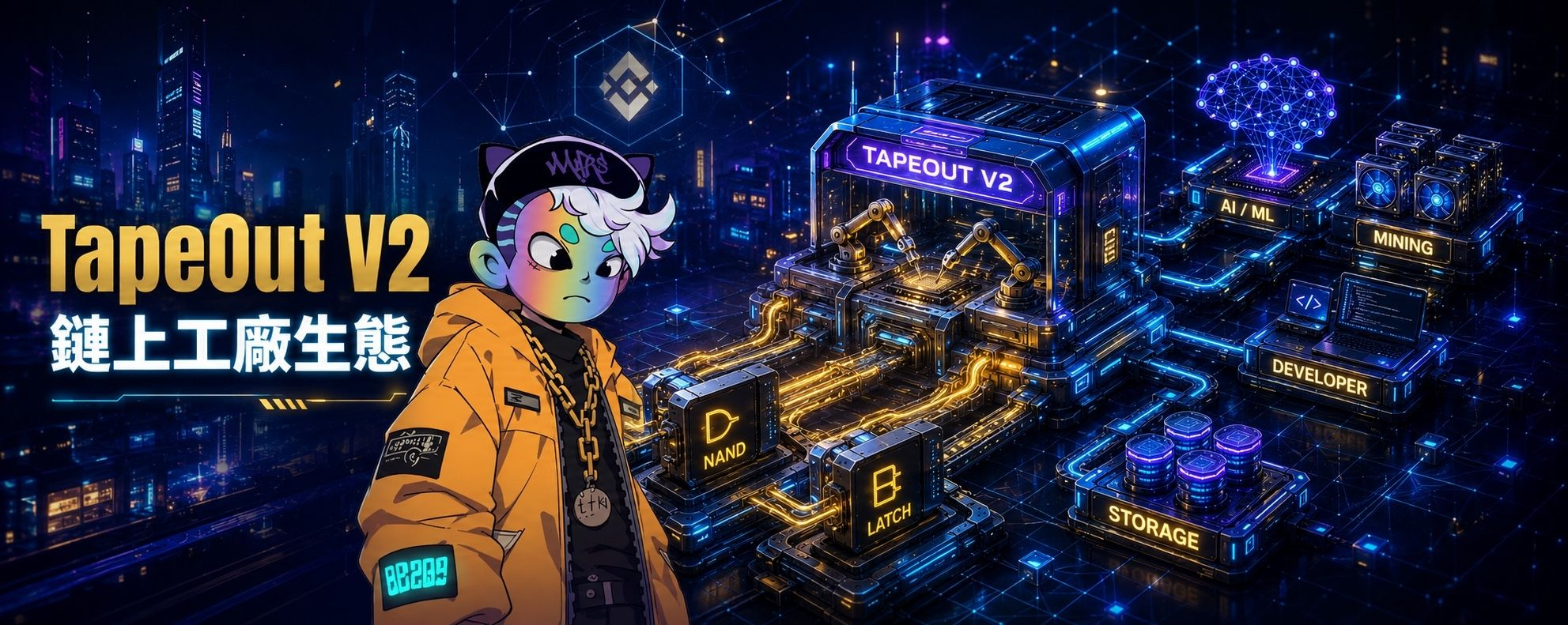

In the previous two articles, I went from NAND and LATCH all the way to PoD, $BEM, and BNN.
At first, I understood TapeOut as:
Electronic Lego on the chain.
You buy components, connect circuits, test them, and tape them out—until you finally get a Circuit NFT.
Then later, when PoD went live, these circuits could be turned into mining rigs again, and started to dig out
$BEM
.
Later on, TapeOut announced the component equipment warehouse.
the processor creators can burn
$BEM
, buying new manufacturing capabilities for my own factory, such as BNN and other components.
When I got to this part, I thought I’d probably already understood V2:
TapeOut is preparing to add some stronger components.
After reviewing Blonskr's V2 core design over the past few days, I realized—
I only understood half of it.
The truly important part of V2 is not just BNN, nor LUT.
However, in the future, these components may no longer be entirely developed by TapeOut.
TapeOut wants to open up the entire factory to third-party developers.
1. V2 does not add components, but rather adds "component slots".
V1's TapeOut has only two basic components:
NAND is responsible for logic.
LATCH, responsible for the state.
In theory, given enough of them, they can be used to construct any digital circuit.
But "theoretically possible" and "actually worthwhile" are two different things.
A computing unit that is very common in real chips, if all of it were split into NAND, might require hundreds, thousands, or even more logic gates.
The area has increased.
Depth increases.
On-chain execution costs also increase.
Just like you can certainly use tens of thousands of Lego bricks to build a computer.
The question is:
Why not just provide a computer module directly?
Therefore, V2 added "component slots".
BNN, LUT, Memory, adders, and cryptographic modules can all theoretically be encapsulated into higher-order native components.
More importantly:
These components are not necessarily developed by TapeOut.
Third-party developers can also write their own component contracts, deploy them, submit them for review, and register slots and list different models after approval.
This introduced a new role for TapeOut for the first time:
Component developer.
Second, this is somewhat like an on-chain hardware version of the App Store.
Component developers need to follow some basic rules:
The components must be purely computational;
The same input will always produce the same output.
Administrators cannot be appointed;
Agency contracts cannot be used;
Once a component is fabricated, its rules cannot be secretly modified.
After approval, developers can upload products in different specifications.
For example:
BNN-64, BNN-128, and BNN-256 are not the same model.
LUT-8 and LUT-16 should not be mixed together.
Because the computational load, storage requirements, and production costs of different specifications are completely different. If they are all priced as the same type of component, arbitrage will quickly become possible.
This led me to understand TapeOut V2 in a different way:
It's somewhat like an on-chain hardware version of the App Store.
What the developer provided was not an app.
Rather, it is a "computing capability" that can be used, combined, and fabricated by other circuits.
Someone is developing AI components.
Someone developed Memory.
Someone has developed cryptographic components.
Someone might write a very small tool that a large number of circuits would use.
What truly matters is not necessarily who builds the largest component.
On the contrary, it might be:
Whose components are purchased by the most factories and used in the most circuits?
Third, Processor is no longer just a different name.
The main differences in the Processor in V1 are:
Name, NAND and LATCH supply, and Mint price.
But the things that can be manufactured at the lower levels are pretty much the same.
After V2, what a factory can produce depends on what equipment it has purchased.
Interested in pursuing a career in AI?
Purchase BNN equipment.
Want to get into cryptography?
Purchase LUTs or other cryptographic components and equipment.
Looking to build low-cost basic circuits?
Alternatively, you could choose not to buy any high-end equipment and simply make NAND and LATCH sufficiently inexpensive.
Therefore, the competition for Processors will shift from:
Which component prices are rising faster?
Gradually becoming:
What can your factory produce? How much does it cost? Who actually needs it?
At this point, Processor truly begins to resemble a factory, rather than simply the same contract with a different name.
Four,
WELL
The economic cycle is also a bit more complete than before.
According to the currently announced V2 design:
Processor manufacturers who want to acquire the ability to manufacture a certain component need to pay $BEM to purchase equipment.
Purchase equipment
WELL
It will be transferred to the black hole address and destroyed.
Once the factory obtains the equipment, it can set the supply quantity and Mint price of the component.
Users can then use BNB Mint components.
The components are used to design circuits and are actually consumed during the tape-out process.
The entire process becomes:
PoD produces BEM
↓
The factory burned down BEM to purchase equipment.
↓
The factory has acquired new component manufacturing capabilities.
↓
Users use BNB Mint components
↓
The components were taken to design and fabrication.
↓
New Circuits and Applications Emerge
The most important thing here is not the words "there is Burn".
Instead:
BEM is not about burning for the sake of burning, but about being transformed into a permanent production capability.
If many factories compete for the right to manufacture different components in the future, then BEM may generate demand directly related to ecosystem development.
Of course, there's a big "if" in front of it.
Fifth, developers have their first opportunity to earn revenue from component usage.
V2 also features a revenue-sharing system for developers.
When users use Mint basic components or advanced components in the factory, the protocol will charge a 1% protocol fee from the manufacturer's BNB revenue.
If the Mint component is provided by a third-party developer, 50% of the protocol fee will be converted into BEM and distributed to the component developer.
In other words, developers' income comes from more than just:
I deployed a component.
Instead, it comes from:
How many factories have purchased it, and how many users continue to use Mint?
This difference is important.
Deploying a component that no one uses will theoretically not generate much revenue.
The truly valuable components need to be used and combined by others, and eventually incorporated into more circuits.
This also connects to the question I kept asking in my first article:
Will the market one day start to price "good design"?
With V2, this problem has taken another step forward:
Will the market start pricing "highly used computing components"?
VI. However, it is too early to announce that the closed loop has been established.
This design sounds very complete.
However, completing the design does not equate to establishing a market.
Many questions still need answers:
How many third-party developers would be willing to write components?
Will the review process become a bottleneck for centralization?
How much BEM does the factory need when purchasing equipment?
Can Mint's revenue cover equipment costs?
How many users actually need BNN, LUT, or other high-level components?
Can the amount of BEM destroyed offset the continued emissions?
After a component is mined, how many actually enter the circuit?
How many circuits will be continuously invoked, rather than existing solely for mining?
In addition, TapeOut is adding an authentication and exposure system.
The community certification currently released is still a draft for comments: after the project team passes the review, they may need to pledge 300 BEM as a deposit.
The new homepage also previews the addition of a feature to use BEM auctions for featured positions.
Authentication solves the trust problem.
Homepage auctions solve the exposure problem.
Component slots solve the supply problem.
Equipment warehouses solve production problems.
But the final and most difficult layer is still:
Real needs.
Even the most brilliant economic model remains just a diagram if no one continues to use the components.
at last
A few days ago, I thought TapeOut's route was:
NAND → Circuit → PoD → BEM → BNN
Now that I've seen V2, I think a more accurate route might be:
Developers
↓
element
↓
Equipment market
↓
Processor factory
↓
Circuit
↓
Applications and users
PoD was responsible for getting the first people to start building.
BEM is responsible for connecting miners, factories, and equipment.
BNN and LUT are just the first batch of new components.
What truly opens up the component slots is the opportunity for other developers to come in and continue expanding the system.
Therefore, the most noteworthy aspect of V2 might not be:
Just how powerful is BNN?
Instead:
Are there any developers willing to turn their computing power into components and put them into this on-chain factory so that others can use them continuously?
If the answer is yes,
TapeOut is no longer just about letting people use the official electronic Lego sets.
It will slowly turn into:
An on-chain manufacturing market where anyone can design new building blocks, factories can purchase production equipment, and users can then use these building blocks to create new things.
Of course, it's still very early.
V2 contracts, device prices, official launch dates, and real-world usage data are all still pending.
But at least this time I finally understood:
TapeOut wants to offer more than just a new component.
It's the entire component development and manufacturing chain.
What's really worth watching next isn't just the BEM price.
Instead~
What will the first batch of third-party developers create on it?
This article is compiled based on publicly available information from TapeOut Protocol and recent public sharing from Blonskr regarding V2, component slots, device repositories, and community certification, and includes personal product observations. Some features are still in the preview or consultation stage, and the final rules should be subject to the official contract and official page. This article does not constitute investment advice.