


Global Market Revolution: Why the 23x5 Transformation of Wall Street Is Not Enough to Compete With 24/7 Crypto Infrastructure
Have you ever realized how limiting time zones can be when we want to participate in the US stock market? For market participants in Asia, the opening bell in New York often rings exactly when many of us are getting ready to rest for the night. For decades, differences in time zones have been the biggest structural barrier to fair liquidity distribution and freedom of global participation. Understanding this fundamental issue, traditional exchange giants like the NYSE and Nasdaq are now starting to take major steps by planning to extend their trading hours into a 23-hours-a-day system for five days a week—something that professionals more commonly refer to as 23x5.
This move to expand exchange hours is indeed a progress worth appreciating. However, in the modern digital era where the flow of information and the circulation of global capital never stops, an important question arises in the discourse of market-structure analysis: is this 23x5 system already ideal enough? The answer may be quite surprising, because in reality, market demand for access to traditional instruments throughout a full 24 hours a week (24/7) has exceeded the maximum capacity of conventional infrastructure.
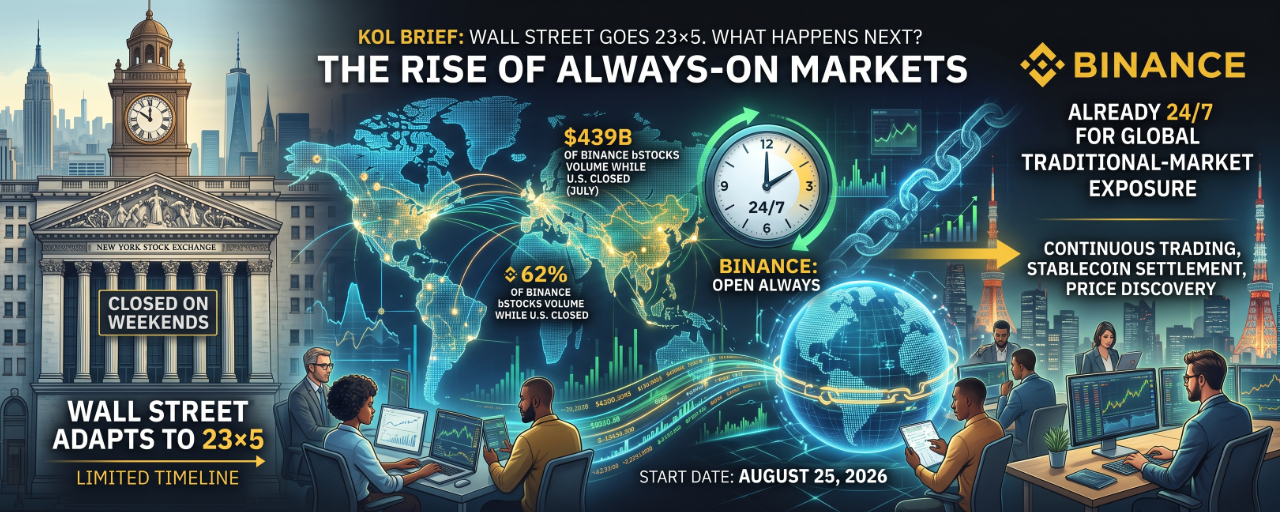
Global Demand Facts Far Exceed U.S. Working Hours Let’s examine the data objectively. When we compare conventional exchange platforms with modern crypto infrastructure, a very clear pattern emerges: financial transaction activity never really stops. Based on internal data collected last July, there was an interesting fact: 62% of the total trading volume of stock products or bStocks on Binance actually occurred when the U.S. stock market was completely closed. Even more notably, the trading activity of these traditional instruments shows a very strong volume spike specifically during Asian trading hours.
These statistical facts clearly show that global market participants have a very urgent need to access a wide range of financial instruments whenever they need them. They are no longer willing to be restricted by the opening or closing schedule of a physical exchange building located on the other side of the world. Intermittent market access ultimately only creates transaction inefficiencies.
Convergence of TradFi and Crypto: Giant-Scale Numbers That Speak for Themselves More than just spot stock instruments, we are also witnessing a major shift in which various Traditional Finance (TradFi) instruments are increasingly being traded on top of the crypto infrastructure layer. A recent market research report released by Delphi Consulting reveals a series of astonishing figures. In just the month of July alone, Binance managed to record bStock volume of $14.7 billion, as well as trading volume for traditional derivative contracts (TradFi-perp) reaching a massive $439 billion.
This convergence trend continues to strengthen over time. By mid-August, the TradFi-perp contract volume that occurred specifically at the end of the week across various crypto exchanges surged sharply—from about $4.5 billion to $28 billion—where the Binance platform controlled nearly half of the total volume. Even more interestingly, these TradFi-based contracts contributed around 37% of the total trading volume of perpetual contracts on the Binance platform up to August. This is undeniable proof that modern traders are no longer focused solely on trading pure digital assets, but are beginning to combine traditional financial instruments with the unlimited flexibility of crypto platforms.
The Root of the Fundamental Problem: Why 23x5 Is Not True 24/7 When delving into trading theory and comparing the architecture of various global exchange platforms, we must understand the technical root of the issue behind the scenes. Why is it so difficult for even massive conventional exchanges to open fully over the weekend? The answer lies in the backbone of the financial system they use. As Shunyet Jan, Head of Exchange & Trading at Binance, explains clearly, creating a market that runs continuously requires more than simply keeping the exchange doors open. All core banking infrastructure and the settlement systems behind it must also operate continuously without breaks for holidays.
This is where the structural weakness of the traditional system lies, since its operations rely heavily on conventional banks’ working hours that are required to be closed at the end of the week. On the other hand, the crypto ecosystem has managed to brilliantly overcome this classic obstacle through the use of stablecoins. Stablecoin assets are fundamentally designed to operate fully, non-stop, 24/7. This technology enables the instantaneous settlement of money-transfer transactions at that very moment. Thanks to this innovation, crypto platforms have been able to break free from the chain of dependence on the operating hours of traditional banking, allowing them to provide truly 24/7 market access to all users.
The Absolute Advantage of a Market That Never Sleeps: Price Discovery In various literature on financial trading theory, the concept of price discovery is a key indicator for measuring how efficient a market is. Let’s imagine a real scenario: what happens when a major macroeconomic news release or a sudden company announcement appears on Saturday afternoon? Traditional stock exchanges would immediately “freeze” because they are closed, and they can only respond to or adjust prices when they reopen on Monday morning. In contrast, crypto-infrastructure exchanges operating 24/7 can directly respond, absorb, and process that flow of information into price action instantly without any delay.
Deep research published by Binance Research provides highly convincing empirical evidence regarding the advantage of this price-discovery feature. Based on a comprehensive study conducted by observing price movements over seven consecutive weekends, the trading activity of bStocks products on the crypto platform has consistently been able to reflect a median value of 92% of the direction of the traditional stock exchange’s opening price movement on the following Monday. Even more impressively, specifically for price movements whose fluctuations exceed 3% on Monday, bStocks trading activity over the weekend proved successful in anticipating the direction of those price movements with perfect accuracy across all 41 cases that were observed in the study.
This historical data provides very clear confirmation that platforms with high continuous access, such as Binance, have extraordinary resilience to contribute significantly to establishing a fair market equilibrium price—even when central exchanges in the United States are completely closed and not operating at all.
Conclusion and Next Steps The structural evolution of the global financial market in this decade is moving very rapidly toward a phase of cross-border integration that we have never witnessed before. The dividing line separating the traditional finance industry (TradFi) and crypto technology innovation is now fading. Decentralized infrastructure has provided tangible proof that equitable global market access—where a market participant based in remote parts of Asia can trade prestigious traditional instruments in the United States anytime, without being blocked by the walls of the banking system—is not merely a utopian theory, but a functional reality that is already in motion.
Understanding the dynamics of the differences in this infrastructure is crucial for every modern investor. The global financial system has never truly fallen asleep, and your portfolio management strategy should also not be constrained by the clock hours on a wall. Don’t let the operating-hour limits of conventional exchanges prevent you from reaching your maximum potential. Explore directly the various innovative traditional-market products 24/7 on the Binance platform now, and see for yourself how the time-limit walls of past trading have been fully torn down.
Start Trading and get rebates of up to 19,800 USDT
#WallStreetNews #WallStreetNews