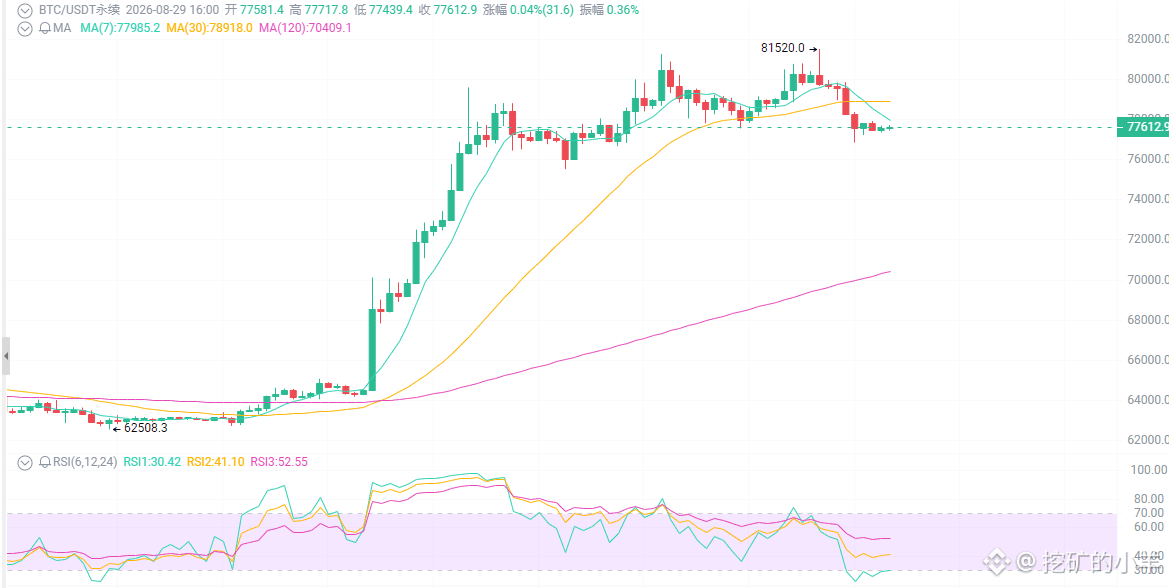
$77,600 BTC—did you get shaken out of the ride?
First, look at the surface: rate-hike odds jumped to 57%, with longs taking a bloodbath.
On Friday, Jackson Hole—newly appointed Fed chair Kevin Warsh delivered his first remarks, leaning hawkish. PCE inflation is 3.7%, the 2% target is “firm, fixed,” and the odds of a September rate hike surged from 35% straight to 57%. BTC was dumped from 803,000 down to a low of 769,000—down a full 3%, wiping out $480 million of long positions.
Friday’s low at 76,800 held. Today there’s low-volume consolidation around 77,700. The RSI has slid down from overbought and is repairing—waiting for direction.
First thing: the Fed spoke tough, but institutions are voting with real money.
Warsh’s speech translated into plain English: “Inflation is still high—don’t expect me to cut rates soon. Even the possibility of more hikes.” The market reacted immediately—U.S. Treasury yields spiked, the dollar strengthened, and risk assets all dropped to their knees.
But U.S. spot BTC ETF net inflows exceeded $3 billion, with 8–9 straight trading days of inflows. On Friday alone it flipped to a net outflow of $200 million, but the institutional buying throughout August has been real.
Second thing: the real problem is the 81,000 level.
The upper edge of the downtrend channel from the historical high of 126,000 lines up perfectly with 81,000. The 50-week moving average is also sitting at 81,000. This August rally from 62,000 to 81,500 hit 81,000 three times—each time it was smashed back.
The 81,000–86,000 zone is a super supply area—long holding costs, options Gamma, and previously trapped positions all piled together. To get through it, you need strong volume plus macro support. Missing either one doesn’t work.
Third thing: you need to see the cracks in the fundamentals clearly.
Institutional channel is the hard support: total ETF size is about $100B, IBIT continues to pull in funds, with $3B inflow in August. In mid-to-late August there will still be a large round of short-squeeze pressure, which is resonating with ETF buying.
But there are cracks too:
Relative to the 126,000 all-time high, you’re still down 38%
Since 2026, the overall ETF is still net outflow—August only recovers half
High rates aren’t over; the cost of capital isn’t friendly to leverage
Near 80,000, a lot of trapped positions have just broken even—sell pressure could flood in at any time
Trading strategy
Bullish bias:
Pull back to 76,800–77,200 for a small-position long. Stop-loss at 76,400 or 75,500. Targets 78,300–78,800; second target 79,800–80,200. Only consider adding size if price holds above 80,000, aiming for 81,000.
Bearish bias:
Only consider shorting if there is a valid breakdown below 76,800 (4-hour close confirmation + volume). Target 75,500 down to 73,000.
Breakout strategy:
If the daily close is above 81,100 and the subsequent retest holds without breaking, that’s the real trend-change signal.
First, look at the surface: rate-hike odds jumped to 57%, with longs taking a bloodbath.
On Friday, Jackson Hole—newly appointed Fed chair Kevin Warsh delivered his first remarks, leaning hawkish. PCE inflation is 3.7%, the 2% target is “firm, fixed,” and the odds of a September rate hike surged from 35% straight to 57%. BTC was dumped from 803,000 down to a low of 769,000—down a full 3%, wiping out $480 million of long positions.
Friday’s low at 76,800 held. Today there’s low-volume consolidation around 77,700. The RSI has slid down from overbought and is repairing—waiting for direction.
First thing: the Fed spoke tough, but institutions are voting with real money.
Warsh’s speech translated into plain English: “Inflation is still high—don’t expect me to cut rates soon. Even the possibility of more hikes.” The market reacted immediately—U.S. Treasury yields spiked, the dollar strengthened, and risk assets all dropped to their knees.
But U.S. spot BTC ETF net inflows exceeded $3 billion, with 8–9 straight trading days of inflows. On Friday alone it flipped to a net outflow of $200 million, but the institutional buying throughout August has been real.
Second thing: the real problem is the 81,000 level.
The upper edge of the downtrend channel from the historical high of 126,000 lines up perfectly with 81,000. The 50-week moving average is also sitting at 81,000. This August rally from 62,000 to 81,500 hit 81,000 three times—each time it was smashed back.
The 81,000–86,000 zone is a super supply area—long holding costs, options Gamma, and previously trapped positions all piled together. To get through it, you need strong volume plus macro support. Missing either one doesn’t work.
Third thing: you need to see the cracks in the fundamentals clearly.
Institutional channel is the hard support: total ETF size is about $100B, IBIT continues to pull in funds, with $3B inflow in August. In mid-to-late August there will still be a large round of short-squeeze pressure, which is resonating with ETF buying.
But there are cracks too:
Relative to the 126,000 all-time high, you’re still down 38%
Since 2026, the overall ETF is still net outflow—August only recovers half
High rates aren’t over; the cost of capital isn’t friendly to leverage
Near 80,000, a lot of trapped positions have just broken even—sell pressure could flood in at any time
Trading strategy
Bullish bias:
Pull back to 76,800–77,200 for a small-position long. Stop-loss at 76,400 or 75,500. Targets 78,300–78,800; second target 79,800–80,200. Only consider adding size if price holds above 80,000, aiming for 81,000.
Bearish bias:
Only consider shorting if there is a valid breakdown below 76,800 (4-hour close confirmation + volume). Target 75,500 down to 73,000.
Breakout strategy:
If the daily close is above 81,100 and the subsequent retest holds without breaking, that’s the real trend-change signal.