Many OPC entrepreneurs ask right away: “Where should we register the company to pay the lowest taxes?”
That question is out of order.
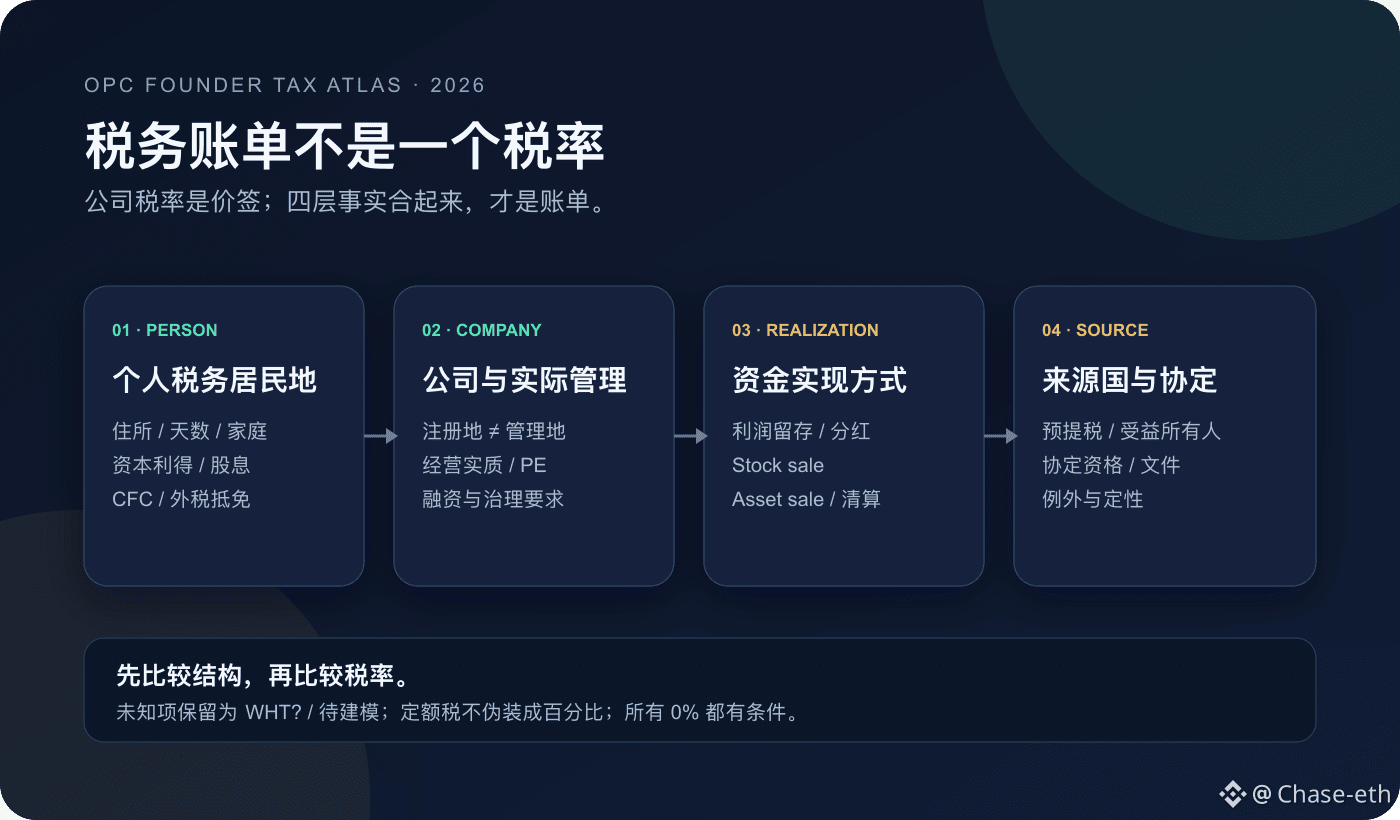
A company’s tax rate is just the price tag. The full “bill” is the combination of: an individual’s tax residency, the company’s actual place of management, how money is taken out, and how withholding is handled in the source country.
I turned this decision logic into an open-source interactive calculator.
The first question isn’t “Where is the company?” but “Where is the person?”
Take China as an example: the determination of tax residency doesn’t only look at 183 days. Having a domicile inside the country is another independent pathway; domicile is also tied to habitual residence shaped by factors such as household registration (hukou), family, and economic interests.
So even if someone stays abroad long enough, it doesn’t automatically cut off China tax-residency status.
Second question: Is the company’s place of incorporation the same as its tax residency?
The biggest pitfall for OPC is that TopCo is abroad, but the contracts, banking, financing, and major decisions are still effectively approved “on the ground” by the founder in another country.
An offshore appearance doesn’t mean offshore management. What follows could be dual residency, PE (permanent establishment), CFC, and transfer pricing.
Europe also can’t be squeezed into a single “low-tax jurisdiction.”
The UK FIG is a window covering up to four consecutive tax years; Malta has to separate offshore income, offshore capital gains, and whether profits are remitted; Italy and Greece use annual lump-sum tax—those regimes are not based on simple percentages; Portugal’s IFICI starts by looking at activities and the qualifications of the entities.
Europe’s corporate hubs serve different purposes too.
Ireland’s 12.5% applies to trading income; Estonia is a retained-earnings deferral stage, with profit distributions taxed from 2025 at 22/78; the Netherlands in 2026 is 19% / 25.8%; Luxembourg can’t be stuffed into one single tax rate—you need full modeling.
Japan deserves a separate category. It isn’t a typical low-tax jurisdiction:
Tax residency isn’t determined only by 183 days; for non-permanent residents, it looks at whether the total time in Japan over the past ten years is not more than five years, and whether remittance occurs; when founder shares are sold, the rate is typically around 20.315%; and if, before leaving Japan, the person has been in Japan for more than five of the past ten years and the target assets are ≥ ¥100 million, you also must test for exit tax. If you choose Japan, it’s usually because you prioritize the market and living there.
For the same company, how the money is realized also rewrites the result:
- Retained earnings: depends on the company level and CFC.
- Dividends: depends on corporate tax, source-country withholding, individual tax, and FTC.
- Founder stock sale: key focus shifts to individual capital gains and source rules.
- Asset sale: it may be company-level first, then the distribution level.
A Delaware C-Corp is the classic case.
It often fits better for U.S. VCs, option pools, and M&A markets, but the federal corporate tax starts at 21%, with state taxes calculated separately. If you pay dividends to non-U.S. shareholders, domestic law withholding could generally be as high as 30%; whether it can be reduced depends on the treaty and the documents. A regular stock sale is a different analysis.
I set three boundaries for this calculator:
1. Annual lump-sum taxes aren’t disguised as percentages.
2. If withholding tax can’t be safely determined, it shows WHT?.
3. For 2026 rules or total company tax that require case-by-case confirmation, it displays unresolved / pending modeling—never fill in 0% to complete blanks.
It’s suitable for first-round screening and an advisor briefing, not for directly generating filing numbers.
One sentence summary: compare the structure first, then compare the tax rate.
OPC Founder Tax Atlas 2026 is open-sourced. All inputs are calculated only in the browser locally—no backend and no tracking.
Online version + official source ledgers:
https://ckpxgfnksd-max.github.io/opc-founder-tax-planner/
Source: @ChaseWang on X
That question is out of order.
A company’s tax rate is just the price tag. The full “bill” is the combination of: an individual’s tax residency, the company’s actual place of management, how money is taken out, and how withholding is handled in the source country.
I turned this decision logic into an open-source interactive calculator.
The first question isn’t “Where is the company?” but “Where is the person?”
Take China as an example: the determination of tax residency doesn’t only look at 183 days. Having a domicile inside the country is another independent pathway; domicile is also tied to habitual residence shaped by factors such as household registration (hukou), family, and economic interests.
So even if someone stays abroad long enough, it doesn’t automatically cut off China tax-residency status.
Second question: Is the company’s place of incorporation the same as its tax residency?
The biggest pitfall for OPC is that TopCo is abroad, but the contracts, banking, financing, and major decisions are still effectively approved “on the ground” by the founder in another country.
An offshore appearance doesn’t mean offshore management. What follows could be dual residency, PE (permanent establishment), CFC, and transfer pricing.
Europe also can’t be squeezed into a single “low-tax jurisdiction.”
The UK FIG is a window covering up to four consecutive tax years; Malta has to separate offshore income, offshore capital gains, and whether profits are remitted; Italy and Greece use annual lump-sum tax—those regimes are not based on simple percentages; Portugal’s IFICI starts by looking at activities and the qualifications of the entities.
Europe’s corporate hubs serve different purposes too.
Ireland’s 12.5% applies to trading income; Estonia is a retained-earnings deferral stage, with profit distributions taxed from 2025 at 22/78; the Netherlands in 2026 is 19% / 25.8%; Luxembourg can’t be stuffed into one single tax rate—you need full modeling.
Japan deserves a separate category. It isn’t a typical low-tax jurisdiction:
Tax residency isn’t determined only by 183 days; for non-permanent residents, it looks at whether the total time in Japan over the past ten years is not more than five years, and whether remittance occurs; when founder shares are sold, the rate is typically around 20.315%; and if, before leaving Japan, the person has been in Japan for more than five of the past ten years and the target assets are ≥ ¥100 million, you also must test for exit tax. If you choose Japan, it’s usually because you prioritize the market and living there.
For the same company, how the money is realized also rewrites the result:
- Retained earnings: depends on the company level and CFC.
- Dividends: depends on corporate tax, source-country withholding, individual tax, and FTC.
- Founder stock sale: key focus shifts to individual capital gains and source rules.
- Asset sale: it may be company-level first, then the distribution level.
A Delaware C-Corp is the classic case.
It often fits better for U.S. VCs, option pools, and M&A markets, but the federal corporate tax starts at 21%, with state taxes calculated separately. If you pay dividends to non-U.S. shareholders, domestic law withholding could generally be as high as 30%; whether it can be reduced depends on the treaty and the documents. A regular stock sale is a different analysis.
I set three boundaries for this calculator:
1. Annual lump-sum taxes aren’t disguised as percentages.
2. If withholding tax can’t be safely determined, it shows WHT?.
3. For 2026 rules or total company tax that require case-by-case confirmation, it displays unresolved / pending modeling—never fill in 0% to complete blanks.
It’s suitable for first-round screening and an advisor briefing, not for directly generating filing numbers.
One sentence summary: compare the structure first, then compare the tax rate.
OPC Founder Tax Atlas 2026 is open-sourced. All inputs are calculated only in the browser locally—no backend and no tracking.
Online version + official source ledgers:
https://ckpxgfnksd-max.github.io/opc-founder-tax-planner/
Source: @ChaseWang on X