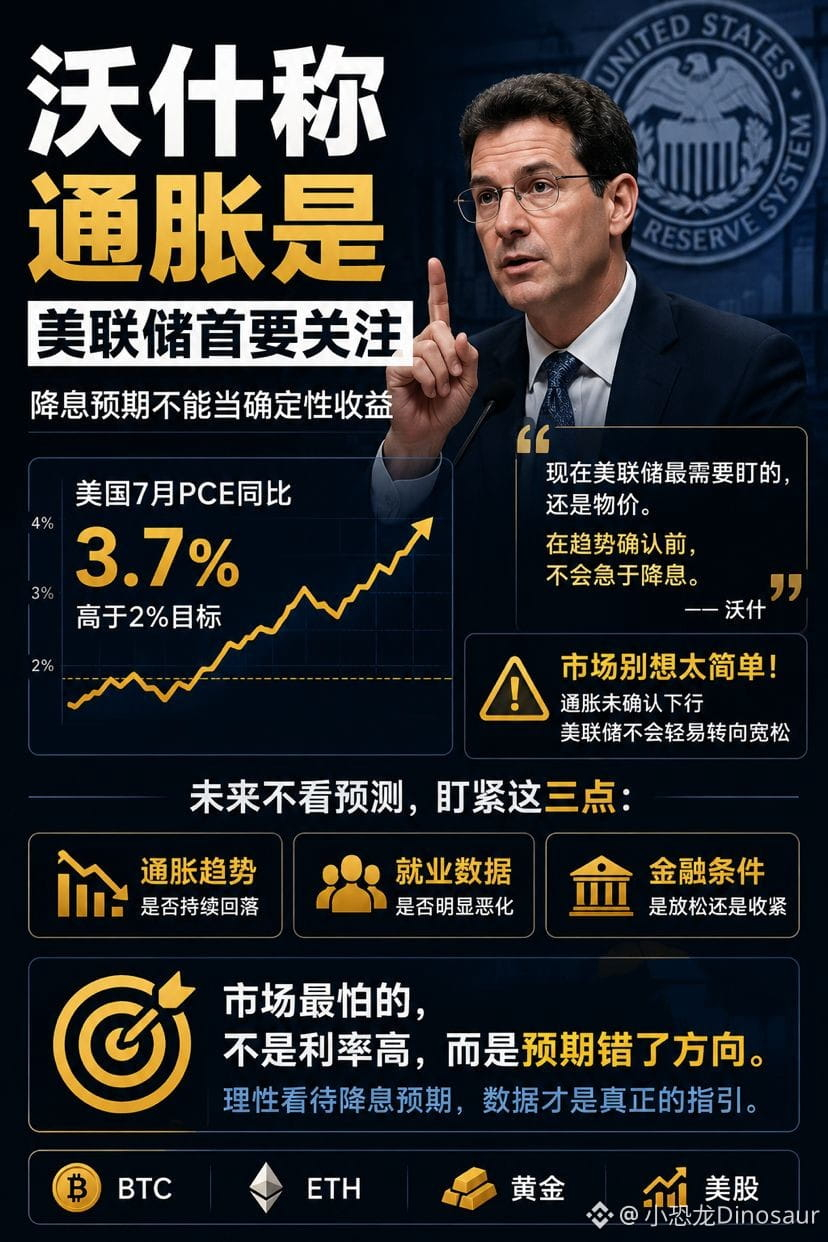

#沃什称通胀是美联储首要关注
To be honest, when I watched Waller’s speech in Jackson Hole last night, my first reaction wasn’t, “Oh no, more rate hikes.” It was:
Has the market been thinking about rate cuts too simply?
This time, Waller was pretty straightforward: what the Federal Reserve most needs to keep an eye on right now is still prices.
U.S. July PCE year-over-year is already 3.7%, clearly above the 2% target. Waller believes that even though the data over the past few months has been a bit better than expected, it’s still not enough to prove that inflation is moving toward 2% at a fast enough pace. Unless this trend is confirmed, the Fed can’t just celebrate early.
These words are honestly pretty brutal.
Because for traders, one of the easiest mistakes to make is:
turning “possible” into “about to happen” too early.
Not long ago, people talked about rate cuts as if they had already been implemented. Stocks went up, gold went up, and BTC also got pulled along as liquidity expectations were traded.
But now Waller is basically reminding everyone:
Don’t guess what the Fed will do next—first look to see whether inflation has truly cooled down.
That’s especially important for the crypto market.
Because risk assets like BTC and ETH are still fundamentally very dependent on global liquidity. Once the market starts trading again on “higher rates kept in place for longer,” and the dollar and U.S. Treasury yields start moving up, the first assets to feel uncomfortable are usually those with high valuations, high leverage, and especially hot sentiment.
So right now, I actually don’t like speculating on whether they will cut rates in September.
What’s really worth watching are three things:
Whether inflation continues to fall,
Whether employment deteriorates noticeably,
And whether financial conditions are actually loosening or tightening.
These three data points matter more than anyone’s mouth.
And there’s another really interesting attitude from Waller this time: he’s not particularly willing to keep feeding the market “forward guidance.” Instead, he emphasizes letting the market judge based on real-time data.
In plain terms, it’s like:
Don’t expect the Fed to tell you the answer in advance.
For traders, that’s not necessarily a bad thing.
Because the real big moves never start only after everyone already knows the answer—they start while people still haven’t figured it out clearly, when capital has already begun repricing.
So going forward, I’ll be even more cautious.
To be honest, when I watched Waller’s speech in Jackson Hole last night, my first reaction wasn’t, “Oh no, more rate hikes.” It was:
Has the market been thinking about rate cuts too simply?
This time, Waller was pretty straightforward: what the Federal Reserve most needs to keep an eye on right now is still prices.
U.S. July PCE year-over-year is already 3.7%, clearly above the 2% target. Waller believes that even though the data over the past few months has been a bit better than expected, it’s still not enough to prove that inflation is moving toward 2% at a fast enough pace. Unless this trend is confirmed, the Fed can’t just celebrate early.
These words are honestly pretty brutal.
Because for traders, one of the easiest mistakes to make is:
turning “possible” into “about to happen” too early.
Not long ago, people talked about rate cuts as if they had already been implemented. Stocks went up, gold went up, and BTC also got pulled along as liquidity expectations were traded.
But now Waller is basically reminding everyone:
Don’t guess what the Fed will do next—first look to see whether inflation has truly cooled down.
That’s especially important for the crypto market.
Because risk assets like BTC and ETH are still fundamentally very dependent on global liquidity. Once the market starts trading again on “higher rates kept in place for longer,” and the dollar and U.S. Treasury yields start moving up, the first assets to feel uncomfortable are usually those with high valuations, high leverage, and especially hot sentiment.
So right now, I actually don’t like speculating on whether they will cut rates in September.
What’s really worth watching are three things:
Whether inflation continues to fall,
Whether employment deteriorates noticeably,
And whether financial conditions are actually loosening or tightening.
These three data points matter more than anyone’s mouth.
And there’s another really interesting attitude from Waller this time: he’s not particularly willing to keep feeding the market “forward guidance.” Instead, he emphasizes letting the market judge based on real-time data.
In plain terms, it’s like:
Don’t expect the Fed to tell you the answer in advance.
For traders, that’s not necessarily a bad thing.
Because the real big moves never start only after everyone already knows the answer—they start while people still haven’t figured it out clearly, when capital has already begun repricing.
So going forward, I’ll be even more cautious.