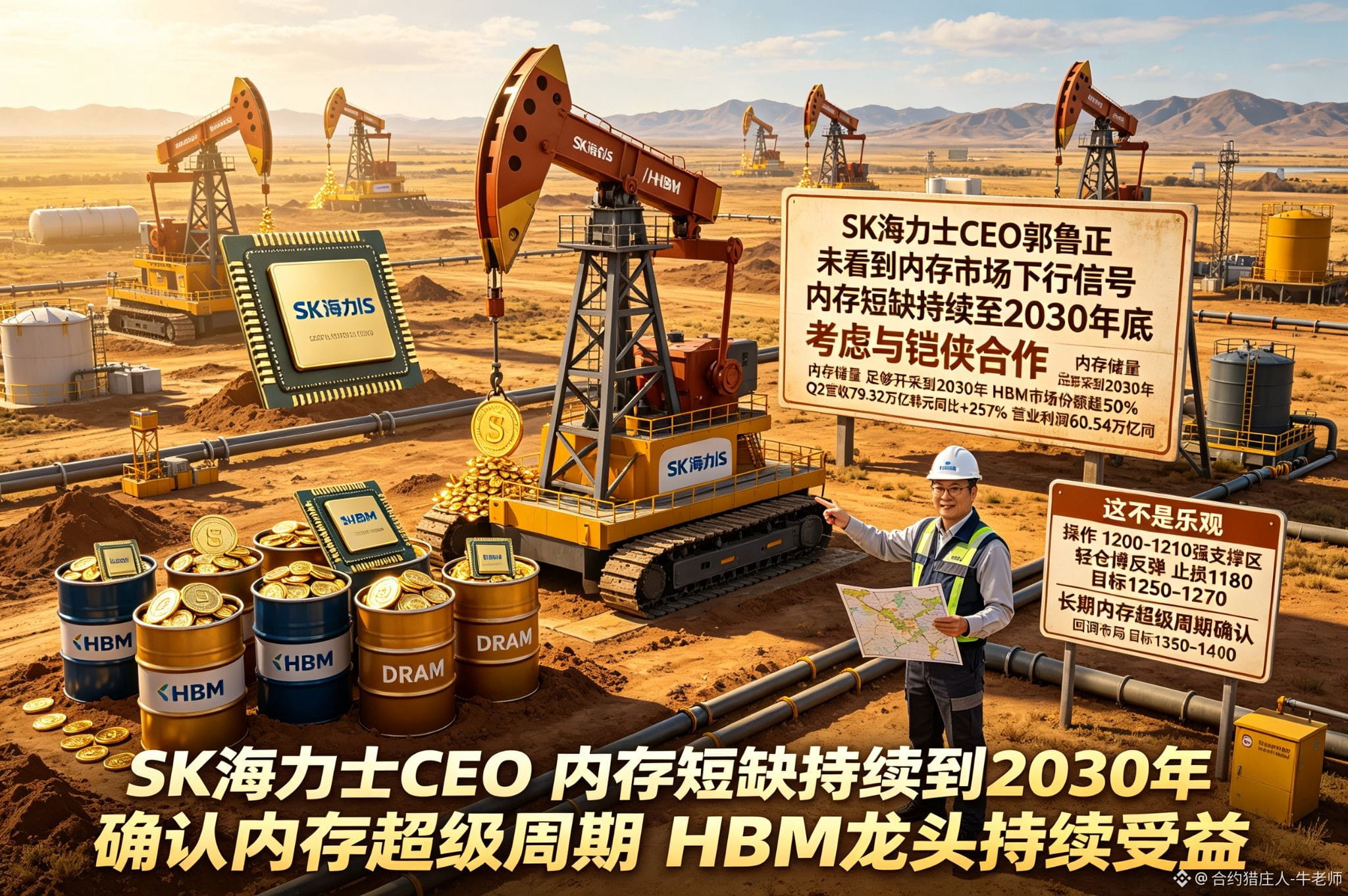
$SKHYNIX SK hynix CEO: Memory shortage will continue until 2030—this is not optimism, it’s confirmation of the supercycle
On August 28, SK hynix CEO Kwak Ro-jeong made it clear: “We haven’t seen any significant downward signals in the memory market. We expect the memory shortage situation to continue through the end of 2030.” He also said the company is considering closer ties with Kioxia.
This isn’t ordinary optimistic wording, but an official confirmation of the entire memory supercycle. If the shortage really lasts until 2030, it means that over the next four years, both HBM and DRAM prices will stay on an upward channel. As the global leader in HBM (market share over 50%), SK hynix will continue to benefit.
Look at the data more clearly: Q2 revenue was KRW 79.32 trillion (up 257% year-over-year), operating profit was KRW 60.54 trillion (up 557% year-over-year), both setting record highs. The share of HBM in revenue has already exceeded 40%, and customers include NVIDIA, AMD, and Google’s TPU. Demand for AI servers is booming—HBM is in short supply, and the price-hike cycle is only just starting.
However, there are short-term pressures: hawkish remarks weigh on global risk assets, and as a high-beta tech stock, SK hynix has fallen more. There’s also downward pressure as the U.S. stock ADR premium to Korean stocks (around 50%) starts to narrow. The current 1210 has pulled back from 1290 by 6%, which looks like short-term oversold.
Strategy: 1200–1210 is a strong support zone (prior trading range + a key integer level). You can take a small position to bet on a rebound, set a stop-loss at 1180, and target 1250–1270. For the long term, with confirmation of the memory supercycle, pullbacks should be viewed as opportunities to build positions. The target is 1350–1400.
The above is my personal analysis only and does not constitute investment advice.#纽约白银期货跌3% #嘉信理财拟新增SOLAVAXLINK交易 #比特币24小时跌3.4%至7.74万美元
On August 28, SK hynix CEO Kwak Ro-jeong made it clear: “We haven’t seen any significant downward signals in the memory market. We expect the memory shortage situation to continue through the end of 2030.” He also said the company is considering closer ties with Kioxia.
This isn’t ordinary optimistic wording, but an official confirmation of the entire memory supercycle. If the shortage really lasts until 2030, it means that over the next four years, both HBM and DRAM prices will stay on an upward channel. As the global leader in HBM (market share over 50%), SK hynix will continue to benefit.
Look at the data more clearly: Q2 revenue was KRW 79.32 trillion (up 257% year-over-year), operating profit was KRW 60.54 trillion (up 557% year-over-year), both setting record highs. The share of HBM in revenue has already exceeded 40%, and customers include NVIDIA, AMD, and Google’s TPU. Demand for AI servers is booming—HBM is in short supply, and the price-hike cycle is only just starting.
However, there are short-term pressures: hawkish remarks weigh on global risk assets, and as a high-beta tech stock, SK hynix has fallen more. There’s also downward pressure as the U.S. stock ADR premium to Korean stocks (around 50%) starts to narrow. The current 1210 has pulled back from 1290 by 6%, which looks like short-term oversold.
Strategy: 1200–1210 is a strong support zone (prior trading range + a key integer level). You can take a small position to bet on a rebound, set a stop-loss at 1180, and target 1250–1270. For the long term, with confirmation of the memory supercycle, pullbacks should be viewed as opportunities to build positions. The target is 1350–1400.
The above is my personal analysis only and does not constitute investment advice.#纽约白银期货跌3% #嘉信理财拟新增SOLAVAXLINK交易 #比特币24小时跌3.4%至7.74万美元