
橙子Joyce
210 Posts

橙子Joyce
 Square Verified+
价值投资者:以十年为单位投资美股及BTC.ETH.BNB.SOL.推特X:@Joyce88ai

BNB Holder
Frequent Trader
8.7 Years
730 Following
32.2K+ Followers
39.5K+ Liked
Posts
All
Quotes
Videos
Live
PINNED
PINNED
NVIDIA and SpaceX form a “match made in heaven”! Rubin computing power reaches space orbit, and Musk anchors SpaceX’s valuation to a Type II Kardashev civilization
In some parallel universe, NVIDIA CEO Jensen Huang and “Mr. All-Powerful” and world’s richest man Elon Musk might be a pair of cosmic super heroes.
Right after “AI chip superpower” $NVIDIA (NVDA.US)$ just released a strong earnings report further lifting global AI capex expectations and launching a new bull run across the AI compute supply chain, Musk is trying to push the expansion boundaries of AI infrastructure from ground level to space orbit—$SpaceX (SPCX.US)$, which he founded and leads, plans to launch its first batch of AI data-center satellites using NVIDIA’s next-generation compute cluster—an AI-dominant cluster led by the Vera Rubin architecture—into space in Q4 2027, and to achieve “significant scale” by 2028. This doesn’t mean ground data centers will be rapidly replaced; instead, it bets that compute in space orbit can bypass major bottlenecks such as terrestrial power grids, land, and water supply, becoming a new layer of AI compute supply.
For NVIDIA, this means expanding the potential market for Vera Rubin from “ground-based AI factories” to “orbital AI factories”; for SpaceX, it’s integrating Starship launches, orbital power, satellite networks, and AI cloud computing into a vertically integrated platform. However, Wall Street financial institutions like Evercore expect that meaningful revenue data won’t be available until as early as fiscal year 2029; thermal management, radiation, collisions, and regulation remain key constraints that will determine whether the concept can be commercialized.$NVDA.US
I invest in BNB and SPCX every day.
I suggest everyone invest according to their own allocation and, for those using contracts, trade with small positions!
$SPCX
In some parallel universe, NVIDIA CEO Jensen Huang and “Mr. All-Powerful” and world’s richest man Elon Musk might be a pair of cosmic super heroes.
Right after “AI chip superpower” $NVIDIA (NVDA.US)$ just released a strong earnings report further lifting global AI capex expectations and launching a new bull run across the AI compute supply chain, Musk is trying to push the expansion boundaries of AI infrastructure from ground level to space orbit—$SpaceX (SPCX.US)$, which he founded and leads, plans to launch its first batch of AI data-center satellites using NVIDIA’s next-generation compute cluster—an AI-dominant cluster led by the Vera Rubin architecture—into space in Q4 2027, and to achieve “significant scale” by 2028. This doesn’t mean ground data centers will be rapidly replaced; instead, it bets that compute in space orbit can bypass major bottlenecks such as terrestrial power grids, land, and water supply, becoming a new layer of AI compute supply.
For NVIDIA, this means expanding the potential market for Vera Rubin from “ground-based AI factories” to “orbital AI factories”; for SpaceX, it’s integrating Starship launches, orbital power, satellite networks, and AI cloud computing into a vertically integrated platform. However, Wall Street financial institutions like Evercore expect that meaningful revenue data won’t be available until as early as fiscal year 2029; thermal management, radiation, collisions, and regulation remain key constraints that will determine whether the concept can be commercialized.$NVDA.US
I invest in BNB and SPCX every day.
I suggest everyone invest according to their own allocation and, for those using contracts, trade with small positions!
$SPCX

Verified
Once Waller’s hawkish remarks hit the market, are forecasts now saying the Fed will hike once in September and once in December?
It is expected that the Federal Reserve will raise rates by 25 basis points in both September and December.
Waller’s speech was “clearly hawkish.” Although he still refused to provide explicit forward guidance, he effectively signaled further tightening of policy.
Market pricing has shifted accordingly. The CME FedWatch data shows that the probability of a September rate hike has risen to 60.4%, a clear increase from before Waller’s remarks. Interest-rate futures indicate that investors are re-pricing the Fed’s in-year hikes, and the policy meeting on September 16 will become the next key milestone.
During his first major speech in his current term at Jackson Hole last Friday, Waller did not directly lay out a September policy path, but his comments on inflation were clearly hawkish.
Even if monthly inflation data over the coming months may soften noticeably, longer-term inflation indicators could still be affected by adverse base effects, meaning the process of inflation cooling by year-end may not be smooth.
The issue is that Waller’s hawkish stance primarily addresses short-end interest rates and inflation expectations, but may not resolve the core pressure facing long-term U.S. Treasury yields.
U.S. government debt has already surpassed $40 trillion. Meanwhile, tech giants have been issuing large amounts of long-term corporate bonds for AI data center construction, also competing for capital that would otherwise flow into the Treasury market, further increasing long-term funding pressures.
Whether the market’s repricing after Waller’s speech can persist ultimately depends on economic data.
If subsequent economic data does not continue to move in a “hawkish” direction, the market action triggered by this speech could fade quickly. Especially if the next jobs report again shows weakness in the labor market, expectations for a September hike could cool down again.
The U.S. quarterly options expiration dates are the third Friday of March, June, September, and December. Similar to triple expiration is double expiration, where two of the three contracts expire simultaneously on the same date.
It is expected that the Federal Reserve will raise rates by 25 basis points in both September and December.
Waller’s speech was “clearly hawkish.” Although he still refused to provide explicit forward guidance, he effectively signaled further tightening of policy.
Market pricing has shifted accordingly. The CME FedWatch data shows that the probability of a September rate hike has risen to 60.4%, a clear increase from before Waller’s remarks. Interest-rate futures indicate that investors are re-pricing the Fed’s in-year hikes, and the policy meeting on September 16 will become the next key milestone.
During his first major speech in his current term at Jackson Hole last Friday, Waller did not directly lay out a September policy path, but his comments on inflation were clearly hawkish.
Even if monthly inflation data over the coming months may soften noticeably, longer-term inflation indicators could still be affected by adverse base effects, meaning the process of inflation cooling by year-end may not be smooth.
The issue is that Waller’s hawkish stance primarily addresses short-end interest rates and inflation expectations, but may not resolve the core pressure facing long-term U.S. Treasury yields.
U.S. government debt has already surpassed $40 trillion. Meanwhile, tech giants have been issuing large amounts of long-term corporate bonds for AI data center construction, also competing for capital that would otherwise flow into the Treasury market, further increasing long-term funding pressures.
Whether the market’s repricing after Waller’s speech can persist ultimately depends on economic data.
If subsequent economic data does not continue to move in a “hawkish” direction, the market action triggered by this speech could fade quickly. Especially if the next jobs report again shows weakness in the labor market, expectations for a September hike could cool down again.
The U.S. quarterly options expiration dates are the third Friday of March, June, September, and December. Similar to triple expiration is double expiration, where two of the three contracts expire simultaneously on the same date.

竹竹 YGØZ²
·
--
【Embracing the new wave of crypto regulation! Russia’s largest bank, Sberbank, expands bitcoin, ether and USDT collateral lending】
As #俄羅斯 fully launches new rules for digital assets, Russia’s largest financial institution, Sberbank (the Federal Savings Bank), has announced that it will further expand its cryptocurrency-collateralized lending business. In the future, corporate clients will be able to use bitcoin (#BTC ) as financing collateral. After the Bank of Russia completes approval for public circulation, the plan is also to add ether (#ETH ) and the USD stablecoin USDT to the list of eligible collateral.
Sberbank’s Deputy Chairman Anatoly Popov said the bank already has practical testing experience in the field of credit for crypto assets. With the relevant legal framework set to take effect in September, the bank is actively building compliant digital-asset custody and infrastructure. The move is intended to provide flexible financing channels for corporate holders, enabling them to obtain liquidity through the traditional banking system without having to sell digital assets in the short term.
Analysis suggests that while Russia strictly prohibits cryptocurrencies from being used as payment tools for day-to-day consumption within the country, this policy signals that the integration of mainstream traditional financial institutions with crypto assets is entering a new, institutionalized stage. It is expected to bring more institutional-grade capital and liquidity-driven innovation to the overall market.
As #俄羅斯 fully launches new rules for digital assets, Russia’s largest financial institution, Sberbank (the Federal Savings Bank), has announced that it will further expand its cryptocurrency-collateralized lending business. In the future, corporate clients will be able to use bitcoin (#BTC ) as financing collateral. After the Bank of Russia completes approval for public circulation, the plan is also to add ether (#ETH ) and the USD stablecoin USDT to the list of eligible collateral.
Sberbank’s Deputy Chairman Anatoly Popov said the bank already has practical testing experience in the field of credit for crypto assets. With the relevant legal framework set to take effect in September, the bank is actively building compliant digital-asset custody and infrastructure. The move is intended to provide flexible financing channels for corporate holders, enabling them to obtain liquidity through the traditional banking system without having to sell digital assets in the short term.
Analysis suggests that while Russia strictly prohibits cryptocurrencies from being used as payment tools for day-to-day consumption within the country, this policy signals that the integration of mainstream traditional financial institutions with crypto assets is entering a new, institutionalized stage. It is expected to bring more institutional-grade capital and liquidity-driven innovation to the overall market.

virus可凡2786BNB
·
--
🧧Don't refuse to accept today's new facts just to prove that yesterday's self was right. The market is always changing🧧.



BTC卧龙
·
--
Before placing orders, first set your trading timeframe and clearly understand the order book structure and chart patterns.
Don’t let intraday price fluctuations disturb your mindset—don’t panic or rush into opening positions.
If the opportunity hasn’t been confirmed, it’s better to stand aside and wait.
Once you act, decide in advance on your risk-control and defensive levels.
Trade with conviction: if the market matches your thesis, strike decisively. If your trade hits the stop-loss, accept the stop with calm.
Follow your own trading rhythm—don’t let short-term volatility sway you. Your sense of profit and loss should be clear in your mind.
Don’t let intraday price fluctuations disturb your mindset—don’t panic or rush into opening positions.
If the opportunity hasn’t been confirmed, it’s better to stand aside and wait.
Once you act, decide in advance on your risk-control and defensive levels.
Trade with conviction: if the market matches your thesis, strike decisively. If your trade hits the stop-loss, accept the stop with calm.
Follow your own trading rhythm—don’t let short-term volatility sway you. Your sense of profit and loss should be clear in your mind.




生蚝哥Oyster
·
--
BullishRobinhood Chain Soars: DEX daily trading volume hits $1.33 billion, chain revenue outshines many major public chains
On August 31, data shows that Robinhood Chain’s popularity continues to surge. In the past 24 hours, DEX trading volume reached $1.33 billion, marking four consecutive days of record highs; over 7 days, trading volume totaled $6.16 billion, up 79% week-over-week.
Daily trading volume has already surpassed Ethereum mainnet, BNB Chain, and Base. Across the entire network, it is only behind Solana, with $1.86 billion.
The contrast is striking: this chain’s DeFi TVL is only $725 million, about 13% of Solana, Base, and BSC—just 1.5% of Ethereum. Driven by high-frequency trading in Meme coins, 24-hour on-chain fees reached $1.07 million, higher than the combined fees of Ethereum and Solana, making it the public chain with the highest network-layer fees across the whole network.
On-chain retained revenue in 24 hours reached $963,000—three times the total revenue of several major chains including Ethereum, Solana, BSC, and Base.
Risk warning: The information above is for reference only and does not constitute investment advice.
On August 31, data shows that Robinhood Chain’s popularity continues to surge. In the past 24 hours, DEX trading volume reached $1.33 billion, marking four consecutive days of record highs; over 7 days, trading volume totaled $6.16 billion, up 79% week-over-week.
Daily trading volume has already surpassed Ethereum mainnet, BNB Chain, and Base. Across the entire network, it is only behind Solana, with $1.86 billion.
The contrast is striking: this chain’s DeFi TVL is only $725 million, about 13% of Solana, Base, and BSC—just 1.5% of Ethereum. Driven by high-frequency trading in Meme coins, 24-hour on-chain fees reached $1.07 million, higher than the combined fees of Ethereum and Solana, making it the public chain with the highest network-layer fees across the whole network.
On-chain retained revenue in 24 hours reached $963,000—three times the total revenue of several major chains including Ethereum, Solana, BSC, and Base.
Risk warning: The information above is for reference only and does not constitute investment advice.


帮帮Bonnie
·
--
No need to force or hesitate; letting nature take its course is the best outcome.
No need to force or hesitate; letting nature take its course is the best outcome.
$BNB #The first post-quantum Bitcoin transaction on the mainnet is completed
No need to force or hesitate; letting nature take its course is the best outcome.
$BNB #The first post-quantum Bitcoin transaction on the mainnet is completed




晚风Vesper_1688
·
--
☕In a quiet afternoon chat, amidst the bustling market, seek a piece of inner calm 🍃.
Fluctuating trends are the norm 📊; there’s no need to chase every wave of market heat.
Real investing discipline is learning to leave a little room for emotions to breathe 🕯️.
Not being swept up by the noisy commotion of the market, keep your own investing rhythm ✨.
Less rushing to achieve, more patience to let things slowly take root and mature with time 💎.
May fellow travelers stay clear-minded and set forth calmly toward the opportunities that belong to them 🕊️.
#投资心态
#韩国单股杠杆ETF交易下降
#1688家族family
Fluctuating trends are the norm 📊; there’s no need to chase every wave of market heat.
Real investing discipline is learning to leave a little room for emotions to breathe 🕯️.
Not being swept up by the noisy commotion of the market, keep your own investing rhythm ✨.
Less rushing to achieve, more patience to let things slowly take root and mature with time 💎.
May fellow travelers stay clear-minded and set forth calmly toward the opportunities that belong to them 🕊️.
#投资心态
#韩国单股杠杆ETF交易下降
#1688家族family



只会呐喊的尖刀手
·
--
May you give yourself a recharge today.
Even if it’s just closing your eyes for ten minutes during your lunch break, or listening to a song you love on your way home from work.
Don’t treat yourself like a perpetual motion machine—you also need to stop and catch your breath.
Only when your battery is fully charged can you take in all the good opportunities life throws your way.
Today, take care of yourself first, and then the whole world.
Even if it’s just closing your eyes for ten minutes during your lunch break, or listening to a song you love on your way home from work.
Don’t treat yourself like a perpetual motion machine—you also need to stop and catch your breath.
Only when your battery is fully charged can you take in all the good opportunities life throws your way.
Today, take care of yourself first, and then the whole world.


Anna-汤圆
·
--
[Replay] 🎙️ It’s Monday again! The US stock market still has momentum!
02 h 28 m 11 s · 10.3k listens

大仁Jaron
·
--
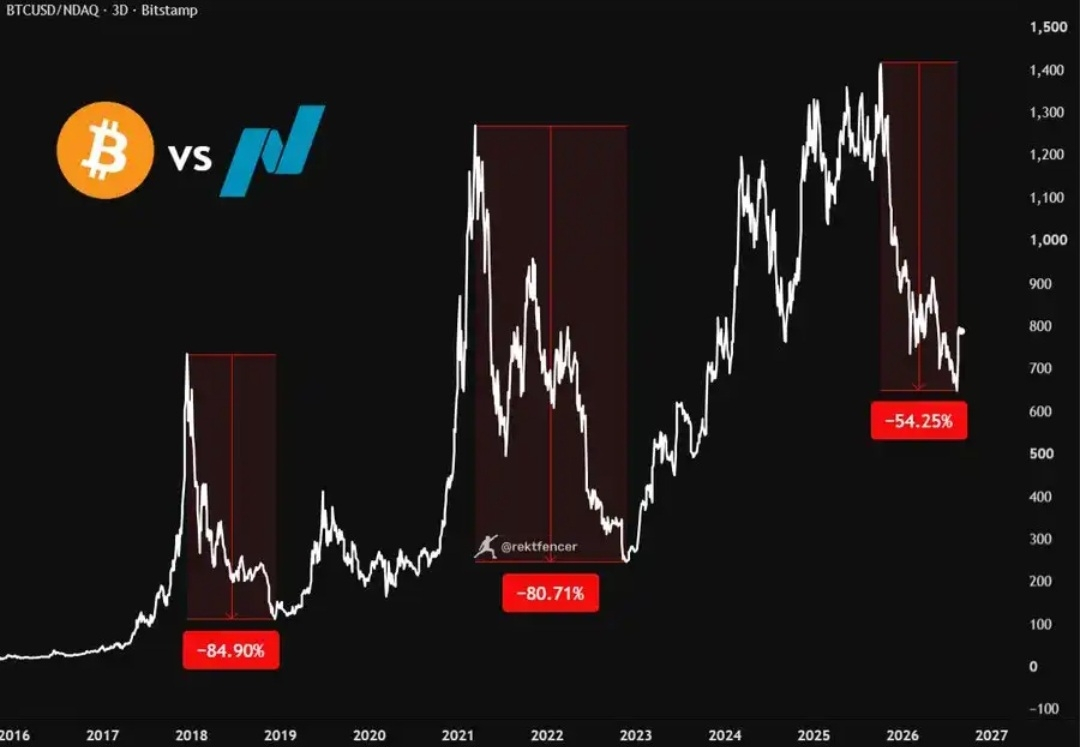
On August 30, analyst Rekt Fencer published a BTC vs. Nasdaq 3-day chart ratio, marking three notable drawdowns: approximately -84.9% in 2018, about -80.7% in 2022, and currently around -54.3% in 2026. Rekt Fencer said that after the first two times Bitcoin fell behind the Nasdaq by such a large margin, it was followed by a very strong independent uptrend, and the price was then sharply driven upward in a straight surge. Now the ratio has dropped significantly again; history may repeat for the third time. The bottom is already near, and next BTC will strengthen again.
🧧🧧🧧Reply 666 to get $SOL 🧧🧧🧧
🎁🎁🎁👇👇👇🎁🎁🎁
🧧🧧🧧Reply 666 to get $SOL 🧧🧧🧧
🎁🎁🎁👇👇👇🎁🎁🎁

大丽7613
·
--
[Replay] 🎙️ Let's talk about your gains in the crypto world—BNB
02 h 20 m 37 s · 14.8k listens
Verified
G20 finance and technology meeting sets the tone for global monetary policy and new AI regulation rules
Next week, the United States will simultaneously host two key G20 ministerial-level meetings to warm up for the year-end G20 leaders’ summit. The two meetings will run in parallel, covering macro-finance and the technology industry, respectively—setting the tone for the direction of global economic policy and AI regulation.
August 31—September 1: The G20 meeting of finance ministers and central bank governors will focus on global inflation, macro policy coordination, exchange-rate volatility, debt risks, and financial stability. The wording in its communique will directly affect the U.S. dollar, U.S. Treasuries, and the outlook for major global asset classes.
September 1—September 2: The G20 technology ministers’ meeting will be held on top of that, bringing together technology officials worldwide and major tech leaders such as Musk, Jensen Huang, and Sam Altman. It will focus on implementing the U.S. AI “Carroll/AIO” principles, and discuss global AI governance, technological innovation, and the rules of the digital economy.
Tesla officially announces: Cybercab launch event on September 3
Stick to dollar-cost averaging into $BTC, $BNB, and mega-cap technology companies
$TSLAB
$NVDAB
$AAPL.US
Next week, the United States will simultaneously host two key G20 ministerial-level meetings to warm up for the year-end G20 leaders’ summit. The two meetings will run in parallel, covering macro-finance and the technology industry, respectively—setting the tone for the direction of global economic policy and AI regulation.
August 31—September 1: The G20 meeting of finance ministers and central bank governors will focus on global inflation, macro policy coordination, exchange-rate volatility, debt risks, and financial stability. The wording in its communique will directly affect the U.S. dollar, U.S. Treasuries, and the outlook for major global asset classes.
September 1—September 2: The G20 technology ministers’ meeting will be held on top of that, bringing together technology officials worldwide and major tech leaders such as Musk, Jensen Huang, and Sam Altman. It will focus on implementing the U.S. AI “Carroll/AIO” principles, and discuss global AI governance, technological innovation, and the rules of the digital economy.
Tesla officially announces: Cybercab launch event on September 3
Stick to dollar-cost averaging into $BTC, $BNB, and mega-cap technology companies
$TSLAB
$NVDAB
$AAPL.US
Verified
Wach提出九问
Wach raised nine questions in one go, and each of them hit the mark. But he did not give answers on the spot; instead, he said the Federal Reserve’s special working group would study these issues in subsequent reports.
For the Federal Reserve, the most core challenge is how artificial intelligence will affect the employment objective within its dual mandate. Two of the questions are centered on jobs. Historically, general-purpose new technologies like AI have always eliminated some jobs, but the number of new jobs ultimately created has often exceeded the number of jobs lost. Some people’s situation may worsen, but most people can benefit from it.
AI may be different.
AI can see, hear, speak, and perform logical reasoning. In the future, it will also smoothly carry out various physical labor. Therefore, its impact will not be confined to a single industry. Although some new jobs may be created, if supporting policies are lacking, the number of newly added positions will likely be far less than the number of existing jobs today.
AI may have already begun to disrupt employment in the U.S. information sector. This sector includes publishing, broadcasting, media, website operations, and software development, among other areas. Employment in this segment peaked in November 2022, the same month ChatGPT was first released. Since then, industry employment has declined by 11%. However, employment changes are influenced by multiple factors, making it difficult to isolate the impact attributable solely to AI.
The other two questions focus on labor productivity. Productivity is closely tied to employment and is also one of the core drivers of economic growth. Looking back at history, after new technologies are introduced, it often takes years or even decades for productivity benefits to become visible. Past experience suggests that in the early stages—before supporting employee training programs and business processes are fully formed—new technologies tend to put downward pressure on productivity.
Artificial intelligence will significantly shorten this time frame.
Continue with regular investment: #BTC , BNB, and below—large technology companies
$NVDA.US
$AMZNB
$METAB
Wach raised nine questions in one go, and each of them hit the mark. But he did not give answers on the spot; instead, he said the Federal Reserve’s special working group would study these issues in subsequent reports.
For the Federal Reserve, the most core challenge is how artificial intelligence will affect the employment objective within its dual mandate. Two of the questions are centered on jobs. Historically, general-purpose new technologies like AI have always eliminated some jobs, but the number of new jobs ultimately created has often exceeded the number of jobs lost. Some people’s situation may worsen, but most people can benefit from it.
AI may be different.
AI can see, hear, speak, and perform logical reasoning. In the future, it will also smoothly carry out various physical labor. Therefore, its impact will not be confined to a single industry. Although some new jobs may be created, if supporting policies are lacking, the number of newly added positions will likely be far less than the number of existing jobs today.
AI may have already begun to disrupt employment in the U.S. information sector. This sector includes publishing, broadcasting, media, website operations, and software development, among other areas. Employment in this segment peaked in November 2022, the same month ChatGPT was first released. Since then, industry employment has declined by 11%. However, employment changes are influenced by multiple factors, making it difficult to isolate the impact attributable solely to AI.
The other two questions focus on labor productivity. Productivity is closely tied to employment and is also one of the core drivers of economic growth. Looking back at history, after new technologies are introduced, it often takes years or even decades for productivity benefits to become visible. Past experience suggests that in the early stages—before supporting employee training programs and business processes are fully formed—new technologies tend to put downward pressure on productivity.
Artificial intelligence will significantly shorten this time frame.
Continue with regular investment: #BTC , BNB, and below—large technology companies
$NVDA.US
$AMZNB
$METAB

The peak of Bitcoin’s current bull cycle is likely driven by institutional capital and ETF demand outside the United States.
Improved stablecoin liquidity and continued development of tokenized asset infrastructure will expand global market participation.
For example, in South Korea, the country currently lacks spot Bitcoin ETFs, retail investors cannot buy overseas-listed spot Bitcoin ETFs, and most companies cannot open trading accounts to buy Bitcoin. South Korea has begun phasing in access for businesses. The Financial Services Commission (FSC) roadmap covers roughly 3,500 listed companies and eligible professional investors, but financial institutions and other firms are still excluded.
Strategy’s Bitcoin banking industry adopts an index-based assessment of 25 major institutions across areas such as trading, custody, digital asset products, financing, and corporate participation, with an overall adoption rate of 32%. Data shows that the value of globally tokenized distributed assets is $38.63 billion, up 2.65% from 30 days ago. The Bank for International Settlements (BIS) notes that stablecoins have the potential to enable faster, programmable payments, but their current design may introduce risks related to financial integrity, liquidity, and monetary aspects.
In the two years before listing, U.S. spot Bitcoin ETFs accumulated net inflows of about $57 billion.
The next phase will be global institutionalization, when more institutions view Bitcoin as a strategic asset and countries lacking ETFs will further develop their investment channels.
$BTC
$BNB
Improved stablecoin liquidity and continued development of tokenized asset infrastructure will expand global market participation.
For example, in South Korea, the country currently lacks spot Bitcoin ETFs, retail investors cannot buy overseas-listed spot Bitcoin ETFs, and most companies cannot open trading accounts to buy Bitcoin. South Korea has begun phasing in access for businesses. The Financial Services Commission (FSC) roadmap covers roughly 3,500 listed companies and eligible professional investors, but financial institutions and other firms are still excluded.
Strategy’s Bitcoin banking industry adopts an index-based assessment of 25 major institutions across areas such as trading, custody, digital asset products, financing, and corporate participation, with an overall adoption rate of 32%. Data shows that the value of globally tokenized distributed assets is $38.63 billion, up 2.65% from 30 days ago. The Bank for International Settlements (BIS) notes that stablecoins have the potential to enable faster, programmable payments, but their current design may introduce risks related to financial integrity, liquidity, and monetary aspects.
In the two years before listing, U.S. spot Bitcoin ETFs accumulated net inflows of about $57 billion.
The next phase will be global institutionalization, when more institutions view Bitcoin as a strategic asset and countries lacking ETFs will further develop their investment channels.
$BTC
$BNB

Log in to explore more content