

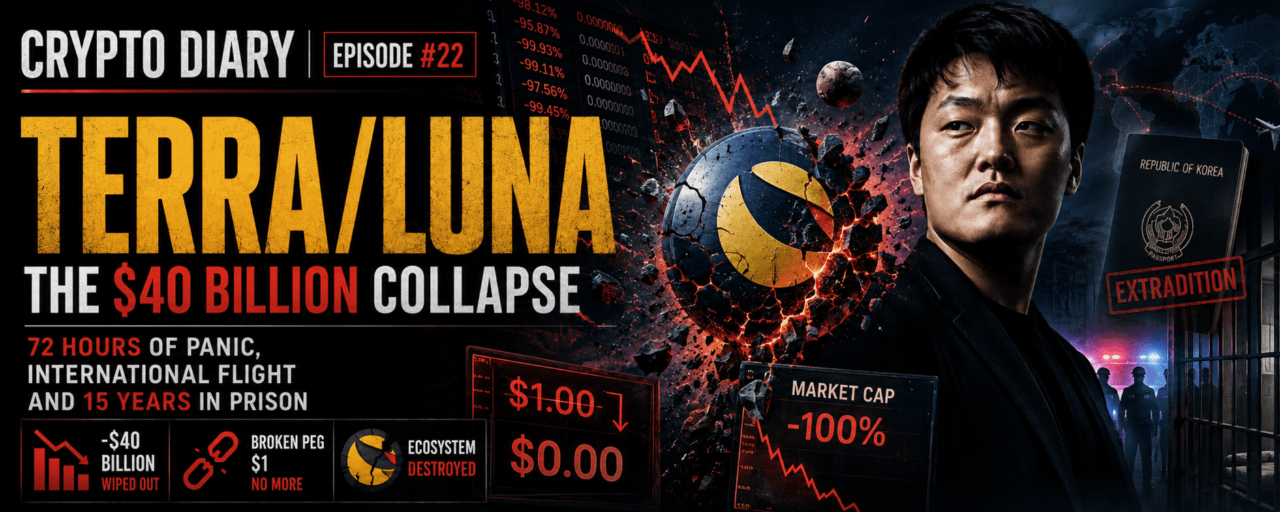

📺 CRYPTO DAILY | EPISODE #22
💀 TERRA/LUNA — THE $40 BILLION SCHEME THAT BROKE THE CRYPTO MARKET IN 72 HOURS, AND THE INTERNATIONAL FUGUE THAT ENDED IN 15 YEARS OF PRISON
Imagine a “bank” that promises to pay 20% interest per year in a supposedly stable currency—and millions of people around the world, including sophisticated institutional funds, decide to trust it. Now imagine the entire system, worth more than $40 billion, evaporating in less than 72 hours, taking along the savings of more than a million investors. The creator flees the country, is caught using a fake passport, spends almost two years between prison stints and extradition battles, and ends up sentenced to 15 years in American federal prison. This isn’t a movie script. This is the story of Terra/LUNA—probably the most studied and most educational collapse in all of crypto history.
👨💻 FROM STANFORD TO THE TITLE OF “KING OF CRYPTOCURRENCY”
Do Hyeong Kwon, a South Korean who studied computer science at Stanford, co-founded Terraform Labs in 2018 with Daniel Shin, another successful South Korean entrepreneur. The original vision was relatively modest compared to what would come later: to create a family of stablecoins tied to strong real-world currencies, reducing transaction costs for e-commerce.
Kwon quickly built a combative, provocative public persona on social media under the handle @stablekwon—becoming famous for replying to economists who questioned the UST model with the line “I don’t debate with poor people.” To a legion of loyal followers, who called themselves “LUNAtics,” it sounded like visionary confidence. For skeptics, it was the first red flag.
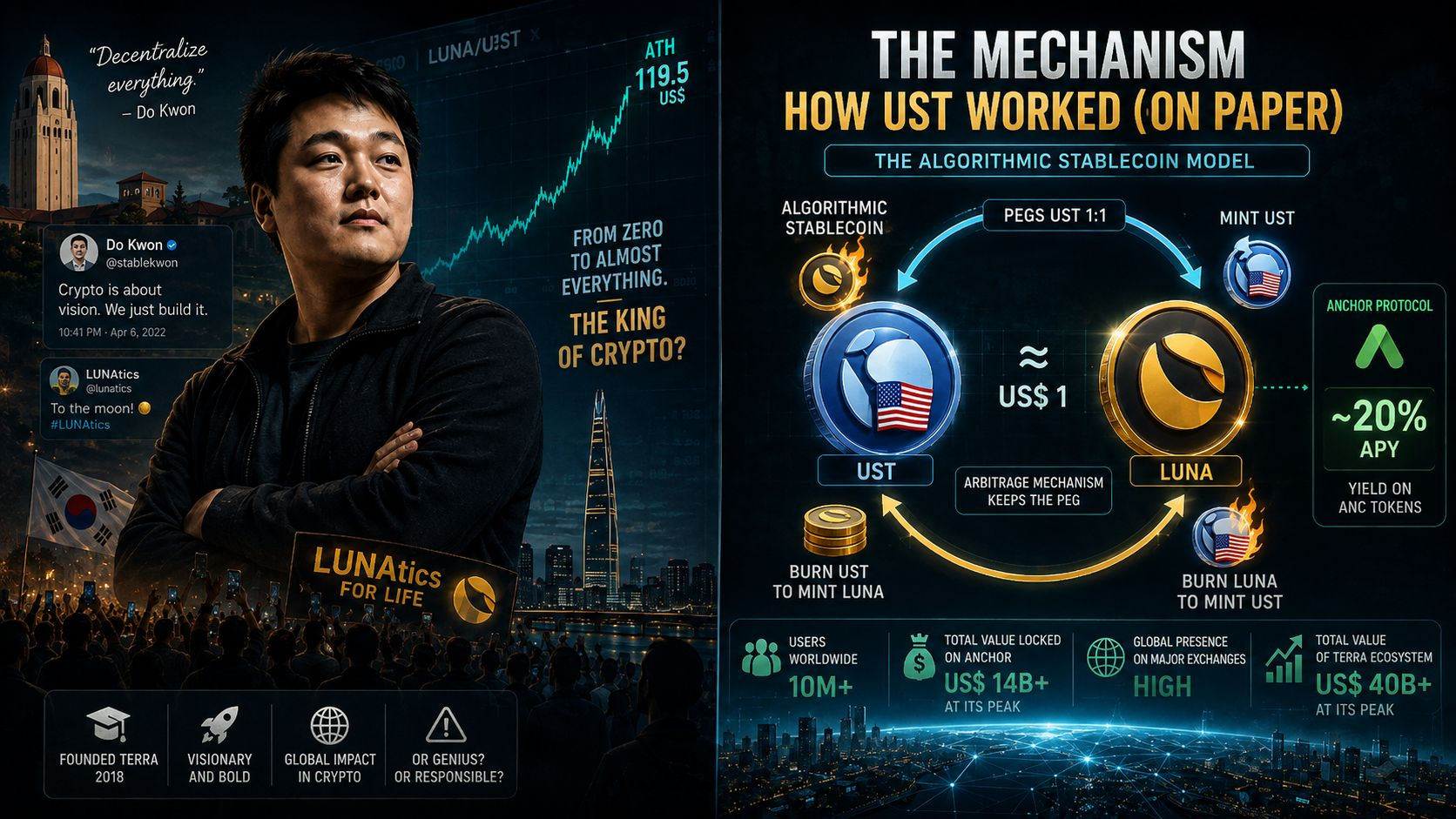
⚙️ THE MECHANISM — HOW IT WORKED (ON PAPER) UST
The heart of the Terra ecosystem was TerraUSD (UST), an “algorithmic” stablecoin: unlike competitors like USDT or USDC, which keep real reserves in cash and bonds, UST maintained its $1 parity through a purely mathematical mechanism involving its brother token, LUNA.
The logic was elegant on paper: it was always possible to burn $1 worth of LUNA to mint $1 worth of UST—and vice versa. If UST fell below $1, arbitrageurs would buy the cheap UST, burn it for LUNA, pocket the difference—reducing the UST supply and pushing the price back toward parity.
To turbocharge adoption, Terraform Labs launched the Anchor Protocol, which paid roughly 20% per year on UST deposits—the “too good to be true” number that attracted billions from retail investors and institutional funds. At its peak, in April 2022, UST had become the market’s third-largest stablecoin, with more than US$ 18 billion in circulation, and the combined value of LUNA and UST surpassed US$ 40 billion.
🚩 THE WARNING SIGN THAT WAS PURPOSELY IGNORED
Here is one of the most damning details of the entire story, revealed only after the collapse: according to a designer of the Anchor Protocol itself, publicly identified as “Mr. B,” the interest rate originally planned and tested internally was only 3.6% per year—any simulation with a higher rate indicated that UST would eventually fail.
Even so, according to this source, Do Kwon decided to raise the rate to 20%, solely to attract mass investors—knowing full well that the available funds weren’t enough to sustain that return in the long run. Critics had already pointed out, before the collapse, that the model looked dangerously like a “giant Ponzi scheme”: UST had virtually no real use outside deposits in Anchor.
💥 MAY 7 TO MAY 13, 2022 — SEVENTY-TWO HOURS THAT BROKE THE MARKET
The collapse began on Saturday, May 7, 2022, when Terraform Labs withdrew US$ 150 million in UST from a liquidity pool on Curve. This destabilized the pool, and hours later a supposed “attacker” sold US$ 350 million in UST at once, knocking parity below US$ 1.
Panic spread quickly: the more people sold UST, the more LUNA needed to be minted to try to restore parity—flooding the market. The supply of LUNA, about 346 million tokens at the end of April, exploded to more than 6.5 trillion in a matter of days.
The Luna Foundation Guard (LFG), an entity created by Kwon to defend parity, injected more than US$ 450 million in reserves and sold a good portion of its more than 27,000 reserve bitcoins—without success. On May 13, 2022, the Terra blockchain was officially shut down. LUNA, which had reached US$ 119.18 in April, touched a low of US$ 0,000016—down by practically 100%. UST never recovered its parity.
🔀 MAY 28, 2022 — THE FORK AND THE ATTEMPTED RESURRECTION
Less than three weeks later, Do Kwon led a fork: the original blockchain was renamed Terra Classic, with the LUNA Classic (LUNC) token, while a new network—without an algorithmic stablecoin—was launched as Terra 2.0, with a completely new LUNA.
Kwon publicly compared the collapse to the 2017 DAO hack that hit Ethereum. The comparison didn’t convince the market: Terra Classic (LUNC) trades today, August 2026, near US$ 0,000053—more than 99.99% below the all-time high.
🛂 MARCH 2023 — THE FLEEING AND THE ARREST WITH A FAKE PASSPORT
Kwon tried to reconstruct part of the operation in Singapore, but the criminal dragnet was closing in fast. In September 2022, South Korea’s Justice Ministry issued an arrest warrant for Kwon and five other people tied to Terraform. It’s estimated that around 280,000 people in South Korea alone had invested in LUNA.
The most dramatic outcome came on March 23, 2023: Kwon was arrested in Podgorica, Montenegro’s capital, while trying to board a private jet to Dubai using a forged Costa Rican passport. A Montenegro court sentenced him to four months in prison for document forgery.
⚖️ THE EXTRADITION DISPUTE BETWEEN TWO COUNTRIES
What followed was a legal battle of that kind: both the United States and South Korea formally requested Kwon’s extradition. Different courts in Montenegro reached contradictory decisions during 2024—in August, an appeals court ruled for extradition to South Korea, reversing an earlier decision.
The impasse was only resolved in December 2024, when Montenegro’s Justice approved extradition to the U.S. definitively—despite no formal treaty existing between the countries. Kwon arrived in the United States on December 31, 2024, after 17 months in custody in Montenegro.
🏛️ DECEMBER 2025 — THE SENTENCE: 15 YEARS IN PRISON
Kwon pleaded guilty to conspiracy to commit commodities fraud, securities fraud, and wire fraud—crimes that together carried a maximum penalty of 25 years. He agreed to forfeit more than US$ 19 million in illegal proceeds.
On December 11, 2025, Judge Paul Engelmayer sentenced Kwon to 15 years in prison. Victims reported to the court the devastating impact—savings destroyed, a letter mentioning that the author’s father had contemplated suicide after losing his entire retirement. Kwon publicly apologized. The judge rejected the defense’s request that the sentence be served in South Korea, where his wife and 4-year-old daughter live.
🌊 THE CASCADE EFFECT ACROSS THE REST OF THE MARKET
Terra’s collapse didn’t stay isolated: the shockwave hit institutions that had invested heavily in the ecosystem, contributing to the chain of failures that defined the 2022 “crypto winter”—including, months later, the collapse of Sam Bankman-Fried’s FTX, already covered in the Solana episode. To this day, it’s considered one of the most studied collapses in finance courses around the world.
🏦 WHERE IS LUNC/LUNA LISTED?
✅ Binance ✅ Coinbase ✅ Kraken ✅ KuCoin ✅ Bybit ✅ BTCC
🤔 IS IT WORTH INVESTING IN LUNC TODAY? THE HONEST VIEW
For the record: the remaining community keeps promoting periodic burns of LUNC—including a burn of 5.33 billion tokens by Binance in January 2026, generating a short rally of 20%. Case closed on the criminal chapter brings clarity; in February 2025, South Korea’s Supreme Court declared that UST and LUNA are not securities.
Attention: down more than 99.99% from the ATH, with no sign of structural recovery; circulating supply in the trillions of tokens, making it practically impossible for it to gain meaningful value; founder convicted criminally, Terraform Labs dismantled; more than a million victims registered globally, with a reputation permanently tied to proven fraud in court.
Honest conclusion: unlike practically all other episodes, there’s no genuine “it’s worth investing” takeaway to evaluate here—the remaining LUNC is, today, essentially a speculative asset of nostalgia and community. The real value of this episode isn’t an investment opportunity, but a lesson: when a return seems too good to be true on a “stablecoin,” it probably is.
This is not financial advice. DYOR. Invest only what you can afford to lose.
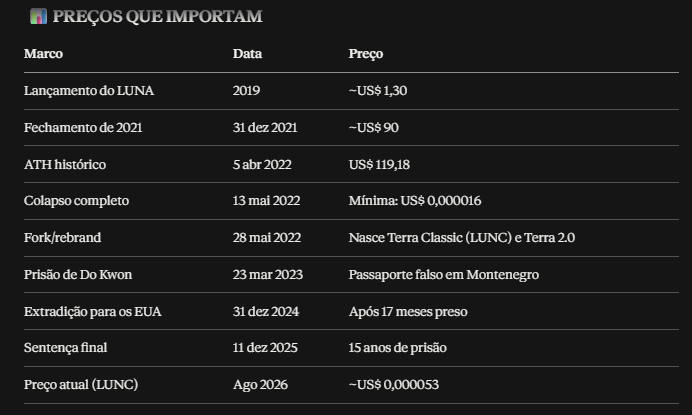
🎯 TIMELINE
2018 → Do Kwon and Daniel Shin found Terraform Labs
2019 → LUNA token is launched, trading around US$ 1.30
2021 → Anchor Protocol starts offering ~20% annual yield
Apr 5, 2022 → LUNA reaches its historical ATH: US$ 119.18
May 7–13, 2022 → Complete collapse; blockchain halted
May 28, 2022 → Fork creates Terra Classic (LUNC) and Terra 2.0
Mar 23, 2023 → Kwon is arrested in Montenegro with a fake passport
Dec 31, 2024 → Kwon is extradited to the U.S.
Feb 2025 → South Korea’s Supreme Court declares UST/LUNA are not securities
Dec 11, 2025 → Final sentence: 15 years in prison
Aug 2026 → LUNC trading near US$ 0,000053
🔚 WRAPPING UP
The Terra/LUNA story is perhaps the most complete portrait of how miscalibrated incentives and public arrogance can combine to destroy more than US$ 40 billion in value in less than three days. It wasn’t a hack. It wasn’t an external attack. It was a system built on a mathematically unsustainable promise—publicly defended by a man who preferred to mock critics instead of listening to the team’s own internal warnings.
The question that remains: when someone promises a 20% annual return on a “stable” coin—and the market itself, deep down, knows that this is mathematically implausible—who is really responsible when everything falls apart: only the one who lied, or also everyone who decided to believe even though it looked too good to be true?
#LUNA #LUNC✅ #DocumentarioIndependente #BinanceSquare



🤝 SUPPORT CRYPTO DIÁRIO
This project is made with serious research, across multiple sources, to deliver true content without fluff. It takes work. A lot of work.
If this content added value to you, you can give back in simple ways: like the article, comment what you thought, share it, or repost it for others who also deserve to learn, and click the coin tag here in the post if you’re going to trade — it’s a direct way to support without costing anything. If you can go further, a gratuity is always welcome and keeps this documentary alive and growing.
Every gesture, no matter how small it seems, makes a difference. Thank you for being here.
Educational and informational content only. This does not constitute investment advice. The cryptocurrency market is highly volatile. Always do your own research (DYOR).
Sources consulted: TheBigCollapse/Medium, Bitstamp, Baker McKenzie, Dragonfly Research/Medium, Datawallet, Wikipedia, CoinCodex, Bitrue, Forbes, Benzinga, U.S. Department of Justice (SDNY and OPA), DL News, Gherson LLP, CNN Business, Cryptonews, Coinspeaker, Associated Press, CoinMarketCap, CoinGecko, BitDegree, TokenInsight, LetsExchange, Bybit, Zipmex.
Crypto Diário | Episode #22 of many.
A documentary about the money of the future—told today.