
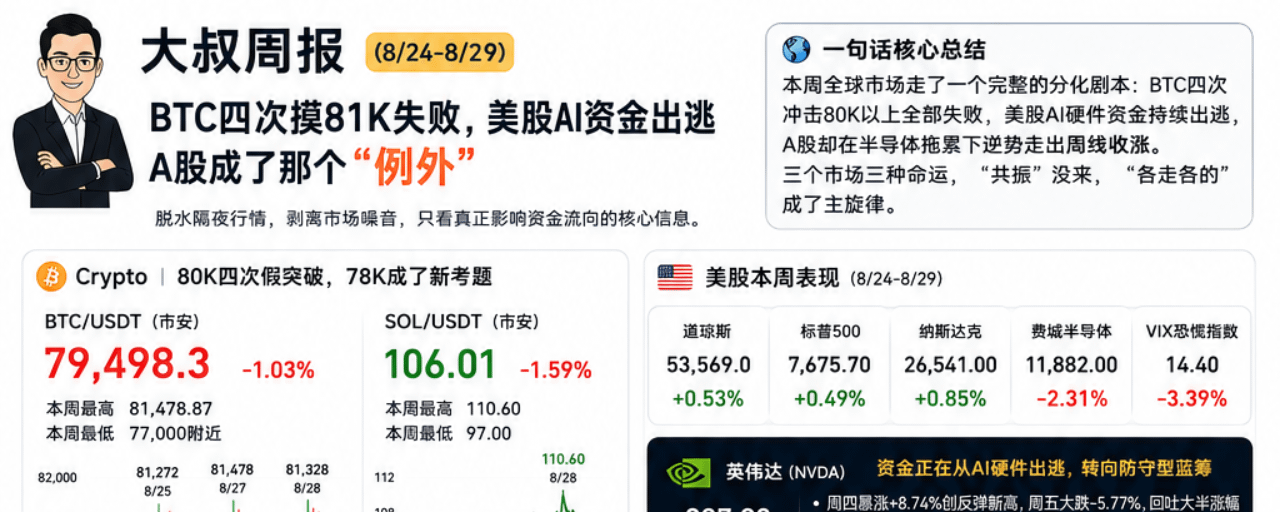

🌍 One-sentence core summary
This week, global markets followed a complete split-script: BTC’s four attempts to break above 80K all failed. Funds kept exiting from US stock market AI hardware. Meanwhile, A-shares still moved against the trend, closing the weekly chart up despite semiconductor drag. Three markets, three fates—no “resonance” showed up; “each went its own way” became the main theme.
🪙 Crypto|80K saw four failed breakouts, and 78K became the new question
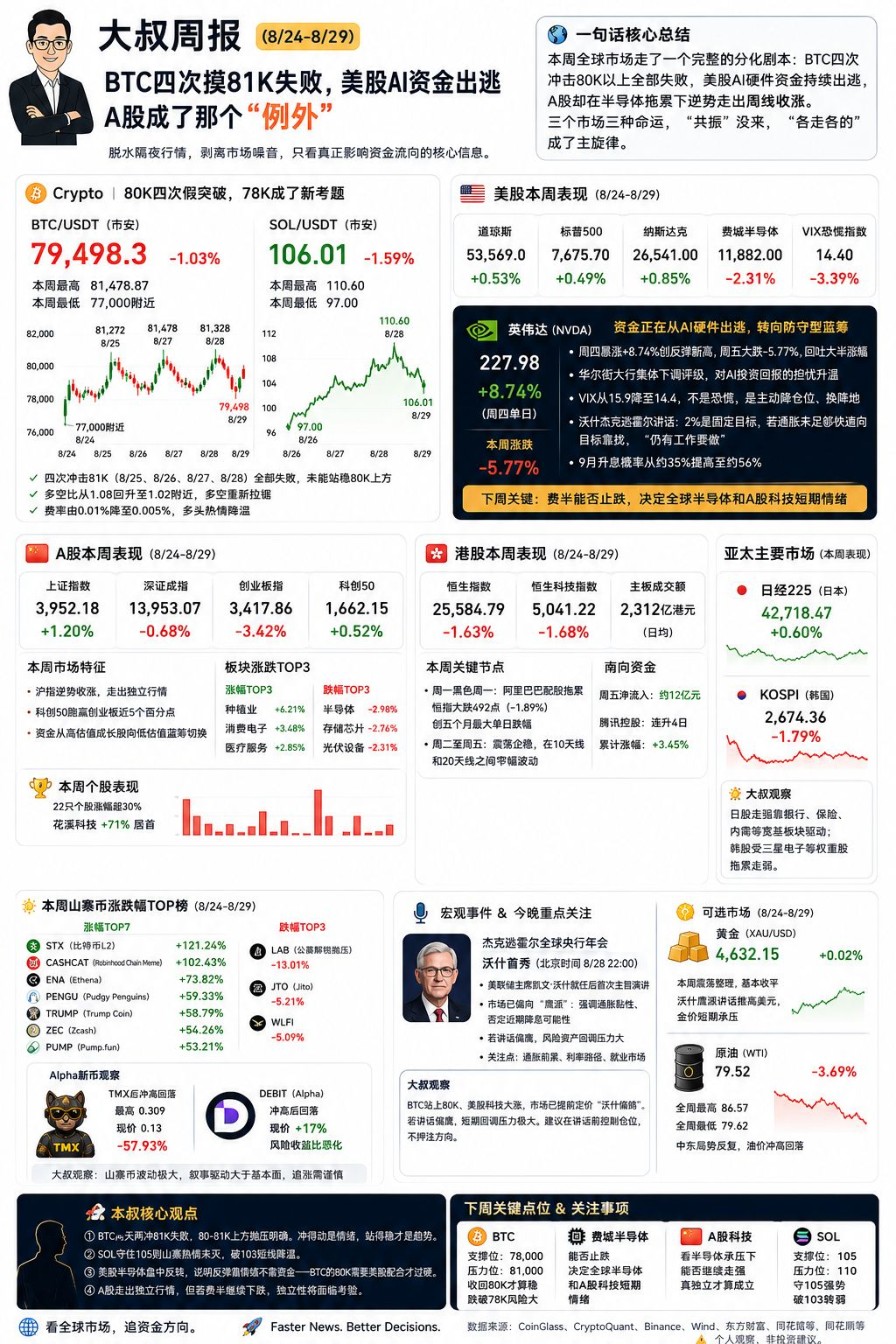
BTC started this week around 77,000. On Tuesday, Wednesday, and Thursday, it rose above 81K three times, peaking at 81,478—but each time it was pushed back. After dropping below 78K on Friday, the futures long/short ratio jumped to 1.18—prices fell, yet retail investors kept adding positions to hold on.
All the long positions holding the chips bought above 80K are now underwater. When retail investors are still adding on the way down, their last bullets are fired into the 78K–80K range. Once this range is effectively broken through, the positions that held on will turn into a wave of stop-loss selling. Next week, what matters most isn’t whether BTC can go up—it’s whether 78K can be defended. If it holds, this is a golden pit; if it doesn’t, it becomes a “graveyard for longs.”
SOL this week moved from 97 to 110, up about 10% for the week, and has repeatedly met resistance around 110—mirroring the time window when BTC was also capped around 81K. SOL’s launch is supported by its own deflation proposal voting and ongoing ETF inflows, but it still depends on risk appetite in U.S. stocks. After Nvidia gave back gains over two days, SOL immediately pulled back from 110 to 104. The counterfeit-coin season index is only 43 (threshold 75). Without U.S.-stock support, an independent counterfeit-coin season is not in place. SOL held above 105; excitement for these coins hasn’t died yet. If it breaks below 103, this rebound will be declared over.
This week’s counterfeit-coin market divergence was even more extreme than the index. $STX Led the whole field with a weekly gain of 121%, with Bitcoin L2 and sBTC narratives becoming this week’s biggest breakout stars. $CASHCAT +102% (the Robinhood Chain Meme leader), $ENA +74% (the Ethena yield-stablecoin track), $PENGU and $TRUMP each up 59%, and $ZEC +54% (a rebound in the privacy narrative), while PUMP +53% (a Solana Meme launch platform). These coins’ blowouts share a common feature: narrative-driven > fundamentals. On the losers’ board, LAB -13% lagged the most due to sell pressure from public offering unlocks; JTO -5.2% and WLFI -5.1% followed through with the adjustment. Alpha new coins TMX and DEBIT played out the classic “spike-then-drop” script—after the TMX TGE, it slid from 0.309 to 0.13. The risk-reward profile for chasing new coins is deteriorating. Next week, focus on whether the trading volume for STX and CASHCAT can sustain—these are the most direct “thermometers” for counterfeit-coin sentiment.
🇺🇸 U.S. stocks|AI hardware cools off as capital moves elsewhere
U.S. stock indexes rose this week, but the internals were badly split. The Dow gained 0.53%, the S&P 500 rose 0.49%, and the Nasdaq climbed 0.85%—yet the Philadelphia Semiconductor Index fell 2.31% on the week. Nvidia jumped 8.74% on Thursday, then sank 5.77% on Friday, giving back more than half of the prior gains. Major Wall Street banks collectively downgraded their ratings, and concerns about returns on AI investment are growing.
Capital is taking profits from the most crowded track—AI hardware—and rotating into defensive blue chips. The VIX fell from 15.9 to 14.4. This isn’t panic; it’s an “active de-risking and switching of positions.” Fed Chair Waller stated clearly at Jackson Hole that 2% is a fixed target. If inflation does not approach the target quickly enough, “there is still work to do.” The market has raised the probability of a rate hike in September from about 35% to about 56%.
Next week’s key isn’t whether Nvidia is up or down on a single day—it’s whether Philadelphia Fed semis can stop falling. If it stops, there will be breathing room for crypto and A-share semiconductors; if it keeps dropping, all talk of “independent trends” is just wishful thinking.
🇨🇳 A-shares|a rare independent trend
The most worth watching marginal change for A-shares this week is that it has formed an independent trend separate from the selloff in U.S. semiconductor stocks. The Shanghai Composite rose 1.2% this week to 3,952.18, and the CSI 50 gained 1.38%—but the ChiNext Index fell 3.42%, while the STAR 50 rose 0.52%, outperforming the ChiNext board.
A-shares are also seeing fierce internal divergence: funds rotated from high-valuation growth stocks into undervalued blue chips, with the CSI 50 outperforming the ChiNext board by nearly 5 percentage points. Across the week, 22 individual stocks rose more than 30%, with Huaxi Technology up 71% ranking first. The semiconductor sector has faced pressure due to the half-year drag, while agriculture planting and consumer electronics have strengthened against the trend.
If Philadelphia Fed semis keep falling next week, can A-share semiconductors still hold up? Only if they do, does the “resilience premium” story for A-shares truly hold. This is the marginal variable to watch—more than BTC.
🇭🇰 Hong Kong stocks and Asia-Pacific|After a black Monday, the market steadies
After Hong Kong stocks delivered a “black Monday” and steadied this week, the market has entered a choppy but stabilized pattern. The Hang Seng Index fell 1.63% on the week (down 424 points cumulatively). On Monday, Alibaba’s share placement dragged the Hang Seng Index down sharply that day, losing 492 points (-1.89%), marking the largest single-day drop in five months. From Tuesday to Friday, the Hang Seng Index fluctuated narrowly between the 10-day and 20-day moving averages.
Southbound capital net inflow on Friday was about 1.2 billion yuan, and Tencent rose for a fourth consecutive day, up 3.45% cumulatively. In the Asia-Pacific region, Japan’s Nikkei 225 rose about 0.6% for the week, while South Korea’s KOSPI fell 1.79%. Japan’s strength is driven by broad-market sectors like banks, insurance, and domestic demand, while South Korea weakened due to heavyweight stocks such as Samsung Electronics dragging it down.
📊 Optional market|Gold trades sideways, crude oil spikes then pulls back
Gold traded range-bound and closed roughly flat for the week. A hawkish speech by a “hawk” pushed up the U.S. dollar, putting short-term pressure on gold prices. WTI crude fell 3.69% on the week. The week’s high was $86.57 and the low was $79.62. With the situation in the Middle East shifting repeatedly, oil prices spiked then pulled back.
💎 Uncle’s view
The biggest signal from global markets this week is not that BTC failed to stay above 80K, but that three markets are each moving their own way. U.S. stocks’ AI theme is fading, A-shares are holding up, and BTC is waiting for direction. This pattern of divergence can’t last too long—next week is likely when a direction is chosen.
Next week, watch three key levels: for BTC, whether it can reclaim 78K—if it reclaims, the shorts fail. For Philadelphia Fed (Semis), whether it can stop the bleeding—it determines near-term sentiment for global semiconductors and A-share tech. For A-shares, whether tech can keep strengthening even under pressure from the semis; if it can hold, only then does the “resilience premium” story truly become valid.
Before the direction is confirmed, don’t answer the market’s “exam” with a heavy position. #比特币24小时跌3.4%至7.74万美元 #沃什称通胀是美联储首要关注
⚠️ Personal observation, not investment advice.
🌍 Look at global markets—chase the direction where the money is flowing.
🧠 Faster News. Better Decisions.