
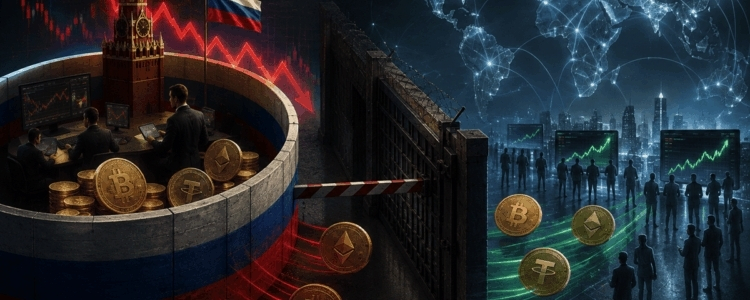

Sanctions could split global liquidity and turn certain assets into high-risk opportunities for local operators.
The new architecture will also give a central role to banks, brokers, and platforms that obtain the corresponding licenses
The new Russian scheme will allow trading Bitcoin, Ether, and USDT under an intermediary system
Russia will limit annual investments in cryptocurrencies to less than USD 4,000 per intermediary
Russia is preparing to formally regulate the cryptocurrency market, but the new framework could have an unexpected consequence: the creation of a trading circuit partially separated from international references.
Vladislav Kochetkov, chairman of the board of the financial group Finam, warned before the state agency TASS that Russia could become a market for cryptocurrencies that other jurisdictions consider too risky due to its track record of interactions with sanctioned addresses, platforms, or entities.
The executive said these assets could be traded within Russia at discounts compared to their international prices. The reason would be the smaller number of buyers willing to accept them and the difficulties in moving them later to other markets. Although he did not provide a specific figure, he described the possible price difference as significant.
This phenomenon does not imply that there is a new technical category of cryptocurrencies. These are assets whose history on the network may be linked to restricted addresses or platforms. Even if their movements are publicly verifiable, that traceability may cause certain counterparties to avoid receiving them.
The situation could create its own pricing cycle in Russia and open arbitrage opportunities for operators willing to take on higher risks. However, it could also increase volatility, widen the differences between platforms, and make it harder to exit positions into international markets.
The scenario will coincide with the entry into force, on September 1, 2026, of the main provisions of Russia’s new legislation on digital currency and digital rights, as explained by CriptoNoticias. The framework will allow non-professional investors to access certain assets, including Bitcoin, Ether, and USDT, albeit within investment limits and through authorized entities.
Banks, brokers, and specialized platforms will be able to participate under different licensing schemes, while so-called digital deposits will take on custody and record-keeping functions for holdings. The model places intermediaries at the center of a market that, in other countries, usually allows more direct access through personal wallets.
Kochetkov expects the Russian market to be oriented primarily toward speculation and trading of assets, rather than their everyday use as a means of payment or through self-custody schemes.
If this scenario materializes, Russia would not only be creating its own regulatory framework for cryptocurrencies, but also a market shaped by its sanctions, its internal rules, and a more limited connection to global liquidity.